




Section 17 of the Trade Marks Act, 1999 provides that when a registered trade mark consists of several matters, such as a word combined with a logo, tagline, or design, registration gives the proprietor exclusive rights only to the mark taken as a whole, not automatically to each word or element inside it.
This limitation surprises trade mark owners who assume that registering a logo protects the words in it, or that registering a label protects each word on it separately. In India, the fix is not automatic: a proprietor who wants exclusive rights in one part of a composite mark has to apply to register that part on its own.
| Quick answer: |
| Section 17(1) gives a composite mark’s proprietor exclusive rights to the mark as a whole. Section 17(2) then withholds that exclusivity from any part that was never separately applied for or registered, or that is common to the trade or non-distinctive. To protect a word or element on its own, file it as a separate application under Section 15(1); once registered, the whole and the part become associated trade marks under Section 16(3). |
What Section 17 of the Trade Marks Act Says
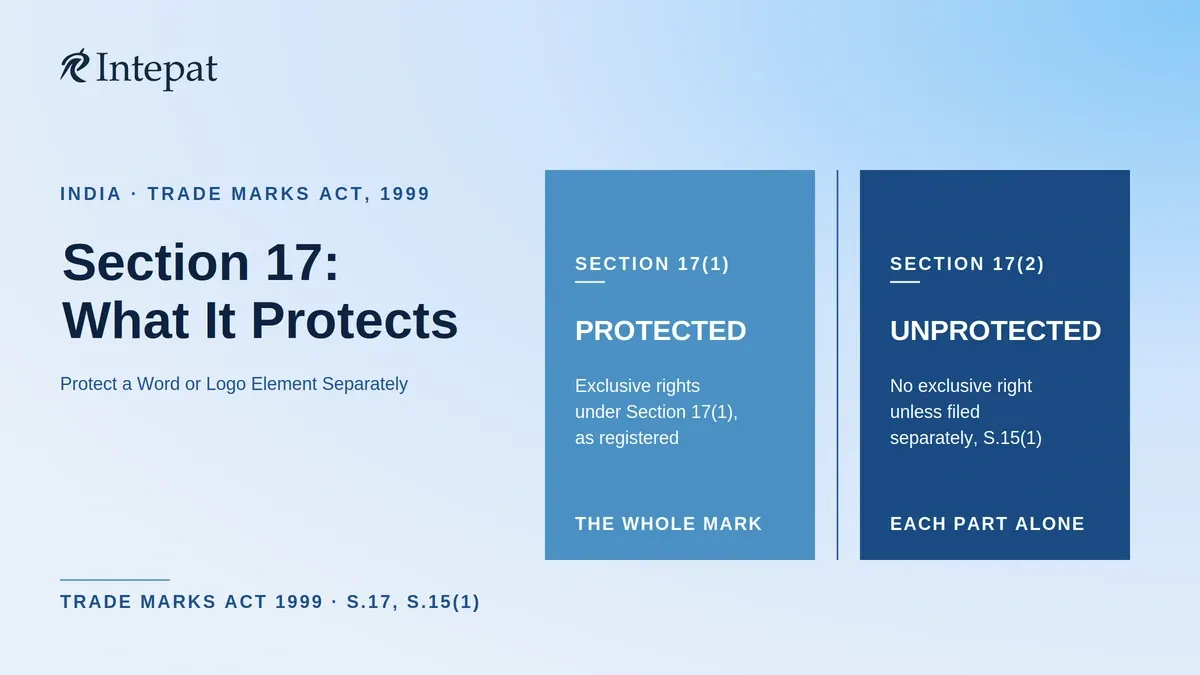
Section 17 has two parts. Sub-section (1) confers exclusive rights in a composite mark as a whole. Sub-section (2) then withdraws that exclusivity from any part of the mark that was never separately applied for or registered, or that is common to the trade or otherwise non-distinctive.
The operative text reads: “When a trade mark consists of several matters, its registration shall confer on the proprietor exclusive right to the use of the trade mark taken as a whole” (Section 17(1)). Sub-section (2) then says that where a mark “contains any part which is not the subject of a separate application by the proprietor for registration as a trade mark; or which is not separately registered by the proprietor as a trade mark; or contains any matter which is common to the trade or is otherwise of a non-distinctive character, the registration thereof shall not confer any exclusive right in the matter forming only a part of the whole of the trade mark so registered.”
A worked example makes the mechanics concrete. Suppose a business registers a word mark and logo combining the invented word “Kelvora” with a leaf device, in Class 3. Section 17(1) gives it exclusive rights to that logo, leaf, and word together, exactly as registered. It does not, on its own, stop every other business from using an unrelated common word that happened to also appear in the label’s design, such as “natural” or “pure”, because that word was never the subject of its own separate application (Section 17(2)(a)(i)), and it is also likely common to the trade for a personal-care product (Section 17(2)(b)).
None of this decides whether a competitor’s mark infringes the registration. Section 17 only says what exclusive rights the registration itself confers; whether a given competing mark crosses the line is a separate question under Section 29, addressed later in this article.
Why the Law Limits Rights to the Mark “As a Whole”
Section 17 exists so that combining a distinctive design with a common or descriptive word cannot be used to fence off that common word for everyone else. Without it, a business could register any generic term inside a stylised logo and then claim the generic word itself had become exclusive property.
This is not a standalone rule. Section 9(1)(b) already bars registration of a mark that consists exclusively of an indication of the goods’ kind, quality, or other characteristics; a word that is common to the trade more often fails under Section 9(1)(c), which separately bars marks that have become customary in the current language or in the bona fide and established practices of the trade. Words caught by either ground routinely fail registration when applied for alone. Section 17(2) closes the gap that would otherwise remain: such a word cannot become exclusive merely by sitting inside a mark that, taken as a whole, clears registration. The exclusive right that Section 28 confers on a registered proprietor is tied to what was actually registered, and Section 17 defines how far that right extends when the registration covers more than one element.
How to Protect a Word or Element Separately
Section 15(1) is the mechanism Section 17 points to. A proprietor who wants exclusive rights in one part of a composite mark can apply to register that part on its own, as a separate trade mark, provided the part independently qualifies for registration.
The part filed separately is not treated as an extension of the original application. Section 15(2) requires it to satisfy every condition that applies to an independent trade mark, meaning it must clear the same absolute and relative grounds for refusal, under Sections 9 and 11, on its own merits. If it is accepted and registered, Section 16(3) then deems the whole mark and the separately registered part to be associated trade marks. Section 44 requires associated trade marks to be assigned and transmitted only as a whole, though for all other purposes each is still treated as a separate trade mark in its own right. A proprietor who no longer needs that link can apply under Section 16(5), on Form TM-P per Rule 54(2), to have the Registrar dissolve the association where there is no likelihood of confusion from separate use.
In practice, this means filing a second Form TM-A, in the relevant class, for the word or element on its own, rather than assuming the composite application already covers it. That separate application carries its own filing date and its own path through examination, advertisement, and opposition; it does not reach back and extend the rights of the original composite registration. A business planning to register a logo as a trade mark should decide, before filing, whether any word inside it also needs its own application.
What the Courts Have Said
Section 17 defines what a composite registration protects; it does not, by itself, decide whether a competitor’s mark infringes that registration, which is a separate question under Section 29. Four decisions, spanning 1955 to 2025, show both sides of that line: what Section 17 withholds, and what it leaves for Section 29 to decide.
The Supreme Court considered a predecessor disclaimer provision as early as 1955, in Registrar of Trade Marks v Ashok Chandra Rakhit Ltd (1955 AIR 558; 1955 SCR (2) 252, decided 15 April 1955), decided under the Trade Marks Act, 1940. The Court held that a registering authority’s discretion to require a disclaimer over a non-distinctive part of a composite mark is a judicial discretion, not an automatic step: an appellate court should not disturb it “merely on the ground that, in the opinion of the High Court it could have been exercised differently,” provided it was exercised in good faith. The 1999 Act does not carry forward the word “disclaimer” itself; Section 17(2) instead states the same underlying principle directly, that exclusivity in a composite mark does not extend automatically to a part that was never separately applied for or registered, or that is common to the trade or non-distinctive.
A more recent illustration is Ultratech Cement Ltd v Dalmia Cement Bharat Ltd, in which the Bombay High Court (Gupte J., order dated 10 June 2016) refused Ultratech interim relief against Dalmia’s use of “Dalmia Ultra” and “DALMIA ULTRA.” Ultratech held registrations for Ultratech Cement, Ultratech White Cement, and Ultratech Concrete, but had never separately registered the word “Ultra” on its own. On the reported account of the order, the court treated “Ultra” as a laudatory, descriptive term that no single trader could monopolise, registered only as one component of Ultratech’s composite marks, and held that a part forming only a portion of a registered mark cannot, on that basis alone, be protected by the registered proprietor. Interim relief was denied. This is a reported interim order, not a final adjudication on the merits, and it is cited here for its reasoning on componentry rather than as a closed, unappealable holding.
Section 17 is only half the picture, though, and the Supreme Court made the other half explicit in Pernod Ricard India Pvt. Ltd. v Karanveer Singh Chhabra (2025 INSC 981, decided 14 August 2025), the “Blender’s Pride” against “London Pride” whisky dispute. The Court held that anti-dissection has statutory footing in Section 17 and requires a composite mark to be compared as a whole, without dissecting out or excluding any part, but that the “dominant mark” doctrine, a judicially evolved principle for identifying a mark’s essential or memorable component, operates as an analytical aid within that holistic comparison, not a licence to isolate one component and ignore the rest. On the facts, Pernod Ricard still lost: the only element the two marks shared was “Pride,” which the Court treated as generic and incapable of monopoly by any single trader, so no injunction followed.
The Delhi High Court applied that same architecture the other way in Dindayal Industries Ltd v Dindayal Ayurved Bhawan (Delhi High Court, FAO(COMM) 15/2024, Division Bench, decided 22 December 2025), an appeal from an interim injunction order. On the reported account, the absence of a standalone registration for “DINDAYAL” did not, by itself, defeat the plaintiff’s case for interim relief on its composite registrations, where the defendant’s mark was alleged to reproduce that dominant element; the Court distinguished claiming exclusivity in “DINDAYAL” in isolation from enforcing the composite registrations that contain it. This is an interim-injunction appeal rather than a final infringement verdict, and, like Ultratech above, the account here rests on court reporting rather than the primary order text, which was not accessible for direct review.
Common Composite-Mark Mistakes That Trigger Section 17
The pattern behind disputes over Section 17 tends to repeat: a business registers a composite mark, assumes the registration protects every word inside it, and only discovers otherwise when a competitor starts using one of those words alone.
Three situations account for that pattern:
- A generic or descriptive word is combined with a distinctive logo, and the proprietor assumes the logo registration by itself gives exclusive rights in that word alone. It does not, unless the word is also filed and registered on its own under Section 15(1). Whether someone else’s later use of the word still infringes the composite registration is a separate question under Section 29, not one Section 17 answers by itself.
- A tagline is registered as part of a larger composite mark, such as a label or packaging design, and the proprietor later tries to stop a competitor’s unrelated use of the same words alone.
- A rebrand drops the logo but keeps a word that was never independently registered, leaving the business with no standalone registration to enforce.
The decision point is the same in each case, and it belongs at the filing stage, not after a dispute starts: identify, before filing, which words or elements in a composite mark carry the brand’s real distinctiveness, and file a separate application for each of them under Section 15(1). For the broader filing sequence this fits into, see our guide to trade mark registration in India.
Frequently Asked Questions
No. Section 17 governs the effect of registration, so an unregistered mark carries no registered exclusivity for it to limit. Section 27 bars a statutory infringement action on an unregistered mark; passing off, which protects reputation in the mark as actually used rather than a registered right in any single part of it, remains available.
Yes. Section 15(1) contemplates exactly this: registering “the whole and the part” as separate trade marks. Both applications are filed and examined independently, each must clear the Act’s registrability tests on its own, and once both are registered they are deemed associated trade marks under Section 16(3), which restricts how they can later be assigned.
Not necessarily. Section 17(2) already withholds exclusive rights in any non-distinctive or trade-common part, whether or not “disclaimer” is used, and that alone does not reduce your rights in the mark as a whole. But Section 28(2) subjects the exclusive right to any conditions or limitations actually entered on the registration, so check your specific entry if this matters.
Section 17(2) limits standalone rights in the word; it does not decide infringement. Use of that word in an unrelated mark does not automatically infringe your composite registration. Infringement instead depends on whether the competitor’s mark, assessed under Section 29 as a whole, is identical or deceptively similar to yours. Filing separately under Section 15(1) remains available, with no deadline.
They are related but distinct. Section 17 governs what a registration protects. The anti-dissection rule is a principle courts apply when comparing marks for infringement: a composite mark is ordinarily compared as a whole, not element by element. Section 17(2) is one reason a component can fall outside a registration’s protected scope.
Yes. Each application, including one filed to separately protect a part of a composite mark, attracts its own government fee under the Trade Marks Rules, 2017, per class and per mark; it is not covered by the fee already paid for the composite mark (verified as of August 2026).
This article explains the law on composite trade mark registration under Section 17 of the Trade Marks Act, 1999 in India as at August 2026 and is for general information only. It is not legal advice. Government fees, forms, and procedures change; confirm current figures with the Trade Marks Registry before you file. For advice on your specific mark, consult a trademark attorney.
Sources
- The Trade Marks Act, 1999 (Act 47 of 1999), Sections 9, 11, 15, 16, 17, 27, 28, 29, and 44. Government of India.
- The Trade Marks Rules, 2017, Rule 23(1), Rule 54(2), Rule 11, and the First Schedule, Entry 1. Government of India.
- Registrar of Trade Marks v Ashok Chandra Rakhit Ltd, 1955 AIR 558; 1955 SCR (2) 252, Supreme Court of India, decided 15 April 1955.
- Ultratech Cement Ltd v Dalmia Cement Bharat Ltd, Bombay High Court, order of Gupte J. dated 10 June 2016. / (commentary consulted: SpicyIP, “Ultratech Cement versus Dalmia Cement: Bombay High Court on Protection of Components of Registered Marks”, 22 June 2016.
- Pernod Ricard India Pvt. Ltd. v Karanveer Singh Chhabra, 2025 INSC 981, Supreme Court of India (Mahadevan J.), decided 14 August 2025.
- Dindayal Industries Ltd v Dindayal Ayurved Bhawan, FAO(COMM) 15/2024, Delhi High Court, Division Bench (Hari Shankar J. and Om Prakash Shukla J.), decided 22 December 2025 (2025:DHC:11707-DB). (commentary consulted: LiveLaw, “Delhi High Court IPR: Dindayal Trademark Interim Injunction Allowed, Rival Ayurvedic Manufacturer Restrained For Similarity”, December 2025.)