




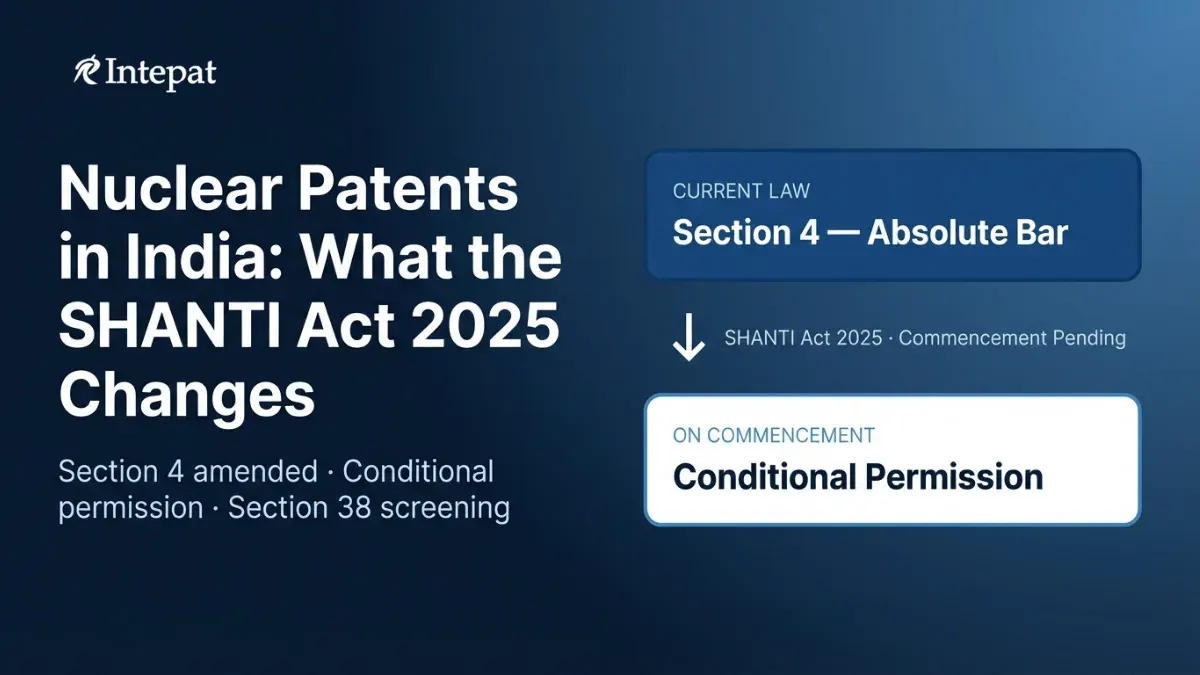
Nuclear patents in India were categorically impossible for over five decades. Section 4 of the Patents Act, 1970 imposed an absolute bar: if an invention related to atomic energy, no patent could be granted, regardless of its intended application or commercial sector. On 20 December 2025, the SHANTI Act (Sustainable Harnessing and Advancement of Nuclear Energy for Transforming India Act, 2025) received presidential assent on 20 December 2025 and was published in the Gazette of India on 21 December 2025. Under Section 1(2) of the Act, the commencement of provisions is subject to separate notification by the Central Government.
The Act replaces Section 4’s absolute prohibition with conditional permission. Patents may now be granted for nuclear inventions that pass a government screening process under Section 38 of the SHANTI Act. This article sets out the amended legal position, explains which inventions qualify, details how applications will be processed, and addresses the prosecution and drafting considerations specific to this technology space.
| Can nuclear-related inventions be patented in India? |
| Current law: No. Section 4 of the Patents Act, 1970 imposed an absolute bar on all nuclear-related inventions. Under the SHANTI Act 2025: Yes, subject to government screening under Section 38. Inventions for the peaceful uses of nuclear energy and radiation may now qualify. Key risks: Security-based rejection without defined criteria; government may deny patent rights or assume control of the invention; post-grant revocation under Section 65 of the Patents Act. |
Section 4 of the Patents Act: The Prior Legal Position on Nuclear Inventions
Before the SHANTI Act, Section 4 of the Patents Act, 1970 stated that no protection could be obtained for inventions “relating to atomic energy,” defined by cross-reference to Section 20(1) of the Atomic Energy Act, 1962. Section 20(1) covered the production, control, use, disposal, prospecting, mining, extraction, and enrichment of prescribed substances and radioactive materials. The prohibition applied regardless of the applicant’s identity or the intended application of the invention.
Three legal mechanisms operated under the prior framework and should not be conflated. The Section 4 patentability bar rejected nuclear applications at examination. The secrecy direction regime under Sections 35 to 42 allowed the Controller to withhold publication and grant on national security grounds and required applicants to obtain a foreign filing licence under Section 39 before filing abroad. The government acquisition power under Section 102 allowed the government to acquire a granted patent for a public purpose, ordinarily with compensation. Each operated independently, and all three remain in force under the amended framework.
In practice, the Patent Office referred nuclear-adjacent applications to the Department of Atomic Energy (DAE). Annual reports published by the Office of the Controller General of Patents, Designs and Trade Marks (CGPDTM) confirm that of the applications referred to the Department of Atomic Energy, only a subset were ultimately treated as relating to atomic energy and excluded on that basis, but the referral mechanism alone created sufficient delay and uncertainty to discourage filings. Private companies operated without IP protection, limiting the commercial case for investment and the legal framework for technology transfer.
What the SHANTI Act Changes: From Absolute Bar to Conditional Permission
The SHANTI Act repeals both the Atomic Energy Act, 1962 and the Civil Liability for Nuclear Damage Act, 2010, replacing them with a single consolidated statute. The patent consequence flows through the Third Schedule, which amends Section 4 of the Patents Act to read:
“The patents may be granted for inventions relating to nuclear energy subject to the provisions of this Act and section 38 of the Sustainable Harnessing and Advancement of Nuclear Energy for Transforming India Act, 2025.”
The substitution of “may be granted” for the earlier absolute prohibition is the operative shift. Section 38 of the SHANTI Act structurally replaces Section 20 of the Atomic Energy Act, 1962, which governed the referral regime under the old framework, and becomes the new substantive filter alongside the standard patentability requirements of novelty, inventive step, and industrial applicability. The policy driver is India’s Nuclear Energy Mission. Government disclosures around early 2025 indicate installed nuclear capacity in the range of approximately 8,180 MW to 8,780 MW, depending on the units included in the count, with a target of 100 GW by 2047.
Patentability Under the SHANTI Act: What Opens and What Remains Reserved
Section 38(1) of the SHANTI Act provides that the Central Government may grant patents for inventions “which in its opinion are for the peaceful uses of nuclear energy and radiation.” The Act does not define “peaceful uses.” Two explicit exclusions define the outer boundary.
The first exclusion covers inventions relating to activities reserved exclusively to the Central Government under Section 3(5) of the SHANTI Act: enrichment or isotopic separation of prescribed or radioactive substances (unless otherwise notified); management of spent fuel, including reprocessing, recycling, radionuclide separation, and high-level waste management; production and upgrading of heavy water by isotopic separation; and any other activities or facilities the Central Government may notify from time to time. Inventions directed squarely at these activities are non-patentable by statutory design. The second exclusion applies to inventions the government considers sensitive or to have national security implications, which carry the additional consequence addressed below.
Within those exclusions, the patentable space is commercially relevant. Technologies that fall within the patentable zone when directed at peaceful applications include: radiation-based oncology devices and radiotherapy planning systems; nuclear imaging and diagnostic equipment; food irradiation systems; components for small modular reactors (SMRs) other than reserved fuel-cycle elements; radiation monitoring and safety instrumentation; and nuclear waste remediation technologies for decommissioning. Inventors working in these areas now have a statutory basis for protection in India that did not exist before 20 December 2025. For an overview of the filing process, see filing a patent application in India.
The Section 38 Screening Process: How Nuclear Patent Applications Are Processed
Section 38 creates a two-stage examination structure. As a practical matter, an application must satisfy the standard patentability criteria under the Patents Act and must also survive the Section 38 security screen through a referral to the Central Government. The Act does not expressly prescribe the sequence of these two stages. The procedural flow as it emerges from the statutory text is as follows.
1. Filing of application. The applicant files in the usual manner. Any claims directed at nuclear energy-related subject matter trigger the screening regime.
2. Trigger for referral. Section 38(3) provides that if a question arises as to whether an invention relates to nuclear energy or falls within the scope of Section 38(1), the Controller shall refer the application to the Central Government. This referral obligation is mandatory, a stronger formulation than the discretionary power that existed under Section 20(6) of the old Atomic Energy Act, 1962. No published criterion governs when such a question is treated as arising.
3. Security review by the Central Government (DAE). The DAE evaluates three questions: whether the invention is for a peaceful use; whether it is sensitive in nature; and whether it has national security implications. Section 38 does not prescribe a timeline for the government’s response, a hearing mechanism, or an express requirement for a reasoned decision.
4. Return of directions to the Controller. If the government determines the invention is sensitive, the invention is treated as non-patentable and the application cannot proceed to grant; the invention is deemed to have been made or conceived by the Central Government under the proviso to Section 38(1). If the invention is determined to be peaceful and not sensitive, examination continues.
5. Examination outcome. The application proceeds through standard examination: First Examination Report, response, hearing if required, and grant or refusal. A granted patent remains subject to post-grant revocation under Section 65 of the Patents Act.
No publicly available standard operating procedure governing Section 38 referrals had been identified in Patent Office or DPIIT publications as of April 2026. The burden of proof on sensitivity, the right to amend claims during the referral period, and the interim status of the application are all unaddressed in the statutory text. An application referred under Section 38(3) has no protection from indefinite delay. Specialist patent prosecution counsel is essential for managing this exposure.
The pre-disclosure obligation in Section 38(5) sits upstream of filing entirely. Any person who has reason to believe an invention relates to nuclear energy must notify the Central Government before disclosing it to any third party, including potential investors, commercial partners, and co-developers. The Act does not prescribe a format for the notification, an acknowledgment timeline, or a grace period. Companies must build this compliance step into their innovation pipeline before any external disclosure takes place.
Government Control, Revocation, and Interaction with Existing Patent Law
Three provisions of the Patents Act that pre-date the SHANTI Act remain fully operative and interact directly with the new nuclear patent regime. Practitioners must account for each alongside the Section 38 framework.
Section 39 of the Patents Act prohibits a resident of India from applying for a patent abroad without first obtaining the Controller’s permission, or without six weeks having elapsed from the Indian filing date without a secrecy direction being issued. This requirement applies to nuclear inventions. The SHANTI Act does not modify Section 39, and the Section 38(5) obligation does not substitute for it. Non-compliance is a criminal offence.
Sections 35 to 42 of the Patents Act govern secrecy directions. Where the Controller considers that publication would prejudice the defence of India or public safety, the Controller may withhold publication and grant for as long as the direction remains in force. Secrecy directions are independent of the Section 38 referral: an application may pass the peaceful-use screen and still attract a direction under Section 35. Practitioners in dual-use technology areas should treat both mechanisms as cumulative risks.
The proviso to Section 38(1) of the SHANTI Act provides that inventions the government considers sensitive or to have national security implications “shall be deemed to have been made or conceived by the Central Government.” The Act does not define the proprietary rights, if any, that flow from this deeming. Because the invention is simultaneously declared non-patentable, the government does not acquire patent ownership: a non-patentable invention cannot support a patent grant in favour of any person, including the government. The downstream consequences for the inventor’s trade secrets, know-how, and compensation entitlement are not expressly addressed in the Act and have not been resolved by any court. Separately, Section 39(1) of the SHANTI Act empowers the Central Government to declare information relating to such non-patentable inventions as restricted information, which may limit its disclosure and dissemination. Section 102 of the Patents Act allows the government to acquire a granted patent for a public purpose, ordinarily with compensation, but that mechanism operates post-grant and is not engaged by the pre-grant Section 38(1) deeming provision.
Section 65(1) of the Patents Act, as amended by the Third Schedule of the SHANTI Act to replace the reference to the Atomic Energy Act, 1962 with Section 38 of the SHANTI Act, gives the Central Government a continuing post-grant power: if satisfied that a granted patent relates to nuclear energy and should not have been granted under Section 38, it may direct the Controller to revoke the patent. The Section 65 power is not time-limited. This risk persists for the life of every granted nuclear patent and is a material factor for licensing and due diligence. For foreign inventors bringing technology into India, Intepat’s global IP filing services address that multi-jurisdiction analysis.
Patent Drafting and Prosecution Strategy Under the SHANTI Framework
Emphasise peaceful use in the specification. The Central Government’s Section 38 assessment turns on its opinion of the invention’s purpose. The specification should make the intended civilian application explicit and technically specific: the end-use environment, the regulatory context, and the technical features that distinguish the invention from any reserved-activity application. Abstract statements of peaceful intent carry less weight than detailed technical context.
As a drafting strategy, practitioners may prefer system and apparatus claims over process claims where the technology permits. Process claims for nuclear-adjacent inventions are more readily read as touching reserved fuel-cycle activities than apparatus or system claims limited to the final peaceful-use device. Claim type selection may reduce the surface area of the security screen but does not guarantee that a referral will not occur.
Separate reserved-activity components before drafting claims. An invention that partly addresses a reserved activity and partly a patentable application needs claims drafted to isolate those components. Claims that straddle the boundary invite a referral covering the entire application. A thorough patent search before drafting identifies how analogous technology has been characterised in other jurisdictions.
Avoid term-masking. In practice, some practitioners previously removed nuclear terminology to avoid the Section 4 bar. Under Section 38, that approach may reduce the evidence of peaceful intent available to the Central Government and may increase the risk of an adverse sensitivity determination. Full, honest technical characterisation is the more defensible drafting posture.
Consider filing order in relation to foreign applications. An India-first filing strategy creates an immediate Section 38 referral exposure but satisfies the Section 38(5) pre-disclosure obligation before any foreign disclosure. A PCT-first or foreign-first strategy requires compliance with Section 39 of the Patents Act: a resident of India must obtain the Controller’s permission before filing abroad, or wait six weeks from the Indian filing date without a secrecy direction being issued. Attempting to bypass Indian filing to avoid Section 38 scrutiny risks non-compliance with Section 39, which is a criminal offence, and does not remove the Section 38(5) pre-disclosure obligation, which attaches on the basis of the inventor’s belief rather than any filing act. Both strategies require sequencing the disclosure and filing decisions carefully in consultation with specialist counsel. Establish the Section 38(5) pre-disclosure protocol before external conversations. The obligation to notify the Central Government before any third-party disclosure attaches when there is reason to believe the invention relates to nuclear energy, a threshold reached well before patent filing in most cases. Account for referral delay in commercial timelines: there is no statutory deadline for the government’s Section 38(3) response, and any milestone dependent on patent grant must carry contingency for an open-ended referral period.
Key Risks for Inventors and Investors in the Nuclear IP Space
| Undefined sensitivity standard. Section 38 does not define “sensitive” or “peaceful uses.” The determination is the Central Government’s opinion, without defined statutory criteria. Section 38 does not expressly prescribe a requirement for a reasoned decision. |
| Discretionary expansion of reserved activities. Section 3(5) allows the government to notify additional reserved activities at any time, with no grandfathering protection for pending applications. |
| Government control of sensitive inventions. The proviso to Section 38(1) deems a sensitive invention to have been made or conceived by the Central Government. The scope of that control and the availability of compensation are not specified in the Act. |
| Post-grant revocation under Section 65. The Central Government may direct revocation of a granted nuclear patent at any time. This risk persists for the life of the patent and is material for licensing and due diligence. |
| Procedural opacity of the referral process. No standard operating procedure governs the Section 38(3) referral. There is no published timeline, no defined burden of proof on sensitivity, and no right of response before the government issues its directions. |
| Key statutory references: |
| Patents Act, 1970, Section 4 (as amended) SHANTI Act 2025, Sections 3(5), 9, 38(1), 38(3), 38(5), 51 Patents Act, Sections 35–42 (secrecy), 39 (foreign filing), 65 (revocation), 102 (acquisition). |
The SHANTI Act opens a statutory path to nuclear patents in India that did not exist before 20 December 2025. That path runs through a government screening process with undefined standards, no procedural timeline, and a deemed-vesting consequence for sensitive inventions. Predictability will depend on how the Section 38 referral is implemented in practice and whether standard operating procedures are published.
This article analyses the patent law framework as modified by the SHANTI Act 2025, which has been published in the Gazette of India, with commencement of provisions subject to notification under Section 1(2). It is intended as general information only. Readers should seek specific legal advice based on their factual situation.
Frequently Asked Questions
Yes, subject to the Section 38 screening process under the SHANTI Act 2025, which received presidential assent on 20 December 2025 and was published in the Gazette of India on 21 December 2025, with commencement of specific provisions subject to Central Government notification under Section 1(2). Inventions for the peaceful uses of nuclear energy and radiation may be granted a patent provided the Central Government determines they are not sensitive and do not have national security implications. Inventions relating to reserved activities under Section 3(5) remain non-patentable.
The absolute bar in Section 4 of the Patents Act is replaced by conditional permission. Patents may now be granted for nuclear inventions that pass the Section 38 security screen. The examination process involves a mandatory referral to the Central Government alongside the standard patentability review. A pre-disclosure obligation under Section 38(5) also requires inventors to notify the government before disclosing the invention to any third party.
The SHANTI Act does not define “sensitive.” The determination is the Central Government’s opinion, expressed without any statutory criteria, defined process, or obligation to give reasons. Inventors cannot determine in advance with certainty whether a particular invention will be classified as sensitive. This is the principal source of legal uncertainty in the new regime.
Where the Central Government determines an invention is sensitive or has national security implications, the proviso to Section 38(1) deems the invention to have been made or conceived by the Central Government. The invention is treated as non-patentable and the application cannot proceed to grant. The Act does not specify the scope of government control, whether the inventor retains rights in other jurisdictions, or whether compensation is payable. This is an area of legal uncertainty not yet resolved by any court.
The decision turns on the nature of the technology, the company’s commercial timeline, and its risk tolerance. For inventions clearly within the peaceful-use space and outside the Section 3(5) reserved activities, filing is now available where it was not before. For inventions near the reserved boundary or involving dual-use technology, the risks of referral delay, undefined sensitivity standards, deemed vesting, and post-grant revocation under Section 65 are material. Early specialist patent prosecution advice is recommended before any disclosure is made.
The SHANTI Act narrows, but does not eliminate, the right of recourse available to operators against equipment suppliers. Under the Civil Liability for Nuclear Damage Act, 2010, operators could seek recourse against suppliers for defective equipment without any requirement of intent. Under the SHANTI Act, recourse is available only if expressly provided for in a written contract, or where the supplier acted with criminal intent to cause damage. This change aligns India with international liability channelling standards and is directly relevant to the commercial attractiveness of the Indian nuclear market for global equipment manufacturers.
The appealability of decisions arising from Section 38 directions is not expressly provided in the SHANTI Act or the Patents Act. It remains legally unsettled whether a refusal based on a Section 38 direction can be challenged under Section 117A(2) of the Patents Act, which generally permits High Court appeals against Controller refusals under Section 15. This contrasts with Section 65 revocation orders, which Section 117A(2) explicitly excludes from its appeal scope. No judicial precedent currently clarifies how courts will treat Section 38-based refusals.
Section 39 of the Patents Act requires a resident of India to obtain the Controller’s permission before filing a patent application in a foreign country, or to wait six weeks from the Indian filing date without a secrecy direction being issued. This obligation applies to nuclear inventions and is separate from the Section 38(5) pre-disclosure obligation. Both must be satisfied before the invention is communicated abroad or filed internationally. Non-compliance with Section 39 is a criminal offence under the Patents Act.
Section 9(1) of the SHANTI Act exempts research, development, design, and innovation related to nuclear energy and radiation for peaceful uses from the licensing requirements that otherwise apply. The exemption does not cover activities of a sensitive nature or activities exclusively reserved for the Central Government. Section 9(2) requires adequate safety measures even for exempt research. The research exemption does not relieve inventors of the pre-disclosure obligation under Section 38(5) if the resulting invention is believed to relate to nuclear energy.