




Indian patent deadlines are strict, but a missed one is not always the end. Some can still be saved by filing a request for extension on Form 4, usually within a six-month window. Others, particularly deadlines fixed by the Patents Act itself and the deadline to enter the Indian national phase of a PCT application, often cannot be cured at all. The first task when a deadline has slipped is to work out which kind it was, when it expired, and whether a Form 4 is still open to you. This guide explains how to tell.
| Quick answer |
| Some missed patent deadlines can be extended by filing Form 4 with the Indian Patent Office. Many extensions must be requested within six months of the original deadline, and the request has to be filed before that window closes. Some deadlines, especially those set by the Patents Act and the PCT national phase entry deadline, may be fatal. Do not assume the six-month extension under Rule 138 applies to every missed deadline; it does not. This guide covers Indian patent prosecution under the Patents Act 1970 and the Patents Rules 2003, as amended through the Patents (Amendment) Rules 2024 notified on 15 March 2024. |
Can the deadline still be saved?
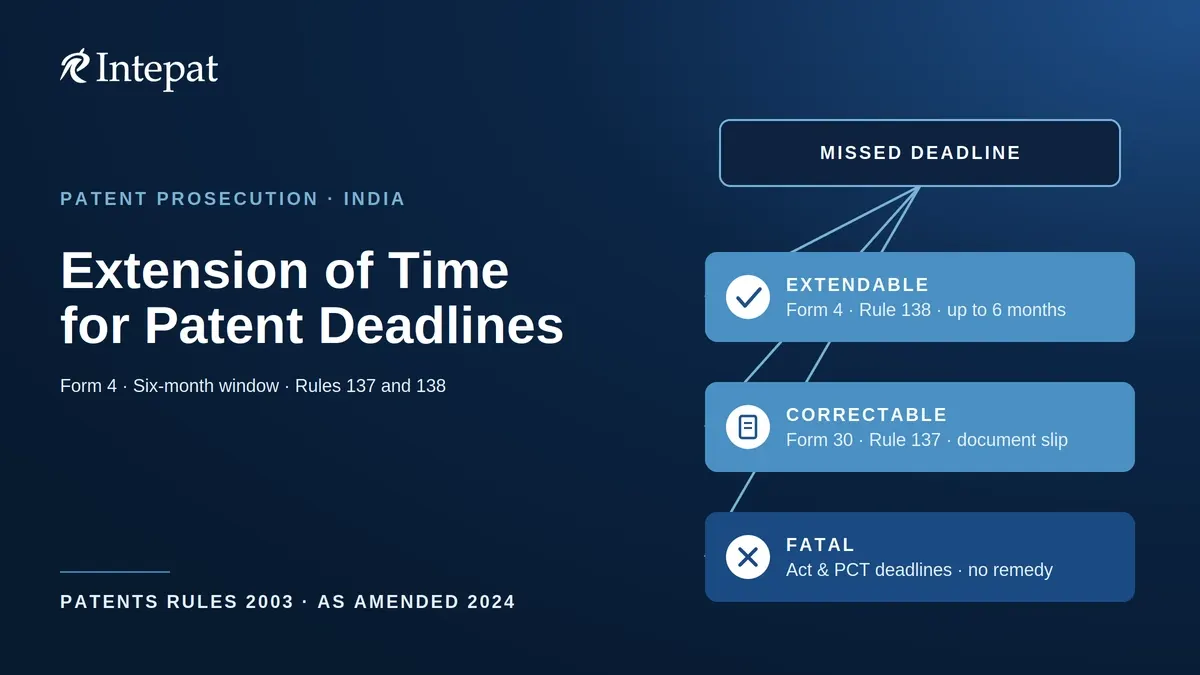
The first thing to work out is where the missed deadline came from. Some deadlines are fixed by the main patent law (the Patents Act) and are usually much harder, sometimes impossible, to extend. Others are procedural deadlines under the Patents Rules and may have an extension route. The table below sorts the common situations.
| What happened? | Can it usually be fixed? | What to file | Time limit and main risk |
| A document has a procedural error or slip (and is not on the carved-out list below) | Usually yes, at the Patent Office’s discretion | Form 30 (Rule 137 petition) | No fixed deadline and no per-month fee, but do not delay. |
| A deadline set by the Patents Rules was missed | Often yes, for up to six months | Form 4 (Rule 138 extension) | INR 50,000 per month for larger applicants; INR 10,000 for individuals, startups and small entities. The Form 4 must be filed before the six-month window closes. |
| A deadline set by the Patents Act was missed, or the six-month window has already closed | Usually no, often fatal | No routine remedy | Examples: the 12-month priority deadline, the deadline to file a complete specification, and the PCT national phase deadline. Seek advice immediately. |
Verified as of May 2026. Fees are online-filing rates. In plain terms, individuals, recognised startups, small entities, and educational institutions usually pay the lower fee; larger companies and applicants outside those categories pay the higher fee (the First Schedule calls the higher category “Other(s)”).
| A quick example |
| Suppose a response to an examination report was due on 1 January 2026 and the date passed. Do not assume it can simply be filed later. If an extension is available at all, it has to be checked at once, and the Form 4 must be filed within the permitted window. Once that outer window closes, the Patent Office may have no power to revive the matter. |
What the March 2024 Amendment Changed
The Patents (Amendment) Rules 2024 came into force on 15 March 2024. Before that date, Rule 138 allowed extensions of one month, subject to a long list of exclusions. Rule 137 operated alongside it as a broad discretionary power to condone procedural irregularities.
The amendment did two things. It expanded Rule 138 from a one-month ceiling to six months, removed the old exclusion list, and allowed repeat Form 4 requests within that window. At the same time it narrowed Rule 137, so that a defined set of missed deadlines, such as foreign filing details, the examination request, and renewal fees, can no longer be condoned as simple irregularities and must instead go through a paid extension. The result is a cleaner division of labour: Rule 138 handles missed deadlines, Rule 137 handles document slips, and the cost of a missed deadline rose substantially.
When a Missed Deadline May Still Be Extended
The route here is Rule 138 of the Patents Rules. Rule 138, as amended, provides that “notwithstanding anything contained in these rules, the time specified for doing any act or taking any proceeding thereunder may be extended or any delay may be condoned by the Controller for a period of up to six months, upon a request made in Form 4, where such request is made before the expiry of the said period of six months.” A proviso confirms that the Form 4 may be filed any number of times within the six-month period.
Three points govern how this works in practice. First, the Patent Office generally cannot consider an extension request filed after the extension window has itself expired. The Form 4 has to go in while the time is still running, not afterwards, a point Indian courts have also treated as critical. Once the window closes without a Form 4, there is no further remedy before the Patent Office.
Second, the fee is charged for every month of extension. It is INR 50,000 per month for Other(s) and INR 10,000 per month for natural persons, startups, small entities, and educational institutions, filing online. A full six-month extension therefore costs INR 3,00,000 for the higher category, or INR 60,000 for the lower one, in official fees alone, with professional charges on top. Because the fee runs per month, the cost of delay adds up quickly, which is a reason to act as soon as a deadline is missed rather than waiting.
Third, Rule 138 reaches only deadlines set by the Rules. It cannot touch a deadline set by the Patents Act itself, a distinction that decides whether a missed deadline is curable at all, as the next section explains.
When a Document Error Can Be Corrected
This is the territory of Rule 137. Rule 137(1) gives the Indian Patent Office, through the Controller, discretion to amend any document for which no special provision exists in the Act, and to correct any procedural irregularity that can be obviated without detriment to any person’s interests. This is a discretionary correction power. It is not a deadline extension route. Where no specific form is prescribed for the petition, Form 30 (the general petition form under the Second Schedule) is used.
What Rule 137 no longer covers is the list the 2024 amendment carved out: foreign filing details, the examination request and the response to the examination report, pre-grant opposition timelines, renewal fees, and the working statement, among others. These are now deadline matters, not irregularities, and they go through Rule 138 or their own specific extension route. The full carved-out list is set out below for readers who need the exact references.
| Rule 137(2): matters that can no longer be corrected as simple irregularities |
| Extension of time or condonation of delay under Rule 12(5) (foreign filing details); Rule 20(4)(i) and 20(6) (national phase translations); Rule 21 (priority documents); Rule 24B(1), (5) and (6) (examination request and examination report response); Rule 24C(10) and (11) (expedited examination); Rule 55(4) (pre-grant opposition); Rule 80(1A) (renewal fees); Rule 130(1) and (2); and Rule 131(2) (working statement). These now require a Form 4 extension under Rule 138 or their own specific route, not a Rule 137 petition. |
Where the matter is genuinely a document slip and not on that carved-out list, Rule 137 still applies, and it carries no per-month fee. That makes it a lower-cost route whenever it is genuinely available.
Deadlines That Are Usually Fatal
Two categories of absolute bar arise from the structure of the Rules and the Act.
The first is a missed Rule 138 window. Once both the original deadline and the six-month outer period have passed without a Form 4 filing, no remedy is available under the Rules. The operational lesson is to docket two dates for every tracked deadline: the original date and the outer Rule 138 boundary. A secondary reminder on the outer boundary is the safeguard that did not need to exist under the pre-2024 one-month regime.
The second is a deadline that comes from the Patents Act itself, not the Rules. These sit above Rule 138 and cannot be extended by it. The clearest examples are the twelve-month priority period for a convention application, the twelve months to file a complete specification after a provisional, the period to file the request for examination (after which the application is treated as withdrawn), and the period to put an application in order after the first examination report (after which it is deemed abandoned). Miss one of these and there is no ordinary remedy before the Controller. The High Courts have, in rare cases involving clear agent error and no intention to abandon, granted relief in their writ jurisdiction, but that is an exception, not a route to plan around.
| PCT National Phase Entry: Treat as Fatal |
| Do not rely on Rule 138 for a missed PCT national phase entry. India has not adopted PCT Rule 49.6 reinstatement of rights, and the Manual of Patent Office Practice and Procedure fixes the national phase entry deadline at 31 months with no reinstatement mechanism. Any argument based on the amended Rule 138 should be treated as untested and high-risk, not a docketing strategy. Separately, non-compliance with the Rule 20 national phase requirements leads to deemed withdrawal under Rule 22. See: Late PCT National Phase Entry in India. |
For lapsed granted patents, a separate regime exists. Under Section 60 of the Patents Act 1970, where a patent has ceased due to failure to pay a renewal fee, an application for restoration may be made within eighteen months from the date of cessation. Under Section 61, the Controller must be satisfied that the failure to pay was unintentional and that there has been no undue delay. This applies only to lapsed granted patents and only to non-payment of renewal fees; it is not a general fallback for missed prosecution deadlines.
What to Do If a Deadline Has Been Missed
Two habits follow from all this. First, docket two dates for every deadline: the original date, and the date six months later, which is the last day a Form 4 can save it. Second, before paying the Rule 138 rate, check whether the specific act has its own specific lower-fee Form 4 route, because several of the most common ones, including foreign filing details, examination report responses, and renewal fees, do.
If you are the applicant rather than the attorney, the most useful thing you can do is ask your patent attorney to check, quickly, six things: the original deadline; whether the missed act is extendable at all; the last date a Form 4 can be filed; whether the Patent Office portal accepts an extension for that specific act; the official fee for your applicant category; and whether the application is already marked abandoned, withdrawn, or lapsed. DPIIT-recognised startups and small entities pay the lower fee, so confirming entity status is worth the moment it takes.
Frequently Asked Questions
Often, yes, if the missed deadline was set by the Patents Rules and the six-month extension window is still open. You file Form 4 with the Patent Office and pay a per-month fee. But if the deadline was set by the Patents Act, or the six-month window has already closed, an extension is usually not available. The first step is to identify which kind of deadline it was and whether the window is still open.
The Rule 138 extension fee is INR 50,000 per month for larger applicants and INR 10,000 per month for individuals, startups, small entities, and educational institutions, filing online. A full six-month extension comes to INR 3,00,000 or INR 60,000 respectively, in official fees, with professional charges separate. Some specific deadlines have their own lower-fee routes. Verified as of May 2026.
No. The six-month window under Rule 138 is itself a deadline: the Form 4 must be filed before it closes. Once both the original deadline and the six-month window have passed without a Form 4, there is no ordinary remedy before the Patent Office for that act.
Treat a missed national phase deadline as lost unless a patent attorney confirms a specific exception applies. India has not adopted PCT Rule 49.6 reinstatement of rights, and the Patent Office Manual fixes the deadline at 31 months. An extension under Rule 138 is not a safe or routine remedy here, and you should not plan around it.
After the period to put the application in order expires, the application is deemed abandoned, and there is no ordinary remedy before the Patent Office. The High Courts have in rare cases, involving clear agent error and no intention to abandon, granted relief in their writ jurisdiction, but this is an exception, not a route to rely on.
Disclaimer
This article is for general information only and does not constitute legal advice. Patent prosecution deadlines are time-critical and the consequences of missing them may be irreversible. Readers should consult a registered patent agent before taking any action in connection with a specific matter. Verified as of May 2026. Fee figures and portal practice are subject to change.