




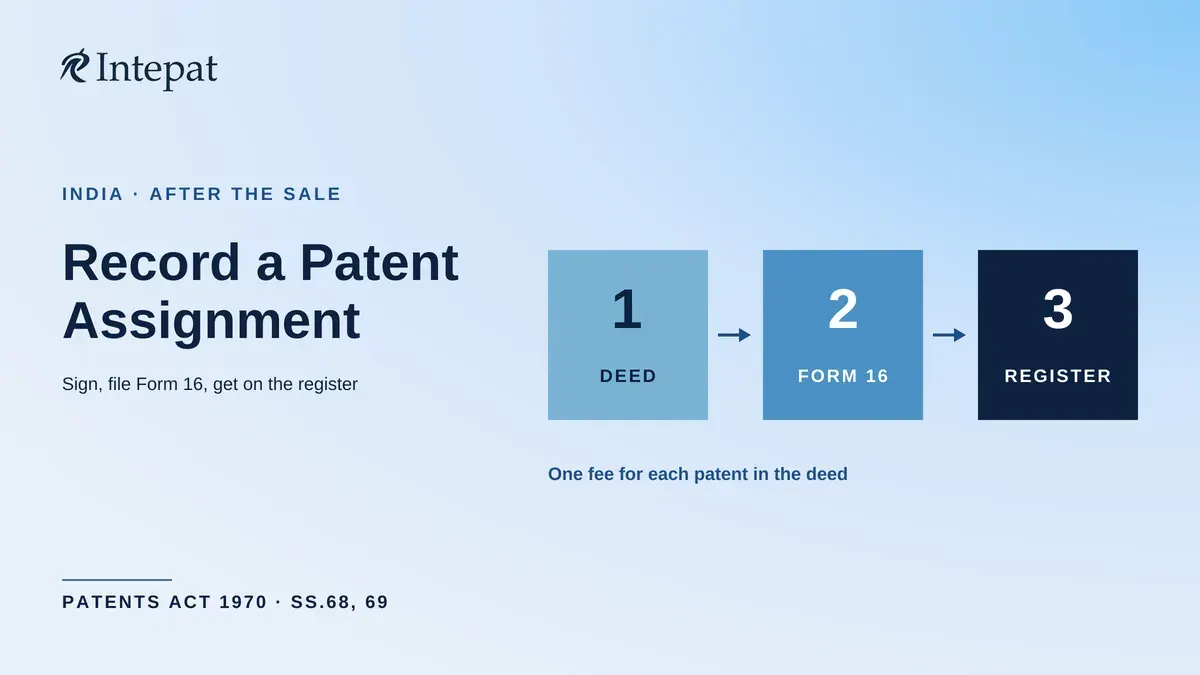
Patent assignment registration is the step that puts the buyer’s name on the Indian register of patents. You sign a written assignment, then apply to the Controller on Form 16 with the deed and the fee. Until the entry is made, the deed is generally not accepted as proof that you own the patent.
This guide covers granted Indian patents under the Patents Act, 1970 and the Patents Rules, 2003. It explains what makes the deed valid, how the application works, what it costs, and what to check before you pay for a patent.
Quick answer: An assignment of an Indian patent must be in writing, set out all the terms in one document and be duly executed. The new owner then applies on Form 16 to register title. For e-filing, the official fee per patent is Rs 1,600 for a natural person, startup, small entity or educational institution, and Rs 8,000 for others. The provisions on registration state no deadline, but an unregistered deed is generally not admitted as evidence of title.
What makes a patent assignment valid in India
A patent assignment is valid in India only if it is in writing, the agreement is reduced to a document that holds all the terms and conditions governing the parties’ rights and obligations, and that document is duly executed. A handshake, an invoice or an informal email exchange is not enough.
The same rule applies to an assignment of a share in a patent, a mortgage, a licence and any other interest in a patent. So a deal that leaves the price mechanism or the scope in side letters is at risk. Put every term the parties rely on into the deed itself.
Identify the patent by its number in the deed. Form 16 asks you to state the patent number, the nature of the document, its date and the parties. A deed that matches those fields leaves less to explain in the application.
If the seller’s ownership came from its own employees or founders, check that chain too. Our guide to employee invention ownership in India explains how an employer gets title from an inventor. Stamp duty on the deed is a separate question that this article does not cover; ask your lawyer about it before signing.
Why patent assignment registration matters
Registration matters because the register is the public record of who owns a patent. A deed that is not entered in the register is not admitted as evidence of title by the Controller or by a court, unless the Controller or the court directs otherwise for reasons recorded in writing.
The Act carves out two situations from that bar. You can still rely on the deed in your own application to register it, and in an application to rectify the register. For everything else, such as proving that you own the patent in a dispute, plan on the entry being in place first.
Registration also affects who can deal with the patent. The Act gives the person registered as grantee or proprietor the power to assign the patent, grant licences under it and give valid receipts for the money. That power is subject to the rules on co-owners and to any rights of other persons that are noted in the register.
The register is open to public inspection and is prima facie evidence of what it records. The Patent Office keeps it in electronic form and makes the entries for each patent available on its website. A buyer, a lender or an investor is likely to check there. If the seller’s name is still on the register, the register does not show your title.
How to register: Form 16, documents and fees
You register an assignment by filing Form 16 with the Controller, with the assignment and the fee for each patent. The Rules call for two copies of the deed, certified as true copies by you or your agent. Either side can file: the new owner must apply, and the seller is also allowed to.
Form 16 asks for the name, address and nationality of the person applying, the patent number and date, the grantee or patentee, a description of the document with its date and parties, and an address for service in India. It is signed by the applicant or by an authorised registered patent agent.
The Rules ask you to present the assignment itself with the application, unless the Controller directs otherwise. The Controller may also call for other proof of title or written consent. Where the Rules speak of two copies, the Patent Office Manual describes a scanned copy of the deed filed with the application, certified as a true copy. Keep the original deed available for verification.
| Step | Natural person, startup, small entity or educational institution | Others (alone or with a lower-fee applicant) |
|---|---|---|
| Register title or an interest, per patent (Form 16, Rules 90 to 92) | Rs 1,600 | Rs 8,000 |
| Alter a name, nationality, address or address for service on the register (Rule 94) | Rs 320 | Rs 1,600 |
| Enter an additional address for service in India (Rule 94) | Rs 800 | Rs 4,000 |
These are the e-filing fees in the First Schedule, verified as of November 2026. Physical filing costs more: Rs 1,750 or Rs 8,800 per patent for Form 16. The fee is charged for each patent, so a deed that transfers five patents means five fees. A startup, small entity or educational institution files Form 28, with proof of that status, with the application to use the lower column.
Take a startup that buys two granted patents from its founder. If the startup files Form 16 online with Form 28, the official fee is Rs 3,200. A buyer in the “others” column pays Rs 16,000 for the same two patents.
Neither the section on registration nor the Rules on Form 16 state a period for filing. That is not a reason to wait. Every month without an entry is a month in which the register shows someone else as the owner.
What the Controller does with your application
Once the Controller is satisfied with the proof of title, the Controller registers the new owner as proprietor or co-proprietor and enters the particulars of the deed in the register. For a lesser interest, such as a licence or a mortgage, the Controller enters a notice of that interest instead.
The test is proof of title “to his satisfaction”, so expect questions if the chain has gaps. Gaps to look for include a missing link between the grantee and the seller, a deed that does not name the patent, and a signatory whose authority is unclear. Fix these before filing where you can.
A dispute can stop the process. If the parties disagree on whether the transaction validly passed title, the Controller may refuse to make the entry until a competent court has decided the parties’ rights. Do not count on the Patent Office to resolve an ownership fight on a Form 16.
If an entry is wrong, missing or should no longer be there, one remedy is rectification of the register. Under the Act, a person aggrieved applies to the High Court, which can order an entry to be made, varied or deleted. A decision of the Controller on an application to register title can also be appealed to the High Court, within three months of the decision or such further time as the High Court allows. Both are court proceedings, not Patent Office filings.
Shares, licences and mortgages on the register
The register records more than outright sales. A person who becomes entitled to a share in a patent, or to an interest as a mortgagee or licensee, also applies on Form 16, and the Controller enters that title or a notice of that interest.
| What you hold | What goes on the register | Point to check |
|---|---|---|
| Whole patent by assignment | You as proprietor, with particulars of the deed (section 69) | Deed holds all the terms and is duly executed (section 68); name each patent by number |
| Share in a patent | You as co-proprietor (section 69) | A co-owner needs the other co-owners’ consent to assign a share, unless an agreement says otherwise (section 50) |
| Licence or mortgage | Notice of your interest (section 69) | For a licence, the patentee or licensee can ask the Controller to keep the terms from disclosure, except under a court order |
Two limits are worth knowing. The register does not carry notice of any trust, so a trust arrangement over a patent will not appear there. And the confidentiality request applies to the terms of a licence, not to an assignment.
If your deal is a licence, the commercial points sit in our guide to patent licensing in India. If you are still choosing between selling and licensing, start with patent commercialisation routes.
If the patent is not yet granted
Form 16 is for granted patents. If the application is still pending, the buyer makes a claim to the Controller before grant, and the Controller may direct that the application proceeds in the buyer’s name. The conditions differ from a post-grant registration.
The pre-grant route has its own conditions. The assignment must identify the invention by the application number, or its maker must acknowledge that it relates to that application. Failing both, the claim can still proceed on a final court decision on the claimant’s rights, or on the Controller’s directions in a dispute between joint applicants. Where one of several joint applicants assigns, the other applicants must consent.
Price matters here too. A pending application carries the risk that no patent is granted, so weigh that in the price. Our guide to patent valuation in India covers the valuation methods.
A recordal checklist before you pay for a patent
Before you pay, check the register, the deed and the filing plan. The person selling should be the person on the register, or be able to show every deed linking it to that person. The deed must stand on its own, and the Form 16 should be ready to file as soon as the deed is signed.
- Read the register entry for each patent. Confirm the proprietor’s name and look for any licence, mortgage or other interest noted against it.
- If the seller is not the registered proprietor, ask the seller to register its own title first, or get every deed in the chain.
- Where there are co-owners, check any agreement between them and get the others’ written consent where it is needed.
- Put all the terms in one deed, and list every patent by number.
- Budget the Form 16 fee for each patent, and have certified true copies of the deed ready to file.
- Update the address for service once you are on the register, so that Patent Office letters reach you.
FAQ
A person who becomes entitled to a patent by assignment “shall apply” to the Controller to register title (section 69). The section states no penalty for delay. One cost is evidentiary: outside your own application to register title and an application to rectify the register, an unregistered deed is not admitted as proof of title unless the Controller or a court directs otherwise for recorded reasons.
No period is stated in the section on registration of assignments or in the Rules on Form 16 (section 69; Rules 90 to 92), as we read them in November 2026. Until the entry is made, the register still shows the seller, and your deed is generally not admitted as evidence of title.
For e-filing, the fee is Rs 1,600 per patent where the applicant is a natural person, startup, small entity or educational institution, and Rs 8,000 per patent for others (First Schedule, entry 24). Physical filing is Rs 1,750 or Rs 8,800. A deed covering several patents attracts the fee for each one.
Yes. The buyer is the person required to apply, but the Act also allows the assignor to apply for registration of the buyer’s title (section 69). In practice, agree in the deed who files and who pays, and make sure the filing party holds the deed and the certified copies.
The Controller may refuse to register the title until a competent court has determined the parties’ rights (section 69). A wrong or missing entry can be corrected through rectification of the register by the High Court (section 71). The Controller’s decision on the application can also be appealed to the High Court within three months of the decision, or such further time as the High Court allows (section 117A).
No. Form 16 registers title or an interest in a granted patent. For a pending application, the buyer makes a claim before grant, and the Controller may direct that the application proceeds in the buyer’s name (section 20). The assignment should identify the application by its number.
This article explains the law on registering patent assignments in India as at November 2026 and is for general information only. It is not legal advice. Government fees, forms, and procedures change; confirm current figures with the Indian Patent Office before you file. For advice on your specific invention, consult a registered patent agent.
Sources
- The Patents Act, 1970, as consolidated to 1 August 2024, Office of the Controller General of Patents, Designs and Trade Marks.
- The Patents Rules, 2003, Office of the Controller General of Patents, Designs and Trade Marks, read 14 November 2026.
- Forms and official fees, including the First Schedule and Form 16, Indian Patent Office, First Schedule PDF dated 31 July 2026, read 14 November 2026.
- Manual of Patent Office Practice and Procedure, Version 3.0, 26 November 2019, Office of the Controller General of Patents, Designs and Trade Marks.