




Section 3(k) PCT national phase India practice judges a computer readable medium claim by its substance, not its label, and the Guidelines exclude a claim only about a storage medium with instructions. The Manual allows only claim deletion on the entry form, so recasting happens before entry or by Form 13, ideally after entry.
This guide is for foreign counsel and in-house teams entering a software PCT application into the Indian national phase under the Patents Act, 1970 and the Patents Rules, 2003. It covers one decision for a software PCT national phase India filing: what to do with a computer readable medium claim India examiners may read as a program claim, or a program product claim, drafted for US or European practice.
Quick answer: Review each computer readable medium claim before entry. If the claim can be given up, delete it at entry, bearing in mind that deletion may not be reversible. To keep it in recast form, amend it in the international phase, by Article 19 or, with a Chapter II Demand, Article 34, or by Form 13 after entry within section 59. Plan on 31 months as the last date.
Section 3(k) PCT National Phase India: What Happens to a Medium Claim
The claim enters India as filed and an examiner then reads it for substance. A claim only about a program product or a storage medium with instructions falls in the Guidelines’ excluded list, so the claim set you enter with is the claim set the examiner tests, unless you change it first.
The reason is structural. An international application designating India has the effect of an Indian application, and its title, description, claims, abstract and drawings are taken as the complete specification [Act s.138(4)]. A claim set drafted for US or European practice often pairs method claims, system claims and a computer readable medium claim, and the entry step does not re-sort them for Indian practice.
An examiner may raise the exclusion against the medium claim in the first examination report. The response is argument, an amendment under section 57 within the limits of section 59, or both, and the amendment route is tightly bounded. The four-limb test and the usual rejection patterns sit in our CRI Guidelines 2025 guide and our guide to section 3 objections at national phase, so this guide stays on claim form.
What the CRI Guidelines 2025 Say About Claim Form
The Guidelines judge a claim by substance in whatever form it is written. They treat claims only about a program product or a storage medium with instructions as excluded, but say a claim whose substance, taken as a whole, falls in no excluded category should not be denied.
Two passages carry most of the weight. The Guidelines say that if “in substance, the claim, taken as whole, does not fall in any of the excluded categories, the patent should not be denied”, and that section 3(k) “does not limit that only system or only method claims are to be granted” [CRI 2025, paras 4.4.2 and 4.5]. Where the specification supports them, method and system claims may both be allowed as independent claims.
The excluded form is described in terms. Claims “only about” computer programme products, a “Storage Medium having instructions”, a “Database” or a “Computer Memory with instruction” are excluded, and Table 2 gives “A computer-readable medium storing instructions for data processing…” as an example of defining software merely by its storage medium [CRI 2025, para 4.5.4 and Table 2]. The same paragraph says the words “per se” make the exclusion not absolute, and that a technical solution to a technical problem through technical means, with a technical effect beyond the incidental, “may lead the claimed invention to overcome exclusion” without Novel Hardware.
As read on 10 November 2026, the Guidelines and Annexure I contain no worked example of an allowable medium claim. The practical question is therefore whether the medium claim, as drafted, defines software by its storage alone. A claim that recites the technical steps and their effect is a different claim from one that recites only the medium, and the Guidelines test the first on its substance.
Three Ways to Handle the Claim
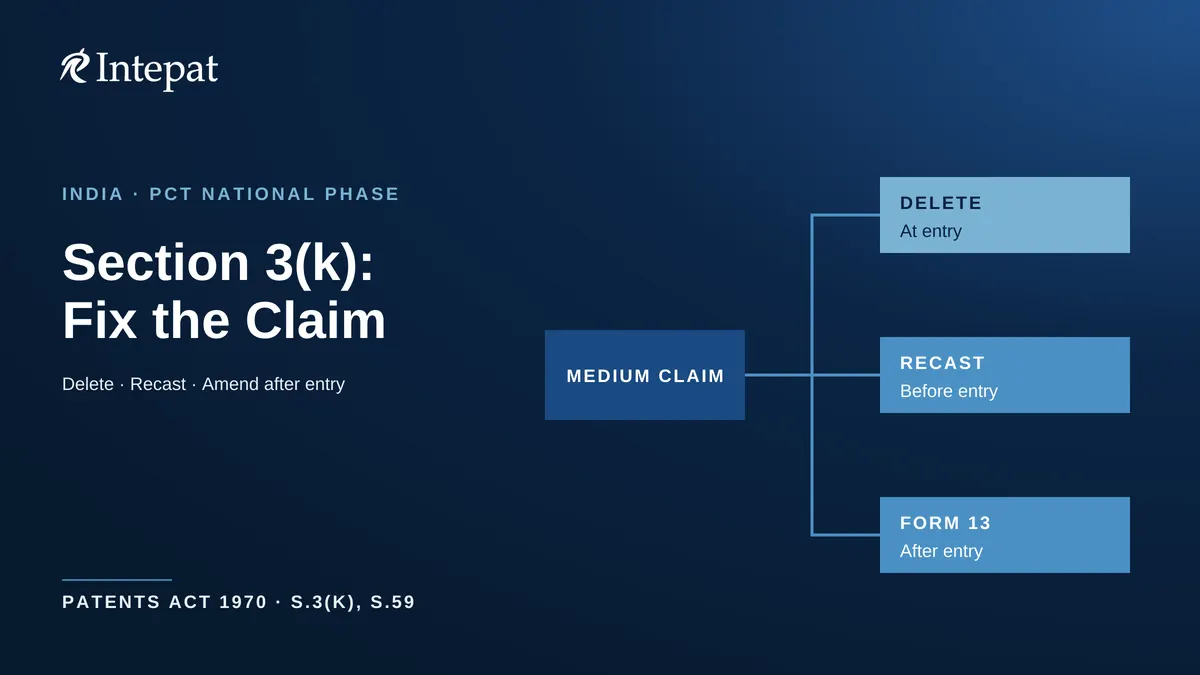
There are three routes: delete the claim on the entry form, recast it by an Article 19 or Article 34 amendment made in the international phase, or amend it by Form 13 after entry. Only deletion is allowed on the entry form itself, so a claim you want rewritten has to be changed before entry or after it.
| Route | Where it happens | What Indian law allows | Main limit |
|---|---|---|---|
| Delete at entry | Entry form, Form 1 | Deletion of a claim [Rule 20(1) proviso]; dependency changes that follow need no separate request [Manual 07.03.02, item 7] | Manual: no addition, revision or modification at entry [Manual 07.03.02, item 7] |
| Recast before entry, Article 19 | International phase | Part of the application you enter with if communicated to the Indian office [Rule 20(1) Explanation] | PCT time limits; no matter beyond the application as filed; translation of amended claims where the text is not in English [Rule 20(3)(b), (5) and (6)] |
| Recast before entry, Article 34 | International phase, after a Chapter II Demand | Part of the application you enter with [Rule 20(1) Explanation]; taken as made before the Indian office if the applicant so desires [Act s.138(6)] | Needs a Demand; PCT time limits; no matter beyond the application as filed; translation as above |
| Amend after entry | Form 13 | Only by way of disclaimer, correction or explanation, and only for incorporation of actual fact [Act s.59(1)] | No matter beyond the disclosure; each amended claim wholly within the scope of a claim before amendment [Act s.59(1)] |
Deletion suits a claim with no Indian future, such as a stand-alone program product claim the family can do without. Treat it as a scope decision you may not be able to reverse: the Act and Rules do not say how a deleted claim counts under section 59(1), and a later amendment must keep every claim wholly within the scope of a claim that stood before it. Our guide to national phase amendments sets out the formalities and the fee questions on deleting at entry.
Recasting before entry is the point at which a changed claim travels into India without a separate request, but only if it was made in the international phase. An Article 19 amendment is filed once, within a window that ordinarily closes 16 months from priority or two months after the search report is sent, whichever is later [PCT Rule 46.1]. By month 25 to 31 both windows have usually closed, so check the international-phase record for each first. The PCT limits and mechanics are in our guide to amending PCT claims before entry.
An Article 34 amendment needs a Chapter II Demand and may be left out of account once the examining authority has begun its opinion or report [PCT Rule 66.4bis].
Either amendment must stay within the application as filed [PCT Articles 19(2) and 34(2)(b)], and an Article 19 amendment is made by a complete replacement claim set with a letter giving the basis for each change [PCT Rule 46.5].
A recast claim carried in this way needs no separate Indian amendment request, provided the Article 19 amendment was communicated to the Indian office and any required translation was filed; if the translation is not filed within the time the office fixes after inviting it, the amended claims are disregarded [Rule 20(6)].
Section 138(6) separately treats amendments made before the searching or preliminary examining authority as made before the Indian office if the applicant so desires, which is how Article 34 amendments are taken in [Act s.138(6)].
Amending by Form 13 after entry is open but narrow. The request goes on Form 13 with retyped amended pages, a marked copy, and a statement of the page and line numbers amended and the reasons, and the Controller decides “whether and subject to what conditions, if any, the amendment shall be allowed” [Rule 81(1) and (2)]. The marked copy and statement follow Rule 14.
The Act confines the amendment to disclaimer, correction or explanation, bars matter not in substance disclosed, and requires every amended claim to fall wholly within the scope of a claim of the specification before the amendment [Act s.59(1)]. Adding limitations the original description supports, such as the technical steps and their effect, may narrow a medium claim, but support in the description is not enough: every limit in section 59(1) still applies. A change of claim category needs the same claim-by-claim check, and whether an amendment counts as disclaimer, correction or explanation, and is accepted, is for the Controller on the file.
Timing and the Limits That Apply
National phase entry is due within 31 months from the priority date, and the Rules take that period outside the Controller’s general power to correct or amend documents. Whether Form 13 can go in with the entry papers is unsettled, because the Manual and WIPO’s India chapter differ.
The period is fixed by Rule 20(4)(i), and Rule 137(2) removes that clause from the general power in Rule 137(1).
Rule 138 lets the Controller extend a time specified in the Rules by up to six months on a Form 4 request made before the six months expire, but this guide does not treat it as a route for the entry date, and the entry papers should be planned for 31 months. A request for examination is due within the same 31 months, but only for applications filed after the 2024 amendments; earlier filings keep their earlier period [Rule 24B(1)(i) and (vi)].
An express request on Form 18, with the fee, lets the office at its discretion process or examine the application before 31 months [Rule 20(4)(ii)].
If you plan to rely on an Article 19 or 34 recast, confirm before that request that it forms part of the application entered: communicated Article 19 claims, or Article 34 amendments you want taken as made before the Indian office.
On Form 13 with the entry papers, the sources disagree. The Manual says an applicant may request amendment of the complete specification on Form 13 “as a separate request … along with the application” [Manual 07.03.02, item 5]. WIPO’s India chapter says amendments may be requested only during the national phase and “not before or at the time of national phase entry” [WIPO Applicant’s Guide, IN.09]. Treat the point as unsettled; a Form 13 filed right after entry avoids the question.
After a first statement of objections issues, the time to put the application in order for grant is six months, extendable by three months on a Form 4 request made before expiry [Rule 24B(5) and (6)]. If an amendment is needed to meet the objections, it has to be on file in time for the application to be in order for grant within that period, since the application is otherwise deemed to have been abandoned [Act s.21(1)].
Each amendment route should be matched to the claim. A medium claim you want to keep in India in recast form belongs in the international phase, if its windows are still open. A medium claim that is only a program claim and can be given up is a deletion. A claim whose support in the description needs checking is a candidate for Form 13 after entry, once the examiner’s position on section 3(k) is known.
Before You File: A Checklist for Foreign Counsel
Review the claim set well before the 31 month date, and earlier if early examination will be requested. The list below puts the decision in the order foreign counsel can act on: identify the exposed claims, choose a route for each, then prepare the Indian papers.
- Mark each claim that recites only a program, a program product or a storage medium with instructions, using Table 2 of the Guidelines (a non-exhaustive list) as a guide.
- Check whether the description supports the technical steps and effect behind the claim, since any later recast depends on that support.
- Check whether the Article 19 and Article 34 windows are still open for this family.
- Choose for each marked claim: delete at entry, recast in the international phase, or hold for Form 13 after entry.
- For a recast carried in from the international phase, tell the Indian agent which claim set is to be filed and confirm the amendment was communicated.
- For a deletion at entry, prepare the retyped pages, marked copy, and statement of page and line numbers with reasons that Rule 14 requires.
- Settle two linked points before deleting: whether the family will want a divisional, and the statement of corresponding foreign applications on Form 3. Our guide to deleting claims at entry covers the divisional question and our guide to Section 8 and Form 3 covers the statement and its deadlines.
Foreign counsel handling a wider software family can find the general position in our guide to software patents in India, and our software and AI patent service covers software claim work generally; claim review for national phase entry sits on the page the box below links to.
Frequently Asked Questions About Computer Readable Medium Claims in India
It depends on substance, not label. The Guidelines treat a claim only about a storage medium with instructions as excluded and judge every claim form by substance. A medium claim tied to technical steps and a technical effect is assessed on that substance, and the Controller decides on the file whether it is allowed.
No. The Rules allow deletion of a claim when the corresponding application is filed, and the Manual says only deletion is allowable, not addition, revision or modification of claims. Recast the claim in the international phase, or by Form 13 after entry, within section 59.
It is part of the application you enter with if it was communicated to the Indian office [Rule 20(1) Explanation]. Section 138(6) separately covers amendments made before the searching or preliminary examining authority, which includes Article 34. Confirm the communication, file any translation, and tell the Indian agent which claim set to file.
The sources disagree. The Manual allows Form 13 “along with the application”, while WIPO’s India chapter says amendments may be requested only during the national phase, not at entry. Treat it as unsettled, and see our Form 13 timing guide for the filing order we suggest.
No. Changing the label does not change the assessment, because the Guidelines judge substance. A recast claim that recites supported technical steps and their effect is assessed on that substance, the Controller still decides on the file, and a recast made by Form 13 after entry must also satisfy section 59.
This article explains the law on section 3(k) and computer readable medium claims at PCT national phase entry in India as at November 2026 and is for general information only. It is not legal advice. Government fees, forms, and procedures change; confirm current figures with the Indian Patent Office before you file. For advice on your specific invention, consult a registered patent agent.
Sources
- Guidelines for Examination of Computer Related Inventions (CRIs) 2025, Office of the Controller General of Patents, Designs and Trade Marks (IP India), accessed 10 November 2026.
- The Patents Act, 1970, IP India, sections 3(k), 57, 59 and 138, accessed 10 November 2026.
- The Patents Rules, 2003, IP India, Rules 14, 20, 24B, 81, 137 and 138, accessed 10 November 2026.
- Manual of Patent Office Practice and Procedure 2019, IP India, paragraph 07.03.02, accessed 10 November 2026.
- WIPO: Regulations under the PCT, as in force from 1 January 2026 (Rules 46 and 66) and Patent Cooperation Treaty (Articles 19 and 34), read from the project copy on 10 November 2026; and the PCT Applicant’s Guide, National Phase, India chapter, paragraph IN.09, applicable from 1 July 2026, as read on 27 October 2026.