




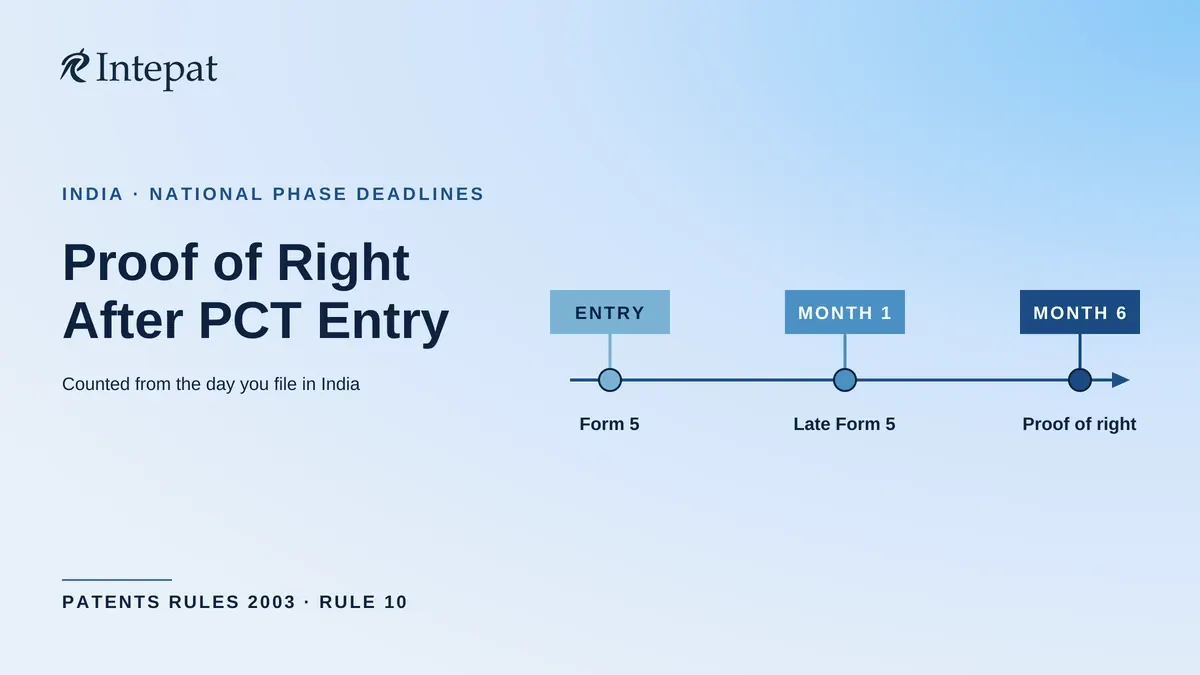
PCT national phase proof of right in India is due within six months of the date you actually file in India, where the applicant claims by assignment. Form 5 is due with the complete specification, in practice the entry papers, or within one month if the Controller allows it on Form 4. Matching PCT Rule 4.17 declarations may cover both; we still file the Indian documents.
This article covers the Patents Act, 1970, the Patents Rules, 2003 and the PCT Regulations as they apply to an international application entering India, as at November 2026. It is written for counsel who file the entry papers for a company applicant and need to know what must follow, by when, and what a miss costs.
Quick answer: Docket two dates from the day you file in India: proof of right within six months where an applicant claims through an assignment, and Form 5 with the entry papers or, if the Controller allows it on Form 4, within one month. If an agent files for you, file Form 26 (or a power of attorney) with the entry papers, because the agency rule does not say its three-month period runs from the actual Indian filing date. A compliant PCT Rule 4.17 declaration limits what the office may ask about the matters it covers, unless the office may reasonably doubt it, but the Manual still expects proof of right, so we file it as a precaution.
What must follow a PCT national phase entry in India?
Three documents can follow the entry papers: proof of the applicant’s right to apply, the declaration as to inventorship on Form 5, and the agent’s authorisation on Form 26. Each has its own clock, and two of them run from the actual date you file in India, not from the international filing date.
Your national phase application takes the international filing date as its filing date in India. But the Rules count the proof of right period and the Form 5 period from the actual date on which the corresponding application is filed in India. So for these two documents, month one starts on the day you file Form 1, not on the international filing date, which is usually a year and a half or more earlier.
The table shows the three clocks with the official fees for e-filing. The first fee column applies to a natural person, startup, small entity or educational institution; the second applies to others, including a company filing jointly with a person in the first group (verified as of November 2026).
| Document and form | Deadline | Fee (Rs), reduced / others |
|---|---|---|
| Proof of right: Form 1 declaration or an authenticated assignment (Rule 10) | With the application, or within 6 months of the actual Indian filing date | No form fee |
| Declaration as to inventorship, Form 5 (Rule 13(6)) | With the complete specification, or within 1 month if the Controller allows it on Form 4 | Nil / Nil |
| Agent’s authorisation, Form 26 or a power of attorney (Rule 135(1)) | Within 3 months of filing the application or document | Nil / Nil |
| Form 4 to extend the Form 5 period, per month | Within 1 month of the actual Indian filing date, no later than the late Form 5 | 480 / 2,400 |
| Form 4 under the general power to extend time, per month (Rule 138) | We file before the original date, as the rule does not state when its six months start; relief is discretionary | 10,000 / 50,000 |
The national phase entry itself is due at 31 months from the priority date. That deadline, the translation and Form 18 are covered in our guide to PCT national phase entry in India.
When is proof of right needed, and what counts as proof?
You need proof of right whenever the application is made by virtue of an assignment of the right to apply, which is the usual case for a company applicant. You furnish it with the application or within the prescribed period, which the Rules set at six months from the actual Indian filing date.
The Act lets three kinds of person apply: a person claiming to be the true and first inventor, that person’s assignee, and the legal representative of a deceased person who could have applied. A company ordinarily applies as an assignee. Where every applicant claims as an inventor in their own right, no proof of right is needed; where any applicant claims through an assignment, that applicant’s title must be proved.
Form 1 gives the routes. The inventors may sign the declaration in Form 1 that the applicant is their assignee or legal representative. Where the applicant in India differs from the applicant in the convention country, that earlier applicant may sign a separate declaration in Form 1. Or the applicant may upload or send the relevant assignment, duly authenticated, within the prescribed period. The Manual says proof of right applies irrespective of whether the application is a convention or national phase application.
Every application must still name the person claiming to be the true and first inventor. Where that person is not an applicant, the application must declare that the applicant believes the person named to be the true and first inventor. That belief statement identifies the inventor; it is not proof of the applicant’s title. For how inventorship and entitlement fit together more generally, see our piece on inventorship and proof of right.
Does a PCT Rule 4.17 declaration replace the Indian documents?
It may, within its scope, but we do not rely on it alone. Where a compliant declaration is on file, the PCT bars the Indian office from requiring further documents on the matter the declaration covers, unless it may reasonably doubt the declaration. WIPO’s India chapter says the declaration “may” satisfy the requirement. The Manual still expects proof of right.
The PCT request can carry declarations made for national requirements. Three matter here, and each covers its own subject: a declaration as to the identity of the inventor, a declaration as to the applicant’s entitlement, as at the international filing date, to apply for and be granted a patent, and a declaration of inventorship, which must be signed as the Administrative Instructions prescribe.
The WIPO PCT Applicant’s Guide, India chapter lists the inventor’s name, address and nationality (if not given in the request), the instrument of assignment or transfer where the applicant is not the inventor, and the declaration of inventorship as requirements that “may be satisfied” by the corresponding declaration.
Three limits follow. The entitlement declaration speaks only as at the international filing date, so the declaration does not prove a transfer made after that date. If the International Bureau has not recorded that transfer, the change of applicant may be effected in India through the Form 6 procedure described below. In the international phase, declarations are added or corrected with the International Bureau within 16 months from the priority date, or later if the notice arrives before technical preparations for publication are complete. Separately, the PCT recognises a compliant declaration submitted directly to the Indian office. And the Manual, which states office practice as at 2019, requires proof of right for national phase applications without mentioning the declaration.
So, as a voluntary precaution, we file the Indian proof of right and Form 5 even where the request carries matching declarations. Check what the international application already contains first, so that the Indian documents match it.
Form 5: the one-month window at entry
File Form 5 with the entry papers. For a PCT national phase application, the declaration as to inventorship is due with the complete specification, which in India is the international application, including any Article 19 or Article 34 amendments carried into the national phase.
If you cannot, the Controller may allow it within one month of the actual Indian filing date on a Form 4 request. Form 5 is required for every application except an ordinary application filed with a complete specification. Convention applications and PCT applications designating India are outside that exception, so a national phase application needs one. The Manual confirms that Form 5 is filed for a national phase application.
The form asks the applicant to declare who the true and first inventors are, with name, nationality and address, and is signed by the applicant or its registered patent agent. A further statement in the form lets any additional inventor not mentioned in the application form assent to the invention being included in the complete specification. Form 5 itself carries no fee. The Form 4 request for the one-month window costs Rs 480 or Rs 2,400 per month on e-filing.
A matching declaration of inventorship in the request may cover this requirement. We still file Form 5 with the entry papers as a precaution, after checking that its inventor details match the international application and any declaration in the request.
Form 26: the three-month agent authorisation
If you appoint an Indian patent agent, file the authorisation on Form 26 or as a power of attorney within three months of filing the application or document it relates to. If it is not filed within that period, no action is taken on that application or document for further processing until it is.
An agent is not compulsory for a foreign applicant, but an address for service in India is. Where an Indian agent files the entry papers for a foreign applicant, Form 26 belongs in the entry package.
The Rules count the proof of right and Form 5 periods from the actual Indian filing date. The agency rule has no such explanation. File Form 26 with the entry papers and the question does not arise.
Form 26 carries no official fee, but the form must be stamped as it states. Where a general power of attorney is already on file in another application, the 2019 Manual says the authorised agent shall file a self-attested copy.
Missed a deadline? Form 4 routes and what they cost
A late Form 5 has its own route: the one-month window on Form 4. Beyond that, and for proof of right, the main route is the Controller’s general power to extend time or condone delay by up to six months on Form 4. Both are discretionary, and the general route is expensive.
Since 2024, the general power lets the Controller extend the time for doing any act under the Rules, or condone a delay, by up to six months. The Form 4 request must be made before the six-month period the rule refers to expires, and it may be made more than once within it. The rule does not say when those six months start, so we file before the original date. It lists no exclusions, but relief is at the Controller’s discretion, so treat the original date as the date to meet. The 2019 Manual, written before the 2024 change, also refers to filing late proof of right with a petition.
| Form 4 route | Extra time available | Fee per month (Rs), reduced / others |
|---|---|---|
| Rule 13(6), Form 5 only | Up to 1 month, if the Controller allows | 480 / 2,400 |
| Rule 138, general power | Up to 6 months, at the Controller’s discretion | 10,000 / 50,000 |
On those figures, an applicant at the others rate that needs three extra months for proof of right pays Rs 150,000 in official fees on e-filing; at the reduced rate it is Rs 30,000. Proof of right filed with the application or within the six months carries no official fee. We collect the assignment before filing in India so that no extension fee arises.
WIPO’s India chapter still describes the earlier version of the general power, with a one-month limit. Do not rely on it for the current position. Our guide to extending Indian patent deadlines sets out how we docket that route.
The applicant changed after the international filing date
If the applicant’s name, or the applicant, changed after the international filing date and the change is not reflected in the International Bureau’s notification on Form PCT/IB/306, the Manual says the change may be effected in India by filing Form 13 or Form 6, as the case may be.
Form 13, the general form for amending an application or a related document, is the route for a change in the applicant’s name; Form 6 covers a change of applicant, and does not apply to a mere change of name. On a Form 6 claim made before grant, the Controller may direct that the application proceed in the claimant’s name, or jointly with the applicant, if satisfied that the claimant would be entitled to the patent or to the applicant’s interest or share. The entitlement must come from an assignment or agreement in writing made by the applicant or one of the applicants, or from operation of law. Where only one of joint applicants made the assignment, the others must consent.
For a direction based on an assignment, the assignment or agreement must identify the application by number, or its maker must acknowledge that it relates to the invention in that application, or a court must have finally established the claimant’s rights, or the Controller must have given directions on a dispute between joint applicants.
The original assignment or agreement, or an official or notarised copy, is produced for the Controller’s inspection, and the Controller may call for further proof of title or written consent. A Form 6 claim costs Rs 800 (reduced rate) or Rs 4,000 (others) on e-filing.
The PCT entitlement declaration does not help here, because it speaks only as at the international filing date. If the inventor will not sign after leaving, our article on employee invention ownership in India covers the routes the Act leaves.
PCT national phase proof of right: checklist before month 31
Collect the signed documents before you file the entry papers, not after. The cheapest proof of right is the one filed with Form 1; the most expensive is one filed under the general extension power.
- Check the international request for Rule 4.17 declarations and note what each covers.
- Collect an assignment from each inventor, or the inventors’ signatures on the Form 1 declaration.
- Check whether the applicant changed after the international filing date and whether Form PCT/IB/306 records it.
- Prepare Form 5 for filing with the entry papers.
- Have the stamped Form 26 or power of attorney ready for the same filing.
- Docket six months from the actual Indian filing date for proof of right where an applicant claims through an assignment, and, if an agent acts, file Form 26 at entry.
Form 3 on foreign filings has its own six-month period; see our Section 8 and Form 3 guide. Where the international application was not filed or published in English, the translation rules are in our translation guide.
FAQ
Not for that applicant’s own title. Proof of right is required where the application is made by virtue of an assignment of the right to apply. Where every applicant claims as an inventor in their own name, no assignment is involved. The application must still name the true and first inventor, and Form 5 is still filed for a national phase application.
The PCT says the office shall not require further documents on the applicant’s entitlement as at the international filing date where a compliant declaration is on file, unless it may reasonably doubt it. WIPO says the declaration may satisfy the requirement. The Manual still expects proof of right, so we file the Indian proof as well, as a precaution.
Do not rely on one. WIPO’s India chapter says the office will invite the applicant to comply with an unmet national requirement within a time limit fixed in the invitation. But the Rules still set the proof of right period at six months from the actual Indian filing date, so docket that date yourself.
Duly authenticated assignments the inventors have already signed can be filed as proof of right within six months of the actual Indian filing date. Form 6 cannot stand in for a missing inventor signature: it moves an application to a claimant on the applicant’s own written assignment or agreement, or by operation of law, not on the inventor’s. Take advice early.
No. The First Schedule charges no fee for Form 5, Form 26 or proof of right. Fees arise when you need more time on Form 4, for the Form 5 month or under the general extension power, as tabled above. A late Form 26 carries no fee, but the file does not move until it is filed. Form 26 must be stamped.
This article explains proof of right after PCT national phase entry in India as at November 2026 and is for general information only. It is not legal advice. Government fees, forms, and procedures change; confirm current figures with the Indian Patent Office before you file. For advice on your specific application, consult a registered patent agent.
Sources
- The Patents Act, 1970 (incorporating all amendments till 1 August 2024), Indian Patent Office: https://ipindia.gov.in/storage/uploads/docs-operator/73b5bf10-b04e-4f45-abef-87ff117315dc.pdf
- The Patents Rules, 2003 (as amended), Indian Patent Office, as at November 2026: https://ipindia.gov.in/acts/patent-rules-2003
- First Schedule (fees), Patents Rules, 2003, Indian Patent Office (file dated 31 July 2026): https://ipindia.gov.in/storage/uploads/docs-operator/d7bed07b-5c56-404b-a0c8-152b4bd18f0f.pdf
- Regulations under the PCT (as in force from 1 January 2026), WIPO: https://www.wipo.int/en/web/pct-system/texts/rules/rtoc_short
- Manual of Patent Office Practice and Procedure (2019), Indian Patent Office: https://ipindia.gov.in/storage/uploads/docs-operator/e1adfe40-7af3-4180-ba04-2e0099c6dca5.pdf