




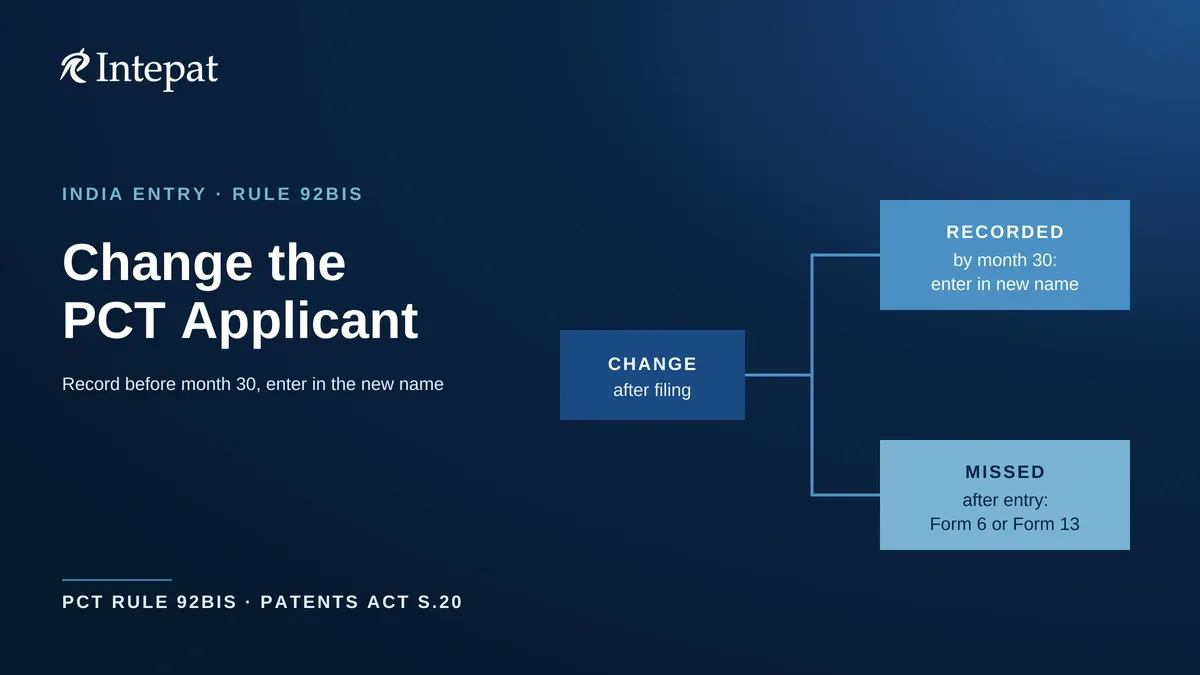
A PCT applicant change under Rule 92bis must reach the International Bureau before 30 months from the priority date. India’s 31-month entry date does not extend it. If the Bureau records the change on Form PCT/IB/306, you enter India in the new name. If it does not, you make the change in India after entry.
This article covers the PCT Regulations and the Indian Patents Act, 1970 and Patents Rules, 2003 as they apply when the applicant, or the applicant’s name, changes after the international filing date. It is written for counsel who must decide, before month 30, where to record the change and what India will then ask for, as at November 2026.
Quick answer: File the Rule 92bis request in ePCT, directly with the International Bureau, well before 30 months from priority. A change shown on Form PCT/IB/306 lets you enter India in the new applicant’s name. For a change of name, India then needs no further evidence of the change. For a new applicant claiming by assignment, file proof of right within six months of the date you actually file in India: the later assignment and, where the record does not already show it, the original applicant’s right. Miss month 30 and you enter in the old name, then file Form 6 (new applicant) or Form 13 (new name) in India.
What can Rule 92bis change on a PCT application?
Rule 92bis lets the International Bureau record a change in the person, name, residence, nationality or address of the applicant. It also covers the person, name or address of the agent, the common representative or the inventor. The Bureau records the change on the request of the applicant or the receiving Office.
Two changes look alike but are different. A change of person means a different legal person becomes the applicant, for example by assignment or succession. A change of name means the same owner under a new name, for example after a company renames itself.
Keep that distinction in mind from the start. The Bureau records both under the same rule. India, as later sections show, treats them on different forms with different evidence.
The text of Rule 92bis is short. Licences and security interests are not among the indications it lists.
Why the PCT applicant change deadline is 30 months, not 31
The International Bureau will not record a change if it receives the request after 30 months from the priority date. India gives you 31 months from priority to enter the national phase. The extra month applies to entry only. It does not extend the time for a Rule 92bis request.
WIPO has said this directly: where an office allows a later entry date, such as 31 months, the time for requesting a recordal still ends at 30 months from priority. The deadline is about receipt at the Bureau, not dispatch. A request posted, or sent through your receiving Office, in month 29 can arrive too late.
So docket two dates, not one. Month 30 is the last day for the Bureau to receive the change. Month 31 is the last day to enter India, as explained in our guide to PCT national phase entry in India.
Leave a margin before month 30. WIPO’s practical advice on changing the applicant near national phase entry recommends filing directly with the Bureau, preferably through ePCT, rather than through the receiving Office. If the Bureau is closed on the last day, the period may move to its next working day, but do not plan on that.
Who signs the request, and what the Bureau needs
What the Bureau needs depends on who asks. The applicant of record, or its agent of record, needs no assignment. A new applicant acting for itself must show its right. A new agent must file a power of attorney signed by the new applicant and, unless the applicant of record or its agent has already told the Bureau of the transfer, evidence of it.
WIPO’s guidance for receiving Offices says a request from the applicant of record is checked for its signature, or that of someone acting for it. Proof of the new owner’s right is not required in that case. The new applicant also need not be a national or resident of a PCT Contracting State.
Where the agent named in the request as filed makes the request and continues to act, no power of attorney from the new applicant is needed for the recordal, because the receiving Office and the Bureau have waived that requirement; an agent appointed later needs one. Where a new agent files, it sends a power of attorney signed by the new applicant and, unless the applicant of record has already told the Bureau, evidence of the transfer; the change is not recorded until those papers arrive. Where the new applicant files itself, it sends a copy of the assignment or similar evidence, and the change is not recorded until that evidence arrives.
The evidence can follow the request. What must reach the Bureau within 30 months is the request itself; the Bureau normally invites any missing papers and allows until the later of the 30-month limit or one month from its invitation.
One trap concerns declarations. If the international application already contains an entitlement declaration, do not file a second declaration naming the new owner. WIPO’s advice is to file the Rule 92bis request with the evidence and authority the requester needs.
Change of name or change of applicant?
Decide first which you have. A change of name keeps the same owner. A change of applicant moves the application to someone else. The Bureau records both under Rule 92bis, but if the change reaches India unrecorded, a name change goes on Form 13 and a change of applicant goes on Form 6.
Form 6 is the claim or request regarding a change in applicant. The form itself carries a note: it is not applicable for a mere change of name. It asks for the original documents and certified copies to accompany the claim, and is signed by the applicant or its registered patent agent.
A change of name, address or nationality is an amendment request on Form 13. The fee is lower than for Form 6, as the table below shows. The national phase amendments guide covers Form 13 for other changes.
| Route | When | Official fee, e-filing (Rs), reduced / others |
|---|---|---|
| Rule 92bis request at the International Bureau | Received no later than 30 months from priority | No fee (covered by the international filing fee) |
| Form 13, change of name, address or nationality (entry 19(iii)) | After entry, before grant | 320 / 1,600 |
| Form 6, claim under section 20(1) (entry 8(i)) | After entry, before grant | 800 / 4,000 |
The reduced column applies to a natural person, startup, small entity or educational institution. The other column applies to anyone else, filing alone or jointly with a person in the reduced categories (verified as of November 2026).
What India does with a change shown on Form PCT/IB/306
When the Bureau records a change, it notifies the applicant and the designated Offices on Form PCT/IB/306. You can then enter India in the new applicant’s name. India asks for a document evidencing a change of name only where the change is not reflected in that notification.
WIPO’s India chapter lists this among India’s national requirements under the PCT.
The Manual of Patent Office Practice and Procedure takes the same line: if a change of name or applicant occurred after the international filing date and is not reflected in Form PCT/IB/306, it may be effected by filing Form 13 or Form 6, as the case may be.
A recorded change records the applicant particulars; it is not a ruling on title, and it does not settle proof of right in India. A PCT entitlement declaration speaks only as at the international filing date, so it does not cover an assignment made later. Where the new applicant claims by an assignment, file proof of right in India within six months of the actual Indian filing date. It should cover the later assignment and, where the record does not already show it, the original applicant’s right to apply. Our article on proof of right after PCT national phase entry sets out those deadlines.
If the new applicant is not the person who filed the priority application, check one more point. Form 1 carries a declaration by the applicant in the convention country for that case, and the PCT lets a designated office ask for proof of the right to claim priority. WIPO’s India list does not name this requirement, so confirm what the office wants before you rely on its absence.
Missed month 30: the Indian route after entry
If the Bureau did not record the change, enter India in the name of the applicant of record, then change it in India. Use Form 6 for a new applicant and Form 13 for a new name. Form 6 can be filed at any time before grant.
For a new applicant, the Controller may direct that the application proceed in the claimant’s name. The claim must rest on an assignment or agreement in writing made by the applicant, or on operation of law. Where one of several joint applicants made the assignment, the others must consent.
The Act adds a condition for an assignment of the benefit of an invention. The assignment must identify the invention by application number, or its maker must acknowledge that it relates to the invention in that application. A court decision finally establishing the claimant’s rights, or the Controller’s directions in a dispute between joint applicants, also serves.
Plan the paperwork with that in mind. An assignment signed before Indian entry can carry, at most, the international application number, not the Indian one. The Act does not say expressly whether that number is enough. An acknowledgment from the assignor after entry, which the Act accepts, removes the doubt. The original assignment or agreement, or an official or notarised copy, is produced for the Controller’s inspection, and the Controller may call for further proof of title or written consent.
The fee category catch
The entry fee in India follows the applicant who files Form 1. A new applicant outside the reduced categories pays the rate for others. Where an application filed at the reduced rate is later transferred to such an applicant, the new applicant pays the difference in fees with the transfer request.
The First Schedule has two applicant categories, each priced for e-filing and for physical filing. The reduced category covers natural persons, startups, small entities and educational institutions. The other category covers everyone else, alone or filing with one of those groups. Form 1 asks the applicant to tick its category.
The Rules deal separately with a transfer after filing. If an application processed by a natural person, startup, small entity or educational institution is transferred to someone outside those groups, the new applicant pays the difference with the request for transfer. The Manual adds that the difference is paid with Form 6 along with Form 30. No difference is payable where a startup or small entity simply loses that status over time or by turnover.
Our guide to startup and small entity status for foreign applicants explains how the reduced rate is claimed and kept.
Applicant change checklist before month 30
Settle the applicant before the national phase starts. A change recorded once at the Bureau reaches every designated office; a change made after entry must be made in each one.
- Confirm whether you have a change of name or a change of applicant.
- Collect the assignment and, for a new applicant, a power of attorney signed by it.
- File the Rule 92bis request in ePCT, directly with the Bureau, well before month 30.
- Check whether Form PCT/IB/306 has issued before you file the Indian entry papers. Do not let month 31 pass waiting for it; if it has not issued, plan to enter in the name of record and to file Form 6 or Form 13 in India unless the notification arrives.
- Enter India in the new name, at the fee rate for the new applicant’s category.
- Docket proof of right for six months from the actual Indian filing date where the applicant claims by assignment.
If proof of right will run late, the general six-month extension route on Form 4 is discretionary and costly; see our guide to extending Indian patent deadlines. For assignments from employee inventors, see our article on employee invention ownership in India.
The rule itself is due to change. Amendments to Rule 92bis adopted by the PCT Assembly at its 58th session, as recorded in the draft report, are due to apply to requests received on or after 1 July 2027. A change will then be recorded only if an email address and telephone number remain available for correspondence. A change to the correspondence contact (its person, address or communication details) will be recordable after 30 months, within a further time limit set elsewhere in the Regulations. Applicant changes will still have to reach the Bureau before month 30.
FAQ
The Bureau does not record it. The application enters each national phase in the name of the applicant of record. In India, you then file Form 6 for a new applicant or Form 13 for a new name after entry. Each office you enter needs its own request, which is why month 30 matters.
Yes. WIPO says the new applicant recorded under Rule 92bis need not be a national or resident of a PCT Contracting State. In India, any applicant needs an address for service in India and, if an agent acts, an authorisation on Form 26 or a power of attorney. The new owner’s residence or nationality may also affect whether it can file a demand for international preliminary examination.
For a name change, no: WIPO’s India chapter asks for evidence only where Form PCT/IB/306 does not reflect it. For a new applicant claiming by assignment, yes: India lists it, and a PCT entitlement declaration cannot cover a later one. File it as proof of right within six months of the actual Indian filing date.
No. WIPO advises filing the Rule 92bis request with the evidence and authority the requester needs, not a fresh declaration. An entitlement declaration speaks as at the international filing date, so it cannot cover a later assignment. Prove the later assignment in India as proof of right within six months of the actual Indian filing date.
No. Form 16 registers title or interest in a granted patent. For an application that is still pending, a new applicant uses Form 6, with the assignment or agreement produced for the Controller’s inspection. A change of name, address or nationality uses Form 13. Form 16 comes in only after grant.
This article explains changing the applicant on a PCT application before and after national phase entry in India as at November 2026 and is for general information only. It is not legal advice. Government fees, forms, and procedures change; confirm current figures with the Indian Patent Office before you file. For advice on your specific application, consult a registered patent agent.
Sources
- The Patents Act, 1970 (incorporating all amendments till 1 August 2024), Indian Patent Office: https://ipindia.gov.in/storage/uploads/docs-operator/73b5bf10-b04e-4f45-abef-87ff117315dc.pdf
- The Patents Rules, 2003 (as amended), Indian Patent Office, as at November 2026: https://ipindia.gov.in/acts/patent-rules-2003
- First Schedule (fees), Patents Rules, 2003, Indian Patent Office (file dated 31 July 2026): https://ipindia.gov.in/storage/uploads/docs-operator/d7bed07b-5c56-404b-a0c8-152b4bd18f0f.pdf
- Regulations under the PCT (as in force from 1 January 2026), WIPO: https://www.wipo.int/en/web/pct-system/texts/rules/rtoc_short
- PCT Applicant’s Guide, National Phase, India chapter (last updated 6 November 2026), WIPO: https://pctlegal.wipo.int/eGuide/view-doc.xhtml?doc-code=IN&doc-lang=en