



Initially Published in 2019; Updated in Aug 2024
The Indian Patents Act, 1970 (39 of 1970) is the principal legislation governing patent protection in India. It came into force on 20 April 1972, replacing the Patents and Designs Act, 1911, and was shaped from the outset by the Ayyangar Committee’s recommendation that patent law serve national development rather than protect foreign monopolies. The Act reached its current substantive form through the Patents (Amendment) Act, 2005, which removed the transitional exclusion on pharmaceutical product patents to achieve TRIPS compliance while inserting Section 3(d), the efficacy filter that became globally significant in pharmaceutical patent litigation. The Patents (Amendment) Rules, 2024 (G.S.R. 211(E), notified 15 March 2024) introduced the most consequential procedural changes since 2003, including the reduction of the request-for-examination deadline from 48 to 31 months, a formal grace period mechanism, and a triennial working statement cycle. The Act is administered by the Office of the Controller General of Patents, Designs and Trade Marks (CGPDTM) through Patent Offices at Mumbai, Chennai, Delhi, and Kolkata, with jurisdiction determined by the applicant’s place of residence, domicile, or business under Rule 4 of the Patents Rules, 2003.
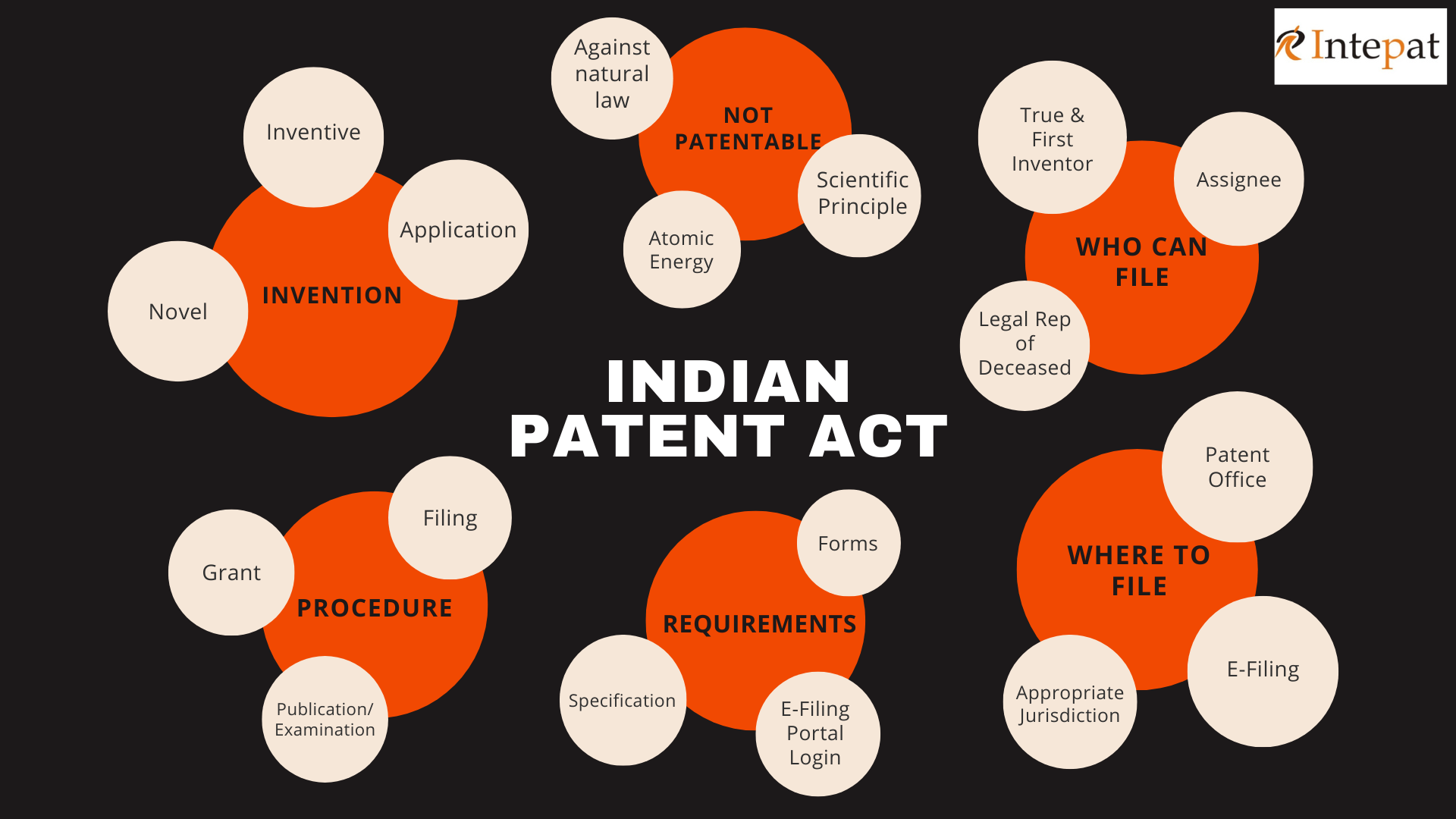
What Qualifies as a Patentable Invention
Section 2(1)(j) defines an invention as a new product or process involving an inventive step capable of industrial application. Three cumulative requirements govern every patentability analysis, and failing any one of them is fatal.
Novelty under Section 2(1)(l) requires that the invention not form part of the state of the art before the priority date. The state of the art is global: every disclosure anywhere in the world, whether through publication, prior use, or prior patent filing, counts. The assessment is not confined to what is known in India.
Inventive step under Section 2(1)(ja) requires a feature that involves a technical advance as compared to the existing knowledge, or has economic significance, or both, and that makes the invention not obvious to a person skilled in the art. The statutory definition is precise on this point: it is not enough that the invention is novel. It must also demonstrate either a technical advance over the prior art or economic significance, and the combination must not be obvious to the skilled person at the priority date. The CGPDTM’s examination practice applies a structured obviousness analysis broadly analogous to Windsurfing/Pozzoli principles, comparing the inventive concept of the claim against the closest prior art and asking whether the differences constitute a technical advance, economic significance, or both.
Industrial applicability under Section 2(1)(ac) requires that the invention be capable of being made or used in any industry. A claim asserting ‘useful biological properties’ without specifying what those properties are, or a compound with no demonstrated utility, fails this test. Industrial applicability must be made self-evident in the specification or stated explicitly. The examiner will not infer it.
What Section 3 excludes. Section 3 lists absolute exclusions: subject matter that is not an invention within the meaning of the Indian Patents Act regardless of novelty or inventive step. The exclusions a practitioner encounters most frequently in prosecution are:
Section 3(d): The mere discovery of a new form of a known substance that does not result in the enhancement of the known efficacy of that substance. The Explanation extends this to salts, esters, polymorphs, metabolites, pure form, particle size, and other derivatives of a known substance, treating them as the same substance unless they differ significantly in properties with regard to efficacy. In Novartis AG v. Union of India (Civil Appeal Nos. 2706-2716 of 2013), the Supreme Court held that ‘efficacy’ for pharmaceutical substances means therapeutic efficacy exclusively. Physicochemical improvements such as better flow characteristics, thermodynamic stability, or lower hygroscopicity do not meet the standard. Enhanced bioavailability is insufficient unless it demonstrably translates to enhanced therapeutic efficacy established by research data. Section 3(d) is examined rigorously at the substantive examination stage and is most effectively addressed in the specification at the drafting stage, with the supporting efficacy data maintained through prosecution.
Section 3(j): Plants and animals in whole or any part thereof, including seeds, varieties, and species, and essentially biological processes for their production or propagation. In Monsanto Technology LLC v. Nuziveedu Seeds Ltd (Civil Appeal Nos. 1148-1152 of 2019), the Supreme Court remanded the matter to the High Court for fresh determination on whether claims directed to a Bt trait gene technology incorporated into cotton constituted a claim to a plant variety or to a microbiological process. The judgment established that Section 3(j) exclusions must be applied with precision through factual analysis, and that claims directed to a gene or trait in isolation may be treated differently from claims to a plant variety as a whole.
Section 3(k): A mathematical or business method, a computer programme per se, or an algorithm. The phrase ‘per se’ is deliberate: a claimed invention that demonstrates a technical effect or technical contribution beyond the computer programme itself, as assessed under the CGPDTM’s Revised Guidelines for Examination of Computer-Related Inventions, 2017, may survive this exclusion. In practice, application of this exclusion has been inconsistent across examination groups; demonstrable technical advancement beyond the programme itself, rather than mere recitation of a technical effect in the claims, is required to overcome a Section 3(k) objection.
Section 3(i) and 3(h): Any process for the medicinal, surgical, curative, prophylactic, diagnostic, or therapeutic treatment of human beings or animals is excluded under Section 3(i). Section 3(h) excludes methods of agriculture and horticulture. The instruments or apparatus used in such treatments or methods may still be patentable; the exclusion is confined to the process itself.
The remaining Section 3 exclusions are Section 3(a) (frivolous inventions contrary to natural laws), 3(b) (public order and morality), 3(c) (scientific principles and discoveries), 3(e) (mere admixtures), 3(f) (rearrangement of known devices), 3(l) through 3(p) (literary works, mental acts, presentations of information, topography of integrated circuits, and traditional knowledge): these arise less frequently in typical prosecution but represent absolute bars when they do. Section 4 separately excludes all inventions relating to atomic energy under the Atomic Energy Act, 1962.
The Patent Specification: Provisional and Complete
The specification is the foundational legal instrument of a patent. The scope of all enforceable rights ultimately depends on the claims as read against the disclosure. An applicant may file either a provisional specification under Section 9(1) to secure a priority date, or a complete specification under Section 10 to initiate substantive prosecution, both filed in Form 2 alongside Form 1.
A provisional specification secures the priority date when the invention can be described on paper but has not been fully reduced to practice. It must contain the title and a description of the invention. Claims should not be included, as including them creates ambiguity in the priority date analysis for individual claim elements. The critical constraint: if a complete specification is not filed within 12 months from the provisional filing date under Section 9(1), the application is treated as abandoned and that window cannot be extended.
A complete specification carries four mandatory obligations under Section 10(4). It must fully and particularly describe the invention and its operation. It must disclose the best method of performing the invention known to the applicant as at the filing date. This obligation is not discretionary. Failure to disclose the best method constitutes a ground for revocation under Section 64(1)(h). The specification must end with claims defining the scope of protection, and it must be accompanied by an abstract of not more than 150 words.
The sufficiency standard under Section 10(4)(a) requires that a person skilled in the art be able to perform the invention based solely on the specification’s disclosure without undue experimentation. Broad claims unsupported by working examples regularly attract objections on this ground. Where the invention uses biological material that cannot be fully described in words, the material must be deposited in an international depository authority under the Budapest Treaty before the filing date, and the source and geographical origin of that material must be disclosed in the specification under Section 10(4), proviso (ii), sub-clause (D). Failure to disclose is a ground for pre-grant opposition under Section 25(1)(j).
Filing: Forms, Applicant Categories, and the Section 8 Obligation
An application for grant of a patent is made in Form 1 alongside the specification in Form 2, a declaration of inventorship in Form 5 for complete specification applications, a statement and undertaking regarding foreign applications in Form 3 under Section 8, and Form 26 if filed through a registered patent agent. All applications filed electronically must bear a valid digital signature; physical filing attracts a 10% surcharge.
The 2024 Amendment introduced a substantively important applicant classification: natural persons, startups, small entities, and educational institutions attract filing fees approximately 80% lower than those payable by companies and other applicants. This classification is a filing decision, not a formality. An incorrect or unsupported category is a defect that survives into prosecution and may be challenged in opposition proceedings. The basic application fee under the 2024 First Schedule is ₹1,600 for concessional categories (e-filing) and ₹8,000 for others, with per-page and per-claim excess charges for specifications exceeding 30 pages or 10 claims.
Section 8 imposes a continuous obligation to disclose all corresponding patent applications filed outside India, both at filing via Form 3 and throughout prosecution as further applications are filed or processed in other jurisdictions. Under Rule 12(2) as amended by the 2024 Rules, the initial Form 3 statement and undertaking must be filed within 3 months from the date of issuance of the first statement of objections under Rule 24B(3) or Rule 24C(8), a shift from the earlier trigger of 6 months from the filing date. This is distinct from the Controller’s independent power under Rule 12(4) to direct a fresh Form 3 within 2 months of a specific communication at any point during prosecution. Non-compliance with Section 8 is among the most frequently invoked grounds in opposition and revocation proceedings: it is a ground for pre-grant opposition under Section 25(1)(h), post-grant opposition under Section 25(2)(h), and revocation under Section 64(1)(m).
Applicants resident in India who wish to file an equivalent application abroad must first obtain written permission from the Controller under Section 39, unless an application for the same invention has been made in India at least six weeks earlier and no secrecy direction is in force. Contravention of Section 39 attracts criminal liability under Section 118 and renders the Indian application liable to revocation.
Examination, First Examination Report, and the Path to Grant
A patent application under the Indian Patents Act is not examined as of right. Examination commences only when the applicant or any other interested person files a Request for Examination in Form 18 with the prescribed fee. Under Rule 24B(1) as amended by the 2024 Rules, the deadline for this request is 31 months from the date of filing or the priority date, whichever is earlier. This is the single most consequential deadline in Indian patent prosecution: failure to file within the prescribed period results in the application being treated as withdrawn. The Act provides no statutory revival mechanism for this default, and writ-based challenges seeking to override the deemed-withdrawal have not succeeded before the courts.
The Delhi High Court in Nippon Steel Corporation v. Union of India (W.P.(C) 801 of 2011) confirmed this outcome plainly: once an application has been deemed withdrawn for failure to file a request for examination, the Controller has no power to entertain an amendment, and Rule 138 (the general extension-of-time provision) cannot rescue an application where no request for extension was made before the period expired. Applications filed before the commencement of the 2024 Rules retain the earlier 48-month deadline by virtue of the transitional proviso in Rule 24B(1)(vi).
Applicants who qualify (startups, small entities, female natural persons, government departments, institutions owned or controlled by government, and applicants under an international arrangement including the Patent Prosecution Highway) may file a Request for Expedited Examination in Form 18A under Rule 24C. The examiner’s reference is ordinarily made within one month from the date of publication or the request for examination, whichever is later.
The examiner’s findings are communicated as a First Examination Report (FER), covering patentability under Section 3, novelty, inventive step, industrial applicability, sufficiency of disclosure, clarity and support of claims, and compliance with Section 8. The applicant must respond and put the application in order for grant within six months from the date of the first statement of objections (Section 21, Rule 24B(10)), extendable once by a maximum of three months on a request in Form 4 filed within the six-month period. The Controller must dispose of the application within three months from receipt of the last reply to the FER, or from the last date to put the application in order for grant, whichever is earlier, except where a pre-grant opposition is pending (Rule 24B(13)).
Where the Controller’s report is adverse, Section 14 requires the Controller to communicate the gist of objections and, if the applicant requests within the prescribed period, provide an opportunity of being heard before the application is disposed of. No application may be refused without that opportunity having been afforded. Following a hearing, the Controller passes a reasoned speaking order under Section 15 either granting the patent or refusing with grounds recorded in writing. A refusal order under Section 15 is appealable to the High Court under Section 117A within three months of the order.
Pre-grant amendments to the specification and claims are governed by Section 59: amendments may correct an obvious mistake or restrict the claims, but no amendment shall be allowed that would claim or describe matter not in substance disclosed in the specification as filed. Post-grant amendments under Section 57 are permissible only for disclaimer, correction, or explanation, and may not extend the scope of the claims as granted. The date of the patent is the date of filing of the application (not the date of grant), and the patent term is 20 years from the date of filing under Section 53, with no extension mechanism available in India for pharmaceutical or agrochemical patents.
Pre-Grant and Post-Grant Opposition
The Indian Patents Act provides two distinct, non-mutually-exclusive windows for third parties to challenge a patent application or a granted patent through the Patent Office. The two proceedings differ in timing, standing, and procedure, but share largely the same substantive grounds.
Pre-grant opposition under Section 25(1) is open to any person and may be filed in Form 7A after publication of the application under Section 11A but before grant. The grounds include wrongful obtaining, prior publication, prior claiming, prior public knowledge or use, obviousness, non-patentable subject matter under Section 3 or 4, insufficiency of disclosure, non-disclosure or wrongful disclosure under Section 8, and failure to disclose or wrongful disclosure of the source or geographical origin of biological material. Under Rule 55 as amended by the 2024 Rules, where the Controller finds no prima facie case, an order must be passed within one month of notification to the opponent. Where a prima facie case is established, the applicant has two months to reply (reduced from three months by the 2024 Amendment). Applications in which a pre-grant representation has been filed and notice has been issued are processed under the expedited examination procedure of Rule 24C.
Post-grant opposition under Section 25(2) is available to any person interested and must be filed in Form 7 within one year from the date of publication of the grant in the Official Journal. The substantive grounds are identical to pre-grant opposition. The Controller constitutes an Opposition Board, which examines the matter and submits a recommendation. After hearing both parties and considering the Board’s recommendation, the Controller passes a speaking order either maintaining, amending, or revoking the patent. The patentee’s reply period was reduced from three months to two months by the 2024 Amendment (Rule 56(4)).
The strategic relationship between the two proceedings is important in practice. A third party who files a pre-grant representation is not barred from subsequently filing a post-grant opposition. The two proceedings are independent. Equally, a patentee against whom a post-grant opposition is filed is not precluded from amending the patent claims, provided any amendment does not extend beyond the matter disclosed in the specification as filed.
Renewal, Lapse, and Restoration
A patent must be kept in force by payment of annual renewal fees. Under Section 53 read with Rule 80, the first renewal fee becomes due at the expiry of two years from the date of filing (covering the third year of the patent term) and must be paid before that two-year expiry. Each subsequent annual fee falls due before the expiry of the preceding year. Renewal fees may be paid late within an extended period of six months from the due date on filing Form 4 with the applicable surcharge. The 2024 Amendment’s Rule 80(3) introduced a 10% reduction in renewal fees where fees are paid in advance for at least four years by electronic mode, a meaningful incentive for portfolio consolidation.
Where a patent lapses due to non-payment, the patentee may apply for restoration under Section 60 in Form 15 within 18 months from the date of lapse. The Controller must be satisfied that the failure to pay was unintentional. Two aspects are relevant in practice. First, the unintentionality standard is examined on the facts; administrative oversight attributable to the patentee’s patent agent is not automatically a defence. Second, under Section 62, third parties who in good faith commenced working the invention on a commercial scale during the lapse period acquire intervening rights that survive restoration; they may continue that specific use without constituting infringement even after the patent is restored.
Every patentee and licensee is required to submit a Statement of Working of the patented invention on a commercial scale in India in Form 27 under Section 146(2). The 2024 Amendment changed the frequency from annual to once per three-financial-year period, to be filed within six months of the expiry of each such period under Rule 131(2). This change substantially reduces administrative overhead for patentees with large portfolios. Furnishing a false statement of working attracts criminal liability under Section 122.
Compulsory Licensing
Section 83 of the Indian Patents Act sets out the governing principle: patents are granted to encourage inventions and to secure that they are worked in India on a commercial scale without undue delay, not merely to enable patentees to enjoy a monopoly for importation. The compulsory licence provisions in Sections 84 to 94 give operational force to that principle.
Under Section 84, any person interested may apply to the Controller for a compulsory licence in Form 17 after the expiry of three years from the date of grant on any of the following grounds: that the reasonable requirements of the public have not been satisfied; that the patented invention is not available at a reasonably affordable price; or that the patented invention is not being worked in the territory of India. The Controller must consider, among other factors, whether the applicant has made reasonable efforts to obtain a voluntary licence on reasonable terms. The practice of the Controller treats six months as the ordinarily reasonable period for such negotiations.
The landmark Natco Pharma Ltd. v. Bayer Corporation decision of March 2012 (India’s first compulsory licence) held that Bayer’s patented oncology compound Sorafenib Tosylate (Nexavar) failed all three grounds under Section 84: the drug was not worked in India, was priced beyond reasonable affordability, and public demand was not met. On the working requirement specifically, the Controller held that Bayer’s importation of the patented product was insufficient to satisfy Section 84(7) on the facts of that case. The working requirement is assessed on a fact-specific basis, and importation alone was held insufficient in Natco; whether local manufacturing is strictly required in all circumstances remains subject to interpretation.
Section 92 provides for compulsory licences in national emergencies, circumstances of extreme urgency, or public non-commercial use by Central Government notification, in which circumstances the voluntary licence negotiation requirement is dispensed with entirely. Section 92A extends the compulsory licence mechanism to permit export of patented pharmaceutical products to countries with insufficient or no manufacturing capacity, in accordance with the TRIPS-Doha Declaration framework.
Key Statutory Deadlines at a Glance
| Stage | Deadline and Citation | Consequence of Default |
| Complete specification | 12 months from provisional filing — Section 9(1) | Fatal — application deemed abandoned; not extendable |
| Convention application | 12 months from basic filing date — Section 135 | Fatal — priority claim lost |
| PCT national phase entry | 31 months from priority date — Rule 20(4)(i) | Fatal — national phase entry barred |
| Publication | 18 months from priority — Section 11A | Automatic — early publication available on Form 9 |
| Request for Examination (post-15 March 2024 filings) | 31 months from priority — Rule 24B(1) | Fatal — application treated as withdrawn; no statutory revival |
| Request for Examination (pre-15 March 2024 filings) | 48 months — Rule 24B(1)(vi) transitional proviso | Fatal — application treated as withdrawn; no statutory revival |
| FER response | 6 months from first statement of objections — Rule 24B(10) | Extendable by 3 months on Form 4 within the 6-month period |
| Pre-grant opposition reply | 2 months — Rule 55(4) (amended 2024) | Discretionary extension possible; prima facie scrutiny applies |
| Post-grant opposition filing | Within 1 year of publication of grant — Section 25(2) | Fatal — time-barred after 1 year |
| Post-grant opposition reply | 2 months — Rule 56(4) (amended 2024) | Discretionary extension possible under Rule 62 |
| Renewal — first instalment | Before expiry of 2nd year from filing date — Rule 80 | 6-month grace period available on Form 4 with surcharge |
| Renewal — late payment | Within 6-month extended period — Rule 80(1A) | Patent lapses; restoration possible within 18 months |
| Restoration after lapse | Within 18 months from date of lapse — Section 60 | Fatal after 18 months; unintentional failure required |
| Compulsory licence application | After 3 years from date of grant — Section 84 | Substantive; voluntary licence effort required first |
| Appeal to High Court | 3 months from Controller’s order — Section 117A | Fatal after 3 months unless extended by court discretion |
This article updated on 21st March 2026 and reflects the Indian Patents Act, 1970 and the Patents Rules, 2003 as amended up to the Patents (Amendment) Rules, 2024 (G.S.R. 211(E), notified 15 March 2024). It covers Indian jurisdiction only and does not constitute legal advice. Readers should consult a registered patent agent or patent attorney for advice specific to their invention and circumstances.