




A patent licence lets someone use your patented invention without transferring ownership of it. In India the agreement has to be in writing and has to contain all the terms, or it is not valid at all. The type of licence you sign also decides whether you can sue an infringer yourself.
This guide covers patent licensing in India under the Patents Act 1970, and it deals with granted patents. If you are still weighing whether to licence at all rather than sell or manufacture yourself, start there instead. Licensing a patent application that has not yet been granted raises separate questions and is not covered here.
One point comes before all the others. A licence is permission from one patent owner, not a clearance to trade. An Indian patent gives its owner the right to stop others making, using, selling or importing the invention (Section 48), and nothing more. It confers no right on anyone to practise the invention free of everyone else’s patents. A licence removes one obstacle, not every obstacle.
| Before you sign, confirm these five things |
| – Does the owner keep the right to work the invention inside the field you are being licensed for? If yes, it is not an exclusive licence there, whatever the document is titled. – Of the negotiated licence types, only an exclusive licensee can sue an infringer in their own name, and only for infringement after the licence date. – The executed agreement, with its completed schedules, must carry every term governing both sides. What the document is called does not matter; what is missing from it does. – Registering the licence costs Rs 1,600 or Rs 8,000 for each patent when filed electronically, depending on who you are. A ten-patent deal costs ten times that. – Some clauses are void even after both sides sign, and such a clause can be turned into a defence against your own infringement suit. |
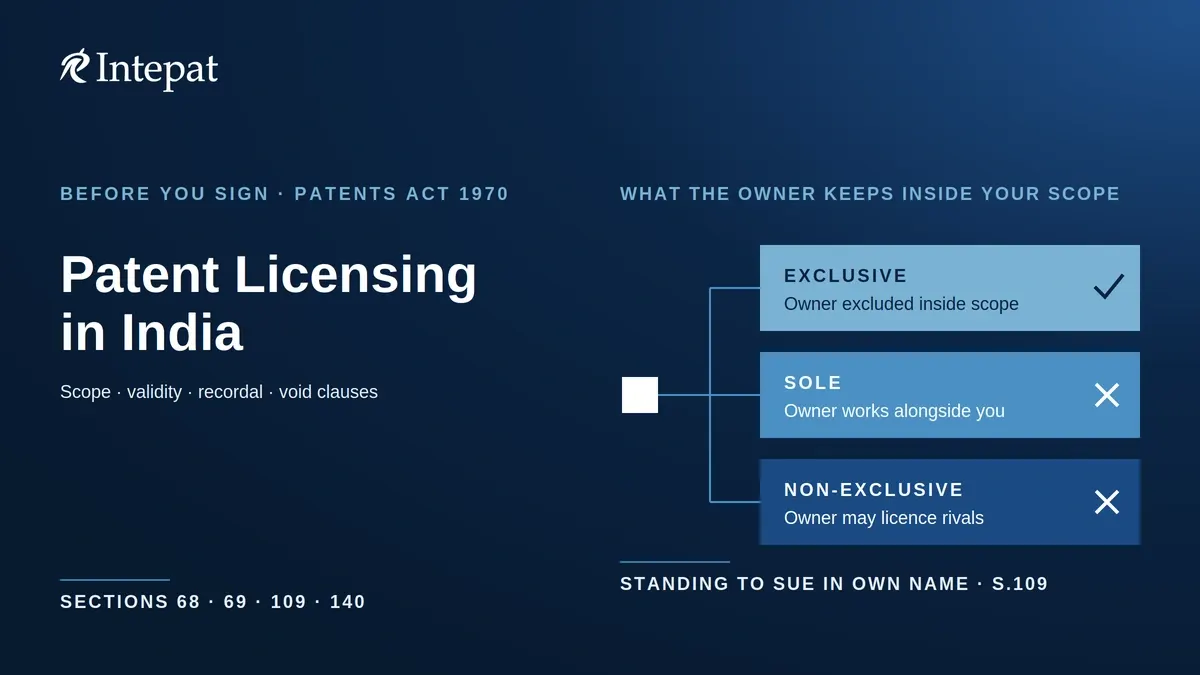
Exclusive vs non-exclusive licence: what each one actually gives you
Three labels get used loosely in licence drafts, and only one of them is actually defined in Indian patent law.
An exclusive licence shuts out everyone else, and that includes the patent owner (Section 2(1)(f)). The definition works on any right in respect of the invention rather than on the patent as a whole, so a licence can be exclusive inside a defined field, product line, territory or customer group while the owner keeps everything outside it. The question is not whether the owner holds any rights at all. It is whether the owner keeps the same right you are being granted, inside the same boundary.
If the owner can carry on making or selling inside your field, you do not have an exclusive licence there, whatever the heading on page one says. What you have is what practitioners call a sole licence: you are the only licensee, but the owner stays in the market beside you.
A non-exclusive licence means the owner can grant the same rights to as many other people as they choose, including your competitors, unless the agreement says otherwise. A fourth kind exists but is not negotiated between the parties at all: a compulsory licence is granted by the Controller on an application under Section 84.
The label matters for one reason above all others. Of these three, only the holder of an exclusive licence can start infringement proceedings in their own name (Section 109). Sign a sole licence instead, and if a competitor starts copying the invention, you cannot go to court yourself. You have to persuade the owner to act, and if the owner has lost interest or has been acquired, you may wait a long time.
Two limits sit on that right even when the licence is genuinely exclusive. It covers infringement committed after the date of the licence, not before. And you cannot sue alone: if the owner does not join you as a co-plaintiff, the owner is added to the case as a defendant.
| Exclusive | Sole | Non-exclusive | |
| Owner can work the invention inside your scope | No | Yes | Yes |
| Owner can licence others inside your scope | No | No | Yes |
| You can sue infringers in your own name | Yes | No | No |
| Defined in the Patents Act | Yes, Section 2(1)(f) | No, commercial usage | By implication |
If you are offered a sole licence and the owner will not move, the gap can be narrowed in the drafting. Parties often add an obligation on the owner to act against infringers within a set period. That is a contractual promise, not the statutory standing Section 109 confers, so it is only worth as much as the owner is.
The practical check takes one minute. Read what the owner keeps, not what the document is called.
What exactly are you licensing
An exclusive licence over the wrong thing is worth less than a non-exclusive licence over the right thing. Before the licence type matters, the document must be clear about its subject.
Check that the agreement names the Indian patent numbers rather than describing the technology, because a description drifts from what the claims actually cover. Check whether patents of addition, divisionals and later grants in the same family travel with the deal.
Then check the acts. A patent owner’s rights run to making, using, offering for sale, selling and importing (Section 48). A licence permitting manufacture but silent on import leaves a gap that surfaces at the worst possible moment.
After that, the boundaries: products, applications, territory, customer groups and commercial field. Then the people, because a licence to your company alone may not reach your contract manufacturer, distributors or affiliates. Sublicensing rights, and whether the owner’s consent is needed, belong in the same list.
Finally, ask what comes with the patent. Know-how, drawings, source code and technical support are not conveyed by a patent licence unless the agreement says so, and a licence to a process you cannot run is not worth much.
What makes patent licensing in India legally valid
A patent licence is valid only if it clears four requirements at once (Section 68). It has to be in writing. The agreement has to be reduced to the form of a document. That document has to embody all the terms and conditions governing both sides’ rights and obligations. And it has to be duly executed.
The third requirement catches people out, and it turns on completeness rather than on what the document is called. A paper headed “term sheet” can satisfy Section 68 if it is complete and meant to bind. An agreement headed “Patent Licence Agreement” can fail it if the commercial detail still sits in emails or in a schedule nobody prepared. Completed schedules form part of the executed agreement; the section tests completeness, not page count.
The consequence is not a technical defect. The section says the licence is not valid. If the relationship later breaks down, the party relying on a partial document is arguing about whether it had a licence at all.
Watch for: an agreement that refers to a schedule, annexure or side letter that has not actually been prepared. The terms in that missing document are terms governing the parties’ rights, and they need to be in the executed document.
Separate from Section 68 entirely: stamp duty. A licence agreement may be chargeable with duty under the stamp law of the State concerned, and both the rate and the classification vary by State. Insufficient stamping can create evidentiary problems long after signature. Settle the position before execution, and check the signatory’s authority and the execution date at the same time.
Oral licences do not work here, and neither does a course of dealing. The writing requirement applies whatever the source of the terms, including a standard public licence. Whether click-through or electronic acceptance satisfies it is not settled in India, which is one reason open source patent licences need care in an Indian deal. If you have been operating on a handshake and an invoice, you do not have a licence that Section 68 recognises.
Registering the licence with the Patent Office, and what Form 16 costs
Once a licence is signed, the licensee is expected to apply to the Controller to have the interest recorded in the register of patents (Section 69). The application goes in on Form 16 (Rule 90), and the licence document is filed with it, along with two copies certified as true copies (Rule 91). The patent owner can also make the application instead of you (Section 69(2)).
There is no filing deadline. Several online sources state that you have six months from the date of execution, and that is simply the trademark position being imported into patent law by mistake. Section 69 and Rules 90 and 91 prescribe no express period for filing Form 16. That is not a reason to wait, for the evidentiary reason that follows.
That does not make registration optional in any practical sense. Apart from using it to make the registration application itself, or to correct the register, an unregistered licence document is not admitted by the Controller or by a court as evidence of your title, unless they decide otherwise for reasons put in writing. If you need to prove you hold rights in the patent, an unrecorded document leaves you arguing for permission before you argue the merits.
Registration matters for a second reason. The power to grant licences and otherwise deal with the patent sits with the person registered as proprietor, subject to any interests already noted there (Section 70). An interest that is not on the register is invisible to the next person who does a deal.
This is also why the register is the first place to look when you are the one taking a licence. Under the Act, the patentee is the person for the time being entered on the register as grantee or proprietor (Section 2(1)(p)). If the company offering you a licence bought the patent last year and never recorded the transfer, the register still shows the seller, and the party signing your agreement is not yet the patentee in the Act’s sense. That does not mean they hold nothing, since Section 70 preserves equities in the patent. It does mean a gap in the title chain, and the answer is to close it: ask for the assignment, proof of execution, and evidence that the Form 16 recordal has been filed.
Form 16 fee, verified as of July 2026
| Applicant | Filing electronically | Filing physically |
| Natural person, startup, small entity or educational institution | Rs 1,600 per patent | Rs 1,750 per patent |
| All other applicants | Rs 8,000 per patent | Rs 8,800 per patent |
Read the last two words in each cell carefully. The fee is charged for each patent, not for each agreement. A licence covering a portfolio of ten patents attracts the fee ten times over, which is a real budget line rather than a rounding error.
Your commercial terms need not become public, but the protection is not automatic. Where the patentee or the licensee asks for it, the Controller is required to take steps to keep the terms of the licence undisclosed except under a court order (Section 69(4)). The duty is triggered by the request, so make it at the time of filing rather than assuming confidentiality follows from the filing itself.
Clauses that are void even after both sides sign
Indian law strikes out certain restrictive conditions in patent licences regardless of what the parties agreed (Section 140). Four categories are caught:
- Making you buy something other than the patented article from the owner or their nominee, or restricting who else you can buy it from.
- Stopping you from using a competing article that the owner did not supply, or restricting that use.
- Stopping you from using any process other than the patented process, or restricting it.
- Requiring you to hand back improvements exclusively, preventing you from challenging the patent’s validity, and forcing you to take a package of licences you did not want.
Any condition of that kind is void. For the first three categories, splitting the condition into a separate side agreement does not save it, whether that agreement is signed before or after the licence.
The part that surprises people: a void restrictive condition is a defence to an infringement suit. If the owner sues an infringer while a licence containing any condition this section makes unlawful is in force, the infringer can raise that as a defence (Section 140(3)). The defence does not run where the person suing was not a party to that contract and shows the condition went in without their knowledge or consent. A clause inserted to tighten control over a licensee can end up protecting a competitor.
Three things sit outside this. A condition prohibiting a person from selling goods other than those of a particular person; a reservation letting the owner supply new parts or keep the article in repair; and the point that the section does not rescue a contract that would have been invalid anyway. Read the first of those narrowly. It is an exclusive-dealing carve-out, not a general blessing for non-compete clauses or restrictions on using competing products.
Section 140 is also not the whole restrictive-clause picture. Exclusivity, tying, pricing and territorial provisions can raise competition law questions that this section does not answer, and that analysis sits outside the Patents Act.
There is also a right to walk away that licensees often overlook. Once the patent has ceased to be in force, or, where the article or process was protected by several patents when the contract was made, once all of them have, the licensee can end the contract on three months’ written notice, and the agreement cannot take that right away (Section 141). In a portfolio deal, the expiry of a single patent does not trigger it.
How royalty and payment terms are usually structured
Royalty terms in Indian patent licences follow a handful of familiar shapes: a single lump sum, a running royalty calculated on sales, payments tied to milestones, a minimum annual amount, or a combination.
Published royalty rates for Indian patent deals are scarce, because almost all agreements are confidential. Treat any percentage quoted to you as a negotiating position rather than a market standard, and ask what comparable deals it is drawn from.
Two operational points do more work than the headline rate. Check which side pays the renewal fees that keep the patent alive, because a licence over a patent nobody is renewing is a wasting asset. And check what happens to payments if the patent is revoked or lapses partway through the term.
Where the royalty runs on sales, the definition of that sales figure matters as much as the percentage: what may be deducted first, whether sales to related companies count, and whether your books can be inspected. None of this is set by statute, so the agreement governs.
The licensee also picks up an obligation that has nothing to do with the contract. Every licensee, exclusive or otherwise, has to file working statements about commercial use of the invention in India (Section 146(2), Form 27). The statement covers each three financial year period and is due within six months of that period ending, with up to three further months available on request (Rule 131). Failing to furnish it carries a penalty of up to Rs 1 lakh, and Rs 1,000 for every day the failure continues after the first (Section 122, as amended with effect from 1 August 2024). The Controller can separately demand information in writing, and that has a two-month clock on it.
If the patent has more than one owner
Co-ownership changes the answer, and it turns on who is registered as grantee or proprietor, not on who is named as an inventor. Startups meet it whenever two founders, or a founder and a research institution, are registered together.
Each co-owner may work the invention for their own benefit without accounting to the others (Section 50(2)). That much is intuitive. What follows is not: no co-owner can grant a licence, or assign their share, without the consent of the other co-owners (Section 50(3)). Both rules are subject to any agreement between the owners.
So if you are taking a licence from one of several registered owners, confirm the others have consented. Without it, the person signing may not have been able to grant what the document says they granted.
Where co-owners cannot agree, any of them may apply to the Controller for directions on granting licences (Section 51). If a co-owner then fails to sign what those directions require within fourteen days of a written request, the Controller may empower someone else to sign in their name.
The checks to run before you sign
Work through the document in this order. Confirm the patent numbers and the licensed acts, because an exclusive licence over the wrong scope is the most expensive mistake here. Confirm what the owner keeps inside that scope, since that decides whether you can ever enforce the patent yourself. Confirm every commercial term sits in the executed agreement or its completed schedules. Check the register for who actually owns the patent and whether anyone else has an interest recorded. Count the patents covered and multiply the registration fee. Read the restrictive clauses against the void list, then ask who pays renewals and who files the working statements.
If the answer to any of these is unclear from the document in front of you, that is the question to put to the other side before signature, not after.
Frequently asked questions
Yes, registration and validity are separate. A licence is valid if it is in writing, contains all the terms, and is duly executed (Section 68). Registration under Section 69 affects whether the document is admitted as evidence of your title, not whether the licence itself is good.
An exclusive licence excludes everyone from the licensed rights, including the patent owner (Section 2(1)(f)). A sole licence excludes other licensees but lets the owner continue working the invention. Of the voluntary licence types, only an exclusive licensee can bring infringement proceedings in their own name under Section 109.
No express period applies. Section 69 and Rules 90 and 91 prescribe no deadline for filing Form 16, unlike the position for trademarks. Sources stating a six-month deadline for patent licences are importing a rule that does not exist in the Patents Act 1970. Delay still carries evidentiary risk.
Rs 1,600 for each patent when filed electronically by a natural person, startup, small entity or educational institution, and Rs 8,000 for each patent for other applicants. Physical filing costs Rs 1,750 and Rs 8,800 respectively. Verified as of July 2026.
They need not, but confidentiality is not automatic. Where the patentee or the licensee requests it, the Controller must take steps to ensure the licence terms are not disclosed except under a court order (Section 69(4)). Make that request when you file, because the duty is triggered by the request.
No, not without consent. A co-owner cannot grant a licence or assign their share without the agreement of the other registered co-owners (Section 50(3)), though the co-owners can vary this between themselves. Each may still work the invention personally without accounting to the others.
Yes. Section 2(1)(f) defines exclusivity by reference to any right in respect of the invention, not the patent as a whole. A licence can therefore be exclusive within a defined field, product line or territory while the owner retains rights outside it, provided the owner is excluded inside that boundary.
Yes, and the duty sits on the licensee independently of the patent owner. Every licensee, exclusive or otherwise, must furnish statements on commercial working of the invention in India (Section 146(2)) on Form 27, covering each three financial year period and due within six months of it ending. Failure carries a penalty of up to Rs 1 lakh.
Disclaimer
This article explains the law on patent licensing in India as at July 2026 and is written for general guidance. It is not legal advice on any particular agreement. Licence terms turn on the specific patent, the parties and the commercial context, and statutory fees are revised from time to time. Before signing, take advice on your own facts from a lawyer qualified to advise on contracts; some registered patent agents are also advocates. For Form 16 recordal and Patent Office procedure, a registered patent agent is the right professional (Section 127).