




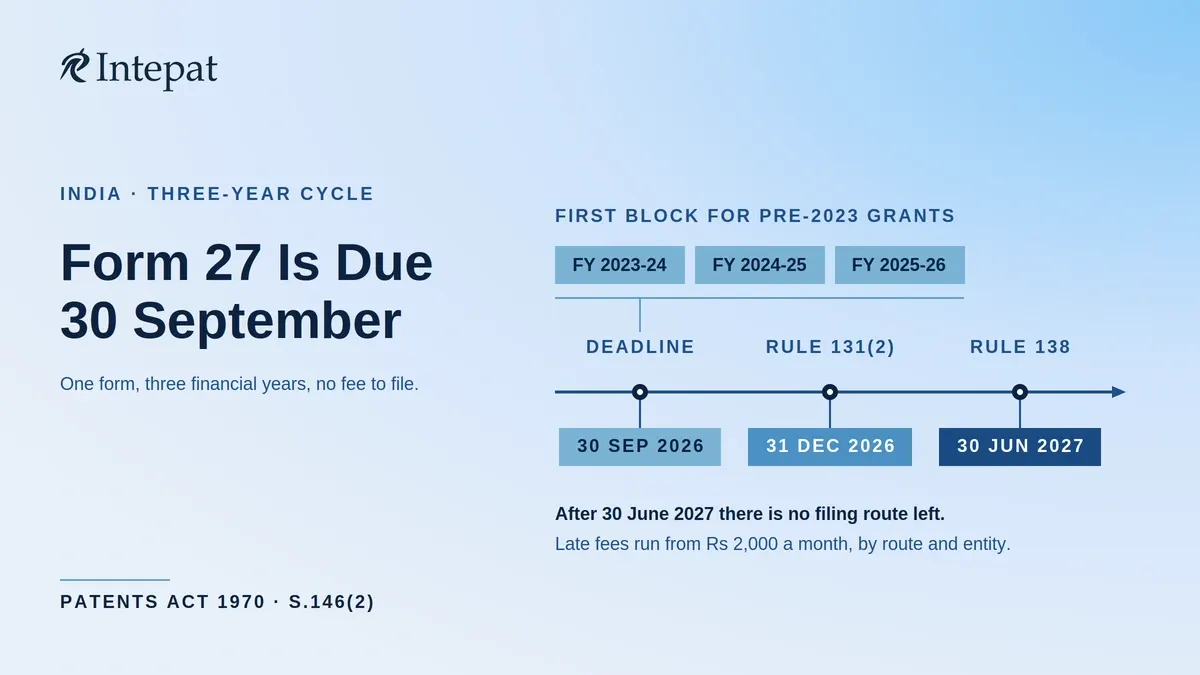
If you hold a granted Indian patent, or a licence under one, you may well owe the Patent Office a Form 27, the statement of working of patents in India, by 30 September 2026. It is a short, free declaration of whether the invention is worked commercially in India, filed once every three financial years since March 2024.
The duty comes from Section 146(2) of the Patents Act, 1970, and the timing from Rule 131 of the Patents Rules, 2003. It applies to every patent in force here, whoever owns it; a foreign patentee is in the same position as an Indian one.
Quick answer: If your patent was granted before 1 April 2023 and ran through to 31 March 2026, your Form 27 is ordinarily due by 30 September 2026. A patent that expired earlier reports a shorter period on an earlier timetable. The patentee and every licensee each carry the duty, and the form is free. A late filing can still be accepted, on Form 4 and for a fee charged by the month; not filing is a penalty risk and weakens your position if anyone applies for a compulsory licence.
Who has to file Form 27
Two duties, not one. The patentee files, and so does every licensee, exclusive or otherwise (Section 146(2), Rule 131(1)). Neither discharges the other, so each carries its own compliance obligation regardless of what the other party does.
That trips up licence deals: a founder who has licensed a patent often assumes one filing covers both sides. It does not, and the licensee carries its own penalty exposure; the fix is a clause requiring the licensee to file on time and copy the patentee.
Joint owners have it easier: where a patent is granted to two or more persons, the form may be filed jointly by all or any of them. Several patents can go on one form too, but only if related and granted to the same patentee; neither the Rules nor the form defines “related”, so where unclear, separate filings are the conservative course. A registered patent agent can file for you, the usual arrangement past a handful of patents.
One rarer route: at any time while the patent is in force the Controller can serve written notice requiring a patentee or licensee to furnish working information within two months (Section 146(1)), a separate clock from the one below.
When your Form 27 is due
The cycle runs in three-financial-year blocks. A block starts on the first day of the financial year immediately after the financial year in which the patent was granted, and the statement is due within six months of that block expiring (Rule 131(2)). An Indian financial year ends on 31 March, so the deadline lands on 30 September.
That cycle came in with the Patents (Amendment) Rules, 2024, G.S.R. 211(E), in force from 15 March 2024. Because the bare provision is awkward to apply to an older patent, the Office published worked scenarios for each grant year in a FAQ of 26 August 2024, running the cycle prospectively from that commencement.
| Patent granted | First three-year block | Filing window | Due by |
| Before FY 2022-23 | FY 2023-24 to FY 2025-26 | 1 April 2026 to 30 September 2026 | 30 September 2026 |
| In FY 2022-23 | FY 2023-24 to FY 2025-26 | 1 April 2026 to 30 September 2026 | 30 September 2026 |
| In FY 2023-24 | FY 2024-25 to FY 2026-27 | 1 April 2027 to 30 September 2027 | 30 September 2027 |
| In FY 2024-25 | FY 2025-26 to FY 2027-28 | 1 April 2028 to 30 September 2028 | 30 September 2028 |
| In FY 2025-26 | FY 2026-27 to FY 2028-29 | 1 April 2029 to 30 September 2029 | 30 September 2029 |
| In FY 2026-27 | FY 2027-28 to FY 2029-30 | 1 April 2030 to 30 September 2030 | 30 September 2030 |
The Office’s scenarios stop at FY 2024-25 because the FAQ was issued in August 2024; later grants follow the same shape, with nothing due for the financial year of grant itself. The first two rows are the block itself and do not depend on earlier filings: a missed FY 2022-23 statement sits outside this block as a separate non-compliance, and cannot be filed now or folded in.
For a patent granted in FY 2022-23 the block starts at FY 2023-24 regardless of the actual grant date, so a patent granted in April 2022 and one granted in March 2023 share a deadline. Otherwise the clock is keyed to the financial year of grant, and the block opens on the following 1 April: a patent granted 31 March 2024 sits in FY 2023-24, while one granted a day later, on 1 April 2024, moves into FY 2024-25 and reports a full year later. For the 31 March 2024 patent, the block itself starts 1 April 2024, but its six-month filing window does not open until 1 April 2027; if you are reading this in that window’s closing weeks, treat it as this week’s task.
A patent that ended part way through a block still reports the years it was alive for: one expiring in FY 2023-24 reported that year only, to 30 September 2024; one expiring in FY 2024-25 reported two years, a year later. Both windows, and their extensions, have closed.
What Form 27 asks you to declare
Six items, none asking for money: the form identifies you and the patents, names the period, records worked or not worked, gives a reason where not worked, asks about licensing, and takes your signature. The 2024 version dropped the revenue and import figures the old one demanded.
One point of confusion first: item 2 still reads “in respect of the financial year”, singular, while the rule now speaks in three-year blocks. The Office has answered directly: a single form covers the whole block, not one filing per year inside it.
Item 3 is a tick box per patent, worked or not worked, with no field for turnover or import figures. A version asking for revenue is an old, retired copy still circulating online; take the current one from the forms and fees page of the Indian Patent Office instead.
What the tick means is less obvious than it looks, and the notes printed underneath settle the commonest doubt: subject to the conditions in the Act, a patented invention shall not be considered “not worked” merely because the patented product has been imported into India. Selling an imported patented product in India is therefore not by itself a reason to tick “not worked”.
The qualifier is real, though. Section 83 records that patents are not granted merely to let a patentee hold a monopoly on importing, and Section 84(7) treats the public’s reasonable requirements as unmet where Indian working is prevented or hindered by imports, whether by the patentee, by anyone buying from him directly or indirectly, or by anyone he has not sued for infringement. So importing settles the question neither way: it does not make the patent not worked, and does not by itself make it worked. The answer turns on your facts, and import that displaces any prospect of Indian working is the pattern a competitor looks for.
Item 4 offers four reasons for not working, and more than one may be ticked: under development or commercial trial; under regulatory review; exploring commercial licensing; or “any other”, specified by you. A pharmaceutical patent awaiting CDSCO clearance sits in the second; use the catch-all sparingly, since a vague entry there is the weakest line on your record later.
Item 5 asks whether the patent is available for licensing, yes or no, with optional email and phone fields; a blank leaves the form incomplete, and where the answer is yes, the contact fields make the offer usable. Item 6 is the signature block, not a formality: the line above it declares the facts true to the best of your knowledge and belief, and Rule 131(1) requires verification by the patentee, the licensee or an authorised agent.
None of this has anything to do with Form 3, the statement and undertaking about your foreign applications: different form, different trigger, different deadline.
If you miss the deadline: Form 4 and what it costs
A missed 30 September is not the end. Two extension routes exist, both on Form 4 and both priced by the month. What is not available is the general power to excuse an irregularity in procedure, switched off for working statements.
The first route is a carve-out written into Rule 131(2): its proviso lets the Controller excuse the delay or extend time by up to three months on a Form 4 request, priced the same whether asked before the deadline or after.
The second is Rule 138, as substituted in 2024, opening “notwithstanding anything contained in these rules” to allow extension or condonation of up to six months, again on Form 4, before that six months has run. Its proviso allows repeated requests inside those six months, which matters since the fee is monthly: ask for one month and ask again if needed, rather than buying six at the outset. The Office treats the routes as stacking.
| Route taken on a 30 September 2026 deadline | Last date to file | E-filing fee per month, concession column | E-filing fee per month, others |
| Rule 131(2) only, up to three months | 31 December 2026 | Rs 2,000 | Rs 10,000 |
| Rule 138 only, first extension not taken | 31 March 2027 | Rs 10,000 | Rs 50,000 |
| Rule 131(2), then Rule 138 | 30 June 2027 | each route at its own rate | each route at its own rate |
Fees verified as of August 2026. Physical filing adds ten per cent (Rule 7). For the ordinary Form 4 routes, nine months is the outer edge, not a soft landing.
Read the column headings strictly, because this is where the money is. The concession column covers a natural person, a start-up, a small entity on the MSMED investment test, or an educational institution; a start-up here is either an Indian entity recognised under Startup India or a qualifying foreign entity filing a declaration to that effect. The other column covers everyone else, and extends to “Other(s), alone or with” any of those, so a patent held jointly with an ordinary company is charged at the higher column regardless of your own status. If claiming the concession column, file Form 28 alongside your extension request, free of charge (Rule 7); a natural person filing in their own name does not need it.
What is closed off is Rule 137: the 2024 amendment listed matters where the Controller’s general irregularity power no longer applies, and the working-statement provision is the ninth item, shutting off that petition route only.
Both extension powers still stand: one inside the proviso to Rule 131(2), and Rule 138, not on that list at all. The Office’s FAQ puts this as barring condonation of delay, which reads harsher than it is; the same FAQ confirms both routes remain open.
A Form 4 extension is discretionary, and a prompt request with a straight reason reads better than one made on the last day; once granted it cannot be appealed, nor need the Controller hear an objector first (Section 81). For the wider picture, see our guide to extension of time on Indian patent deadlines.
What not filing actually costs you
Four exposures: a penalty for the failure, a separate turnover-linked one for filing something false, a criminal tail for then ignoring the resulting order, and a slower risk that a gap in your record becomes evidence used against the patent.
The money first. Failing to furnish a statement required under Section 146 attracts a penalty of up to Rs 1,00,000, plus a further Rs 1,000 for every day the failure continues after the first (Section 122(1)). The lakh is a ceiling; the daily amount is not, so a year left standing adds more than Rs 3,60,000 on top of it.
Filing something untrue is punished differently: furnishing information you know or believe to be false carries a penalty of one half per cent of your turnover or gross receipts, or Rs 5 crore, whichever is less (Section 122(2)). That cap only bites above about Rs 1,000 crore of turnover; on a Rs 20 crore business the figure is Rs 10,00,000. The declaration is signed, and whether it is true gets tested against your import, licensing, regulatory and manufacturing records, not the penalty arithmetic.
These are civil penalties rather than offences, following the Jan Vishwas (Amendment of Provisions) Act, 2023, effective 1 August 2024. A designated Patent Office officer, not a court, imposes them after a hearing, with appeal to an officer at least one rank above within sixty days. The decriminalisation stops there: ignoring that order, or the appellate order, within ninety days brings, on top of the penalty, a fine of Rs 1,00,000 or up to a year’s imprisonment, or both (Section 124B).
Then the structural risk. Three years after grant, any person interested may apply for a compulsory licence, ordering you to license the patent to someone else on the Controller’s terms; one ground is that the invention is not worked in India (Section 84(1)).
That class is wider than competitors: Section 2(1)(t) expressly includes anyone engaged in or promoting research in the same field, and Section 84(2) lets even an existing licensee apply. Your filings may therefore become relevant evidence in that proceeding.
A single declaration that the invention was not worked, with a specific and credible reason, does not automatically result in a compulsory licence. Where too little time has passed, the Controller may adjourn for up to twelve months, if satisfied you took prompt and adequate steps to start working it (Section 86). A pattern across blocks with nothing but a vague catch-all is different: two years after a first compulsory licence, the Central Government or any person interested may apply to revoke the patent, and the Controller may revoke it (Section 85). Fuller treatment is in our pieces on compulsory licensing of patents in India and revocation of a patent in India.
There is a commercial cost too. The Controller may publish what is filed (Section 146(3)), and due diligence in a funding round, an acquisition or a licensing negotiation may examine the filing history. A gap in it costs bargaining room at exactly the moment you need it.
Where patentees get Form 27 wrong
Four recurring errors turn up across patent portfolios, and two are simple docketing failures: counting the block from the grant date instead of the financial year, and assuming one filing covers every licensee, when the duty is independent of theirs.
The other two are about what you write. Confusing this with the other post-grant clocks costs more than it should: renewal fees fall due annually under Rule 80 and keep the patent alive, while a working statement is free and keeps nothing alive. Our guide to patent renewal in India covers that clock, and the patent deadline tracker holds both. And leaning on the catch-all reason at item 4, instead of one of the three specific options, is the weakest line on your record.
The one date to put in your diary now
Take each granted patent, find the financial year it was granted in, and read your Form 27 due date off the table above, for every patent you own or hold a licence under. Write the patent numbers beside the date.
For a patent granted before April 2023 that ran through the whole block, that working statement deadline is 30 September 2026. The grant date is on the patent certificate and in the Office’s register, open to public inspection.
If a date has gone, the question is how many months late you are: both routes are priced by the month, and the outer edge of the ordinary Form 4 sequence is nine. Past that, those two routes are closed. Rule 6(6) leaves a narrow exceptional door open, but only for delay proven to come from war, civil disorder, strike, calamity or a like communications breakdown, acted on within a month of it ending, not ordinary diligence failures. Details of the 2024 changes are in our overview of what the 2024 amendment rules changed.
Frequently Asked Questions
No. Section 146(2) and Rule 131(1) put the duty on every patentee and every licensee, and the form’s own notes say each is required to file it. The Patent Office has confirmed that patentees and licensees, exclusive or not, can file separately for the same patent.
Importing does not by itself make it not worked. The form’s notes say a patented invention is not to be treated as not worked merely because the product has been imported into India. The qualifier is that importing which prevents or hinders Indian working is itself a compulsory-licence ground, so the answer turns on your facts.
Item 4’s second option, under review or approval with regulatory authorities. Tick the first as well if pre-submission development is still running, since more than one reason is allowed, and consider answering yes at item 5 if you would license it to someone able to carry the approval.
No. The duty falls on a patentee and on licensees under a granted patent, and the form asks for patent numbers, so a pending application requires no working statement. Your first block starts the financial year after the one in which the patent is eventually granted, so nothing is due for the grant year itself.
Yes, on Form 4. Rule 131(2) allows up to three months and Rule 138 a further six, at Rs 2,000 and Rs 10,000 per month for a start-up or small entity e-filing, and Rs 10,000 and Rs 50,000 for others. See the table above for the full figures; the Rule 137 petition route is unavailable.
No. The Patent Office treats a statement whose due date passed before 15 March 2024 as no longer filable, and lapsed years cannot be clubbed into a new three-year block. Each missed annual statement is a separate non-compliance under Section 122, so take advice before the current block falls due.
None. The form is headed “No Fee”, and entry 54 of the First Schedule records no fee in every column, for electronic and physical filing alike, whatever your entity type. Fees arise only if you are late and need Form 4. Verified as of August 2026.
This article explains the law on Form 27 working statements in India as at August 2026 and is for general information only. It is not legal advice. Government fees, forms, and procedures change; confirm current figures with the Indian Patent Office before you file. For advice on your specific invention, consult a registered patent agent.