




Originally published 13 June 2019. Republished and updated 19 November 2026.
PPH request requirements decide whether a patent office examines your application sooner because another office has already found claims allowable. They turn on how the two applications relate, whether your claims correspond to the allowed claims, whether the later office has begun examination, and whether you file the right documents. For routes and offices, see our Patent Prosecution Highway decision guide.
Quick answer: To file a PPH request you need an application at the later office that is related to the earlier one, all claims on file sufficiently corresponding to the claims the earlier office found allowable (same, similar or narrower scope, no new or different claim category), and, in the usual pattern, a published application with a request for examination filed, no examination yet begun at the later office, and the relevant office actions, allowed claims, a claims correspondence table and cited references. Publication, timing and document requirements vary by office. Each office publishes its own guidelines, which decide the details; WIPO’s PCT-PPH page links to them, and the JPO’s guidelines page covers filing at the JPO.
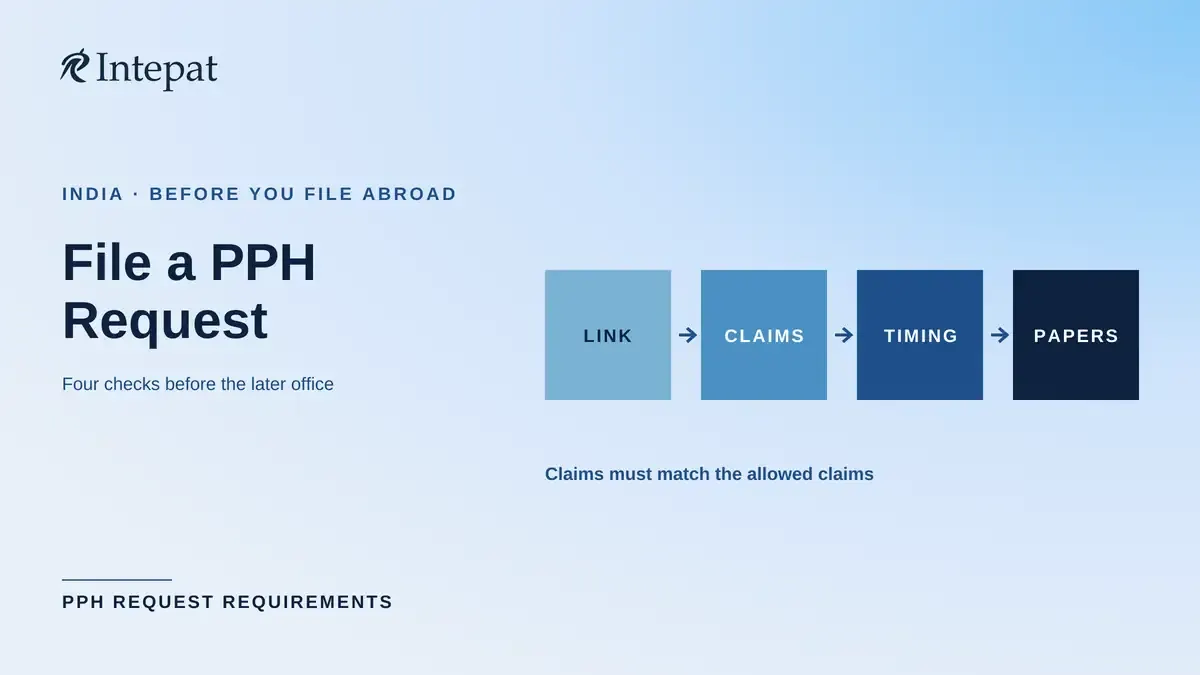
PPH Request Requirements: Check the Later Office First
A claims correspondence table is a chart showing, claim by claim, how your claims match the allowed ones. The request goes to the later office, the one you want to speed up, and it rests on work from the earlier office. The JPO’s PPH Portal says PPH requirements include the correspondence between claims found allowable by the first office and the claims in the PPH application, that offices may have different requirements and procedures, and that applicants should see the guidelines on the relevant office’s website.
The JPO’s explanatory material for the Global PPH matrix lists the typical requirements and says users must still request acceleration under each participating office’s own guidelines. The Global PPH is a pilot among 29 offices (JPO, as at 6 January 2026). The sections below follow that material; treat them as the usual pattern, not as any one office’s rule.
How the Two Applications Must Be Related
For a request based on national work, the earlier and later applications must share the same earliest date, whether a priority date or a filing date. The JPO’s material gives four relationships: the later application claims Paris Convention priority from the earlier one; it is the basis of a priority claim for the earlier one; the two share a common priority document; or both derive from a common PCT application with no priority claim.
The earlier application must also have at least one claim identified as patentable or allowable in its latest office action. What counts as that decision differs by office. The JPO’s material gives examples: IP Australia’s Notice of Acceptance, the JPO’s notification of reasons for refusal with a statement that no reason for refusal was found, and the USPTO’s Notice of Allowability.
The Claim Correspondence Test
This is the condition that needs the most care. All the claims in your application at the later office must sufficiently correspond to the claims the earlier office found allowable. According to the JPO’s material, claims are sufficient if they are of the same or similar scope, or narrower, and a narrower claim adds a technical feature supported by the specification.
A claim that introduces a new or different category is not sufficient. The JPO’s example: if the earlier office found only claims to a process of manufacturing a product allowable, later claims that introduce product claims do not sufficiently correspond.
Before you file, line up every claim on file against the allowed claims. The JPO’s material treats only same, similar or narrower scope as sufficient, and a claim in a new category does not correspond. If you expect to restructure your claims in the later country, check whether a request is workable before you rely on it.
Timing and Procedural Conditions
The JPO’s explanatory material gives the typical conditions: the later office has not begun examination or issued a final decision, a request for substantive examination is filed at the later office with the PPH request or earlier, and the later application has been published. These conditions are office-specific, so check each one against the later office’s guidelines. For the IP5 programme (the JPO, CNIPA, EPO, Korea’s office and the USPTO), the JPO’s page adds that the JPO, EPO, CNIPA and USPTO require that substantive examination has not begun, while Korea’s office also accepts requests after it has begun. Check the later office’s guidelines for its exact timing rule.
Documents to File
The JPO’s material lists these documents for a request based on national work, and says documents already filed with the later office need not be filed again but must still be listed on the request form:
- Copies and translations of the earlier office’s office actions relevant to patentability. Where the earlier office has already issued a decision to grant, the JPO’s material says only the action issued just before that decision is needed (check the later office’s rule), and a dossier access system (the earlier office’s shared electronic file access) can remove the need to file them where the documents are provided through it. Machine translations are accepted, though the examiner may ask for a better one.
- Copies and translations of the claims the earlier office found allowable, unless they are available through the dossier access system; the later office’s rules decide whether a separate copy is needed.
- A claims correspondence table showing how every claim at the later office corresponds. A literal translation can be marked as the same; the table must show how every claim corresponds.
- Copies of documents cited by the earlier examiner. Non-patent literature must be filed. Patent documents are treated differently by different offices: the USPTO form asks for an information disclosure statement (IDS) listing the references cited in the earlier work product and copies of them, except US patents and US published patent applications.
If a request fails a requirement, the JPO’s material says the applicant is notified of the defects and may be given an opportunity to correct certain specified defects (the material adds ‘only one time’); when all requirements are met, the applicant is notified that the application has entered the PPH programme.
Requests Based on a PCT Work Product
For PCT-PPH the earlier work is the latest written opinion of the International Searching Authority, the written opinion of the International Preliminary Examining Authority or the international preliminary examination report, and it must find at least one claim patentable or allowable. A request cannot be based on an international search report alone. If the work product contains observations in Box VIII, the applicant must identify and explain which claims are patentable or allowable, whether or not an amendment is filed; without that explanation the JPO’s explanatory material says the application will not be eligible for PCT-PPH, and the later office’s own rule governs. The claims correspondence principle is the same as for national work, a claims correspondence table and copies of cited references are also filed, and the JPO’s material applies the same timing, examination request and publication conditions as for national work, but the later office sets them and they can differ. A copy of the work product and the allowable claims are filed with translations, but some offices let the applicant omit the work product, its translation and the allowable claims when they are available on PATENTSCOPE, WIPO’s public database of international applications. The USPTO form warns that if the applicant asks it to retrieve a document and the attempt fails, the applicant must supply it, so check availability first.
The USPTO as the Later Office
At the USPTO a request is made by petition on form SB/20GLBL, which serves both Global PPH and IP5 PPH, and the USPTO states there is no fee under its PPH programs. For the JPO’s request form, see its guidelines page. For a US national stage application under 35 U.S.C. 371, the revised form carries an express request to begin national stage processing, with a reminder that specific requirements must be met for that request to be effective. As at 30 November 2025 the USPTO reported 107,685 applications with petitions, of which 97,983 had petitions granted (about 91 percent); the remainder are not recorded as granted. These figures are totals to that date. The USPTO also says it adjusted the docketing of PPH applications with a granted petition so that first action pendency in a particular technology is approximately half that of non-PPH applications. From 1 January 2026 its target for the average period from completion of a PPH request to the first office action on the merits is six months, revised from three; it is an average performance target, not a deadline for any one application. For how the USPTO treats PPH applications on speed, see our decision guide.
Frequently Asked Questions About Filing a PPH Request
This article is for general information only and is not legal advice. It describes typical PPH request requirements based on the JPO’s explanatory material as available in November 2026; each office sets its own requirements, forms and fees, so confirm current rules with the office concerned before you file. For advice on your specific invention, consult a registered patent agent.
All claims on file must sufficiently correspond to the claims the earlier office found allowable, according to the JPO’s material. Same, similar or narrower scope counts; a different claim category does not, so check each claim before you file.
Generally not. The JPO’s material says the later office must not have begun examination. Under the IP5 programme, the JPO’s page says the JPO, EPO, CNIPA and USPTO require that substantive examination has not begun, while Korea’s office also accepts requests after it has begun. Check the later office’s guidelines.
No. The JPO’s material says a request cannot be based on an international search report alone. The work product, such as a written opinion of the searching authority, must find at least one claim patentable or allowable.
We found no PPH arrangement open in India: the India-Japan pilot ended in November 2022, and India is absent from WIPO’s lists (12 February 2026), which omit purely national-work-product agreements. Indian expedited examination is a separate Form 18A request. Abroad, PCT-PPH rests on the authority’s report, if the later office accepts it. See our record of the pilot and our India guide.
Sources
- Explanatory material of Global PPH Matrix, Japan Patent Office.
- IP5 PPH, JPO PPH Portal (in Japanese), read as a search extract.
- Patent Prosecution Highway (PPH) Fast Track Examination of Applications, USPTO, last updated 18 August 2026.
- PCT-Patent Prosecution Highway Program (PCT-PPH and Global PPH), WIPO, status on 12 February 2026.
- PPH pilot program between the JPO and the IPO, Japan Patent Office, last updated 15 January 2024.