




A patent strategy is the decision of whether, what, and where an invention is worth protecting before you spend on filing. In India, once granted, a patent lets you stop others making, using, or selling your invention for up to twenty years, inside India only, and it can cease if renewal fees go unpaid within the allowed period. Valuation weighs that protection against its cost.
This guide covers patent strategy and valuation for founders and small businesses in India. The ideas of cost, value, and territory apply everywhere, but the specific rights, fees, and obligations described here are those under the Patents Act, 1970. Where protection outside India is involved, we point you to dedicated guides rather than cover it inline.
The short version
• A patent is a right to stop others, not a right to freely use your own invention.
• It lasts up to twenty years from the filing date, and can cease if renewal fees are not paid within the prescribed or extended period (limited restoration is possible within eighteen months).
• It works only in India; protecting an invention abroad means filing country by country, within twelve months of your first filing or through the international (PCT) route.
• After grant, you must file periodic working statements (Form 27); an unworked patent can be exposed to a compulsory-licence application three years after grant.
• Patent when the invention is new, hard to design around, and commercially worth the cost. Otherwise, consider keeping it secret or publishing it.
Patent or not? A quick read
- Patent if the invention is commercially important, visible to competitors in your product, hard to design around, and worth enforcing or licensing.
- Hold off if it is a minor feature, easy to work around, has a short market life, or is better kept as confidential know-how
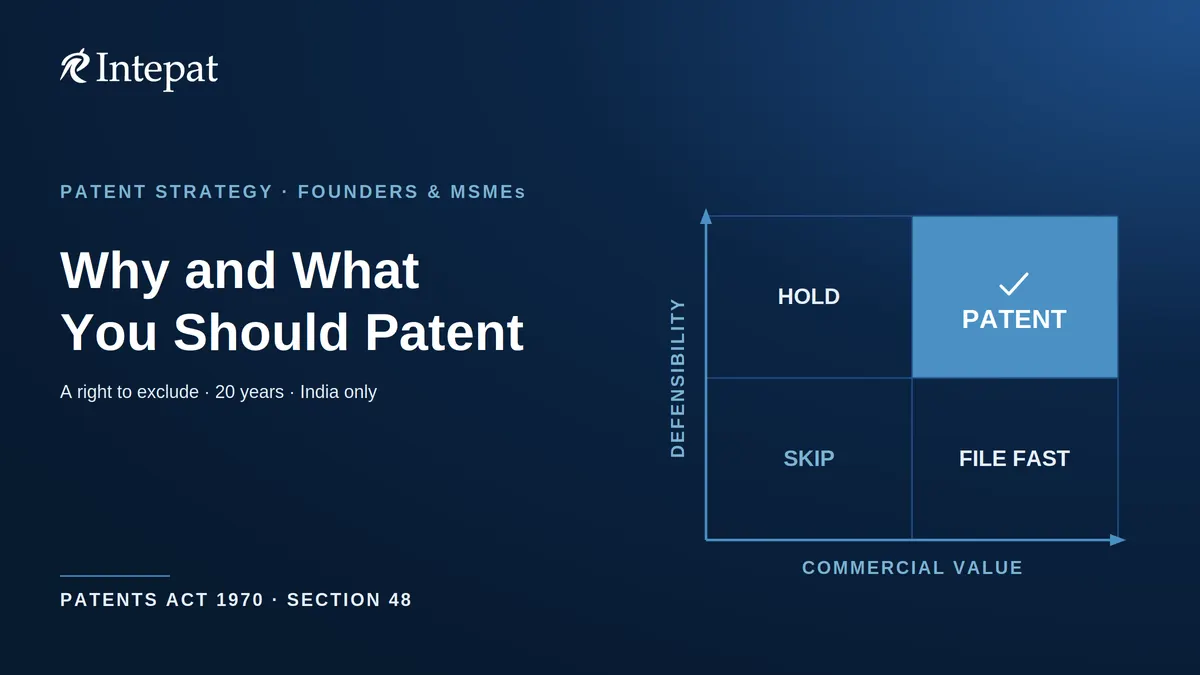
What a patent actually gives you
The right a patent grants is the right to exclude. Under the Patents Act, once a patent is granted it lets you prevent others from making, using, offering for sale, selling, or importing your patented product or process in India without your consent. The official text of Section 48 of the Patents Act, 1970 frames it as a right to prevent third parties, which is narrower than most founders assume. These rights are also subject to statutory exceptions, including research use, government use, and the regulatory or Bolar-type acts treated as non-infringing under Section 107A.
That distinction matters. A patent does not hand you a positive licence to practise your own invention. You may still need regulatory clearance to sell a product, and you can still be blocked by someone else’s earlier patent that your invention builds on. The patent is a sword you can raise against copycats, not a shield that clears your own path. The right also does not depend on proving that anyone copied you; a competitor who arrives at the same invention independently can still be stopped.
The right is also territorial. An Indian patent stops others in India and nowhere else. A competitor in another country can make and sell the same invention there unless you hold a patent in that country too. This single fact drives most of the cost decisions later in this guide.
A patent runs for up to twenty years from the date you file the application, and it stays in force only while the renewal fees that fall due through the term are paid. If a renewal fee is not paid within the prescribed period or the extended period allowed, the patent can cease; in limited cases a lapsed patent can be restored within eighteen months of ceasing. Once a patent ceases or its term expires, the invention is open for anyone to use. So protection is not a one-time purchase. It is a twenty-year commitment you can stop funding, and many patents are deliberately allowed to lapse once they stop earning their keep.
Why founders and small businesses patent
Beyond simply stopping copycats, a patent earns its place for three practical reasons.
Royalties and licensing
A patent is property. You can license others to make or sell the invention in exchange for a fee or a share of revenue, which turns a cost centre into an income stream and lets the invention reach markets you cannot serve yourself. Our guide on monetising a patent walks through how licensing and assignment work in practice.
The funding signal
Investors often read a credible patent position as evidence that a business has something defensible behind it, not just a product anyone can clone next quarter. A patent will not save a weak business, but for a strong one it can support the story you tell when raising money. If you are an early-stage company, the cost-saving routes in our note on the government IP scheme for startups are worth reading before you file.
Defensive value
A patent lets you act when a competitor copies what you built, rather than watching your lead erode. In some cases a single foundational patent has seeded an entire industry; the electrophotography (xerography) patents that grew into Xerox are a frequently cited example. More often, the defensive value is quieter: a competitor decides your patent is not worth designing around and leaves your market alone.
Practitioner note: A patent you never intend to enforce or license is an expensive certificate. Before filing, ask what you would actually do if a competitor copied you. If the honest answer is nothing, the money may be better spent elsewhere.
Should you patent it? What to file and what to skip
Not every invention is worth patenting. A workable test asks four questions. Is the invention new, in the sense the law requires? (Our guide on the novelty requirement explains what counts.) Is it the kind of subject matter Indian law allows you to patent at all? (See what can be patented in India.) Is it hard for a competitor to design around or reverse-engineer? And is it commercially valuable enough that protecting it justifies the spend?
A useful rule of thumb: if the invention is successful enough that competitors would want it, it is worth protecting. If it earns a reasonable return through licensing, it is worth protecting. If it yields only a thin margin and is easy to work around, the patent may cost more than it returns. The quick read near the top of this guide captures the same test in two lines.
There is also a strategic fork before you file at all: patent it, or keep it a trade secret. A patent requires you to publish the invention in full, and protection ends after twenty years. A trade secret has no fixed term and no filing cost, but it dies the moment the secret leaks or a competitor independently works it out. The choice usually turns on whether your invention can be reverse-engineered from the product you sell.
| Factor | Patent | Trade secret |
| Disclosure | Full invention is published | Kept confidential |
| Term | Twenty years from filing | Indefinite, until disclosed |
| Reverse-engineering | Still protected | Protection lost |
| Upfront cost | Drafting, filing, prosecution | Low, but needs ongoing controls |
| Best fit | Products that reveal the invention when sold | Processes or recipes you can keep in-house |
What patent valuation tells you before you spend
Patent valuation is usually discussed in the context of mergers, acquisitions, or licensing deals. For a founder at the filing stage, it is more useful to start with a plain commercial assessment than a formal valuation: will the protected product earn enough, through sales you defend or royalties you collect, to beat what the patent costs over its life?
Valuers approach this through cost, market, and income-based methods, each suited to a different situation. We cover those mechanics in detail in our guide on patent valuation methods and licensing approaches. For the filing decision itself, you do not need a formal valuation; you need an honest estimate of the invention’s commercial upside set against the cost layers described next. A strong patent portfolio also gives a company a distinct position when it raises money or negotiates a deal, which is why valuation and strategy are two sides of the same question.
Patent cost in India: what to budget for
Patenting is an expensive undertaking, and it becomes more expensive the wider you go, because patents are territorial. There is no single worldwide patent. Each country is a separate filing, a separate fee, and often separate professional help. You can file abroad within twelve months of your first application through the convention route, or buy more time to decide through the international PCT route, both covered in our guide on filing an international patent.
Within India, the cost has three layers. The largest controllable cost is professional drafting and prosecution, the work of writing claims that hold up and steering the application through examination. Official fees come next, and they are tiered: natural persons, recognised startups, small entities, and educational institutions pay a lower scale than larger applicants, as set in the First Schedule to the Patents Rules. You can model these on the official Patent Fees Calculator. Renewal fees are the third layer, and they recur and rise across the twenty-year term (paying several years in advance by electronic means earns a small reduction).
| Budget reality: Renewal fees are an ongoing commitment, not a one-time payment. Many patents are allowed to lapse mid-term once they stop earning, which is a legitimate strategy, not a failure. Plan the term, not just the filing. (Verified as of June 2026.) |
After the grant: working the patent in India
A patent in India comes with an obligation that surprises some holders. The law does not automatically cancel a patent you fail to use, but it does require patentees and licensees to file a periodic statement of working (Form 27) recording the extent to which the invention has been worked commercially in India. Under the current rules, this statement is filed once for every three financial years, within six months of each period’s end (a short extension is possible on request). Patents are meant to encourage real use in India, not simply to let a holder import a product under a monopoly.
The consequence of not working sits in the compulsory licensing provisions. At any time after three years from grant, an interested person can apply for a compulsory licence on grounds that the reasonable requirements of the public are not being met, that the invention is not available at a reasonably affordable price, or that it is not being worked in India (Section 84). A licence is not automatic; the Controller grants it only if the grounds are made out. Our guide on compulsory licensing in India explains how this plays out. The strategic point for you is that part of a sound patent plan is a plan to use or license the invention, not merely to hold the certificate.
Putting your patent strategy to the test
Before you commit, run the invention through a short go or no-go check:
- Is it new in the way the law requires?
- Is it the kind of subject matter Indian law lets you patent?
- Is it hard for a competitor to design around?
- Will the market value it enough to justify the cost over the term?
- Do you have a realistic plan to use or license it?
- Where do you actually sell, and does that justify the added cost of foreign filing?
If most answers are yes, the next step is a prior-art or patentability search to confirm the invention is genuinely new, followed by a conversation with a registered patent agent who can scope the cost and the claims before you spend. If most answers are no, keeping the invention as confidential know-how, or publishing it so no one else can patent it, may serve you better than a patent that costs more than it returns. Use publishing deliberately, though: once an invention is public, it can also defeat your own later application, so treat defensive publication as a one-way decision.
Frequently asked questions
No. A patent is a right to exclude others, not a right to use. It lets you stop third parties from making, using, offering for sale, selling, or importing the invention in India without consent. You may still need regulatory approvals to sell, or you may be blocked by someone else’s earlier patent your invention relies on.
An Indian patent lasts up to twenty years from the filing date. It stays in force only while renewal fees are paid within the prescribed or extended period. If a renewal is missed the patent can cease, though limited restoration is possible within eighteen months; after that, anyone may use the invention.
No. Patents are territorial, so an Indian patent protects you only in India. To protect it abroad you file in each country, within twelve months of your first filing or through the international PCT route. For a PCT application that designates India, the twenty-year term is counted from the international filing date.
Patent inventions that are new, fall within patentable subject matter, are hard to design around, and are commercially valuable enough to justify the cost. Skip minor tweaks competitors can easily work around, inventions with a market life shorter than the years to grant, or ideas you can defend better through execution.
It depends on whether the invention can be reverse-engineered from your product. A patent publishes the invention and protects it for twenty years even against reverse-engineering. A trade secret lasts indefinitely and costs little to start, but offers no protection once the secret leaks or a competitor independently discovers it.
Non-working does not automatically cancel a patent, but you must file periodic working statements in Form 27 showing whether and how the invention has been worked commercially in India. After three years from grant, non-working can support a compulsory-licence application by an interested person if the statutory grounds are made out.
This article is general information on Indian patent strategy and valuation, not legal or financial advice. Patent rights, fees, forms, and obligations are governed by the Patents Act, 1970 and the Patents Rules, and Registry fees and procedures change from time to time. Decisions on whether and what to patent depend on the specific invention and commercial situation. Consult a registered patent agent before filing or relying on any point above.