




To file a patent outside India, you choose one of three routes: a PCT international application, direct filings in each foreign country under the Paris Convention, or an Indian filing followed soon after by foreign filings. Every route runs through one gate first, the Section 39 permission, which you clear before any application leaves the country.
Quick answer
• Clear Section 39 first. File in India and wait at least six weeks with no secrecy direction, or get prior permission on Form 25 (the Patent Office disposes of the request within 21 days).
• Pick a route. The PCT lets one filing hold your place across its contracting states and defers the country-by-country decision; the Paris Convention route means a separate filing in each country within 12 months.
• Watch the deadlines. Priority window is 12 months from your first filing. India’s national phase deadline is 31 months from the priority date, not from the PCT filing date.
• Use the current tool. PCT applications are filed through WIPO’s ePCT portal; the older PCT-SAFE software was discontinued on 1 July 2022.
• Do not skip the permit. Filing abroad in breach of Section 39 deems your Indian application abandoned and can cost you the patent.
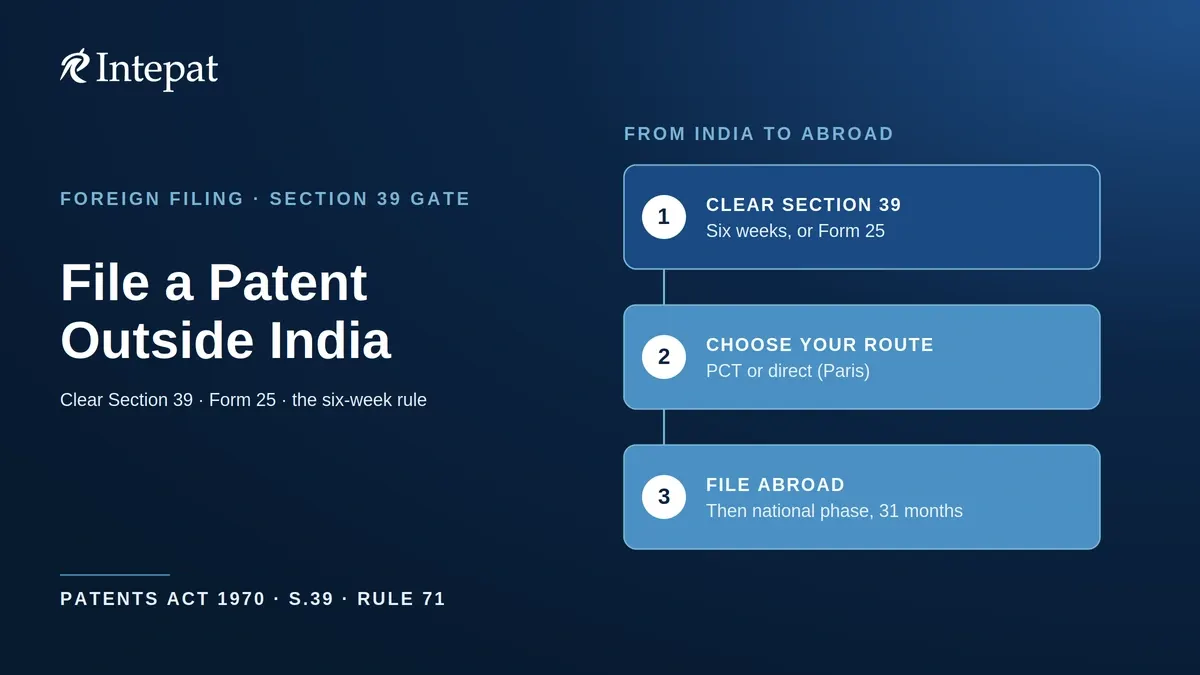
Section 39: the permission you need before filing abroad
Section 39 of the Patents Act 1970 is the first step in how to file patent outside India. It bars any person resident in India from making, or causing to be made, a patent application abroad unless one of two conditions is met: an application for the same invention has already been filed in India at least six weeks earlier, with no secrecy direction in force (none has been given under Section 35, or any that was given has been revoked), or the Controller has granted a written permit. There is no third way around it.
The permit route uses Form 25, filed with the prescribed official fee (Rs 1,600 for individuals, startups, and small entities, or Rs 8,000 for others, for e-filing, verified as of June 2026). The Controller disposes of the request within 21 days of filing, under Rule 71 of the Patents Rules 2003; our guide to the foreign filing licence in India covers the form and its conditions in full. Where the invention is relevant to defence or atomic energy, the Controller cannot grant the permit without the prior consent of the Central Government, and the 21-day clock then runs from the date that consent is received.
Two points commonly trip up applicants. First, since the 2005 amendment, Section 39 applies to inventions in every field, not only defence or atomic energy; the Madras High Court confirmed this reading in Selfdot Technologies v Controller General of Patents (2023). Second, the trigger is residence, not where the invention was made. Do not assume that an overseas employer or an overseas R&D location avoids Section 39: the question is whether a person resident in India made, or caused to be made, the foreign application. The Act does not define “resident,” so the analysis turns on the facts of each case.
The consequence of getting this wrong is severe. Under Section 40, an application made abroad in contravention of Section 39 is deemed abandoned in India, and any patent granted on it is liable to be revoked under Section 64. Section 118 adds criminal liability: imprisonment that may extend to two years, or a fine, or both. Section 39 does not apply where an invention was first filed abroad by a person resident outside India.
Route 1: File a PCT international application from India
The Patent Cooperation Treaty lets you file one international application that holds your filing date across all PCT contracting states, then defer the separate country-by-country filings. It does not grant a patent anywhere; it buys time and information before you commit to national prosecution. India has been a PCT contracting state since 1998, and the Indian Patent Office acts as Receiving Office (the office where the international application is filed), International Searching Authority (the office that searches the prior art and gives an opinion on patentability), International Preliminary Examining Authority, Designated Office, and Elected Office.
An Indian applicant can file the international application in one of two places. The first is the Indian Patent Office as Receiving Office, using the WIPO request form PCT/RO/101 through the ePCT portal or, offline, on paper. The Patent Office then transmits the application to WIPO’s International Bureau. The fees payable include the international filing fee, the search fee, and a transmittal fee that varies by Receiving Office. The second is the International Bureau directly. Either way, the Section 39 position must be cleared first: permission is needed where the international application is filed within six weeks of the Indian priority, or where it is filed directly with the International Bureau or the Indian Receiving Office without an Indian priority claim.
The international phase gives you an International Search Report and a written opinion on patentability, plus international publication at around 18 months from priority. You use that record to amend claims and to decide which markets justify the cost of prosecution in the national phase, the stage where each country examines the application under its own law. For the full mechanics, see our guides on how the PCT works for India and on filing a PCT application from India.
Route 2: File directly in each country under the Paris Convention
If you already know the handful of countries where you want protection, you can skip the PCT and file a direct national application in each, claiming priority from your Indian filing under the Paris Convention. The priority window is 12 months from the date of your first filing, your priority date. File in each target country within that year, and each office treats your application as if filed on that priority date for the purposes of novelty.
Section 39 still governs the timing. You either wait six weeks after the Indian filing, with no secrecy direction, or take a Form 25 permit before filing abroad. If you claim Indian priority, you also have to get a certified copy of the priority document to each foreign office on its own terms; under the PCT, the equivalent deadline for furnishing the priority document is 16 months from the priority date.
The direct route is usually simpler and cheaper when the country list is short and settled, because you avoid the PCT’s international fees. It becomes expensive and harder to manage as the list grows, since you prepare, translate, and prosecute a separate application in every country from the start, with no consolidated search to guide the spend.
Common sequence: file in India first, then go PCT or direct
Filing in India first is not a separate route to foreign protection; the PCT and direct Paris Convention filings are the two routes, and this is the sequence most applicants use to reach either one. It is the lowest-risk way to satisfy Section 39, because the Indian filing establishes the priority date and starts the six-week clock.
Here the timing rule does the work. If you want to file abroad sooner than six weeks after the Indian filing, you must take a Form 25 permit. If you can wait, then once six weeks have passed from the Indian filing date and the Patent Office has issued no secrecy direction in the meantime, you may file in one or more countries outside India without a permit. Either condition, the elapsed six weeks with no direction, or the granted permit, clears Section 39.
Filing in India first also preserves your full 12-month priority window for the foreign filings and, if you go the PCT route, your 31-month national phase window after that. The main thing to avoid is filing abroad in the first six weeks without the permit, which is exactly the contravention Section 40 penalises.
PCT or direct route: how to file patent outside India
The choice between the PCT and direct Paris Convention filings turns on how many countries you want, how settled that list is, and how much decision time you need. The table below maps the common situations.
| Factor | PCT route | Direct (Paris Convention) route |
| Number of target countries | Many, or not yet decided | Few, and already known |
| Decision window from priority | Up to 30 or 31 months | 12 months |
| Upfront cost | Higher (international filing and search fees) | Lower at first, multiplies per country |
| Prior-art read before you commit | Yes, via the International Search Report | No consolidated search |
| Speed to a national grant | Slower, an extra phase sits in front | Faster, straight into each national office |
In short, the PCT suits a wider or undecided market list where the extra time and the search report justify the upfront fee. The direct route suits a short, certain list where speed and lower initial cost matter more. For a deeper look at what the international phase delivers, see our note on the international phase versus the national phase. If India is among your target markets, the choice of search authority also matters, and designating the Indian Patent Office as your search authority can affect later examination.
Foreign patent filing deadlines from India
Foreign filing is deadline-driven, and most of the deadlines run from the priority date, not from any later filing. Missing one can forfeit rights that the invention’s merit cannot recover. The table below sets out the key periods. Verified as of June 2026; confirm each foreign deadline against the WIPO national phase time limits table for each designated country.
| Milestone | Period | Runs from |
| Foreign filing without a permit | At least 6 weeks after the Indian filing | Indian filing date (Section 39) |
| Form 25 permit disposal | 21 days | Date the request is filed (Rule 71) |
| File a PCT or convention application | 12 months | Priority date |
| Furnish the priority document (PCT) | 16 months | Priority date (PCT Rule 17.1) |
| International publication | About 18 months | Priority date |
| National phase entry, India | 31 months | Priority date (Rule 20) |
| National phase entry, other states | Usually 30 or 31 months | Priority date, varies by country |
A common error in older guides is to count the 31-month Indian national phase deadline from the PCT filing date. It runs from the priority date. Where India is entered through the national phase, the request for examination on Form 18 falls within the same 31-month frame, so the two are usually docketed together. For the Indian national phase steps in detail, see our guide on entering the Indian national phase.
| Worked example |
| An Indian provisional is filed on 1 January 2026. Foreign filing without a permit is usually possible from 12 February 2026, six weeks later, provided no secrecy direction has issued; otherwise a Form 25 permit is needed. The priority deadline for a PCT or direct filing is 1 January 2027 (12 months). If the PCT route is taken, India’s own national phase deadline is 1 August 2028 (31 months from the priority date). |
A pre-filing checklist before your application leaves India
Before any application goes abroad, four points decide whether the filing is clean.
- Section 39 cleared. Confirm either six weeks have passed since the Indian filing with no secrecy direction, or a Form 25 permit is in hand. File nothing abroad until one is true.
- Route chosen on the country list. Match the PCT or direct route to how many markets you want and how settled that list is, using the comparison above.
- Priority date docketed. Record the priority date and work every downstream deadline, 12 months, 16 months, 31 months, from it, not from any later filing.
- Current filing tool. Use WIPO’s ePCT portal for PCT applications; do not rely on PCT-SAFE, which WIPO retired in 2022.
Get the first point wrong and the foreign filings rest on shaky ground, because the Indian patent is exposed to abandonment and revocation. Get all four right and the foreign filing rests on a clean Indian foundation.
Frequently asked questions
Yes, unless you have already filed the same invention in India at least six weeks earlier with no secrecy direction in force. Otherwise, a person resident in India must obtain the Controller’s written permission on Form 25 under Section 39 of the Patents Act 1970 before filing abroad.
The application is treated as abandoned in India under Section 40, and any patent granted on it is liable to be revoked under Section 64. Section 118 adds criminal liability of imprisonment up to two years, or a fine, or both. The breach can therefore cost you the Indian patent.
The Controller disposes of a Form 25 request within 21 days of filing, under Rule 71 of the Patents Rules 2003. Where the invention relates to defence or atomic energy, the 21-day period runs from the date the Controller receives the Central Government’s consent, which can extend the overall timeline.
A PCT application enters the Indian national phase within 31 months from the earliest priority date, under Rule 20 of the Patents Rules 2003. The deadline runs from the priority date, not the international filing date. Indian law provides no general restoration once this period lapses.
Neither is better in the abstract. The PCT suits a wide or undecided list of countries, giving up to 30 or 31 months and a search report before you commit. Direct Paris Convention filing suits a short, settled list where lower upfront cost and faster national grant matter more.
Section 39 does not apply where the invention was first filed abroad by a person resident outside India. The control point is residence, not where the invention was made, and the Act does not define “resident,” so cases involving Indian residents working overseas should be assessed on their specific facts.
Yes, but only after clearing Section 39. File in India first and wait six weeks with no secrecy direction, or obtain a Form 25 permit. You can then file in the United States directly, claiming Paris Convention priority, or through a PCT application that later enters the US national phase.
No. The PCT does not grant a patent. A PCT application holds your filing date across its contracting states and defers the country-by-country decision, but a patent is granted only after you enter each country’s national phase and that office examines the application under its own law.
Missing the 12-month window means later filings can no longer claim priority from your first application, so intervening disclosures can defeat novelty. Restoration may be available within 14 months under PCT Rule 26bis.3, depending on the Receiving Office. See our guide on a missed 12-month PCT deadline.
This article explains the routes and statutory deadlines for filing patents outside India and is current as of June 2026. Statutory periods, official fees, and Patent Office and WIPO procedures change; verify every deadline against the Patents Act 1970, the Patents Rules 2003, and the WIPO time limits table for each designated country before acting. This is general information, not legal advice. Foreign filing decisions turn on facts specific to your invention and target markets. Consult a registered patent agent before you file.