




Section 10(4)(d)(ii)(D) of the Patents Act 1970 requires a complete specification to disclose the source and geographical origin of biological material used in an invention. Non-disclosure or wrong mention grounds pre-grant opposition, post-grant opposition, and revocation. Sub-clause (D) is distinct from the deposit mechanics in sub-clauses (A) to (C), though all four appear in the same proviso to Section 10(4)(d).
At a glance
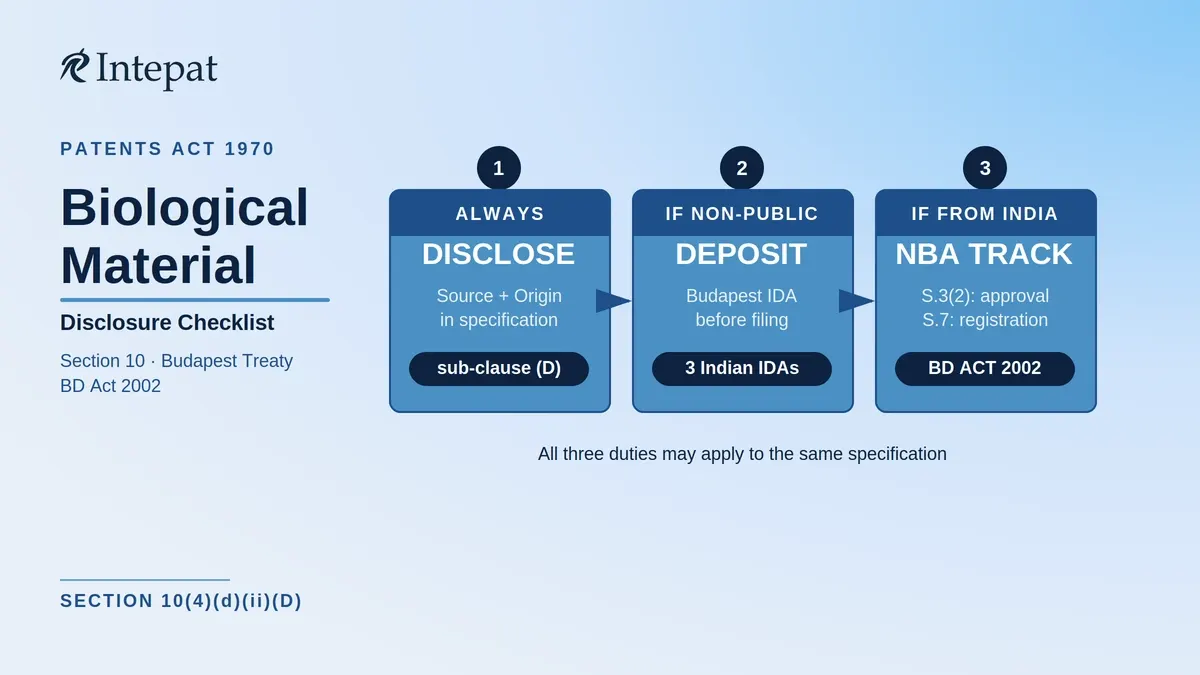
- Disclose the source and geographical origin of every biological material used in the invention, in the complete specification. This obligation applies whether or not a Budapest Treaty deposit is also required.
- A Budapest Treaty deposit at a recognised international depositary authority is required only when two conditions both apply: (1) the material cannot be described in a way that would satisfy Section 10(4)(a) and (b), and (2) the material is not available to the public. If both conditions are met, deposit on or before the Indian filing date at an internationally recognised depositary. India has three such depositories: MTCC in Chandigarh, MCC in Pune, and NAIMCC in Maunath Bhanjan (UP). Reference the deposit in the specification within three months of filing, or before any early-publication request under Rule 24A, whichever is sooner.
- After 1 April 2024, the Biological Diversity Act 2002 splits compliance into two tracks based on who the applicant is. Foreign persons, non-resident Indians, and Indian companies controlled by a foreigner (as defined under the Companies Act 2013) fall under Section 3(2) and need prior approval from the National Biodiversity Authority (NBA) before a patent is granted. Indian citizens and Indian companies not under foreign control fall under Section 7 and only need to register with the NBA before grant; NBA approval is reserved for the commercialisation stage.
- Failing to disclose source and geographical origin, or stating it incorrectly, can lead to an examination objection, refusal, opposition before or after grant, and revocation of a granted patent.
Which duties apply? Quick check
| Situation | What to do |
| You are using biological material in the invention | Record its source and geographical origin in the specification; complete the Form 1 biodiversity declaration |
| The material is not publicly available AND cannot be adequately described in words | Also deposit it at a Budapest Treaty depositary before filing; comply with the deposit rules in sub-clauses (A) to (C) |
| Publicly available cell line (e.g. from ATCC) | Disclose source and origin in the specification; a deposit is likely not required |
| Herbal formulation using Indian plants | Disclose source and origin for each ingredient; separately assess whether National Biodiversity Authority (NBA) approval or registration is needed, and address the traditional knowledge bar under Section 3(p) |
| Invention based on a biological resource obtained from India | Determine which NBA track applies based on your category; note that “obtained from India” (the BD Act trigger) and “geographical origin” (the specification trigger) are two different questions |
What Section 10(4)(d) requires
Section 10(4)(d) of the Patents Act 1970 governs the abstract of a complete specification and, through its proviso, introduces the biological-material regime. The proviso to sub-clause (d)(ii) applies when two conditions coexist: the material may not be described in a way that satisfies Section 10(4)(a) and (b), and the material is not available to the public. When both are met, the application must be completed by depositing the material at an international depository authority under the Budapest Treaty and satisfying sub-clauses (A) to (D).
Sub-clause (A) fixes deposit timing and the specification reference. Sub-clause (B) requires identification characteristics, depository name and address, and deposit date and number. Sub-clause (C) restricts public access until the Indian filing date, or the priority date if priority is claimed. Sub-clause (D) requires the specification to disclose the source and geographical origin of the biological material, when used in an invention.
Although sub-clause (D) appears within the same proviso as the Budapest deposit conditions, the Manual of Patent Office Practice and Procedure, examination practice, and the independent opposition and revocation grounds in Sections 25 and 64 justify treating source-and-origin disclosure as a stand-alone drafting and risk-control obligation whenever biological material is used in the invention. The Manual directs the examiner to verify source and geographical origin at the sufficiency-check stage wherever the invention relates to or uses biological material, whether or not a deposit is called for. Sections 25(1)(j), 25(2)(j), and 64(1)(p) refer to biological material “used for the invention” without conditioning on the deposit trigger.
Budapest Treaty deposit: three Indian depositaries and timing rules
The Budapest Treaty provides a single-deposit system: a deposit made at any recognised international depositary authority (IDA) stands as a valid deposit for the patent offices of all contracting states, subject to that IDA’s declared material scope. India acceded in 2001 and now has three IDAs: the Microbial Type Culture Collection and Gene Bank (MTCC) at Chandigarh; the Microbial Culture Collection (MCC) at Pune; and the National Agriculturally Important Microbial Culture Collection (NAIMCC) at Maunath Bhanjan, Uttar Pradesh, which acquired IDA status on 28 July 2020 by WIPO Notification No. 338. Not every IDA accepts every category of biological material; scope must be confirmed before filing.
Rule 13(8) of the Patents Rules 2003 requires the specification reference to the deposit within three months of the Indian filing date, or by the date of any early-publication request under Rule 24A, whichever is earlier. For PCT national-phase applicants, a Budapest deposit made outside India can generally support the Indian filing, but the IDA’s declared material scope, PCT Rule 13bis deposit indications, and compliance with Section 10 and Rule 13(8) must each be verified independently.
Source and geographical origin: what to disclose and how
Sub-clause (D) applies whenever biological material is used in the invention: plant material, animal material, cell lines, isolated genes, microbial strains, and traditional formulations all engage it, not only microorganism cases where a deposit is required.
Neither “source” nor “geographical origin” is defined in the Act. Conservative drafting practice separates two facts: (i) the immediate acquisition source, such as a supplier, culture collection, or repository; and (ii) the country and, where known, the region from which the material naturally originates. Record both separately for each material used. A blanket “the herbs are of Indian origin” statement may satisfy sub-clause (D) in some cases; it is likely to attract an objection where each herb has a distinct natural range or supplier.
An illustrative per-material entry (offered as an example, not a prescribed form):
- Biological material: [scientific name and strain]
- Immediate source: [supplier or repository name], accession number [number]
- Geographical origin: [country and, where known, region]
- Deposit information (where required): [IDA name], deposited [date], accession number [number]
Distinguish materials used in the invention from materials mentioned only as background or prior art. The disclosure duty attaches to what is used, not to what is merely cited. Failure to disclose can produce an objection at the First Examination Report stage and, if uncured, refusal under the Controller’s general power in Section 15.
Form 1 declaration and the National Biodiversity Authority regime
Two compliance layers outside Section 10 interact with it directly: Form 1 and the Biological Diversity Act 2002 (BD Act), which is administered by the National Biodiversity Authority (NBA).
Form 1.
Paragraph 12 of Form 1 contains a declaration that the invention uses biological material from India and that the necessary permission from the competent authority will be submitted before grant. An applicant using biological material from India completes the applicable declaration. This is a separate compliance duty from the Section 10(4)(d)(ii)(D) specification disclosure. The word “permission” in Form 1 should be read against the split Section 6 tracks now in force under the amended BD Act.
BD Act Section 6 after 1 April 2024.
The Biological Diversity (Amendment) Act 2023, notified on 18 January 2024 and in force from 1 April 2024, substituted Section 6 with a two-track regime keyed to applicant category. Section 3(2), as amended, covers non-citizens, non-resident Indians, and Indian bodies incorporated in India that are controlled by a foreigner within the meaning of clause (27) of Section 2 of the Companies Act 2013. Mere foreign shareholding no longer suffices; the test is control. Section 7 covers Indian citizens and Indian bodies that fall outside Section 3(2).
The trigger in both tracks is an invention based on research or information on a biological resource accessed from India, including a resource deposited in a repository outside India, or associated traditional knowledge. “Accessed from India” and “geographical origin” are distinct: a material with Indian geographical origin accessed abroad may fall outside the Section 6 trigger; a material of foreign geographical origin accessed from an Indian repository may fall within it.
| Applicant category | Before patent grant | At commercialisation |
| Section 3(2): foreign persons and foreign-controlled Indian companies | Prior NBA approval (Form 9) | Prior NBA approval |
| Section 7: Indian citizens and Indian-controlled companies | NBA registration (Form 8) | Prior NBA approval (Form 9) |
The Biological Diversity Rules 2024, notified 22 October 2024 and in force from expiry of sixty days from notification, superseded the 2004 Rules. The Biological Diversity Regulations 2025 (notified 29 April 2025) set benefit-sharing slabs and extend coverage to digital sequence information. The Biological Diversity (Amendment) Rules 2025 (effective 1 November 2025) substituted Rule 19 on certificates of origin for cultivated medicinal plants. The 2024 Rules supersede the 2004 Rules, subject to savings for things done or omitted before supersession. For pending NBA applications, verify the live NBA portal status and any specific NBA guidance before assuming the earlier procedure continues.
Verified as of July 2026.
Non-disclosure: opposition and revocation grounds
Section 25(1)(j) allows any person to file a pre-grant representation after publication and before grant on the ground that the specification does not disclose or wrongly mentions the source or geographical origin of biological material used for the invention. Section 25(2)(j) allows post-grant opposition within twelve months of publication of grant on the same ground, using the conjunctive: “the source and geographical origin.” Section 64(1)(p) is the revocation ground: the High Court may revoke on petition by any person interested or the Central Government, or on a counter-claim in an infringement suit. Section 64 does not prescribe a window equivalent to the twelve-month post-grant opposition period.
A textual point: Sections 25(1)(j) and 64(1)(p) use the disjunctive “source or geographical origin”; Section 25(2)(j) mirrors the conjunctive “source and geographical origin” in Section 10(4)(d)(ii)(D). Disclosing both facts fully is safer under any of the three grounds.
Judicial decisions: source disclosure and biodiversity compliance
Three decisions between 2018 and 2026 shape the practical picture.
Fraunhofer Gesellschaft zur Foerderung der angewandten Forschung v Controller General of Patents, Designs and Trade Marks (Calcutta High Court Intellectual Property Rights Division, appeal against refusal of patent application No. 202137013369, decided June 2026): The Court dismissed the appeal for insufficiency under Section 10(4)(a) and (b) and failure to disclose source and geographical origin under sub-clause (D). The Court also made a broad observation that deposit is required in every biological-material case. That wider observation should be read against the express two-part statutory trigger in the proviso. What Fraunhofer confirms is that sub-clause (D) applies wherever biological material is functionally used in the invention, even where not claimed.
Shaafi Naturcure LLP v Assistant Controller of Patents and Designs (Delhi High Court, 2026:DHC:5157, C.A.(COMM.IPD-PAT) 109/2022, decided 22 June 2026): Justice Tushar Rao Gedela dismissed an appeal against refusal of a herbal asthma composition on Sections 2(1)(ja), 3(p), and 10(4)(a) and (b) grounds. The applicant argued that an NBA agreement rendered the traditional knowledge exclusion under Section 3(p) unsustainable. The Court rejected that argument: NBA approval regulates access and benefit sharing; patentability under the Patents Act is a separate determination. Shaafi Naturcure is not a sub-clause (D) case; its practical lesson is that NBA compliance does not substitute for any patentability assessment.
Divya Pharmacy v Union of India (Uttarakhand High Court, 2018 SCC OnLine Utt 1035, decided 21 December 2018): pre-amendment authority establishing that Indian entities using Indian biological resources for commercial purposes are subject to benefit-sharing under the BD Act. The amended regime retains a Section 7 benefit-sharing obligation at commercialisation, but no post-amendment court has expressly applied Divya Pharmacy under the new provisions.
Verified as of July 2026.
Pre-filing checklist
1. Identify every biological material used, relied on, or necessary to perform the invention. Distinguish materials used from materials mentioned only as background or prior art.
2. For each material used, check whether a Budapest deposit is required. A deposit is only needed when both of the following are true: the material cannot be described in a way that would satisfy Section 10(4)(a) and (b), and the material is not publicly available. Both conditions must be met.
3. Where deposit is required, deposit at a Budapest IDA with scope covering the material class, on or before the Indian filing date. Reference the deposit in the specification under Rule 13(8) or by the Rule 24A request date.
4. Record sub-clause (B) particulars: depository name and address, deposit date, accession number. Confirm sub-clause (C) access restriction.
5. For every biological material used, disclose source and geographical origin in the description under sub-clause (D), per material.
6. Complete the applicable Form 1 paragraph 12 declaration. Read the word “permission” against the Section 6 tracks now in force.
7. Determine the Section 6 NBA track: Section 3(2) persons need prior approval before grant; Section 7 persons register before grant and obtain prior approval at commercialisation.
8. Distinguish “accessed from India” (the BD Act trigger) from “geographical origin” (the Section 10 trigger). Both analyses run on separate tracks.
9. Where traditional knowledge is involved, address the Section 3(p) patentability bar separately. NBA compliance does not cure a Section 3(p) objection.
Frequently asked questions
Under Section 10(4)(d)(ii)(D) of the Patents Act 1970, the complete specification must disclose the source and geographical origin of every biological material used in the invention. A Budapest deposit under sub-clauses (A) to (C) is additional and arises only where the material may not be described to satisfy Section 10(4)(a) and (b) and is not publicly available.
No. India has three IDAs: MTCC Chandigarh, MCC Pune, and NAIMCC Maunath Bhanjan. A deposit addresses sub-clause (A). Sub-clause (D) is a separate obligation requiring source and geographical origin to be disclosed in the specification text, and it applies whenever biological material is used in the invention, with or without a deposit.
An Indian citizen or Indian body not controlled by a foreigner within the meaning of clause (27) of Section 2 of the Companies Act 2013 registers with the NBA on Form 8 before grant. Section 3(2) persons (foreign persons and foreign-controlled Indian bodies) require prior NBA approval before grant. Neither track requires NBA action before the application is filed.
Yes. Section 64(1)(p) of the Patents Act 1970 permits the High Court, on a petition by any person interested or the Central Government, or on a counter-claim in an infringement suit, to revoke a patent on the ground that the specification does not disclose or wrongly mentions the source or geographical origin of biological material used for the invention.
By Senthil Kumar, Managing Partner, Intepat IP (Registered Patent Agent, IN/PA-1545).
Disclaimer.
This article provides general information on Indian patent practice and the Biological Diversity Act regime as at July 2026. The Biological Diversity (Amendment) Act 2023 provisions commenced on 1 April 2024; the Biological Diversity Rules 2024 came into force on 22 December 2024; the Biological Diversity Regulations 2025 were notified on 29 April 2025; the Biological Diversity (Amendment) Rules 2025 came into force on 1 November 2025. Practitioners who advised under the pre-April 2024 regime should re-verify current positions under the amended Act and Rules. Nothing in this article is legal advice for any specific matter.
Primary sources verified.
Patents Act 1970 (Sections 10, 25, 64) and Patents Rules 2003 (Rule 13(8), Rule 24A) via India Code; Form 1 via IP India; Biological Diversity Act 2002 as amended, Biological Diversity Rules 2024, Biological Diversity Regulations 2025, and Biological Diversity (Amendment) Rules 2025 via India Code and NBA portal; WIPO Budapest Treaty IDA notifications via WIPO; Fraunhofer and Shaafi Naturcure decisions via Indian Kanoon (official High Court copies preferred where available).