




Some founders lose a brand name they spent two years building because a competitor filed a trademark application first. The competitor did not copy the name. They simply filed before the founder did. Most founders know they should register their trademark. Almost none do it early enough.
Trademark registration for startups in India means filing your brand name, logo, or tagline with the Trade Marks Registry under the Trade Marks Act, 1999, securing exclusive rights in the selected class for 10 years, renewable indefinitely. The filing date is the legal moment your brand becomes yours. Everything before it is a risk. For what registration covers, what it does not, and how to select the right class, see the complete guide to trademark registration in India.
For DPIIT-recognised startups, the statutory e-filing fee is Rs. 4,500 per class, a 50% discount on the standard rate. Under the SIPP scheme, eligible startups pay nothing in professional fees. The Central Government bears that cost entirely. The only question is when to file. The answer is always: now.
Why Company Registration Does Not Protect Your Brand
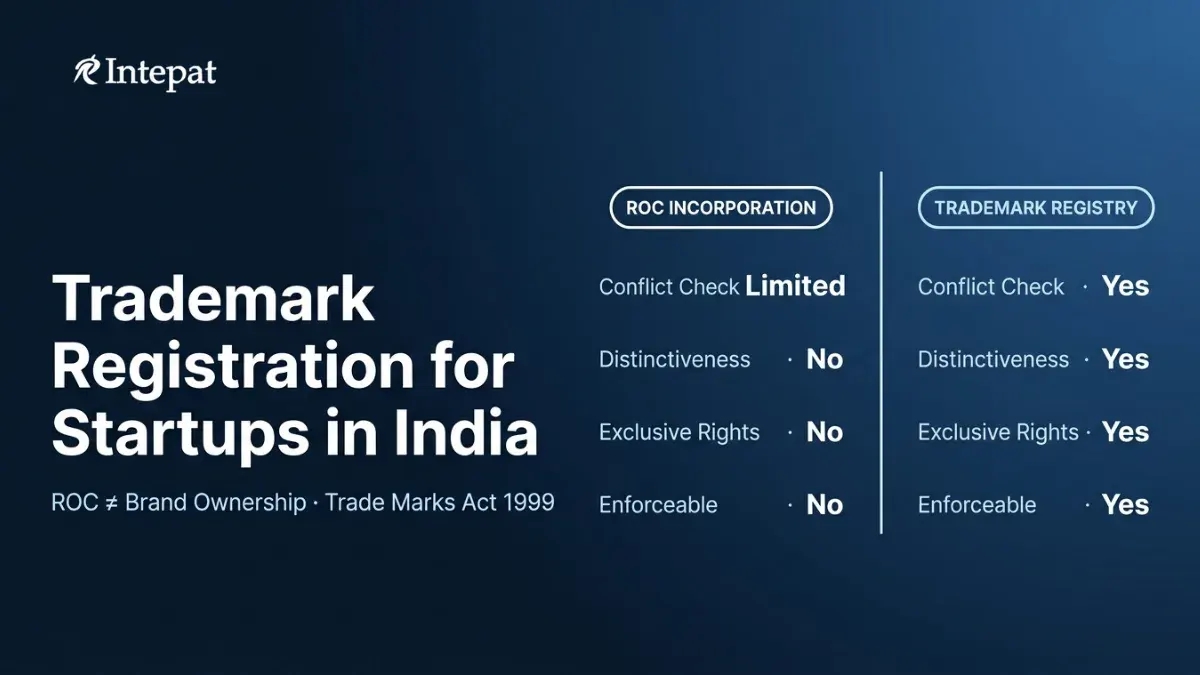
If your company is already incorporated and no trademark application has been filed, your brand is unprotected from the day you received your Certificate of Incorporation. The ROC gave you a company. It did not give you a brand.
Conflicting names sail through ROC approval regularly, because the ROC does not conduct the structured examination the Trade Marks Registry performs. Rule 8A of the Companies (Incorporation) Rules, 2014 requires the ROC to check proposed names against the trademark register, but in practice the check is a name-similarity screen, not a legal examination. The volume of Section 16 rectification proceedings under the Companies Act, 2013, which allow a trademark owner to force a company to change its name after incorporation, confirms the check fails more often than founders assume.
More fundamentally: passing the ROC check confers no intellectual property right. ROC approval does not assess whether your name is distinctive, does not grant exclusive commercial rights over it, and does not prevent a competitor from filing and registering the same name as their trademark while your company trades under it unprotected.
What the Trade Marks Registry does is materially different. Examination under Section 9 of the Trade Marks Act, 1999 tests whether the mark can distinguish your goods or services from others. Names that are laudatory (such as “Best”, “Super”, “Ultra”) or that describe what the product does (such as “Cloud Software” or “Online Delivery”) are refused outright. A company incorporated as “Best Cloud Software Private Limited” has a valid certificate and no enforceable brand rights. The ROC never flagged the problem because the ROC never checks for it. The ROC check is a conflict-avoidance screen, not a grant of intellectual property rights.
Your Priority Date: The Legal Moment Your Brand Becomes Yours
The filing date is the legal moment your brand becomes yours in law. When Form TM-A is submitted and the statutory fee paid, that date is recorded by the Trade Marks Registry. Every subsequent dispute traces back to it.
Trademark law rewards speed, not effort. This is the core principle behind trademark registration for startups in India: the date you file is the date your claim begins. Section 34 of the Trade Marks Act, 1999 does protect prior users against later registrants, but asserting that right means evidence, litigation, and uncertainty. A competitor who files your name during the window you left open secures the priority date advantage. No amount of marketing spend or customer recognition feels as good as simply owning the trademark from day one. Filing costs Rs. 4,500 per class for a DPIIT startup. The alternative is a rebrand after the brand has accrued real value: not just the financial cost in tens of lakhs, but the loss of the name the business was built around.
File the day the name is finalised. The priority date is locked on the date of filing. Every day without a filed application is a day the brand is legally unclaimed.
What Investors Check During Due Diligence
At Seed stage and above, investors check for a filed trademark as a standard due diligence item. An unregistered brand signals two things: the name may be legally vulnerable, and the founders have not treated their most visible asset seriously. That combination shifts negotiating leverage. Investors use IP gaps as a valuation protector, justifying lower valuations or holding funds pending filing. A startup that files early walks into due diligence with a clean data room and no leverage conceded.
What DPIIT-Recognised Startups Actually Pay
The statutory fee is governed by the Trade Marks Rules, 2017, First Schedule, Entry 1, paid per class at the time of filing Form TM-A. India records over 5.5 lakh trademark applications annually, with a growing share from startups and digital businesses (IP India Annual Report 2024-25). E-filing is the lower-cost route.
| Applicant category | E-filing fee (per class) | Physical filing fee (per class) |
| Individual / Startup (DPIIT) / MSME (Udyam) | Rs. 4,500 | Rs. 5,000 |
| Large entity (company / LLP without qualifying status) | Rs. 9,000 | Rs. 10,000 |
In eligible cases, the Government bears the professional fees under the SIPP scheme.
DPIIT-recognised startups filing through an empanelled facilitator, subject to DPIIT recognition and empanelled facilitator engagement, pay only the government statutory fee: Rs. 4,500 per class. No professional fees on top.
Intepat IP is an empanelled SIPP facilitator with experience across SaaS, D2C, fintech, and healthcare startup filings.
Example: two-class filing (Class 42 + Class 35) as a DPIIT startup via SIPP Statutory fees: 2 × Rs. 4,500 = Rs. 9,000 total Professional fees: Rs. 0 (Government bears this cost) Same filing for a large entity: Rs. 18,000 in statutory fees alone, plus professional fees.
DPIIT recognition must be in place at the time of engagement. Founders without it can still access the Rs. 4,500 rate immediately via Udyam Registration as an MSME. See Trademark Registration for MSMEs in India for that eligibility track. For the full fee schedule, see the trademark registration fees in India.
Which Classes to File In: Future-Proof Your Brand
Most startups require at least two classes: one for the core offering and one for commercial or distribution activity. Trademark rights are enforced class-wise; registration in one class does not automatically extend protection to others. Getting class selection right is one of the most consequential decisions in trademark registration for startups in India. The question is not which class covers where your business is today. It is which classes cover where it will operate in the next two to three years.
| Business model | File in | Add if expanding |
| SaaS / software | Class 42 | Class 35 if marketplace or e-commerce layer added |
| Fintech / payments | Class 36 + 42 | Class 35 for B2B sales platform |
| D2C / consumer brand | Product class (e.g. 25, 30) | Class 35 for retail or distribution services |
| Edtech | Class 41 | Class 42 if tech platform, Class 35 if marketplace |
| Healthtech / telemedicine | Class 44 | Class 42 for software platform |
| Communication / messaging | Class 38 | Class 42 for software, Class 35 if B2B |
Class 42 protects your technology. Class 35 protects your revenue channel.
The gap examiners see most often: a SaaS startup files Class 42 only, then adds a marketplace feature. A competitor files the same brand name in Class 35 for their storefront. That competitor is not infringing the Class 42 registration; they are operating legally under the startup’s name in the class left unprotected. The registered trademark does not stop them. At Rs. 4,500 per class for a DPIIT startup, adding Class 35 at filing costs less than a day of engineering time. Use the trademark class search to build the exact filing specification before submitting Form TM-A. For a full cost and strategy analysis, see single vs multi-class trademark filing in India.
When to File: One Rule, Three Triggers
The rule: file the day the brand name is finalised. The three triggers below are where delay becomes genuinely costly.
Before launch. The ideal window. Name decided, product in build, DPIIT recognition potentially available. Filing now means the priority date predates the first customer.
Before the first investor round. Light diligence at Pre-Seed will note the application number. At Seed, the absence of a trademark filing hands investors a valuation lever. File before they open the data room, not after they flag the gap.
Before Series A if not yet filed. File immediately and consider additional classes for brand extensions. Evaluate the Madrid Protocol (WIPO) for markets where the startup operates or plans to expand. At this stage the brand has accrued real commercial value; the cost of a forced rebrand is no longer theoretical.
The Post-Filing Process and Your Symbols
Once Form TM-A is filed and the statutory fee paid, the application enters the Trade Marks Registry examination pipeline. The examiner checks Section 9 absolute grounds and Section 11 relative grounds and issues an Examination Report, typically within 10 to 14 months, though timelines may vary depending on Registry workload. Applications that clear examination are published in the Trade Marks Journal for a 4-month opposition window. If no opposition is filed, or any opposition is decided in the applicant’s favour, the registration certificate is issued. End-to-end: approximately 18 to 24 months from filing to certificate. See the Trademark Registration Process in India guide for a full walkthrough.
Filing → Examination (10–14 months) → Publication → Opposition window (4 months) → Registration
| Stage | Symbol permitted | What it means |
| Application filed (1–3 working days for acknowledgement) | TM ™ | Immediate marketing win: brand is claimed and in process |
| Examination passed; published in Journal | TM ™ | Opposition window open; mark not yet registered |
| Registration certificate issued | ® | Mark registered; exclusive rights fully enforceable |
The TM symbol is the immediate win founders often overlook. Within 1 to 3 working days of filing, the acknowledgement is issued and TM can be placed next to the brand. That signals to customers, investors, and partners that the name is claimed and the process is in motion, while the 18 to 24 month registration completes in the background.
Using the ® symbol before the registration certificate is issued is a credibility risk with anyone who notices it, and a criminal offence under Section 107 of the Trade Marks Act, 1999, punishable by up to three years imprisonment or a fine. The TM symbol costs nothing and is available from day one.
Five Mistakes That Cost Founders Their Brand
1. Choosing a name that cannot be registered
Section 9(1)(b) of the Trade Marks Act, 1999 refuses marks that describe the kind, quality, or intended purpose of the goods or services. Laudatory names such as “Best”, “Super”, and “Premier” fail on Section 9(1)(a). The consequence: the application fails, the filing fee is lost, and the brand must be changed or the objection defended at a hearing. Run a search and consult the Section 9 and Section 11 grounds for refusal guide before committing to any name.
2. Treating ROC incorporation as brand protection
A third party can file your brand name as their trademark the day after your company is incorporated, and you will have no registered right to stop them. The ROC check is a conflict-avoidance screen, not a grant of intellectual property rights. Only a filing with the Trade Marks Registry creates exclusive brand ownership.
3. Filing in too few classes
Class 42 protects the technology. It does not protect the revenue channel. If the business model expands into marketplace, distribution, or e-commerce, a competitor can legally operate under the same name in Class 35 without infringing the Class 42 registration. The cost of adding a class at filing is Rs. 4,500. The cost of discovering the gap after a competitor has filed is a contested opposition or a forced co-existence.
4. Assuming a domain name equals a trademark
Owning yourname.com does not give any right over the name as a brand in commerce. Domain registration is administered by registrars under ICANN rules; trademark registration is a statutory right granted by the Trade Marks Registry. A competitor can hold a registered trademark over a name you have been using as a domain for years, and use it to challenge your online presence, advertising, and product listings. Register the trademark. The domain alone is not enough.
5. Using ® before registration is granted
Most founders who do this simply do not know the difference. But the ® symbol before registration is a credibility signal to investors and partners that something is not right, and a criminal liability under Section 107 for everyone. The TM symbol is available from the date of filing. Use it.
After Registration: Monitor What You Own
Registration is not the end. During the 4-month opposition window after journal publication, third parties can oppose any application that conflicts with a registered mark. After registration, rights are only as strong as the ability to detect and act on conflicting filings before the opposition deadline closes. A Trademark Watch service monitors the Trade Marks Journal and flags conflicts automatically.
Protect Your Startup Brand: What to Do Next
The brand name is the first thing every customer, investor, and partner sees. Filing a trademark application is the act that makes it legally yours. Trademark registration for startups in India is more accessible than at any previous point: a 50% fee discount for qualifying entities, government-paid professional fees under SIPP, and a clear path from filing to certificate. The window to act at the lowest cost is before launch, before the first investor, before the brand carries the weight of everything built so far.
Get a free availability check and class strategy before investing in branding. Intepat IP has handled trademark registration for startups in India across SaaS, D2C, fintech, and healthcare sectors.
The team will confirm availability, identify the right classes, and advise on the DPIIT or SIPP route. Response within 24 hours. No obligation. 100% confidential.
Legal disclaimer: This article is for informational purposes only and does not constitute legal advice. Fees and timelines reflect the position under the Trade Marks Rules, 2017 as of March 2026 and are subject to change. For advice specific to your situation, consult a registered trademark attorney.
Frequently Asked Questions
The day the brand name is finalised, ideally before launch. Every day before filing is a day the name is legally unclaimed.
Yes for the SIPP professional fee waiver. The Rs. 4,500 per class statutory rate also applies to individuals and MSME-registered entities under Udyam Registration, without requiring DPIIT recognition.
No. ROC approval is a company name check, not a brand ownership grant. It does not prevent a third party from registering the same name as a trademark. Only a filing with the Trade Marks Registry creates exclusive brand rights.
Yes. A word mark and a device mark (logo) are separate applications, each requiring Form TM-A and the applicable fee. Filing both protects the name in any font and the specific visual identity.
Approximately 18 to 24 months end-to-end under 2025 timelines, subject to Registry workload. The TM symbol is available from day one of filing. The ® symbol is permitted only after the registration certificate is issued.
Yes. An individual can file in their own name before the company exists. The application can be assigned to the company once incorporated. This is the fastest way to lock a priority date.
Yes, in certain circumstances. Two marks that are identical or similar can coexist if they are registered in different classes and the goods or services are sufficiently distinct that there is no likelihood of consumer confusion. However, if one mark is well-known under Section 11(2) of the Trade Marks Act, 1999, it can be enforced across classes regardless of overlap. This is why filing in the right classes from the outset matters: a competitor in a different class today may become a legal conflict as both businesses expand.