




You are ready to file a patent in India when you can describe your invention well enough that a person with ordinary skill in your field can reproduce it without guesswork. For a complete specification, the law requires a full and particular description and disclosure of the best method. For a provisional specification, the requirement is to describe the invention.
At a glance
- You can file a provisional specification while the invention is still being refined, provided you can describe it meaningfully as it stands.
- A complete specification must fully and particularly describe the invention, including the best method of performing it, at the time of filing.
- Public disclosure before filing will, in almost all cases, destroy novelty under Indian law. India has no general grace period; narrow statutory exceptions apply only in specific, conditioned circumstances.
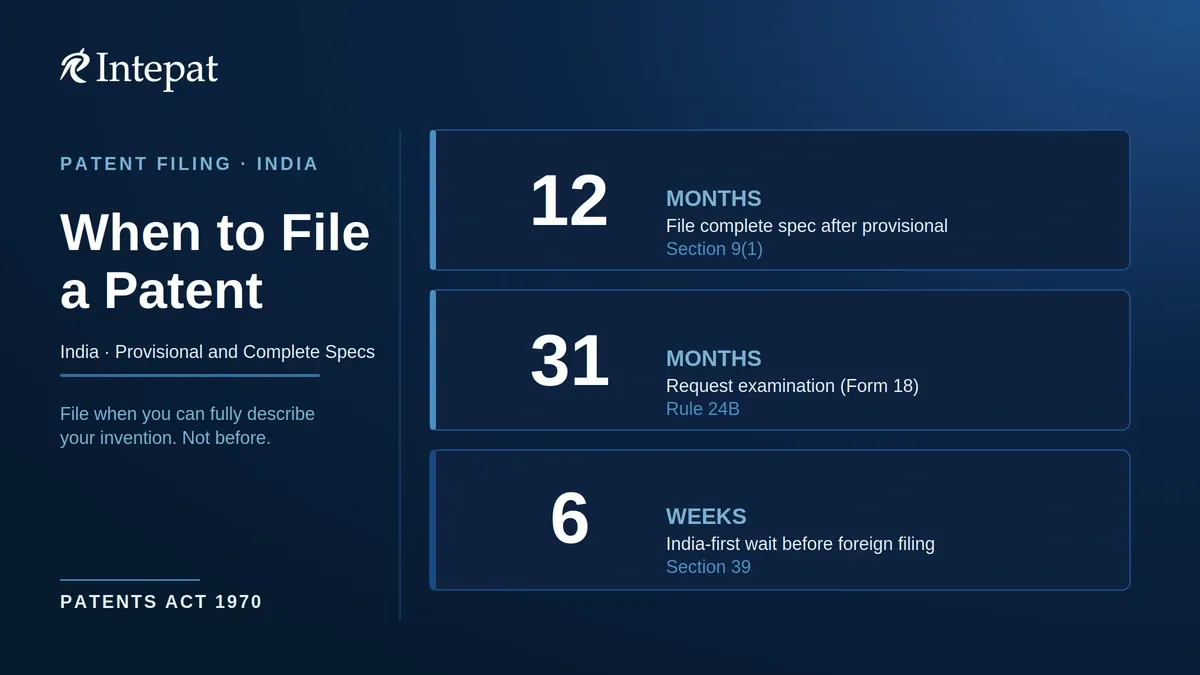
- If you plan to file abroad, Indian patent law requires you to file in India first and wait at least six weeks before making any foreign application, unless the Controller grants prior written permission.
What you need before you file a patent in India
A patent covers a “new product or process involving an inventive step and capable of industrial application.” Before the Indian Patent Office will examine an application, the specification attached to it must meet the disclosure standard the law sets.
For a complete specification, the Patents Act 1970 requires the document to “fully and particularly describe the invention and its operation or use and the method by which it is to be performed” and to “disclose the best method of performing the invention which is known to the applicant.” The claims must be “clear and succinct” and fairly based on what the specification discloses.
The practical readiness test follows from that requirement. If you can write, or instruct a patent agent to write, a description that enables a person of ordinary skill in your field to carry out your invention without needing to experiment extensively, you have reached the filing threshold. If significant unknowns remain in how your invention works or how it is to be reproduced, you have not yet reached that threshold, and filing now creates a specification that may be challenged or invalidated later on insufficiency grounds.
A prototype is not a legal requirement. What matters is descriptive completeness, not physical construction. Many inventions are patented before a working model exists, provided the specification can fully describe them.
Provisional or complete specification: which one fits your stage
When you file an application in India that is not a convention application and not a PCT application designating India, you may choose between two routes: file a complete specification immediately, or file a provisional specification now and a complete specification within twelve months.
The provisional route suits inventors who have a sufficiently developed conception of the invention to describe it meaningfully but need time to refine details, conduct testing, or finalise the best method before committing to a complete specification. The provisional specification must still describe the invention; it is not a placeholder or a mere sketch. Filing a provisional on scant information and expecting to fill in the gaps later is a common misconception worth correcting.
If you file a provisional specification and do not follow it with a complete specification within twelve months from the provisional filing date, the application is deemed abandoned under Section 9(1) of the Patents Act 1970. That deadline is strict and carries no extension. A complete specification filed after the provisional carries no additional government fee on the first 30 pages and the first 10 claims; page and claim excesses attract the standard per-sheet and per-claim charges (verified as of June 2026).
The complete-specification route is the right choice when you have enough information to write the full specification now. Your filing date under this route is your priority date, and you avoid the twelve-month deadline management that the provisional route requires. For most inventions where the working method is established, the direct complete-specification route is simpler.
One less-used option: a complete specification filed initially can be converted to a provisional specification, on the applicant’s request within twelve months of the filing date, if the Controller so directs, under Section 9(3) of the Patents Act 1970.
The following table summarises the better route by readiness stage.
| Your stage | Better route |
| Core conception is clear, but testing or refinement is still underway | File provisional specification now; file complete within 12 months |
| Working details and best method are fully established | File complete specification directly |
| Only a problem statement or business idea exists, with no technical solution | Wait; develop the technical disclosure before filing |
| Public disclosure is imminent | File at least a provisional specification before the disclosure |
For a full explanation of what a provisional specification must contain and how it differs from a complete specification, see our guide to provisional patent applications in India and our article on understanding patent specifications.
The public disclosure trap: India has no general grace period
This is the rule that catches most first-time inventors off guard. Under Indian patent law, the definition of “new invention” requires that the subject matter “has not been anticipated by publication in any document or used in the country or elsewhere in the world before the date of filing of patent application with complete specification.” In almost all cases, publication, public use, or any other form of public disclosure before you file destroys novelty and, with it, the right to a patent.
| Warning India does not have a general grace period for prior disclosures. If you present your invention at a conference, publish a paper, post a description online, or demonstrate it publicly before filing, your invention is no longer new in the legal sense. This applies even if the disclosure was your own. Under US patent law, for example, inventors generally have twelve months after their own disclosure to file; India provides no such window for most disclosures. |
The Patents Act 1970 recognises a narrow set of situations where a prior disclosure does not destroy novelty. Understanding what those situations are, and what they are not, matters for anyone planning a research presentation or product launch.
Disclosure without the inventor’s consent (Section 29): If your invention was published or disclosed by someone else without your consent, that disclosure does not count as anticipation, provided you apply for a patent as soon as reasonably practicable after you learn of it, and provided the invention was not commercially worked in India before the priority date.
Communication to the government (Section 30): Disclosing your invention to a government authority or a person authorised by the government to investigate it does not amount to anticipation.
Display at a notified exhibition or paper before a learned society (Section 31): If the Central Government has notified a particular industrial or other exhibition under Section 31, displaying your invention there does not constitute anticipation, provided you apply for a patent within twelve months of the opening of the exhibition. Similarly, reading a paper describing the invention before a learned society, or publishing it in that society’s transactions, does not constitute anticipation if you apply within twelve months of that reading or publication. This provision is narrow: the exhibition must have been specifically notified by the Central Government. A trade show or industry event that has not been so notified does not fall within Section 31.
To claim the Section 31 grace period, an application must be filed in Form 31 under Rule 29A of the Patents Rules 2003 (as amended), along with the prescribed fee. Do not assume that any exhibition or conference qualifies; the statutory conditions must be confirmed and the Form 31 application filed before relying on this exception.
Public working for reasonable trial (Section 32): If your invention was publicly worked in India within one year before the priority date for the purpose of reasonable trial only, and the public working was reasonably necessary given the nature of the invention, that working is not anticipation.
What Section 33 does for provisional filers: Once you file a provisional specification, any use or publication of the matter described in that specification, occurring after the provisional filing date, does not defeat the grant of a patent when the complete specification is filed. Section 33 of the Patents Act 1970 provides this protection explicitly. Filing a provisional promptly when your invention is sufficiently developed secures a priority date against later disclosures.
For a closer look at the Section 31 exhibition grace and Section 32 trial working provisions, see our article on the grace period under Section 31 of the Patents Act in India. For the novelty requirement in detail, see our article on decoding the requirement of novelty in patents.
| Need help before you disclose? Speak to a registered patent agent before any public presentation or product launch. Connect Now. |
If you plan to file abroad: the Section 39 obligation
If you are resident in India, Section 39 of the Patents Act 1970 restricts you from filing, or causing to be filed, a patent application outside India unless the statutory route is followed.
Section 39 of the Patents Act 1970 provides that no person resident in India may apply for a patent outside India unless an application for the same invention has first been made in India, not less than six weeks before the foreign application, and no secrecy direction under Section 35 is in force in relation to that Indian application (or any such direction has been revoked).
There is an alternative: the Controller may grant a written permit authorising a foreign filing before the six-week period has elapsed. The application for that permit is made in Form 25 under Rule 71(1) of the Patents Rules 2003.
The obligation under Section 39 applies to residents of India, regardless of nationality. A foreign national who resides in India is subject to the same requirement. The provision does not apply where the first patent application was made outside India by a person resident outside India.
Filing abroad without complying with Section 39, and without the Controller’s prior written permission, is a serious matter: the corresponding Indian application is deemed abandoned, and any Indian patent already granted shall be liable to revocation under Section 64 of the Patents Act 1970. Indian law does not itself revoke the foreign patent. If you are planning a multi-country filing strategy, consult a registered patent agent before filing anywhere.
For the procedural steps of filing in India, including the examination request deadline, see our guide to patent filing procedure in India. For the request for examination process and the 31-month deadline under Rule 24B, see our article on patent request for examination.
Filing costs: what to expect at the application stage
The government fee to file a patent application in India depends on the applicant category. The table below shows the e-filing rates from the First Schedule to the Patents Rules 2003 (verified as of June 2026).
| Applicant category | Base filing fee (e-filing) | Per sheet over 30 | Per claim over 10 |
| Natural person | Rs 1,600 | Rs 160 | Rs 320 |
| Startup / Small entity / Educational institution | Rs 1,600 | Rs 160 | Rs 320 |
| Company or other applicant | Rs 8,000 | Rs 800 | Rs 1,600 |
Natural persons qualify for the Rs 1,600 rate without needing to file Form 28. Startups, small entities, and educational institutions must accompany their application with a Form 28 declaration to claim the same concessional rate. If a concessional-category applicant later transfers the application to a general applicant, the difference in fees becomes payable at that point.
A complete specification filed after a provisional application carries no additional base filing fee on the first 30 pages and the first 10 claims; only page and claim excesses above those thresholds attract charges.
The request for examination (Form 18 under Rule 24B) must be filed within 31 months from the priority date or the filing date, whichever is earlier. The examination request fee is Rs 4,000 for a natural person or concessional-category applicant (e-filing) and Rs 20,000 for others. For applications filed before the commencement of the Patents (Amendment) Rules 2024, the earlier 48-month deadline applies under the transitional provision.
For a fee breakdown across all stages of prosecution, including renewal fees, see our patent fees and cost guide for India.
Frequently Asked Questions
Can I file a patent application in India before I build a prototype?
You can file a patent application in India without a prototype, provided your specification describes the invention fully enough that a person of ordinary skill in your field can reproduce it without undue experimentation. What the law requires is descriptive completeness, not a working model. If you cannot yet describe the invention in that detail, filing now risks producing a specification that may later be challenged as insufficient.
What happens if I disclose my invention before filing in India?
Disclosing your invention publicly before filing a patent application in India will, in almost all cases, destroy novelty and end your right to a patent. India does not provide a general grace period. The narrow exceptions under Sections 29 to 32 of the Patents Act 1970 are specific and conditional; they do not cover a general public disclosure such as a conference presentation, online post, or product launch.
Is a provisional specification a good option if I am still refining my invention?
A provisional specification can be an appropriate choice when you have a meaningful conception of the invention and want to secure a priority date while continuing development. It is not a placeholder for a half-formed idea. The specification must describe the invention even in provisional form. You then have twelve months from the provisional filing date to file a complete specification, failing which the application is deemed abandoned under Section 9(1) of the Patents Act 1970.
How long does a patent last in India?
A patent in India lasts twenty years from the date of filing of the patent application, as provided under Section 53(1) of the Patents Act 1970. Annual renewal fees are payable from the third year onwards, as set out in the First Schedule to the Patents Rules 2003. Failure to pay a renewal fee within the prescribed period causes the patent to lapse.
Do I need to file in India first before filing in other countries?
If you are resident in India, Section 39 of the Patents Act 1970 requires you to file a patent application in India first, and then wait at least six weeks before filing abroad, unless the Controller has granted prior written permission. Filing outside India without complying with this requirement means the Indian application is deemed abandoned under Section 40 and any Indian patent granted shall be liable to revocation under Section 64.
What information should I gather before approaching a patent agent?
Before consulting a patent agent, you should be able to articulate the problem your invention solves, how it solves it differently from existing options, how it works in enough detail to be replicated, and its potential commercial applications. For a structured way to document this, see our guide to the invention disclosure form, which sets out the information a patent agent will need to draft your specification.
This article explains the law on patent filing readiness in India as at June 2026 and is for general information only. It is not legal advice. Government fees, forms, and procedures change; confirm current figures with the Indian Patent Office before you file. For advice on your specific invention, consult a registered patent agent. Deadlines in this area are strict, and missing one can result in the loss of rights. The figures and timelines here are indicative and change; do not rely on them for a specific filing without confirming the current position.