




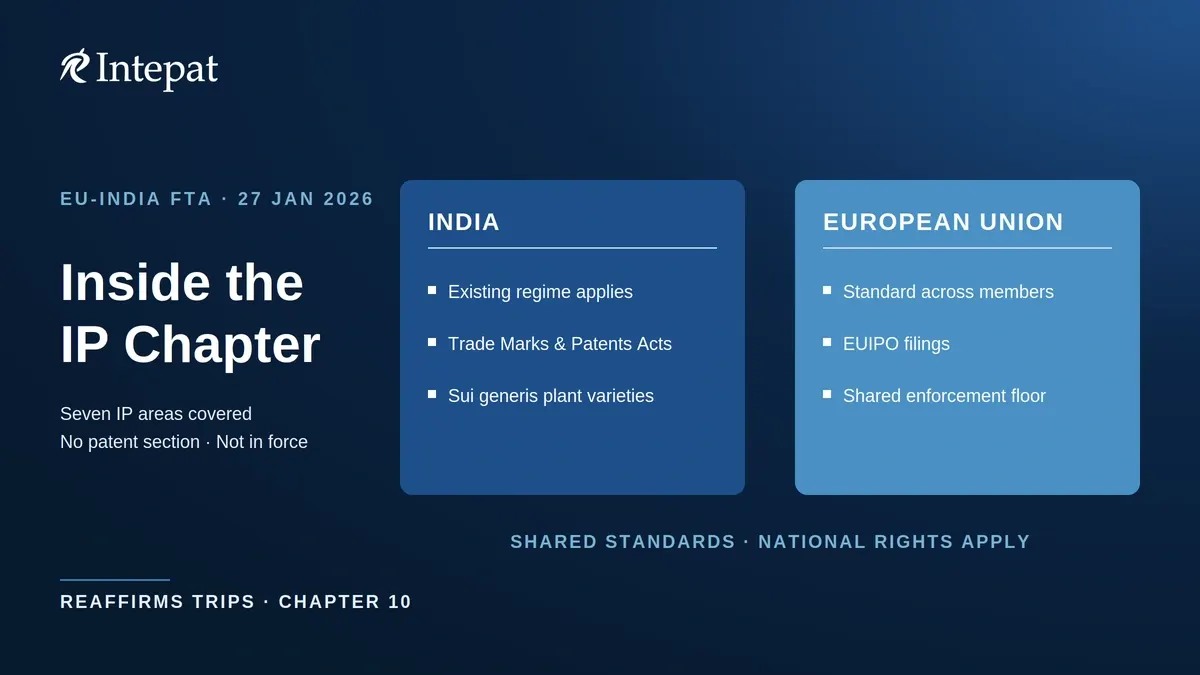
The intellectual property chapter of the EU-India Free Trade Agreement, concluded on 27 January 2026, sets shared standards for copyright, trademarks, geographical indications, industrial designs, undisclosed information, and plant varieties, plus border measures and enforcement. India has confirmed it needs no change to its IP laws and that no data exclusivity is imposed. The text is not yet in force.
Quick answer
- Negotiations concluded on 27 January 2026. The published text is for information, is subject to legal revision, and is not yet in force.
- The chapter covers copyright, trademarks, geographical indications, industrial designs, undisclosed information, plant varieties, and border measures and enforcement.
- India has stated the chapter requires no change to its IP laws and imposes no TRIPS-plus data exclusivity.
- There is no dedicated patent section. A single technology-transfer article sits in the general provisions.
- The agreement creates rights and obligations only between India and the EU, not directly for private businesses.
The EU-India FTA IP chapter is one part of a broad bilateral treaty between India and the European Union. The scope of this overview is comparative and international. The agreement sits alongside India’s domestic IP framework, the Trade Marks Act 1999, the Copyright Act 1957, the Designs Act 2000, and the Patents Act 1970, and does not replace any of them. For Indian businesses and foreign filers alike, that distinction is the starting point: the treaty sets standards between two governments, while the rights you register and enforce continue to come from national law.
What the EU-India FTA IP chapter covers
The chapter is built as a single framework for IP protection and enforcement. Its stated objectives are to support investment in innovation, strengthen creative and knowledge-based industries, combat piracy and counterfeiting, and help information, knowledge, and technology move more freely between the two markets. It reaffirms the WTO TRIPS Agreement as the baseline rather than rewriting it.
According to the Government of India, the chapter covers copyright, trademarks, geographical indications, industrial designs, undisclosed information, plant variety protection, and border measures and enforcement. It does not contain a dedicated patent section. Instead, a single article on technology transfer sits within the chapter’s general provisions. The table below maps each right to what the chapter does and to where India already provides protection.
| Right | What the chapter does | Where India already protects it |
| Copyright and related rights | Reaffirms TRIPS-level protection; supports creative and knowledge-based industries | Copyright and fair use |
| Trademarks | Protection and enforcement consistent with existing law | Trade Marks Act 1999 |
| Geographical indications | Included within the chapter’s scope | Geographical indication protection |
| Industrial designs | Protection consistent with the Designs Act 2000 | Industrial design registration |
| Undisclosed information (trade secrets) | Aligned with TRIPS Article 39; no dedicated statute required | Trade secrets and other tools |
| Plant varieties | Aligned with TRIPS Article 27(3)(b); no UPOV reference | Sui generis system (PPV&FR Act 2001) |
| Border measures and enforcement | Procedures, remedies, and customs measures both sides must provide | Indian courts and Customs |
Scope based on the Government of India FAQ on the agreement. Verified as of May 2026.
What the chapter does not do: no change to Indian IP law, no data exclusivity
For an Indian audience, the most useful point is what the chapter leaves untouched. The Government of India has stated there is no obligation under the chapter that requires India to change or modify any of its IP laws, because the provisions are consistent with India’s existing IP regime. In practice, the Trade Marks Act, the Copyright Act, the Designs Act, and the Patents Act continue to apply as they do today. India protects trade secrets through contract and the common law of confidence rather than a standalone statute, and the chapter’s undisclosed-information provisions, aligned with TRIPS Article 39, do not require that to change.
The chapter also does not impose TRIPS-plus data exclusivity. There is no obligation to grant exclusivity over the test data submitted for marketing authorisation of pharmaceutical and plant products, and the language retains the flexibility in Article 39.3 of the TRIPS Agreement. This is the provision earlier draft texts were criticised over, because data exclusivity can delay generic medicines independently of any patent. Its absence preserves the policy space India built into its patent law in 2005. (This is the EU agreement. A separate India-EFTA agreement involving Iceland, Liechtenstein, Norway, and Switzerland is sometimes confused with it.)
Two related safeguards follow the same pattern. The chapter does not restrict India’s right to grant compulsory licences for public health purposes, and its obligations are without prejudice to the flexibility in Article 44.2 of the TRIPS Agreement. For plant varieties, the chapter makes no reference to the UPOV Convention. Protection is aligned with Article 27(3)(b) of TRIPS, which lets a member protect plant varieties through patents, a sui generis system, or a combination, leaving India’s existing sui generis approach intact.
Enforcement: the procedures and remedies both sides commit to provide
Enforcement is where an IP chapter earns its place, and this one sets out the procedures, remedies, and measures each side must keep available, including border measures that let customs act against infringing goods. Combating piracy and counterfeiting is one of the chapter’s express objectives, and the reaffirmed international obligations are intended to hold both systems to a common standard.
A practitioner caveat matters here. The agreement does not create rights a business can enforce directly. The Government of India has confirmed that the treaty does not confer rights on private persons and cannot be invoked directly in domestic courts; its rights and obligations exist only between India and the EU. A brand owner facing infringement in India still sues under the Trade Marks Act or the Copyright Act before an Indian court, and a rights-holder in the EU still relies on EU and national procedures. What the chapter changes is the baseline both governments commit to maintain, not the route a company takes to enforce a right.
What it means for Indian businesses and for foreign filers
For Indian businesses and exporters
For an Indian company selling into the EU, the chapter signals a predictable and reasonably uniform standard of IP protection across the member states, which lowers the risk of a brand, design, or confidential process being copied in a key export market. The practical work does not change. You still secure your rights in each market: a trademark through national filing or the Madrid Protocol, a design through national or regional registration, and a mark in the EU through the EUIPO. Trade secrets carry across borders only as far as the contracts that protect them, because the chapter does not create an automatic cross-border right.
For foreign filers and EU rights-holders
For an EU business entering India, the message is continuity with a firmer floor. India’s regime continues to operate through the Patents Act 1970, the Trade Marks Act, the Designs Act, and the Copyright Act, and the chapter adds a shared commitment to enforcement and cooperation rather than a new set of Indian rights. The route in is the familiar one: file and enforce under Indian law, register product appearance as a design, and secure a geographical indication where a product’s origin carries value. The chapter makes the environment more predictable; it does not shortcut national registration.
When the EU-India FTA takes effect, and what to do now
The agreement is concluded but not yet in force. The text the European Commission has published is expressly for information and may still change through legal revision and scrubbing. Signature comes next, followed by each side’s internal procedures: on the EU side, approval by the Council and consent of the European Parliament; on the Indian side, approval through the Union Cabinet. The chapter enters into force on the first day of the second month after India and the EU exchange written notifications that those procedures are complete, and the agreement then runs for an indefinite term.
For a business, the practical answer is that nothing needs to wait for ratification, and nothing needs to be re-papered because of the treaty. The useful step is a familiar one: make sure the IP you rely on is already registered and enforceable in both markets under existing law, because the chapter works through those national systems rather than around them. Treating the agreement as a prompt to audit your cross-border IP, rather than as a new filing regime, is the right reading. The published text and the official FAQ are the sources to watch as the agreement moves toward signature.
Primary sources: the European Commission’s published EU-India agreement text (Chapter 10, Intellectual Property) and the Government of India’s official FAQ on the agreement. Both state the text is published for information and may change through legal revision.
Frequently asked questions
No. Negotiations concluded on 27 January 2026 and the text was published for information, subject to legal revision. It enters into force on the first day of the second month after India and the EU exchange notifications confirming their internal legal procedures are complete.
No. The Government of India has stated the IP chapter requires no change to Indian IP laws, because its provisions are consistent with India’s existing IP regime. The Trade Marks Act, Copyright Act, Designs Act, and Patents Act continue to apply unchanged.
No. The chapter imposes no obligation to implement TRIPS-plus data exclusivity for the test data submitted to obtain marketing authorisation for pharmaceutical and plant products. It retains the flexibility in Article 39.3 of the TRIPS Agreement, which preserves India’s policy space for affordable generic medicines.
It covers copyright and related rights, trademarks, geographical indications, industrial designs, undisclosed information, plant variety protection, and border measures and enforcement. It has no dedicated patent section, though a single article on technology transfer appears in the chapter’s general provisions, according to the Government of India.
Disclaimer
This article is general information, not legal advice. It reflects the EU-India Free Trade Agreement text published by the European Commission for information and the Government of India’s published FAQ, both of which state the text may change through legal revision and is not yet in force. Verified as of May 2026. For advice on protecting or enforcing IP in India or the EU, consult a qualified practitioner.