




India’s 2024 patent rules amendment made Form 3 significantly easier to manage. If your portfolio includes Indian patents with corresponding foreign filings, you no longer need to track and report every foreign prosecution event as it happens. The old rolling update system is gone. In its place is a simple framework: file once at application, update once at the First Examination Report, and respond within two months if the Controller asks for more. For most portfolios, that is a genuine improvement.
The simplification does come with one hard edge worth understanding clearly. Each of those deadlines has exactly one remedy if missed: Form 4, with a three-month cap. There is no fallback, no discretionary extension beyond that window, and no Rule 138 route. Miss the window and the gap stays on the prosecution record. This guide covers what the new framework requires, where the risks sit, and what your docketing system needs to reflect.
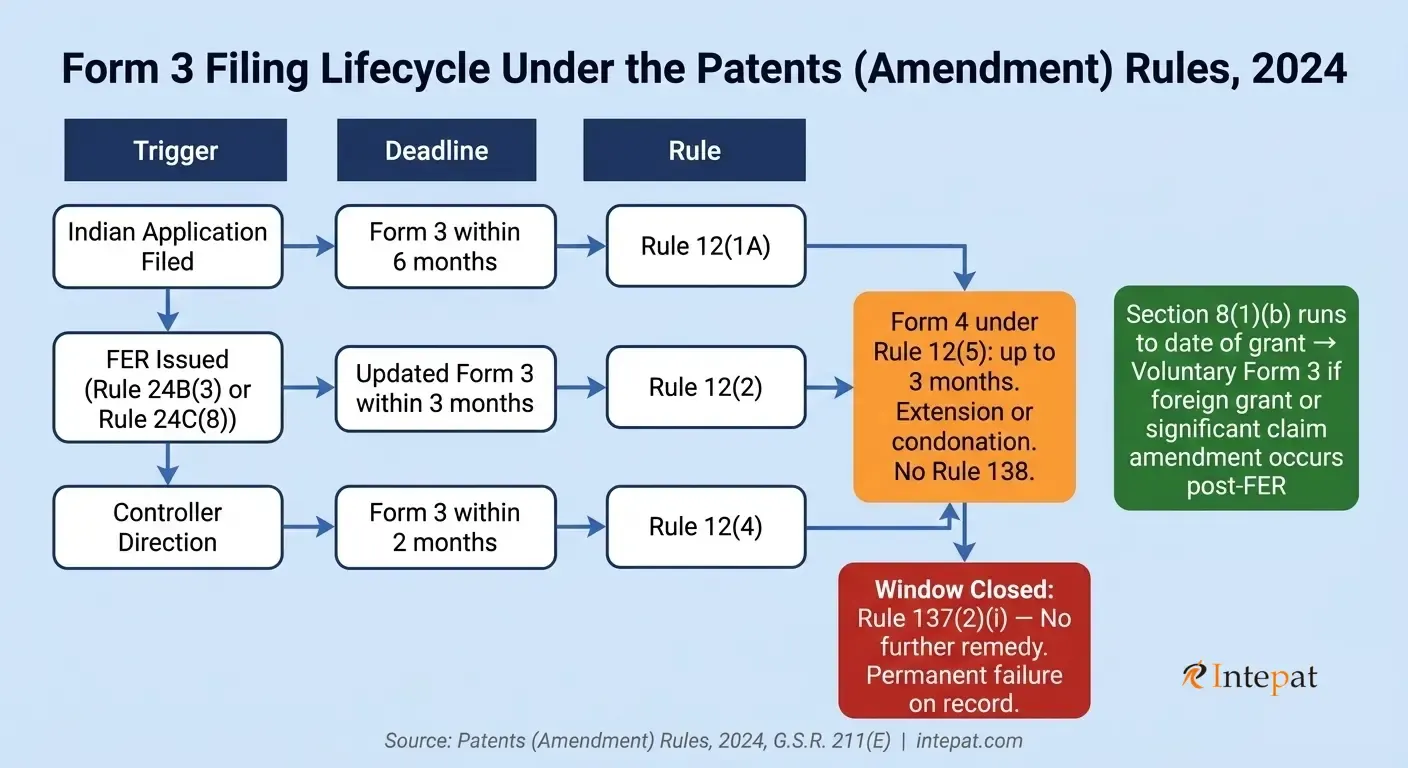
1. What Form 3 Is and Why It Matters
When you file a patent application in India and have counterpart filings abroad, India requires you to disclose those foreign applications to the Controller. That disclosure obligation runs from the date of your Indian filing all the way through to the date of grant. Form 3 is how you discharge it.
The 2024 amendment simplified how and when you file Form 3, but it did not reduce the scope of what must be disclosed. One point that catches many practitioners off guard: even after you submit your updated Form 3 at the FER stage, the obligation continues. If a foreign patent gets granted, a key claim gets allowed, or a significant amendment goes through after your FER response but before your Indian patent issues, you are still required to keep the Controller informed. Filing a voluntary Form 3 in that window is widely considered best practice to mitigate the risk of a later Section 8 challenge.
| Practitioner Action: The Post-FER Voluntary Form 3 Rule 12(2) establishes the FER-triggered milestone for filing the updated Form 3. Section 8(1)(b) of the Act continues until the date of grant. If a foreign grant, allowance, or significant claim amendment occurs after the FER response and before the Indian patent is granted, it is prudent to file a voluntary Form 3 promptly. No fee. No prescribed deadline. Proactive disclosure helps mitigate the risk that a post-grant opponent could invoke Section 64(1)(m) based on incomplete Section 8 disclosure. |
What Happens if You Do Not Comply
Getting Form 3 wrong is not a minor procedural issue. An incomplete or missing Form 3 provides a statutory ground to challenge a patent at three different stages:
- Before grant: Any person may file a pre-grant opposition on this ground from the date of publication until grant.
- After grant: Any person interested may file a post-grant opposition within twelve months from the date of grant publication.
- At any stage after grant: A revocation petition may be filed under Section 64(1)(m), which carries no statutory limitation period. This means the issue can arise even years after the patent has been granted and is being enforced.
In practice, Section 8 issues most often surface during examination, when the Controller may cross-verify the applicant’s disclosure against publicly available patent databases. Addressing the issue at that stage is far simpler than defending a post-grant challenge. For the complete revocation framework, see Patent Revocation in India: Section 64 Explained
| Law Update: Patents (Amendment) Rules, 2024 | Effective 15 March 2024 | G.S.R. 211(E) Rule 12(2): Rolling six-month updates replaced by a single consolidated Form 3 due within three months of the First Examination Report (FER). Rule 12(3): The Controller may access publicly available patent databases to verify corresponding foreign applications. Applicants are no longer required to routinely submit foreign prosecution documents unless specifically directed. Rule 12(4): Controller-directed Form 3 response window reduced to two months, with reasons to be recorded in writing. Rule 12(5): Exclusive procedural remedy for missed Form 3 deadlines. Form 4 may be used for extension before the deadline or condonation after it, up to a maximum of three months from the original deadline. Rule 138 is not available for Form 3 matters. Rule 137(2)(i): The general correction power under Rule 137(1) is expressly excluded for matters relating to Form 3. |
Form 3 Deadline Reference: Section 8 Compliance at a Glance
| Filing Event | Trigger | Deadline | Rule | Remedy if Missed (Form 4 only, max 3 months) |
|---|---|---|---|---|
| Initial Form 3 | Indian application filing date (or national phase entry date for PCT applications) | 6 months | Rule 12(1A) | Form 4 under Rule 12(5). Maximum 3 months from the missed deadline. Rule 138 not available. |
| Updated Form 3 | FER issuance under Rule 24B(3) or Rule 24C(8) | 3 months | Rule 12(2) | Form 4 under Rule 12(5). Maximum 3 months from the missed deadline. Rule 138 not available. |
| Controller-Directed Form 3 | Written direction under Rule 12(4) | 2 months | Rule 12(4) | Form 4 under Rule 12(5). Maximum 3 months from the missed deadline. Rule 138 not available. |
| All windows closed | 3 months from the missed deadline expired | — | Rule 137(2)(i) | No procedural remedy exists under the Rules. The failure remains on record and may support opposition or revocation arguments. |
Source: Patents Rules, 2003 as amended by G.S.R. 211(E), 15 March 2024. FER = First Examination Report. Rule 24B(3): ordinary national examination. Rule 24C(8): PCT national phase examination.
2. The Three Deadlines: When Form 3 Must Be Filed
At Application: Six Months from Filing
Your first Form 3 is due within six months of your Indian application filing date. For PCT national phase applications, that six-month clock starts from your national phase entry date in India, not your PCT international filing date. These two dates can be up to 30 months apart, so the distinction matters for docketing. See PCT National Phase India for national phase entry requirements and timelines.
There is no fee for filing Form 3. One common docketing error worth flagging: when filing a Form 4 extension request, the deadline rule to cite is Rule 12(1A), not Rule 12(1). Rule 12(1) designates the form only. Using the wrong rule citation on a Form 4 can cause procedural complications.
At the FER: Three Months from Issuance
This is the most significant change in the 2024 amendment. When your First Examination Report issues, you have three months to file a single consolidated Form 3 covering your entire corresponding foreign family. The three-month clock starts from the date of issuance of the FER, not the date you receive it. Under the old rules, you had to update Form 3 every time something happened with a foreign counterpart. That obligation is now replaced by this single consolidated update at the FER stage.
- Ordinary national prosecution: Your FER is issued under Rule 24B(3). The three-month clock starts from the date of that report.
- PCT national phase examination: Your FER is issued under Rule 24C(8). The trigger date is the same: date of issuance. For details on expedited examination, see Expedited Patent Examination in India: Rule 24C Guide.
You do not need to file any interim Form 3 updates between your initial filing and the FER, regardless of how many foreign applications are filed or amended in that period. The FER-triggered Form 3 captures everything in one go.
| Docketing the FER Deadline: What to Set Up Docket from the date of FER issuance, not receipt. Set an intermediate reminder at six weeks to begin assembling the updated foreign family record. The Controller may cross-verify your disclosure against publicly available patent databases. Any gap between what you disclose and what those databases show may generate a Section 8 objection during examination. If a running foreign family register has not been maintained during prosecution, the three-month FER window can become a tight turnaround to assemble the required information. Start the register at filing.. |
On Controller Direction: Two Months
At any point before your patent is granted or refused, the Controller can ask for a fresh Form 3. The direction must give reasons in writing and you have two months to respond, down from six months under the old rules. If you receive a direction without recorded reasons, that is worth querying before the two-month deadline expires.
These directions most commonly come up when the Controller’s database search has turned up foreign counterparts that are not reflected in your existing Form 3, or when prosecution outcomes in key jurisdictions raise questions about patentability.
3. If You Miss a Deadline: Your Only Option
If you miss any of the three Form 3 deadlines, you have one remedy: Form 4. That is it. There is no Rule 138 petition route for Form 3 matters. The window is three months maximum, and it covers both extending before the deadline and seeking condonation after it. Same form, same fee, same cap.
Filing Before the Deadline Passes
If you know you are going to miss an upcoming deadline, file Form 4 before it expires to request an extension of up to three months. No separate petition document is needed.
Filing After the Deadline Has Passed
If the deadline has already passed, file Form 4 as soon as possible for condonation of the delay. The Controller has discretion to grant or refuse, and a well-reasoned request filed promptly is more likely to succeed than one filed at the outer edge of the window. The maximum period available is three months from the date the original deadline expired. After that, there is nothing left to file.
| Critical: The 3-Month Hard Cap The maximum combined window for extension and condonation under Rule 12(5) is 3 months. Once that window closes, no procedural remedy remains under the Rules. The failure stays on record and may later be relied upon in opposition or revocation proceedings. There is no Rule 138 petition route for Form 3. Any docketing system or workflow that references Rule 138 for Form 3 matters must be corrected immediately. |
| Scenario: Missed Updated Form 3 Deadline: Remedies in Practice An independent inventor filed a patent in India in March 2024. His FER was issued on 10 November 2024. The updated Form 3 deadline was 10 February 2025. He missed it without filing Form 4. Position on 11 February 2025: The deadline has passed. The available remedy is Form 4 for condonation of delay. The maximum window is three months from the missed deadline, expiring 10 May 2025. Fee: Rs. 2,000 per month (individual, e-filing). One month of delay: Rs. 2,000. Two months: Rs. 4,000. If 10 May 2025 passes without a remedy: no further remedy is available under the Rules. The failure remains on record and may later support opposition or revocation arguments. |
4. What Goes Into Form 3 and What It Costs
Filling the Form
The same Form 3 is used for all three filing events: at application, at FER, and on Controller direction. The current prescribed form is available directly from the Indian Patent Office at ipindia.gov.in. Make sure you are using the current prescribed form: the new Form 3 has a ‘Date of disposal’ column rather than ‘Date of grant’, and includes a field for the Indian application number that was not in the old form. Filing on an outdated template can attract a procedural objection.
Form 3 must cover every application for the same or substantially the same invention filed anywhere in the world. That includes PCT applications and all derived national and regional phase entries, convention applications, divisionals, continuations, utility models, and any applications in the name of assignees or persons from whom the Indian applicant derives title. Applications that have lapsed, been abandoned, or been refused still need to be listed. Disposal does not remove the disclosure obligation.
| No. | Field | Entry | Key Note |
| 1 | Country | Jurisdiction of filing | List PCT application separately from each national/regional phase entry |
| 2 | Date of application | Actual filing date in that jurisdiction | For PCT, the international filing date under Article 11; for national phases, the actual entry date |
| 3 | Application No. | As assigned by the relevant office or WIPO | Include PCT application number separately from national/regional numbers |
| 4 | Status | Current prosecution status as of Form 3 filing date | Pending, under examination, allowed, granted, refused, abandoned, or withdrawn |
| 5 | Date of publication | Date of publication by the relevant foreign office | Leave blank if not yet published |
| 6 | Date of disposal | Changed from ‘Date of grant’ in the old form | Covers grant, refusal, abandonment, and withdrawal. Leave blank for pending applications. For revived applications, update status and note the revival. |
Source: New Form 3, Second Schedule, G.S.R. 211(E), 15 March 2024. Column 6 changed from ‘Date of grant’ in old Form 3. Item 2(i) in new form requires Indian application number, not present in the old form.
Fees
| Request | Form | Individual / Startup / MSME (e-filing, per month) | Other entities (e-filing, per month) | Physical filing | Rule |
| Filing Form 3 (initial, updated, or Controller-directed) | Form 3 | Nil | Nil | Nil | 12(1A), 12(2), 12(4) |
| Extension before deadline (per month) | Form 4 | Rs. 2,000 | Rs. 10,000 | +10% | 12(5) |
| Condonation after deadline (per month, max 3 months) | Form 4 | Rs. 2,000 | Rs. 10,000 | +10% | 12(5) |
Source: First Schedule, Table I, Entries 3 and 4(ii), G.S.R. 211(E), 15 March 2024. No separate petition fee for condonation. Same Form 4 and same fee schedule for both extension and condonation under Rule 12(5).
5. Compliance Checklist and What Goes Wrong
What to Docket at Each Stage
- At filing: Submit your initial Form 3 within 6 months of the Indian filing date. For PCT applications, that clock starts from national phase entry date in India, not the international filing date.
- At FER: Submit your updated Form 3 within 3 months of FER issuance. Docket from the issuance date, not receipt. Keep a live foreign family register throughout prosecution so you are not scrambling at FER stage.
- If you miss a deadline: File Form 4 immediately. Three months maximum from the missed deadline. No Rule 138. No separate petition.
- Between FER and grant: Check your foreign family for any grants, allowances, or significant amendments that occurred after your FER response. If anything material happened, file a voluntary Form 3. No fee, no deadline. This is the step most often overlooked and the one most often exploited in post-grant challenges.
- On Controller direction: You have two months from the date of the Controller’s communication. The old six-month parameter no longer applies.
What Commonly Goes Wrong
- Citing the wrong rule on Form 4: Rule 12(1) designates the prescribed form only. The operative deadline provision is Rule 12(1A). Incorrect citation in a Form 4 extension request can create avoidable procedural complications.
- Using the PCT international filing date for the initial Form 3 deadline: The six-month period runs from the national phase entry date in India, not from the PCT international filing date. These two dates may differ by up to 30 months.
- Applying the old six-month parameter to Controller directions: The response period under Rule 12(4) is now two months. Docketing systems not updated since March 2024 may still reflect the earlier six-month parameter.
- Incomplete family scope: Form 3 must cover every corresponding application worldwide, including divisionals, continuations, utility models, and applications that have lapsed, been abandoned, or refused. The Controller may cross-verify disclosures using publicly available patent databases, and omissions may trigger a Section 8 objection during examination.
- Using a non-prescribed Form 3 template.: The revised Form 3 replaces “Date of grant” with “Date of disposal” in column 6 and includes a field for the Indian application number, which was absent from the earlier form. Automated document generation systems should be updated accordingly.
Three Deadlines. One Exclusive Remedy. No Second Chances.
India’s 2024 amendment genuinely simplified Form 3 compliance. Three fixed deadlines replace the old rolling update system, and one consolidated Form 3 at the FER stage covers the entire foreign family. For most portfolios, that is less work and less risk of missing something.
The area that still catches practitioners out is the window between the FER response and the date of grant. The amendment simplified the filing mechanics, but the underlying obligation to keep the Controller informed runs right up to grant day. If a foreign patent issues or a significant claim amendment goes through in that window, a voluntary Form 3 costs nothing and closes a gap that a well-advised opponent would otherwise have available to them indefinitely.
For foreign counsel and Indian corporate IP teams, the practical actions are straightforward: update your docketing system to the three new deadlines, make sure your Form 3 templates are the current prescribed version, and build the post-FER foreign family review into your pre-grant workflow. For dedicated Indian patent prosecution support, see Patent Prosecution Services in India.
Managing an Indian patent portfolio with corresponding foreign filings? Intepat’s registered patent agents provide dedicated Form 3 compliance support. Contact us.
This article provides general information about Indian patent law and procedure as of the date of publication. It does not constitute legal advice and does not create an attorney-client relationship. Patent law is jurisdiction-specific and subject to change. For advice on your specific situation under Indian patent law, consult a registered patent agent or attorney qualified to practise in India.
Frequently Asked Questions
15 April 2025. The three-month clock runs from the date of FER issuance, not receipt. If you cannot meet that deadline, file Form 4 before 15 April 2025 for an extension. If 15 April 2025 has already passed, file Form 4 immediately for condonation. Hard outer limit: 15 July 2025. After that, no remedy remains.
Yes, and this is the point the 2024 amendment does not change. Filing your consolidated Form 3 at the FER stage discharges the FER-triggered obligation, but your duty to keep the Controller informed continues right up to the date of grant. If a foreign patent issues, a key claim gets allowed, or a significant amendment goes through after your FER response and before your Indian patent issues, file a voluntary Form 3 straight away. There is no fee and no prescribed deadline for a voluntary filing. Not filing leaves a gap on your prosecution record that a post-grant opponent can use, indefinitely.
No. Rule 138 is not available for Form 3 matters. Your only option is Form 4, which covers both extensions before the deadline and condonation after it. You have three months from the original deadline. No separate petition is needed. Once those three months are gone, there is no further remedy available.
The classification is based on the applicant’s status at the time of filing Form 4. Individuals, DPIIT-recognised startups, and qualifying MSMEs all pay Rs. 2,000 per month (e-filing). Other entities pay Rs. 10,000 per month. Physical filing adds 10% for all categories. See the fee table in Section 4 for the complete schedule.