




China follows a first-to-file trademark system: the right to a mark generally goes to whoever files first, not whoever used it first, meaning a stranger with no connection to a brand can legally register it in China before the actual owner does, and then stop that owner from using it there. Foreign applicants without a business address in mainland China must file through a CNIPA-recognised trademark agency; a mainland registration does not extend to Hong Kong, Macau, or Taiwan, which run separate registries. China’s Trademark Law was revised on 26 June 2026 and takes effect on 1 January 2027, tightening rules on bad-faith and non-use filings.
Mainland China means the customs territory administered by the People’s Republic of China’s central government, excluding Hong Kong, Macau, and Taiwan for trademark purposes. This article covers filing with the China National Intellectual Property Administration (CNIPA), the mainland trademark office.
Quick answer: what a foreign brand owner needs to know
China is predominantly first-to-file. Narrow statutory exceptions exist for prior use with “certain influence” (Article 32) and bad-faith filings by agents or distributors (Article 15), but both are evidence-heavy, not a substitute for early filing. A foreign applicant with no domicile or business establishment in mainland China must appoint a CNIPA-recognised agency; self-filing is not available to such applicants.
A CNIPA registration protects the mark only in mainland China, not Hong Kong, Macau, or Taiwan, each with its own registry. Brand owners active in China typically need more than one filing: the English or Latin-script mark, a Chinese-character mark, and, where used, a logo.
China’s Trademark Law was revised by the NPC Standing Committee on 26 June 2026 (Presidential Order No. 77) but is not yet in force: it takes effect 1 January 2027. Until then, the 2019 amendment governs.
Why an early filing strategy matters
Under the current law, registration, not use, is the primary basis for ownership within the registered scope, unlike use-based systems such as the United States. Unregistered use gets limited protection: except in narrow circumstances, a business without a Chinese registration cannot rely on its own prior use to stop a later applicant, and once a third party registers the mark, the original user’s continued use can expose it to an infringement claim, subject to one statutory defence below.
Four routes let a genuine owner challenge a conflicting filing, each fact-specific rather than a general prior-use defence: prior use with “certain influence” (Article 32); agent or representative bad faith (Article 15), the ground most often invoked where a Chinese partner files before a formal agreement exists; bad faith not intended for use (Article 4); and well-known mark protection (Article 13), assessed case by case.
Separately, Article 59(3) lets a party who already used an identical or similar mark, with “certain influence,” before the registrant’s filing date continue that use after the later mark registers, though the registrant may require a distinguishing sign. This defends continued use; it does not block or invalidate the later registration. Filing early removes the need to rely on any of these.
Who can apply
Chinese and foreign individuals, companies, and other legally constituted entities may apply. No local company is required. The material distinction is representation: under Article 18, a foreign applicant without a domicile or business establishment in mainland China must file through a CNIPA-recorded agency; self-filing is unavailable to such an applicant. This sits on top of the national-treatment obligation China owes foreign applicants under the Paris Convention and TRIPS; it is a procedural formality, not a barrier to eligibility. Foreign applicants can also designate China through the Madrid Protocol instead (compared below).
What to register: word marks, Chinese names, and logos
A single English-language filing rarely gives complete coverage. Chinese consumers, media, and platforms often refer to foreign brands by a Chinese-character name whether or not the owner has chosen one; an unclaimed name can be costly to reclaim once adopted by the market or filed by a third party.
The Chinese name falls into three distinct categories: transliteration (approximates pronunciation), translation (renders meaning), or an independently created name (unrelated in sound or meaning, chosen for distinctiveness). The choice is a marketing decision; the legal task is registering whichever name the business commits to before someone else does.
File a logo separately from word elements, since Chinese examination treats them distinctly. Article 8 also permits 3D marks, colour combinations, and sounds. Defensive filings covering adjacent classes are common, but the 2026 reform’s scrutiny of filings lacking genuine intent to use (below) has direct implications for how they should be structured.
Classification and the subclass system
China uses the 45-class Nice Classification but layers its own “similar group” (subclass) structure on top. CNIPA’s classification table is an important reference for assessing similarity, not the sole legal test; examiners and courts can in principle depart from it based on function, use, and trade custom. In the ordinary run of filings, though, goods in different subclasses of the same Nice class are treated as dissimilar, so registering “the class” does not secure the whole class, a common source of coverage gaps.
Non-standard specification terms are not prohibited: the Implementing Regulations let an applicant use a term outside the classification table provided it attaches an explanation, though a standard term carries a lower formality-query risk. Where CNIPA issues a partial refusal on a multi-class application, the applicant may divide out the approved classes within fifteen days.
Clearance searching
Search the transliteration, translation, and any independently created Chinese-character candidates, not just the Latin-script mark, and cover the relevant subclasses, not just the headline class. CNIPA’s databases, WIPO’s Global Brand Database, and TMview have a lag between filing and indexing, so a cleared mark can still be blocked by an unindexed application. Extend the search to company names, domain names, social handles, and e-commerce use, since a name already in commercial use elsewhere signals filing risk. No search guarantees a clean registration, though a structured clearance search narrows the risk before filing.
Documents required
Full legal name and address, nationality or place of incorporation, a clear mark reproduction, and a specification, ideally in standardised terms. Corporate applicants need an incorporation document with a Chinese translation where the original is foreign-language. A power of attorney is required to authorise the agency; under the Implementing Regulations, notarisation and authentication for a foreign applicant’s POA and supporting documents follow the principle of reciprocity between China and the applicant’s home country, so the requirement varies by jurisdiction and should be confirmed with the agency rather than assumed uniform.
Registration procedure
- Clearance search and filing strategy.
- Preparation and filing, electronically, in Chinese, through the agency for a foreign applicant.
- Formality examination.
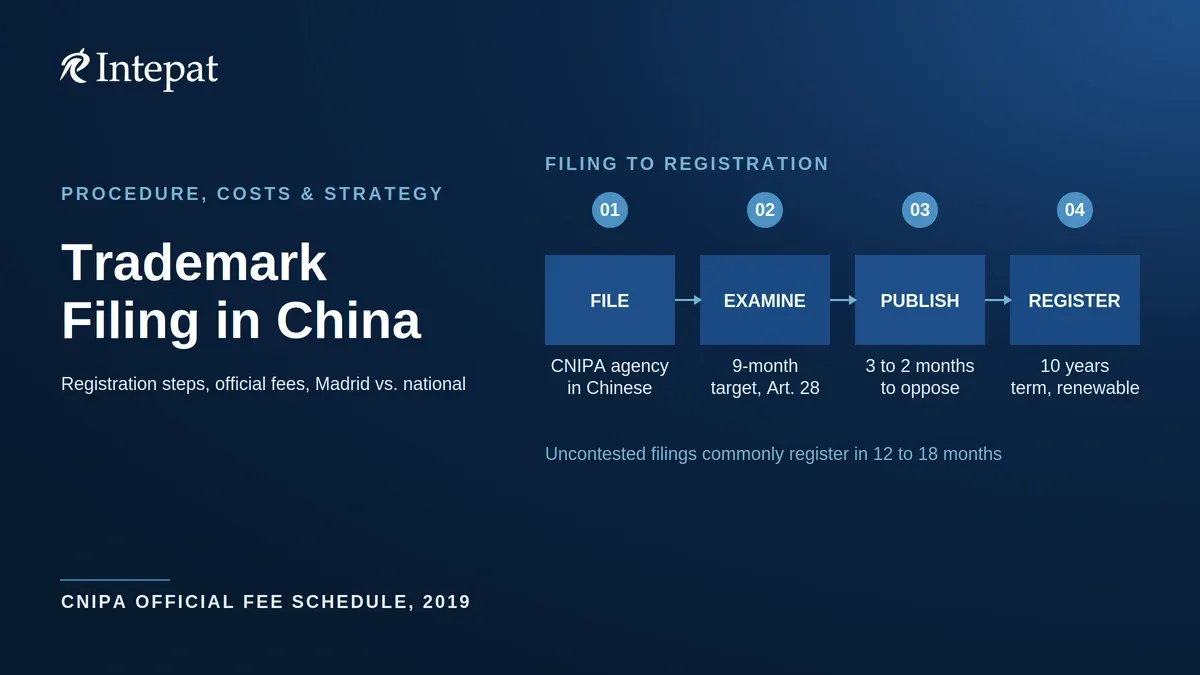
- Substantive examination against absolute grounds (distinctiveness, prohibited signs) and relative grounds (earlier marks). Article 28 sets a nine-month target for this step, not a guarantee of overall registration timing.
- Preliminary approval and publication in the CNIPA Trademark Gazette.
- Opposition period: three months from publication under current law (Article 33), shortening to two months once the 2026 reform is in force; decision target twelve months, extendable six (Article 35).
- Registration, for a ten-year term, if unopposed or the opposition resolves favourably.
- Post-registration monitoring and renewal.
Agencies commonly report an uncontested filing-to-registration period of roughly twelve to eighteen months; this is indicative, not a statutory figure, and contested applications take longer.
Grounds for refusal
Absolute grounds concern the mark itself: lack of distinctiveness, descriptiveness, deceptiveness, prohibited state symbols, or a broad “adverse effect on public order” ground. Relative grounds concern earlier rights: an earlier mark, or a prior copyright, trade name, personal name, or design right used without consent. Bad-faith applications are refusable at examination (Article 4) and challengeable after publication or registration (Articles 15, 32, 44, 45). Non-standard specifications are a frequent, avoidable objection ground. A refused applicant may seek review within fifteen days (Article 34), with further judicial review before Beijing’s specialised IP courts.
Opposition, invalidation, cancellation, and non-use
Opposition: any party on absolute grounds, a prior right holder or interested party on relative grounds, within three months of publication (two months once the 2026 reform is in force).
Invalidation splits into two tracks with different limits, and choosing the right one matters in practice, not just in theory. Article 44 (absolute grounds, fraud, or other improper means, including bad-faith squatting) has no fixed time limit. Article 45 (relative grounds, including agent bad faith under Article 15 and prior use with influence under Article 32) must ordinarily be brought within five years of registration; the only exception is a well-known mark owner challenging a malicious registration, not squatting generally. A genuine owner who discovers a squatted registration more than five years after it registered, and whose case rests on agent bad faith or prior use rather than fraud, may find the Article 45 route already time-barred; framing the same facts as fraud or improper means under Article 44 where the evidence supports it can matter more than which article “sounds right.”
Non-use cancellation: under Article 49, any party may apply after three consecutive years of non-use without justified reason. The registrant bears the burden of proving genuine use once challenged; token or fabricated use does not satisfy this. Defensive filings with no accompanying use are exposed once three years pass, an exposure sharpened by the 2026 reform’s scrutiny of filings lacking genuine intent to use.
Use evidence
Preserve evidence contemporaneously, since the burden falls on the registrant once challenged and the relevant window may have passed by the time it arrives. Useful evidence includes invoices and contracts referencing the mark, customs records, dated advertising, e-commerce listings, packaging and photographs, exhibition materials, licence records, and Chinese-language materials where the business markets in Chinese. A licence not recorded with CNIPA remains valid between the parties but cannot be asserted against a bona fide third party; recording it removes that exposure. An assignment takes legal effect from CNIPA’s approval and announcement date, not the private agreement date.
National filing versus Madrid Protocol designation
China acceded to Madrid effective 1 December 1995. Neither route is categorically superior.
| Factor | Direct national filing | Madrid designation |
| Prerequisite | None | Requires a basic home application/registration |
| Language | Chinese from the outset | English, French, or Spanish at filing |
| Dependency | None | 5-year central-attack dependency on the home mark |
| CNIPA examination | Same standards | Same; a refusal still needs a China-based agency to respond |
| Cost efficiency | None | Efficient across several Madrid members from one filing |
Where China is the primary target, or the home mark faces active challenge, a direct filing avoids the central-attack risk. CNIPA applies the same subclass and specification practice either way. For a broader comparison of Madrid Protocol designation against direct national filing, see Intepat’s Madrid Protocol vs direct filing guide.
Costs
Figures reflect CNIPA’s official schedule, in effect since 1 July 2019 (NDRC-Pricing Document No. 914), verified current as of November 2025. Non-use cancellation and invalidation sit in different fee categories: cancellation is a Trademark Office matter at the lower rate; invalidation is a Trademark Review and Adjudication matter at the higher rate.
| Fee item | Electronic | Paper |
| Application, per class (up to 10 items) | RMB 270 | RMB 300 |
| Extra item surcharge | RMB 27 | RMB 30 |
| Opposition | RMB 450 | RMB 500 |
| Revocation / non-use cancellation | RMB 450 | RMB 500 |
| Invalidation / review proceedings | RMB 675 | RMB 750 |
| Renewal, per class | RMB 450 | RMB 500 |
Total cost also includes agency professional fees (scope-dependent), search fees, translation and naming costs, and separate fees for any opposition, review, or enforcement action; official fees above are typically the smaller share of total spend once agency and translation costs are added. Intepat’s own fees depend on the number of marks, classes, and subclasses actually filed, so a firm quote follows a short scope review rather than a generic price list.
Registration term and renewal
Ten years from registration. Renew within twelve months before expiry; a missed window carries a six-month grace period. Under the current law (Article 50, 2019 numbering), CNIPA is barred from approving an identical or similar mark for identical or similar goods for one year after a mark lapses through non-renewal, revocation, or invalidation, so it is not immediately free for a third party to take. The 2026 revision narrows this specifically to voluntary cancellation by the registrant, carried under a renumbered provision in the revised law; revocation, invalidation, and non-renewal are not carried into the revised bar in the same combined form, so this is a restructuring, not a brand-new restriction. Article numbers in this piece follow current 2019 numbering unless marked “revised,” since several provisions are renumbered in the version taking effect 1 January 2027. No fresh use evidence is required at renewal itself, though the mark stays separately exposed to non-use cancellation. Assignment, licence recordal, and name/address changes are three distinct mechanisms with different legal effect (see Use Evidence above for assignment and licensing).
Hong Kong, Macau, and Taiwan
No, a CNIPA registration does not cover them. Each operates its own registry: Hong Kong’s Intellectual Property Department under the Trade Marks Ordinance, Macau’s Economic and Technological Development Bureau under its own regime, and the Taiwan Intellectual Property Office under Taiwan’s own Trademark Act. A business trading in any of these needs a separate filing there.
Enforcement
Administrative enforcement (local Administrations for Market Regulation) is faster and lower-cost than litigation but does not award damages. Civil litigation, through China’s specialised IP courts, can yield injunctions and damages, including punitive damages for bad faith. Customs recordal lets officers detain suspected infringing goods at the border. Criminal enforcement applies to serious counterfeiting meeting judicially-set thresholds. Online marketplace complaints proceed under a notice-and-takedown framework. A cease-and-desist letter, backed by evidence preservation, is often the first practical step.
The 2026 Trademark Law reform
Status. Enacted 26 June 2026 (Presidential Order No. 77), not yet in force. Effective 1 January 2027; the 2019 law governs until then.
Genuine intent to use. Revised Article 19 sets a conjunctive test: an application is rejected only where it is both not for the purpose of use and obviously exceeds normal business needs, not either condition alone, a meaningfully narrower standard than a plain reading of “intent to use or excessive filing” would suggest. The practical reason is to target large-volume speculative and squatting filers without sweeping in a legitimate brand running an ordinary defensive filing programme. Whether CNIPA applies it narrowly in practice, or reads “obviously exceeds normal business needs” broadly enough to catch a wider range of defensive filing, depends on implementing guidance not yet published, so the real-world scope is genuinely open. Action now: tie filings to an actual or near-term business plan and keep the file showing why each class was chosen, so a broad-filing owner has a ready answer if CNIPA reads the standard more broadly than the enacted text alone requires.
Bad-faith and misleading-use penalties are separate provisions. Article 54 addresses bad-faith registration conduct that “causes adverse effects” (undefined in the text, and likely to be shaped by early CNIPA decisions rather than the statute itself), with a warning and a fine up to RMB 100,000. Article 56 addresses misleading use of an already-registered mark, a post-registration offence, with a fine up to five times illegal turnover (capped at RMB 250,000 where turnover is under RMB 50,000). Treating these as one undifferentiated “bad-faith penalty” risks assuming a filing-stage risk applies to ordinary post-registration marketing conduct, or vice versa; they trigger on different conduct, at different stages, enforced against different actors.
One-year re-filing bar narrows, it isn’t new. Current Article 50 already bars re-filing for one year after revocation, invalidation, or non-renewal. The revised provision narrows this to voluntary cancellation only.
Opposition period shortens from three months to two. Reassess trademark-watch cadence accordingly.
Agency conduct rules tighten, including employee registration and bars on assisting bad-faith filings.
Well-known marks are addressed across Articles 21, 63, and 69 together; Article 69 lets CNIPA confirm well-known status for use in overseas proceedings, and on its face is not limited to Chinese-owned marks, though how this will work in practice for foreign rights holders is unsettled.
New sign types: dynamic (motion) marks are added, with the functionality exclusion extended to colour, sound, and dynamic marks.
Not confirmed in the enacted text: a discrete mechanism transferring a bad-faith registration to the genuine owner, a coexistence-agreement procedure, and numeric filing caps. CNIPA must prescribe implementing rules for its new ex officio revocation power, but no publication date is stated in the law itself.
Practical filing strategy
- File before market entry, trade shows, distributor appointment, or launch, in both English and Chinese-character form.
- File in the name of the entity that actually owns the IP, never a distributor or manufacturing partner.
- Put a written licence or distribution agreement in place before a partner uses the mark.
- Map classes and subclasses to real business activity, given the 2026 reform’s scrutiny of over-broad filing.
- Consider customs recordal where counterfeiting risk is realistic.
- Monitor the Trademark Gazette, watching the opposition window shrink to two months once the reform is in force.
- Preserve use evidence continuously.
- Assess Hong Kong, Macau, and Taiwan separately.
Common mistakes
- Relying on a non-China registration without a China filing.
- Filing only the English mark and leaving the Chinese name to the market.
- Ignoring the subclass system and assuming a class-level filing covers the whole class.
- Appointing a distributor as registered owner instead of the actual IP owner.
- Delaying filing until launch, trade show, or distributor appointment.
- Filing excessive defensive marks with no accompanying use strategy.
- Using non-standardised specification terms without the required explanation.
- Not monitoring the Trademark Gazette for third-party filings.
- Not preserving use evidence contemporaneously.
- Assuming mainland coverage extends to Hong Kong, Macau, or Taiwan.
Frequently asked questions
Generally no, except for goods where a law or regulation specifically requires a registered trademark (Article 6). Otherwise an unregistered mark gets very limited protection under the first-to-file system, so registration is not compulsory but is, practically, necessary for enforceable rights.
Yes, directly through a China-based agency (mandatory absent a mainland business establishment), or via Madrid Protocol designation from an existing Indian application or registration.
Only narrowly: where the prior use gained “certain influence” (Article 32), or the later applicant is an agent or business contact acting in bad faith (Article 15). Article 59(3) separately lets a genuine prior user with “certain influence” continue using the mark after a later registration, subject to adding a distinguishing sign if asked.
CNIPA targets nine months for substantive examination (Article 28). Including the opposition window (three months now, two once the reform is in force), an uncontested filing commonly registers in roughly twelve to eighteen months; indicative, not statutory, and contested cases take longer.
The official application fee, verified as of November 2025, is RMB 270 per class electronically (RMB 300 paper), covering up to ten items, plus agency fees that vary with scope.
In most cases yes: an unclaimed name may be adopted informally by distributors, media, or consumers, and can be costly to reclaim later.
Sometimes, and the route matters: fraud or improper means under Article 44 carries no time limit, while agent bad faith or prior use under Article 45 must ordinarily be brought within five years of registration. Filing early remains more reliable than recovering afterward.
No. Hong Kong has its own registry under its own Trade Marks Ordinance.
Yes, under Article 49, after three consecutive years of non-use without justified reason, with the burden on the registrant to prove use once challenged.
Neither categorically. Madrid suits designating several countries from one filing; direct filing avoids the five-year central-attack dependency, useful where China is the primary target or the home mark is under challenge.
CNIPA divides Nice classes into subclasses treated as presumptively dissimilar in the ordinary run of examination, though the classification table is a reference rather than an absolute rule. A class-level filing does not secure the whole class.
Legal name and address, translated incorporation or identity documents, a mark reproduction, a specification, and a power of attorney; notarisation follows a reciprocity principle that varies by jurisdiction, so confirm with the agency.
Article 19’s conjunctive test (not for use, and obviously exceeding normal business needs) raises the practical bar for broad, speculative filing, since large volumes of unused filings are the pattern most likely to satisfy both conditions. Filings tied to a genuine business plan remain viable.
Ten years from the registration date, renewable within twelve months before expiry (six-month grace period if missed). Renewal itself needs no fresh use evidence, though the mark stays separately exposed to non-use cancellation between renewals.
Search CNIPA’s own database, WIPO’s Global Brand Database, and TMview, covering the transliteration, translation, and any Chinese-character candidate, not just the Latin-script mark. Filing and indexing lag means no search is a guarantee; it narrows risk rather than eliminating it.
Registering in China is not a matter of replicating a foreign portfolio and adding a China designation. The first-to-file system, the subclass structure, and the Chinese-character decision all call for filing choices made specifically for China, made early, in the name of the entity that actually owns the brand.
Intepat IP assists with China trademark clearance searches, national and Madrid filing strategy, Chinese-character mark strategy, opposition and refusal-response coordination through local associates, portfolio reviews ahead of the 2026 reform, and customs and enforcement coordination. Whether the immediate need is filing before a trade show, choosing a Chinese-character name, or auditing an existing portfolio for 2026-reform exposure, contact Intepat IP to scope a China filing strategy for your business.
This article is for general informational purposes and does not constitute legal advice. Trademark law, official fees, and CNIPA practice, particularly around the 2026 reform’s 1 January 2027 effective date, are subject to change. Seek advice specific to your circumstances before making filing decisions.