




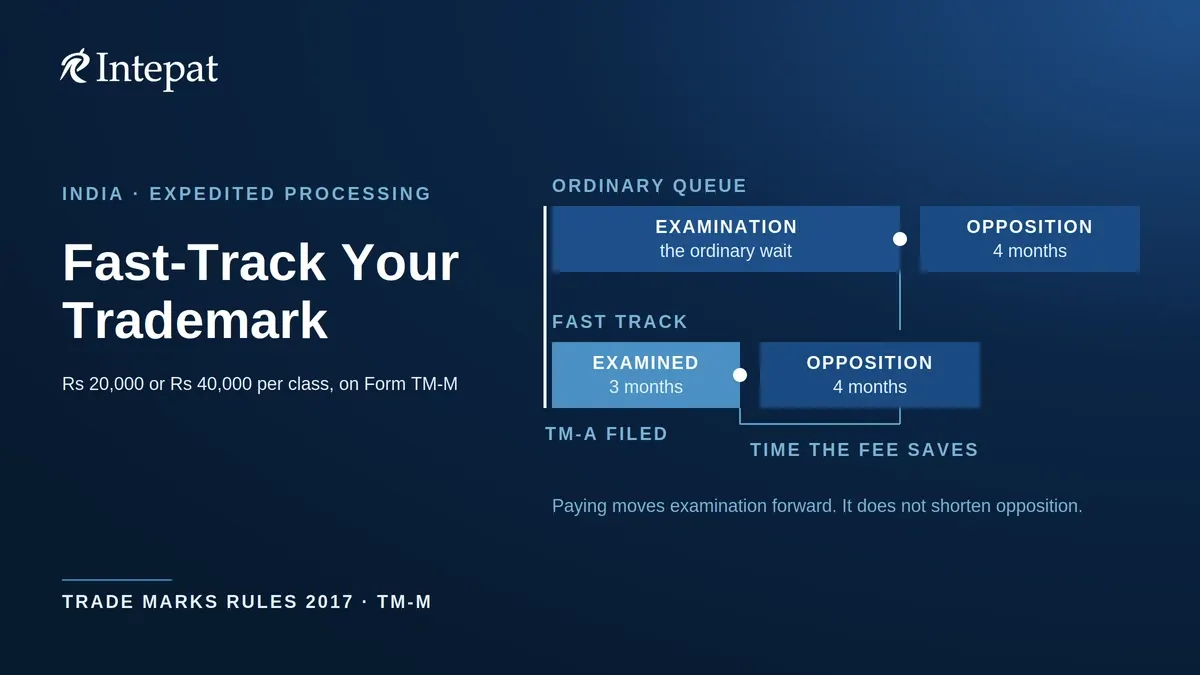
Fast-track trademark examination in India is a paid request that moves your application to the front of the Trade Marks Registry’s examination queue. You file it after the application number issues, pay Rs 20,000 or Rs 40,000 per class, and the Registry is then expected to examine the application within about three months.
The option exists under the Trade Marks Rules 2017 and applies to applications filed with the Indian Trade Marks Registry. It changes the timetable, not the test your mark has to pass, and it does not shorten the four-month window in which anyone may oppose the mark once it is advertised. What it does buy, what it costs per class, and when it is worth the money are set out below.
Quick answer: Expedited processing is requested on Form TM-M after the application number issues, costs Rs 20,000 per class for an individual, startup or small enterprise and Rs 40,000 per class for everyone else, and is e-filing only. The application is then examined ordinarily within three months, and the later stages up to final disposal are also meant to run expedited. Registration itself is not guaranteed within any period.
What fast-track trademark examination actually speeds up
The request moves examination forward: the Rules say an application under expedited processing shall be examined expeditiously and ordinarily within three months from the date of submission. The same rule then directs that the later stages, from your reply to the examination report through publication and any opposition, be dealt with expeditiously as well, up to final disposal.
Two words in that rule carry the weight. “Ordinarily” means the three months is the Registry’s working target, not a promise with a remedy attached. And “expeditiously” for the later stages is tied to guidelines the Registrar may publish in the Trade Marks Journal, so how fast a hearing is listed or a publication is made under the fast track depends on what the Registry has notified at the time.
The Registrar may also limit how many applications are accepted for expedited processing, again by notice in the Journal. No such limit is stated in the Rules themselves, but the power exists, and it is the reason a request is an application rather than a right.
None of this rewrites the Act’s own expectation for any application, expedited or not: registration within eighteen months of filing, provided the application has been accepted and either no opposition was filed in time or the opposition was decided in the applicant’s favour. Fast track compresses the front of that timetable; it does not create a separate, shorter one.
What fast-track trademark examination costs, and why the per-class unit matters
The expedited examination fee is Rs 20,000 per class and per mark for an individual, a recognised startup or a small enterprise, and Rs 40,000 per class and per mark for every other applicant. It can only be paid online; the Schedule does not allow physical filing for this request. Both figures are verified as of September 2026.
The figures come from the First Schedule to the Trade Marks Rules 2017, read alongside the application fee that precedes them, because the two are paid on the same application within days of each other.
| What you are paying for | Individual, startup or small enterprise, e-filing | All other applicants, e-filing | Unit | Form |
| Application for registration | Rs 4,500 | Rs 9,000 | Each class, each mark | TM-A |
| Expedited processing | Rs 20,000 | Rs 40,000 | Each class, each mark | TM-M |
The per-class unit is the part of the fee note that is easy to miss. A recognised startup filing one mark in three classes pays Rs 13,500 to apply and a further Rs 60,000 to expedite, so the fast track costs more than four times the application itself. A company that is neither a startup nor a small enterprise pays Rs 27,000 to apply and Rs 1,20,000 to expedite the same three classes. If speed matters for one class only, it is often cheaper to file that class as a separate application and expedite only that one.
The concession is wider than the words “small enterprise” suggest. The Rules define a small enterprise as one whose investment in plant and machinery, or in equipment for a services business, does not exceed the limit set for a medium enterprise under the MSME legislation, so a business that thinks of itself as medium-sized can fall inside the lower column. The investment figures themselves sit in the MSME legislation, not in the Trade Marks Rules, so check them before you rely on the label. A startup means an entity recognised as such under the Startup India initiative, or a foreign entity meeting that initiative’s turnover and incorporation criteria and filing a declaration. Form TM-A requires the startup or small-enterprise certificate to be provided, so hold it before you claim the lower column.
Claiming the wrong column is not a billing correction. A document filed without the fee, or with a short fee, is deemed not to have been filed at all for the purposes of any proceeding under the Rules. On an expedited request that means the clock you paid to start has not started. The full Trade Marks Registry fee schedule sets out the remaining entries.
How to request expedited processing
You cannot ask for expedited processing in the application itself. The request goes on Form TM-M, and the Rules allow it only after you have received the official application number. So the sequence is: clear the mark, file Form TM-A, wait for the number, then file TM-M with the fee online.
The clearing step matters more, not less, when you intend to pay for speed. A mark that was not searched against the register does not become safer by being examined sooner; it is simply objected to sooner, with Rs 20,000 or Rs 40,000 per class already spent. Run a trademark search against identical and similar marks in the classes you intend to file before the application goes in, and fix the specification of goods or services at the same time, because the classes you name are the classes you will be paying to expedite.
Filing the application on Form TM-A is unchanged by the decision to expedite. Once the number appears on the Registry’s status portal, the TM-M request can go in the same day. There is no outer deadline in the Rules for making the request, so an application already sitting in the ordinary queue can be moved to the fast track later if circumstances change.
What happens after the request, and the deadline that does not move
After the request, the Registry issues either an acceptance or an examination report. If a report raises objections, you have one month from receiving it to reply, and the Registrar may treat the application as abandoned if you do not. Expedited processing does not extend that month; it only makes it arrive sooner.
That is the practical risk of paying for speed. Under the ordinary queue an applicant often has months to gather evidence of use, user affidavits and distinctiveness material before a report lands. On the fast track the report may arrive within weeks, and the one-month reply clock starts on receipt. Assemble the evidence you would need for a reply to the examination report before you file TM-M, not after the report arrives.
The stages that follow are the ordinary ones, run on the expedited footing the rule describes. If the written reply does not satisfy the Registrar, or you ask to be heard, the matter goes to a show cause hearing. If the application is accepted, it is advertised in the Trade Marks Journal, and any person then has four months from the advertisement date to file an opposition. Only after that window closes unopposed, or an opposition is decided in your favour, does the mark proceed to registration.
One more clock is worth knowing before you pay. If the Registrar refuses the application, or accepts it only on conditions you object to, the decision is communicated to you in writing, and you have thirty days from that communication to ask, on Form TM-M, for the grounds of the decision and the materials the Registrar relied on. An appeal to the High Court runs from the date the decision is communicated, or, where the grounds were requested in time, from the date you receive them. Fast track examination brings that decision forward too, so the appeal question can arrive within months of filing rather than years.
Expedited processing is not expedited search
The Rules also price an expedited search at Rs 30,000, and the two are routinely confused. That search is a certificate the Registrar issues under the Copyright Act, confirming that no identical or deceptively similar trademark exists for an artistic work you want to register as copyright, ordinarily within seven working days. It does not move your trademark application.
The two requests go on different forms, TM-C for the search certificate and TM-M for expedited processing, and serve different purposes. If you are registering a logo as copyright as well as a trademark, you may need the search certificate; if you want your trademark application examined sooner, you need expedited processing. Paying for one does not buy the other.
Is fast-track trademark examination worth paying for? A decision rule
Pay for expedited trademark examination when an examined application within months, rather than after the ordinary queue, is worth more than Rs 20,000 or Rs 40,000 per class and you can act on the examination report the day it arrives. Skip it when the mark has not been cleared, or when opposition rather than examination is the delay you fear.
Three situations usually pass that test. The first is a launch, a funding round or a distribution agreement with a date attached, where the counterparty wants to see an examined or advertised application rather than a bare filing receipt. The second is a competitor already using a similar mark, where knowing sooner whether the Registry treats the earlier mark as a conflict changes how you spend on enforcement. The third is a portfolio decision: a startup building its first filings sometimes expedites the house mark alone, so the rest of the programme can be planned around a known examination outcome.
Two situations usually fail it. A mark that has not been searched should not be expedited; the money buys an earlier objection, not a better one. And where the class is crowded and an opposition from a known rival is likely, the four-month opposition window and the evidence rounds that follow it will set the pace regardless, so the expedited fee shortens only the part of the wait that was not the problem.
Fast track trademark registration is a misnomer in one respect: the fee accelerates the Registry’s work, not the Act’s timetable for opposition, so the total wait is shortened only by the time the application would otherwise have spent in the examination queue. If the mark clears, the evidence is ready and a date depends on it, that saving is usually worth the fee. If any of those three is missing, the ordinary registration process reaches the same result at the ordinary cost.
Frequently Asked Questions
No. The request for expedited processing on Form TM-M is allowed only after the applicant has received the official application number. File Form TM-A first, wait for the number to issue, and then file the TM-M request with the fee online. The two filings can be days apart, but they cannot be combined into one.
No. Once the application is advertised in the Trade Marks Journal, any person has four months from the advertisement date to file a notice of opposition, whether or not the application was expedited. The Rules direct that opposition proceedings on an expedited application be dealt with expeditiously, but the window in which an opposition may be filed is unchanged.
Often, yes. The Rules define a small enterprise by reference to the investment ceiling for a medium enterprise under the MSME legislation, so an enterprise whose investment in plant and machinery or equipment sits within that ceiling can take the Rs 20,000 column. Confirm the figure against the MSME legislation and hold the certificate Form TM-A asks for.
The Rules say the application shall be examined ordinarily within three months, and the expedited processing rule itself sets no consequence and no refund for a longer wait. Check the application’s status on the Registry portal, and raise the delay with the Registry through your agent if it stretches well beyond the target. Verified as of September 2026.
Yes. The fee is charged for each class and for each mark, so an application covering three classes attracts three expedited fees. If only one class is commercially urgent, filing that class as a separate application and expediting it alone is usually cheaper than expediting a multi-class application in full, provided the specification is planned before filing.
This article explains the law on expedited processing of trademark applications in India as at September 2026 and is for general information only. It is not legal advice. Government fees, forms, and procedures change; confirm current figures with the Trade Marks Registry before you file. For advice on your specific mark, consult a trademark attorney.
Sources
- The Trade Marks Rules, 2017, Rules 2(1)(v), 2(1)(x), 10(5), 22(1) and (3), 23(4), 33(2) to (6), 34, 36 and 39(1); the First Schedule, entries 1, 12 and 17; the Second Schedule, Form TM-A. Government of India.
- The Trade Marks Act, 1999 (Act 47 of 1999), Sections 18(5), 20(1), 21(1), 23(1) and 91(1). Government of India.