




Trademark registration in Coimbatore is filed at the Chennai office of India’s Trade Marks Registry, costs Rs 4,500 to Rs 9,000 per class in government fees when filed online, and is now a faster-growing activity here than in Chennai itself: 50,418 applications carry a Coimbatore address, and annual filings rose 2.76 times between 2017 and 2025.
This guide is built on those Registry records, pulled on 25 September 2026, and on the Trade Marks Act 1999 and Trade Marks Rules 2017. It sits alongside Intepat’s guides to the Chennai trademark office and trademark registration in Bangalore; for the nationwide process in full, see the complete guide to trademark registration in India.
| Quick answer: |
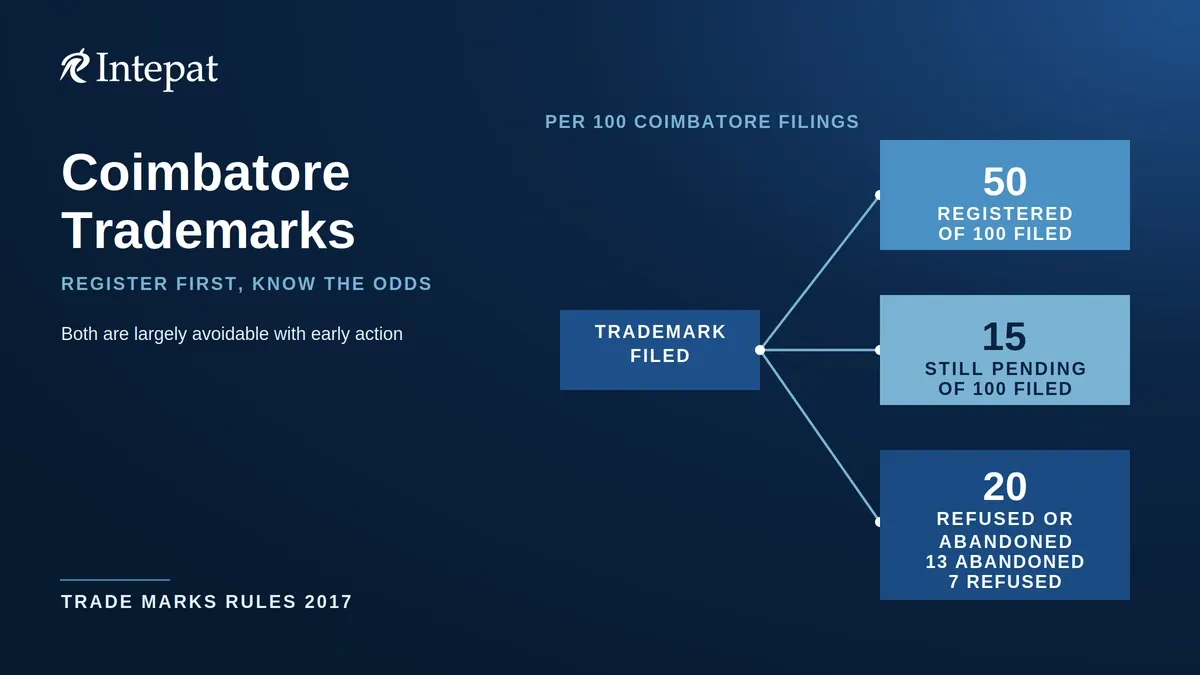
| File online on Form TM-A through the Chennai Trade Marks Registry, budget Rs 4,500 per class if you are an individual, startup or small enterprise and Rs 9,000 otherwise, choose the classes (the 45 numbered categories of goods and services, paid for one at a time) that match what you actually sell, and check the geographical indications register before naming a product after a local craft. One in five Coimbatore applications ends in refusal or abandonment, and both are largely avoidable: search both registers before filing, choose a name that is not merely descriptive, and calendar the response deadlines. |
How Trademark Registration Works from Coimbatore
A Coimbatore applicant files at the Chennai office of the Trade Marks Registry, the government office that registers trademarks. The Act and the Rules allocate an application to the office covering the applicant’s principal place of business, and Chennai’s territory covers Tamil Nadu, Karnataka, Kerala, Andhra Pradesh, Telangana, Puducherry and Lakshadweep, per IP India’s office locations.
The Registry is separate from the Patent Office, and an applicant with no place of business in India is allocated instead by its address for service.
The application itself is Form TM-A, filed online, and it is the same form for brand name registration in Coimbatore (a word mark) and logo registration in Coimbatore (a device mark); Intepat’s guide to word marks against logo marks explains which to file first when the budget covers only one. The application is examined, and any objection in the examination report has to be answered within a month of receipt. Once accepted, the mark is advertised in the Trade Marks Journal, and anyone may oppose it within four months of that advertisement. Acceptance can be withdrawn before registration if the Registrar decides it was given in error; the applicant then has thirty days from receiving that notice to amend or ask for a hearing, failing which the acceptance is deemed withdrawn. If nobody opposes, or the opposition fails, the mark is registered for ten years and can be renewed indefinitely in ten-year blocks. Intepat’s guide to the trademark registration process in India walks through each stage.
In practice none of that sequence requires a trip to Chennai. The Rules let the Registrar hold a hearing by video conference and deem such a hearing to have taken place at the appropriate office, although the Registrar keeps the power to require personal attendance in a particular case. A business with premises in two cities files at the office covering whichever of them it names on Form TM-A as its principal place of business, because the Rules define that term, for a multi-site business, as the place the applicant mentions; once filed, the allocation is fixed, and a later move of the head office or the address for service does not shift the file to another office. Intepat’s guide to trademark jurisdiction in India covers the parallel rule for disputes.
What 50,418 Coimbatore Filings Reveal
Proprietors with a Coimbatore address have filed 50,418 trademark applications on the Indian register as at 25 September 2026, and nearly two-thirds of them (64%) were filed from 2016 onwards: this is a young register, and it is growing faster than Chennai’s and faster than Tamil Nadu’s.
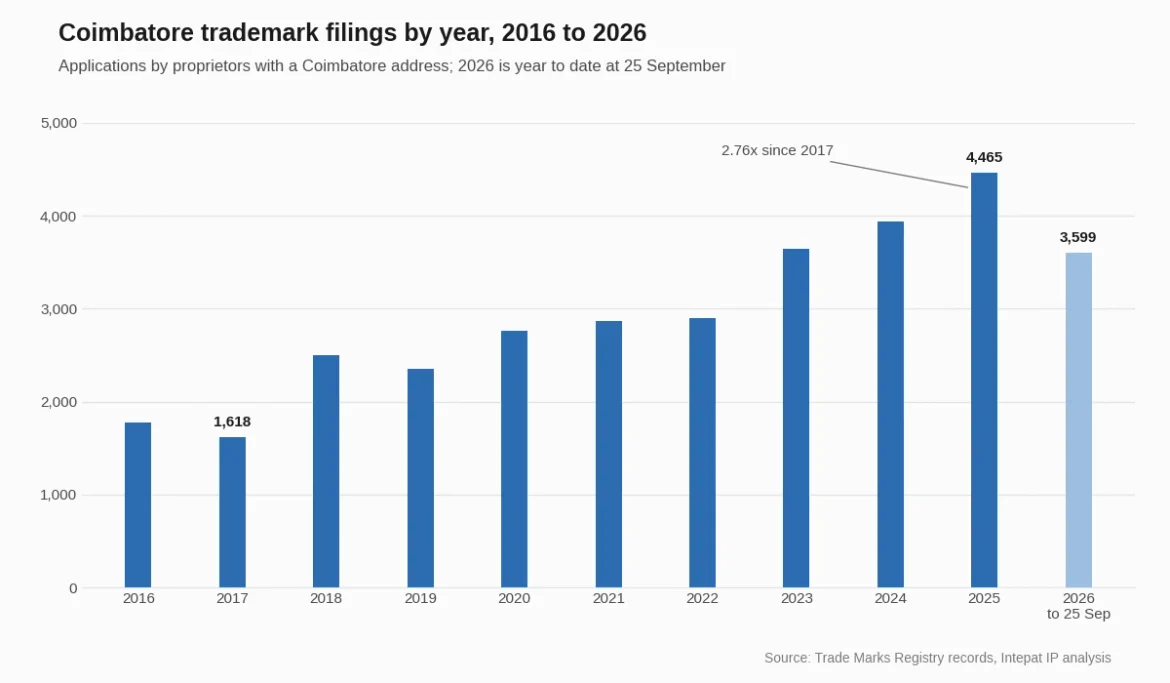
Coimbatore filed 1,618 applications in 2017 and 4,465 in 2025, a rise of 2.76 times, or about 13.5% a year compounded. Over the same eight years, Chennai addresses grew 2.05 times (7,260 to 14,904) and Tamil Nadu as a whole 2.37 times (15,746 to 37,348), on the figures published in Intepat’s Chennai guide. Every year since 2023 has set a new Coimbatore record, and 2026 is running at about 13 applications a day, which would put the year near 4,900 if the pace holds.
That growth has shifted the city’s weight inside the state. In 2017 Coimbatore accounted for 10.3% of Tamil Nadu’s new filings; in 2025 it was 12.0%, and across 2023 to 2025 it averaged 12.3%. In 2017 it filed 22 applications for every 100 that Chennai filed; by 2025 it filed 30. The capital still files more than three times as many marks, but the gap is closing from the Coimbatore side. For an applicant the growth means more recent local marks to search against every year, not a slower queue.
Some 17,993 Coimbatore marks, 36% of the total, were filed in 2015 or earlier, and many of those are still on the register. A new applicant is not searching a thin local record: the older third of the register holds the long-established local names, so a clearance search (a check of the register for earlier marks that could block yours) must cover that stock as well as recent filings.
Coimbatore’s Trademark Classes: Machines Stand Out, Medicines Lag
Coimbatore does not file like the rest of Tamil Nadu: machinery (Class 7) is the city’s fourth-largest class at 7.5% of filings, about 3.4 times the state share, while pharmaceuticals (Class 5), the largest class in both Tamil Nadu and Bangalore, runs here at only two-thirds of its state share.
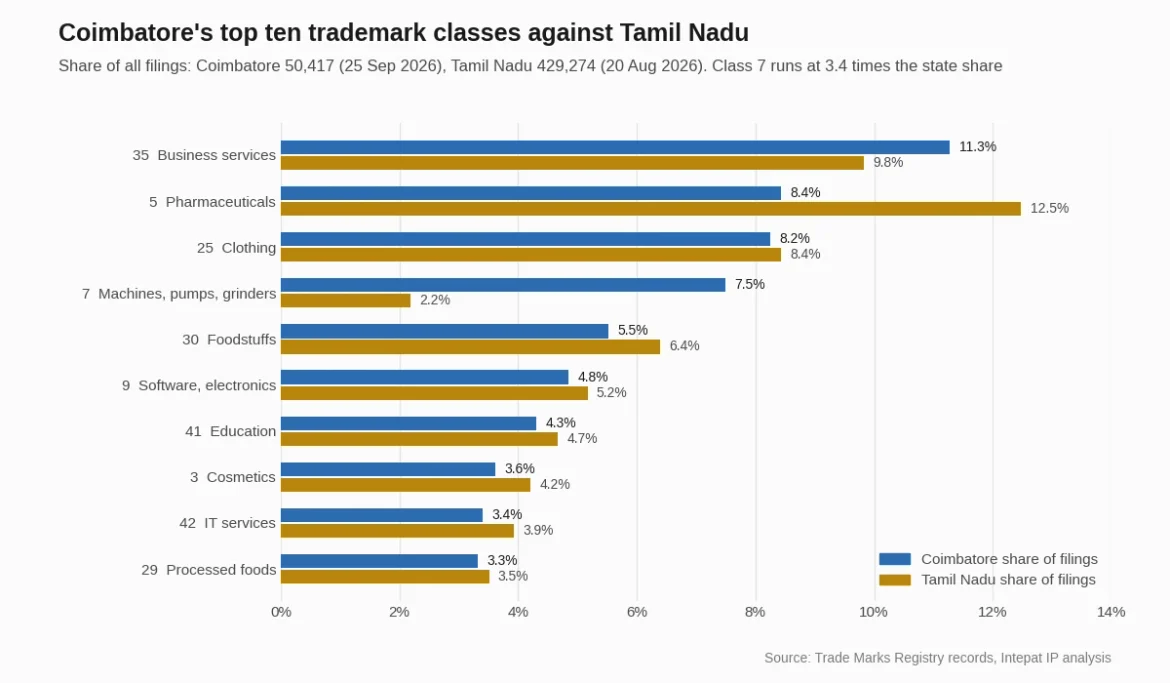
The chart reads each class twice: the Coimbatore share of the city’s filings, and the same class’s share across Tamil Nadu. Coimbatore shares are of the 50,417 classified filings, Tamil Nadu shares of the 429,274 state filings published in the Chennai guide, and class descriptions are shortened from the Nice Classification headings with local examples added.
Business services (Class 35) leads on 5,686 filings and pharmaceuticals (Class 5) follows on 4,252, with clothing (Class 25) close behind on 4,160. The top five classes account for 41% of everything Coimbatore files, and the top ten for 60%, so the register is concentrated. Class 7 is what sets it apart. Pumps, motors, wet grinders and textile machinery are the goods this city is known for (the MSME ministry’s own district profile credits Coimbatore with about 80% of the country’s textile machinery output and close to half its pump sets), and 3,775 trademark applications sit in that class alone. Across Tamil Nadu, Class 7 is a 2.2% class; in Coimbatore it is 7.5%. No other class in the top ten departs from the state pattern by anything like that margin.
The same tilt runs further down the list. Yarns and threads (Class 23) run at two and a half times the state share, consistent with the city’s textile mills. Common metals and castings (Class 6) run at 1.6 times, consistent with its roughly 700 foundries. Heating, cooking and lighting apparatus (Class 11) at 1.5 times, and agricultural products and animal feed (Class 31) at 1.4 times, round out the picture. Goods classes together take 68.5% of Coimbatore’s filings, against about 68% for Tamil Nadu on the same class counts and about 61% for Bangalore; services classes take 30.2%, and the remaining 1.3% (654 applications) carry the register’s multi-class code rather than a single class.
What the city under-files is as telling. Pharmaceuticals, the single largest class in Tamil Nadu at 12.5% and in Bangalore at 9.7%, is 8.4% here. Tobacco and matches (Class 34) run at a third of the state share, and paper and printed matter (Class 16) and beverages (Class 32) both run well under the state figure.
A pump or motor maker files in Class 7 for the machine, and should consider Class 11 if the product is a domestic appliance and Class 12 if it is a vehicle component, because the boundaries are drawn by function, not by factory. A garment unit files in Class 25 for the clothing and, if it also sells fabric or yarn, in Class 24 or Class 23. A trader or distributor without a factory files in Class 35, which is why that class leads the table.
The Rules adopt the current edition of the World Intellectual Property Organization’s (WIPO) Nice Classification by reference, and separately require the goods and services named in the application to correspond, as far as may be, to the Registrar’s own published class-wise list; check the current heading on Intepat’s trademark class search, then match the wording to IP India’s published list. Filing in more than one class is a single application with a fee per class. The trade-off is that if anyone opposes one class, the other classes wait until the applicant asks for the application to be divided (Form TM-M, Rs 1,800 online), and the divided applications keep the original filing date; Intepat’s guide to multiple trademark classes in India covers when a single filing is worth it.
What Happens to Coimbatore Applications After Filing
Of every 100 applications ever filed from a Coimbatore address, about 50 are registered today, 15 are still pending or in an intermediate status, 13 were abandoned, 7 met an objection, 7 were refused, 3 face opposition, 3 were removed and 3 were withdrawn; the outcome profile tracks Tamil Nadu’s almost exactly, even though the growth profile does not.
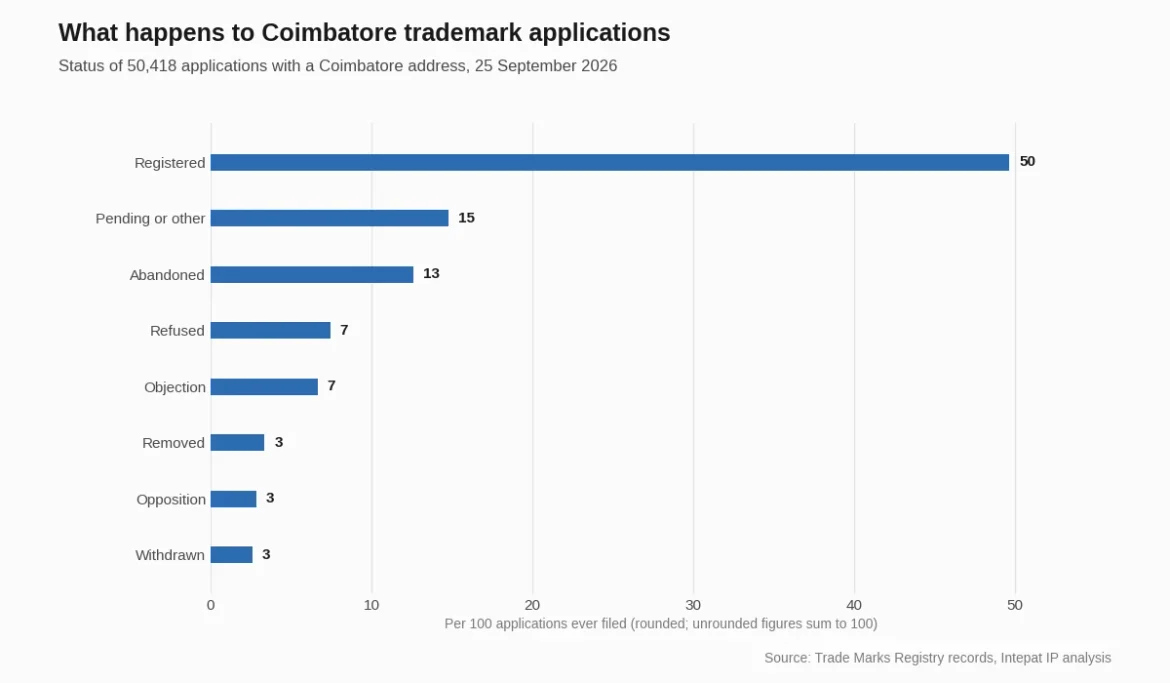
Those figures are rounded, so they total 101. The counts behind them are 25,037 registered, 3,354 in objection, 1,425 in opposition, 3,745 refused, 6,357 abandoned, 1,695 removed, 1,307 withdrawn, 30 that failed the formalities check, and 7,468 pending or in another status. Counting only the cases the register marks as concluded by registration or by the death of the file (registered plus abandoned, withdrawn and removed), 72.8% of Coimbatore applications ended in registration, and the Tamil Nadu figure on the same basis is 73.3%. Add the 3,745 refusals to the concluded set and the Coimbatore figure falls to 65.6%. Bangalore’s published profile is close as well: 49 registered, 7 refused and 12 abandoned per 100.
Abandonment (13 per 100) is the largest failure mode by a distance, and the rules that produce it are procedural: an examination report unanswered, a hearing missed, a deficiency not fixed in time. Refusal (7 per 100) is the substantive one, where the Registry examined the mark and said no, and Coimbatore’s refusal rate runs a point above the state’s 6%. The first is avoidable by calendaring; the second by searching before filing and by choosing a name that is not merely descriptive of the goods or their origin. Both are cheaper to prevent than to appeal.
The figures in this article come from Trade Marks Registry records extracted on 25 September 2026 for proprietor addresses containing “Coimbatore”, with Intepat’s own analysis. The all-time and yearly figures use a base of 50,418; the class shares use the 50,417 records carrying a class (the sum of the class rows; the class sheet’s own header count is 50,410, and the shares are identical to one decimal place on either base). The “pending or other” segment holds every status the register does not label as registered, objected, opposed, refused, abandoned, withdrawn, removed or failed at the formalities check; the 30 formalities-check failures are the register’s own label for a deficiency notice not yet answered. The refused count was taken as a separate status pull because the register’s summary panel carries no refused line (its “Rejected” line reads zero). Tamil Nadu and Chennai comparators are the figures published in Intepat’s Chennai guide, compiled on 20 August 2026, and are used only as shares and ratios. The Tirupur and Tiruppur pulls were run on address text and may overlap with the Coimbatore pull where an address carries both names; no overlap count was extracted, so the Tiruppur figures below are a separate series that may share records with the Coimbatore total.
Two Coimbatore Names You Cannot Simply Trademark
Coimbatore Wet Grinder and Kovai Kora Cotton Sarees are registered geographical indications (GIs), not trademarks. The Registrar must refuse or invalidate a trademark containing either name where the goods do not come from the place and the use misleads buyers about origin, so the 3,775 Class 7 filings above sit where a local name is spoken for.
A geographical indication protects a product name for producers in a place, not a brand for any one of them. The Coimbatore Wet Grinder GI was registered in 2006 to a manufacturers’ association, in a cluster the government’s own diagnostic study puts at about 700 units within 25 kilometres of the city. Twenty years on, the GI Registry’s public record for the mark shows no registered authorised user. The name is protected against outsiders, but it hands no Coimbatore manufacturer an exclusive right to brand with it: under the GI Act that right belongs only to a registered authorised user, and none is on the register. Any producer in the area can apply to be entered as one. Kovai Kora Cotton Sarees, registered in 2008, shows the mechanism working the other way: the state handloom weavers’ co-operative society (Co-Optex) is on the register as an authorised user.
Two different bars apply, and neither is quite what its name suggests. Under the Trade Marks Act a mark that consists exclusively of a geographical name is refused as descriptive of origin, whoever makes the goods, unless it had already become distinctive of one business through use before filing or is a well-known mark. Under the GI Act the Registrar must refuse or invalidate a mark that contains or consists of a geographical indication for goods that do not come from the place, where that use would mislead buyers about origin (both conditions must be met), and, for goods the government has specially notified, without any misleading test; no such notification for either Coimbatore GI was found. Two savings run the other way: a mark applied for or used in good faith before the GI application was filed (2005 for the wet grinder, 2007 for Kovai Kora) is not prejudiced by the GI, and a distinctive house name paired with the place, on goods actually made in Coimbatore, falls outside both bars. But a mark that is simply “Coimbatore” plus the product, in Class 7, Class 24 or Class 25, is the mark most likely to be objected to on one ground or the other, and the GI register is the second register a clearance search has to cover. Intepat’s guide to collective trademarks in India covers the alternative for an association that wants a shared name it can actually license.
Proprietors with a Tirupur or Tiruppur address have filed 29,936 applications between the two spellings, about three-fifths of Coimbatore’s total, and Class 25 alone holds 4,160 of Coimbatore’s own filings. Much of that cluster manufactures to order for merchant exporters and overseas brands, often for years, without putting its own name on the garment. A unit in that position is not without rights: the Act protects continuous use of a mark on particular goods that began before both the other side’s first use and its registration date, but only where that use can be proved. The right attaches to a name used as a mark on or in connection with the goods; a trading name that appears only on invoices to a buyer, never on the garments, their labels or packaging, may not count as use for the garments, and that is the question to put to counsel before relying on it. Dated invoices, purchase orders and job cards are the evidence, and an application claiming use before filing must carry an affidavit with those documents attached; Intepat’s guide to prior user rights in India explains what the Registry and the courts expect to see.
Trademark Registration Fees in Coimbatore and the Small Enterprise Concession
A trademark application from Coimbatore costs Rs 4,500 per class online for an individual, a startup or a small enterprise, and Rs 9,000 per class for everyone else, and the definition of “small enterprise” in the Rules is wider than most owners assume because it is pegged to the ceiling for a medium enterprise.
| What you are paying for | E-filing fee (INR) | Form |
| Application, individual / startup / small enterprise, per class | 4,500 | TM-A |
| Application, all other applicants, per class | 9,000 | TM-A |
| Expedited processing, individual / startup / small enterprise, per class | 20,000 | TM-M |
| Expedited processing, all other applicants, per class | 40,000 | TM-M |
| Notice of opposition, or counterstatement, per class opposed | 2,700 | TM-O |
| Renewal, per class | 9,000 | TM-R |
| Renewal with surcharge (within six months after expiry), per class | 4,500 plus the renewal fee | TM-R |
| Restoration and renewal (after six months and within one year of expiry), per class | 9,000 plus the renewal fee | TM-R |
Fees are from the First Schedule to the Trade Marks Rules 2017, verified as of September 2026. Application and expedited fees are per class and per mark. E-filing fees are 10% below the physical-filing fees where physical filing is allowed; expedited processing is e-filing only. Renewal can be filed up to a year before expiry; after expiry there is a six-month surcharge window, then a further six months in which the Registrar may restore the mark at the higher fee, and after that the mark is gone. A full fee guide covers every schedule entry.
Coimbatore’s micro, small and medium enterprise (MSME) base should test the concessional column before paying the higher fee. The Rules peg “small enterprise” to the investment limit set for a medium enterprise under the MSME Development Act, tested on plant and machinery for a goods business and on equipment for a services business, and not on turnover. The government replaced that scale with a composite investment-and-turnover test in 2020 and no later instrument has reconciled the two, so this article states no rupee threshold.
A Udyam Registration Certificate (the government’s own standard proof of MSME status) showing Micro or Small is the safe case; an enterprise classified Medium may qualify but should confirm before filing at Rs 4,500. “Startup” in the Rules means an entity recognised as one under the Startup India initiative, so the concession follows the DPIIT recognition certificate, not the description; a new company without it pays Rs 9,000 unless it qualifies as a small enterprise or files in the founder’s own name as an individual. Form TM-A requires the requisite certificate where a startup or small enterprise claims the concession; an individual needs none. Intepat’s guides to trademark registration for MSMEs and for startups cover the certificates in detail.
How Long Trademark Registration Takes in Coimbatore
The register publishes no Coimbatore pendency figure, meaning no measure of how long applications actually wait, so this section states what the law provides and what the outcome data shows rather than a number of months: the Act directs the Registrar to register an accepted, unopposed mark within eighteen months of filing, and expedited examination is available for a fee.
Three clocks apply. Once an application is accepted and either not opposed or successfully defended, the Act directs the Registrar, unless the Central Government directs otherwise and subject to the Registrar’s power to withdraw acceptance, to register it within eighteen months of the filing date; the Act attaches no consequence to that period being exceeded. The opposition window itself is four months from advertisement in the Journal. For an applicant in a hurry, an expedited processing request on Form TM-M (Rs 20,000 or Rs 40,000 per class) brings the examination forward, ordinarily to within three months of the request; the Rules set no outer time limit and provide no refund, and the Registrar may cap the number of expedited requests by Journal notice.
Fifteen of every 100 Coimbatore applications ever filed are still pending or in an intermediate status, and 2026 alone has added about 3,600 files to the Chennai office’s queue from this city. The eighteen months is a direction to the Registry, not a guarantee to the applicant; an objected or opposed application runs longer, and its length depends on the applicant’s own response times as much as the Registry’s. Intepat’s guide to checking trademark application status explains what each status on the register means.
Six Trademark Deadlines That Start After You File
Six clocks start on a Registry notice, an examination report, a notice of opposition or the opponent’s evidence, and missing them has different consequences: three lead to automatic abandonment and three give the Registrar the option to abandon the file. None of the six is known on filing day; each starts when a notice arrives.
- Deficiency notice: one month. If the Registry notifies a deficiency in the application and it is not fixed within one month of the notice, the application is treated as abandoned. Mandatory. (Rule 31)
- Examination report: one month from receipt. If the applicant does not respond within one month of receiving the examination report, the Registrar may treat the application as abandoned. The Rules treat an emailed report as served when it is sent to the email address on the form, or to the agent’s address if one was authorised. Discretionary in terms, so do not rely on it. (Rule 33(4))
- Hearing. If the applicant fails to appear at the scheduled hearing and has filed no reply to the objection, the Registrar may treat the application as abandoned. Both conditions must be met. (Rule 33(7))
- Counterstatement: two months. If a notice of opposition is served and no counterstatement (the applicant’s written reply to the opposition) is filed within two months of receipt, the application is deemed abandoned. Mandatory. (Section 21(2))
- Evidence in opposition: two months from the opponent’s evidence. The opponent has two months from receiving the counterstatement to file evidence or say it will rely on the notice alone, failing which the opposition is deemed abandoned. The applicant then has two months from receiving that evidence, or that statement, to file its own evidence or say it relies on the counterstatement; take no action and the application is deemed abandoned. Automatic both ways. (Rules 45(2), 46(2))
- Non-completion notice: twenty-one days. If registration is not completed within twelve months of filing because of the applicant’s default, the Registrar may issue a notice on Form RG-1; unless the default is fixed within twenty-one days of that notice, extendable to a month on Form TM-M, the application is treated as abandoned. Discretionary, but the notice itself sets the date. (Section 23(3), Rule 52)
Because none of the dates is known in advance, the application status and the email address on record are what have to be watched. Three deadlines above leave the Registrar no choice, because the provision itself treats or deems the application as abandoned; the other three use the word “may”. One tool changes the arithmetic: a time set by the Rules, such as the one-month examination reply, can be extended on Form TM-M (Rs 900 online) by up to one month at the Registrar’s discretion, even after it has run out, whereas a time set by the Act itself, such as the two-month counterstatement window, cannot be extended at all. With 13 of every 100 Coimbatore applications ending in abandonment, these six dates are the cheapest intervention in the process. Intepat’s guides to replying to an examination report and opposition proceedings cover each in full.
Documents Required for Trademark Registration in Coimbatore
Most applications need the applicant’s name, address and nationality, an address for service in India with a working email, a clear representation of the mark, and the specification of goods or services, meaning the list of what the mark will cover. An applicant claiming prior use or the concessional fee needs two documents beyond that.
- The applicant’s full name, address and nationality, an address for service in India (a postal address and a working email address, because the Registry may serve the examination report by email and the Rules treat it as served the moment it is sent), and a power of attorney where an agent files
- A clear representation of the mark, in the format the e-filing system accepts
- The specification of goods or services, classified under the current Nice Classification edition
- For a mark in Tamil or any script other than Hindi or English, a transliteration in roman letters, an English translation and a statement of the language
- A user affidavit (a sworn written statement) with supporting documents, where use before the filing date is claimed
- The requisite certificate, where a startup or small enterprise claims the concessional fee
The prior-use affidavit is the document Coimbatore and Tiruppur applicants most often get wrong, because Form TM-A itself says the statement of use, once made, is final. Claim a date you can prove with invoices, not the date the business started. Most other slips are not final: an error in the application, including a wrong class where all the goods belong in another one, can be corrected on Form TM-M for Rs 900, so long as the mark itself is not substantially altered and no new goods or services are added. Before filing, run a public search against the trademark register and the GI register, and after registration, calendar the renewal cycle so the ten-year term does not lapse. Intepat’s document checklist covers formats and attestation.
What This Means Before You File
Five decisions taken before the application is filed move the odds, and the Coimbatore data points to each: choose classes from what you actually make or sell, search both registers, fix the user date, test the fee concession, and calendar the deadlines.
First, pick classes from what you actually make or sell, not from a template; the class chart above shows where Coimbatore businesses actually land, and a manufacturer here is far more likely to belong in Class 7, Class 6, Class 11 or Class 23 than the state average suggests, while a trader belongs in Class 35. Second, search before you file, against the trademark register and, if the name carries a place or a product name, the GI register, and avoid a name that merely describes the goods or their origin; refusals run at 7 per 100 here and many are avoidable. Third, if the business has traded under the mark for years, gather the dated invoices before deciding the user date on the form, because that statement cannot be changed later.
Fourth, test the small enterprise concession against the Udyam certificate before assuming the Rs 9,000 fee applies; Micro and Small are the safe cases, and a Medium classification needs confirming. Fifth, put the six deadlines on a calendar the day the application is filed. Abandonment is Coimbatore’s largest failure mode, and every one of its causes has a date attached. Those five steps address refusal and abandonment, which together account for 20 of every 100 Coimbatore filings.
Frequently Asked Questions
Yes. The Act and the Rules send an application to the Registry office covering the applicant’s principal place of business in India, and Chennai’s office covers Tamil Nadu along with Karnataka, Kerala, Andhra Pradesh, Telangana, Puducherry and Lakshadweep. Being based in Coimbatore, Tiruppur or Erode does not change that allocation.
Usually not. The Rules allow hearings by video conference and deem them held at the appropriate office, and in Intepat’s experience that is how most hearings now run, so a Coimbatore or Tiruppur applicant usually attends from their own office; the Registrar can still require personal attendance in a particular case. Filing itself is online on Form TM-A.
Rs 4,500 per class online if you qualify as an individual, startup or small enterprise, against Rs 9,000 otherwise. The Rules peg “small enterprise” to a medium-enterprise investment ceiling the government no longer uses, so a Udyam certificate showing Micro or Small is the safe case and a Medium enterprise should confirm eligibility first. A startup qualifies only with Startup India (DPIIT) recognition.
Class 7 covers machines, motors and pumps, and it is the class where 3,775 Coimbatore applications already sit. File in Class 11 as well if the product is a domestic appliance, and in Class 12 if it is a vehicle component, because the classification follows the product’s function rather than the factory that makes it.
Class 25 for clothing, footwear and headwear, which holds 4,160 Coimbatore filings and is the natural home of a Tiruppur brand. Add Class 24 for fabrics and household linen, Class 23 for yarn, and Class 35 if the business also trades or retails other makers’ goods under the same name.
The Act directs the Registrar, unless the Central Government directs otherwise, to register an accepted, unopposed mark within eighteen months of filing, and the opposition window alone is four months from advertisement; the direction carries no consequence if it is exceeded. No Coimbatore-specific pendency figure is published; about 15 of every 100 Coimbatore applications ever filed are still pending or in an intermediate status.
Possibly, but check first. “Kovai” on its own is not a registered GI, but words like it are often part of registered trademarks, so a name using it needs a search of both registers before you rely on it, and a mark combining it with a product the Kovai Kora Cotton Sarees GI covers needs clearance against that GI as well.
On its own, very little. The exclusive right to use a GI belongs only to a registered authorised user, and the GI Registry shows nobody registered against the Coimbatore Wet Grinder GI, so operating in the district does not give you that right. A producer there can apply to be entered as an authorised user; that right sits alongside your own brand, which still needs its own Class 7 trademark.
Possibly a defensive right. If you can show continuous use of your own mark on the same goods from before both the other side’s first use and its registration date, whichever came first, the Act stops them from interfering with that use. But a name used only on invoices, never on the garments, may not count as use for the garments, and dated documents are what prove it.
It depends which one. Miss the one-month deadline to fix a deficiency notice and the application is treated as abandoned. Miss the one-month window to reply to an examination report and the Registrar may treat it as abandoned; that is discretionary, but assume the file will be closed. A Rules-set time can be extended by a month on Form TM-M for Rs 900, even after expiry.
No rule requires a local agent. Any registered trademark agent or attorney in India can file at the Chennai office online, so trademark consultants in Coimbatore, Chennai or Bangalore are equally placed to act; what separates them is the quality of the search before filing and the deadline management after it. Intepat files and manages Coimbatore applications end to end.
No. A trademark registered through any office of the Trade Marks Registry is valid throughout India for ten years from the filing date and renewable every ten years. The office only determines where the file is administered, not where the right applies.
This article explains the law on trademark registration in Coimbatore in India as at September 2026 and is for general information only. It is not legal advice. Government fees, forms, and procedures change; confirm current figures with the Trade Marks Registry before you file. For advice on your specific mark, consult a trademark attorney.
Sources
- Trade Marks Registry records, proprietor addresses containing “Coimbatore”, “Tirupur” and “Tiruppur”, extracted 25 September 2026; Intepat IP analysis.
- The Trade Marks Act 1999 (47 of 1999), consolidated text as on 1 June 2026, India Code, Government of India. Sections 2(2)(c), 9(1)(b), 18(2), 18(3), 19, 21, 22, 23, 25, 34, 131.
- Trade Marks Rules 2017, G.S.R. 199(E), IP India, Office of the Controller General of Patents, Designs and Trade Marks. Rules 2, 3, 4, 5, 17, 18, 19, 20, 23, 25, 28, 31, 33, 34, 37, 38, 42, 45, 46, 52, 57, 60, 108, 109, 115; First Schedule entries 1, 2, 3, 4, 5, 13, 14 and 17; Form TM-A.
- Geographical Indications of Goods (Registration and Protection) Act 1999 (48 of 1999), consolidated text as on 1 June 2026, India Code, Government of India. Sections 17, 21, 25, 26.
- GI Registry, public search, application records for Coimbatore Wet Grinder (application 26) and Kovai Kora Cotton Sarees (application 93), search.ipindia.gov.in, accessed 20 September 2026.
- IP India, Territorial Jurisdiction of Trade Marks Registry Offices, ipindia.gov.in/office-locations.
- Ministry of MSME, S.O. 2119(E) of 26 June 2020 as amended by S.O. 1364(E) of 21 March 2025, classification of enterprises.
- Department for Promotion of Industry and Internal Trade, G.S.R. 108(E) of 4 February 2026, Startup definition.
- Office of the Development Commissioner (MSME), Diagnostic Study of the Wet Grinder Cluster at Coimbatore.
- Intepat IP, Chennai Trademark Office: Jurisdiction, Process and Filing Data, Tamil Nadu and Chennai figures compiled 20 August 2026; and Trademark Registration in Bangalore, Bangalore figures compiled 20 August 2026.
- WIPO, Nice Classification, NCL(13-2026), class headings.
- MSME Development Institute, Chennai, Brief District Industrial Profile, Coimbatore (2015-16), Ministry of MSME: textile machinery, pump set and foundry figures.
- MSME Development Institute, Chennai, Brief Industrial Profile, Tiruppur (2015-16), Ministry of MSME: cluster structure and job-work units.