




Indian patent status labels shown on the Indian Patent Office portal indicate the current stage of prosecution of a patent application under the Patents Act, 1970. Each status carries a specific procedural meaning and may signal whether the applicant must take action, respond to an examination report, attend a hearing, or wait for the next prosecution step.
Some status labels simply reflect administrative processing. Others mark the start of strict statutory deadlines that cannot be extended, where failure to act results in permanent and irreversible loss of the application without prior notice from the Indian Patent Office. Understanding the precise meaning of each status is therefore essential for applicants managing live patent prosecution in India..
This reference guide explains the meaning of every Indian patent status label, the stage of prosecution each status represents, and the actions typically required at that stage. For instructions on retrieving your status from the official portal and understanding Indian patent application number formats, see the companion guide: Step-by-step guide to checking your patent status in India.
All statutory references reflect the Patents Act, 1970 and the Patents (Amendment) Rules, 2024, effective 15 March 2024, as notified in the Official Gazette by CGPDTM (ipindia.gov.in). Based on prosecution experience across Indian national phase applications filed by foreign applicants in technology, pharmaceutical, and engineering sectors, the three deadlines identified in this guide account for the majority of irreversible application losses encountered in practice.
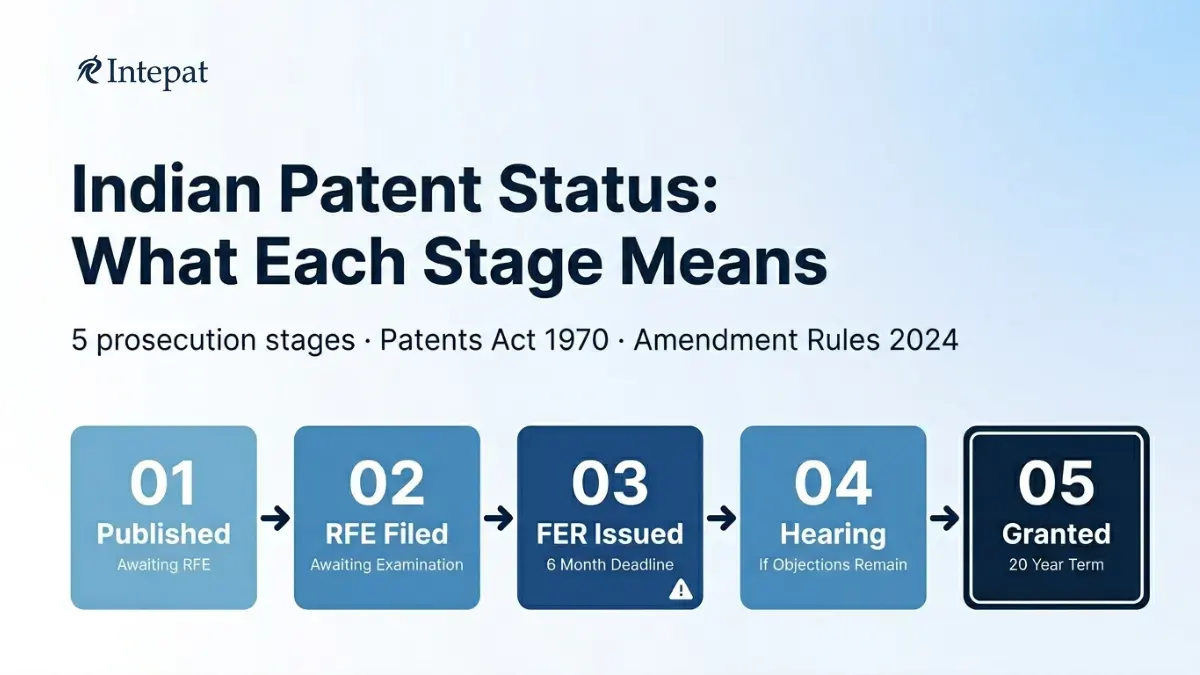
Critical Rule Change: RFE Deadline Split at 15 March 2024
Before reading the status reference table, confirm which RFE deadline governs each application in your portfolio. This is the most consequential change introduced by the Patents (Amendment) Rules, 2024 and the one most likely to cause a diarising error in a multi-jurisdiction practice.
| Filing Date | RFE Deadline | Rule Reference |
| Before 15 March 2024 | 48 months from priority or filing date | Rule 24B(1)(vi) |
| On or after 15 March 2024 | 31 months from priority or filing date | Rule 24B(1)(i) |
For PCT national phase entries filed on or after 15 March 2024: the 31-month deadline coincides exactly with the national phase entry deadline. Form 18 must be filed simultaneously with national phase entry. There is no grace period built into the standard rules.
Docketing risk: This split does not exist in USPTO or EPO practice. Docketing systems configured for US or European prosecution timelines will not automatically generate an Indian RFE trigger at 31 months. Foreign counsel managing Indian applications through a multi-jurisdiction platform should audit their portfolio specifically for this deadline, particularly PCT applications with priority dates between mid-2021 and mid-2022 where the 31-month window is approaching or has recently passed. For the consequences of missing the RFE deadline, see: consequences of missing the RFE deadline in India.
Status Reference: Prosecution Implications at Every Stage
Pre-Examination Statuses
| Status | Prosecution Implication | Action Required | Key Deadline |
| Application Does Not Exist / Not Yet Published | Three scenarios: 18-month publication window under Section 11A has not expired; application number format is incorrect; or a secrecy direction under Section 35 is in force. For PCT applications, Section 35 directions have been issued in defence-related technology areas. | Confirm application number format. If correct and publication is overdue, file a query with the appropriate Patent Office. File Form 9 if early publication serves your commercial timeline. See: patent filing procedure in India. | 18 months from filing/priority, under Section 11A |
| Application Published: Awaiting Request for Examination | Active deadline running. The application is in the public record but examination will not begin without an RFE. Third-party pre-grant oppositions under Section 25(1) are possible from this point. | File Form 18 (normal) or Form 18A (expedited, Rule 24C) without delay. For PCT national phase entries filed on or after 15 March 2024, Form 18 must accompany national phase entry. Missing this deadline results in deemed withdrawal under Section 11B(4) with no Patent Office notice. | 48 months (filed before 15 Mar 2024) or 31 months (on or after 15 Mar 2024) from priority/filing, under Rule 24B(1)(i) / Rule 24B(1)(vi) |
Examination Statuses
| Status | Prosecution Implication | Action Required | Key Deadline |
| Application Awaiting Examination | RFE filed and queued for Controller allocation. No active deadline running. For current FER wait times and examination queue context, see: patent examination procedure in India. The 6-month FER reply window begins on FER issuance, not on the date of receipt or portal update. | No action required. Diarise FER monitoring from RFE filing date. If the expedited route was not used and commercial timelines are tight, assess whether Form 18A can still be filed within the applicable RFE deadline. | No active statutory deadline. |
| FER Issued: Reply Not Filed | Active deadline running from the FER issuance date. The Controller’s report will raise objections under: novelty (Section 2(1)(l)), inventive step (Section 2(1)(ja)), industrial applicability (Section 2(1)(ac)), non-patentable subject matter under Section 3 (including Section 3(k) for software and business method-related claims), Section 4 atomic energy exclusions, or formal requirements. Every objection, substantive and formal, must be addressed. A partial reply that addresses some but not all objections is treated as no reply for the purposes of Section 21(1) and will result in abandonment even if filed on time. Update Form 3 within 3 months of FER issuance under Rule 12(2) as amended 2024. | Instruct Indian associates to prepare a comprehensive reply addressing every objection. See: First Examination Report in India: Structure, Objections and How to Respond . Confirm the Form 3 update obligation under the 2024 amendments. File Form 4 if the 6-month window is insufficient; the extension request may be filed within the 3-month extension window under Rule 24B(6) as amended 2024. | 6 months from FER issuance date, extendable to 9 months via Form 4, Rule 24B(6) as amended 2024. |
| Reply Filed: Application in Amended Examination | Reply received. Controller is re-examining in light of amendments and arguments. No active statutory deadline. If satisfied, the next status will be grant. If not, a hearing notice will follow. | No action required. Update docketing to monitor for hearing notice. Brief client on likely timeline to grant or hearing. | No active statutory deadline. |
| Application in Hearing | Significant unresolved objections remain. The Controller has determined the written record is insufficient and requires oral hearing. A maximum of two adjournments are available under Rule 129A, each not exceeding 30 days. Under the Patents (Amendment) Rules, 2024, the post-hearing submissions deadline is extendable under Rule 138 via Form 4; however, extension fees for large entities are approximately INR 50,000 per month and extension is at the Controller’s discretion. Do not rely on this as a planning assumption. | Attend the hearing or instruct Indian associates to appear. File written submissions within the 15-day window. Prepare amendments carefully, as amendments on appeal are subject to Section 59 limitations and cannot introduce new matter. | 15 days after the hearing date, under Rule 28(7). Extendable under Rule 138 (Form 4) for up to 6 months under the 2024 Amendment Rules, at a prescribed fee of INR 50,000 per month for large entities. |
Post-Decision Statuses
| Status | Prosecution Implication | Action Required | Key Deadline |
| Granted | Patent sealed and entered in the Register of Patents. The 20-year term runs from the filing date, or from the international filing date for PCT applications, not the grant date. Pre-grant oppositions under Section 25(1) are no longer possible. Post-grant oppositions under Section 25(2) remain open for 12 months from the grant date. | Diarise the renewal schedule immediately from the filing date. First renewal payment falls due on the 2nd anniversary of the filing date covering year 3 onward (Section 53, Rule 80). If granted more than two years after filing, all accrued renewal fees from year 3 to the grant year are payable as a lump sum within 3 months of the date of entry in the Register. File Form 27 working statements every 3 financial years. Once granted, establish a patent watch on competitor filings in your technology field to monitor related applications and track abandonment of competing patents. Renewal fees calculator. Renewal process and restoration of lapsed patents. | Annual renewal fees from year 3. First payment: 2nd anniversary of filing date. Lump sum if granted late: within 3 months of Register entry. |
| Application Refused under Section 15 | Substantive refusal by the Controller. Appealable under Section 117A to the appropriate High Court within 3 months of the order. Jurisdiction follows the Patent Office where the application was filed: Chennai (Madras HC), Delhi (Delhi HC), Kolkata (Calcutta HC), or Mumbai (Bombay HC); not the applicant’s address. | File appeal within the 3-month limitation period. Assess scope for claim amendments within Section 59 constraints before the appeal hearing. | 3 months from refusal order date, under Section 117A. |
| Abandoned under Section 9(1) | Provisional application filed; complete specification not filed within 12 months. Automatic abandonment, no revival. The priority date established by the provisional is permanently lost. | File a fresh application if the invention is still within the patentable window. Priority date restoration is not available. | No revival available. |
| Abandoned under Section 21(1) | Application not placed in order for grant within the FER reply period (6 months, extendable to 9 months). Unlike EPO practice where an applicant can request further processing under Rule 135 EPC after most procedural failures, Indian law provides no equivalent safety net. Courts have confirmed this outcome is not appealable under Section 117A. A partial FER reply, even if filed within the deadline, can trigger Section 21(1) if all objections were not addressed. | File a fresh application if the invention remains commercially relevant. Priority date is lost. Assess Rule 138 extension with a registered Indian patent agent immediately; Rule 138 remains discretionary and fact-specific, and reliance as a planning mechanism is not recommended. See also: inactive and abandoned patents in India. | No standard revival or appeal available. |
| Application Withdrawn under Rule 26 | Voluntary withdrawal on Form 29 before grant. | If withdrawal was filed before FER issuance, a 90% refund of the examination fee is available under Rule 7(4A). Refund eligibility is determined by entity classification at the time of filing. | No further action required. |
| Deemed to be Withdrawn under Section 11B(4) | No RFE filed within the applicable deadline. Automatic withdrawal without prior notice from the Patent Office. Foreign counsel managing Indian applications through a docketing system that does not generate a standalone Indian RFE trigger; particularly under the post-March 2024 31-month rule, are at elevated risk of this outcome. | Assess Rule 138 extension eligibility without delay. Do not allow further time to pass. A discretionary extension is available at a prescribed fee of INR 50,000 per month for large entities (up to 6 months), but IPO acceptance is not guaranteed and the position is fact-specific. See: consequences of missing the RFE deadline and late PCT national phase entry options. | Permanent loss of rights if no extension is secured. |
Three Prosecution Stages Where Applications Most Commonly Lapse
These three transitions account for the majority of irreversible patent losses encountered in Indian prosecution practice. Each carries a risk that is specific to Indian procedure and is not adequately captured by the equivalent risk management frameworks used in US or European prosecution.
1. The RFE deadline: a diarising gap for multi-jurisdiction portfolios.
The 31-month deadline for applications filed on or after 15 March 2024 coincides with the PCT national phase entry deadline, leaving no independent filing window. Docketing systems built for USPTO or EPO timelines will not generate this trigger automatically. Create a standalone Indian RFE docket entry that is date-specific to each application, independent of the national phase entry template. Missing this deadline results in automatic deemed withdrawal with no prior notice from the Patent Office.
PCT national phase entry in India: deadlines and strategic considerations
2. The FER reply: completeness, not just timeliness.
The 6-month window, extendable to 9 months via Form 4, is the highest-volume lapse point in Indian prosecution. The critical risk is not missing the deadline; it is filing a reply that addresses some but not all objections. Courts have confirmed that a partial reply results in Section 21(1) abandonment with no appeal available under Section 117A. Unlike EPO examination where a good-faith partial response typically keeps the application alive for further prosecution, the Indian standard requires every objection in the FER, substantive and formal, to be addressed in the same reply.
Understanding what the FER contains and preparing a complete response
3. The post-hearing submissions window: tight, extendable, but not a planning tool.
Fifteen days from the hearing date, under Rule 28(7). Under the Patents (Amendment) Rules, 2024, Rule 138 now carries a broad “notwithstanding” extension power: the previous list of non-extendable deadlines has been deleted, and the post-hearing submissions window is now extendable via Form 4 for up to 6 months at the Controller’s discretion. The prescribed fee is approximately INR 50,000 per month for large entities. Extension requests can be filed even after the initial 15-day period has lapsed, though filing before expiry is strongly recommended. The 15-day window remains the operational target; extension is a remedy, not a planning assumption. Applications have been refused where post-hearing submissions were not filed promptly.
Patent prosecution support in India
Expedited Examination: Prosecution Timeline Implications
Form 18A under Rule 24C materially changes the prosecution timeline for eligible applicants. Under the expedited route, the FER is typically issued within 1 to 3 months rather than the 12 to 24 months common on the normal route, with total grant timelines of 1 to 1.5 years achievable in straightforward cases.
Eligibility categories include DPIIT-recognised startups, small entities, female applicants, government institutions, IITs, NITs, PCT applicants where India acted as ISA or IPEA, and entities under Patent Prosecution Highway agreements. Full eligibility criteria and procedure: Expedited examination in India.
Two procedural points that frequently arise in foreign counsel instructions: Form 18A must be filed within the same RFE deadline applicable to the application, not extending that deadline. For PCT applicants where India acted as ISA or IPEA, the expedited route is available regardless of entity size and carries no additional official fee premium beyond the Form 18A filing fee.
Portfolio Compliance Checklist
For each active Indian application in your portfolio, confirm:
☐ RFE deadline correctly diarised: Rule 24B(1)(i) (31 months) for applications filed on or after 15 March 2024; Rule 24B(1)(vi) (48 months) for earlier filings?
☐ FER reply deadline calculated from the FER issuance date, not from the date of receipt?
☐ Form 4 extension request instruction prepared if the 6-month window is insufficient for a comprehensive reply?
☐ Form 3 update obligation diarised for 3 months post-FER issuance under Rule 12(2) as amended 2024?
☐ Post-hearing submissions protocol in place with Indian associates for the Rule 28(7) window (15-day baseline; extendable under Rule 138/Form 4 for up to 6 months under the 2024 Rules at INR 50,000/month for large entities)?
☐ Renewal schedule diarised from the filing date with first payment on the 2nd anniversary?
☐ Form 27 working statement obligation calendared for every 3 financial years post-grant?
☐ Post-grant opposition window diarised for 12 months from grant date under Section 25(2)?
☐ Patent watch established on competitor filings in the technology field post-grant?
Managing Indian Patent Prosecution Status and Deadlines
Every prosecution status carries a defined legal consequence under the Patents Act, 1970 and the Patents (Amendment) Rules, 2024. The consequences of a missed statutory deadline range from a refundable examination fee to permanent, unappealable loss of the application; in several cases the Patent Office issues no prior warning.
The 2024 Amendment Rules introduced the most significant change to Indian prosecution timelines in over a decade. For foreign counsel managing Indian applications within a multi-jurisdiction practice, the 31-month RFE deadline requires a specific diarising adjustment that standard PCT national phase docketing templates will not capture automatically.
For applications at the FER reply stage, approaching a hearing, or showing a post-decision status that may still carry a recovery path, India-specialist prosecution support provides the procedural certainty that remote portfolio management cannot replicate.
Get a Prosecution Review
Foreign counsel and corporate IP teams managing Indian patent applications can request a focused review of current prosecution status, applicable deadlines, and recommended next steps.
Response within 24 hours. All consultations remain 100 % confidential.
This post is for informational purposes only and does not constitute legal advice. For advice specific to your situation, consult a registered patent agent. Position reflects the Patents Act, 1970 and Patents (Amendment) Rules, 2024 as in force on the date of last review.
Frequently Asked Questions
No. Extended waits after RFE filing are normal on the standard examination route. FER issuance by the Indian Patent Office declined sharply in 2024-25 due to internal workload reallocation, and current wait times on the normal route range from 12 to 24 months. The application is not at risk during this period provided the RFE was filed within the applicable deadline. If commercial timelines require faster examination, assess whether a retrospective Form 18A filing is still possible within the RFE deadline window.
File Form 18 simultaneously with national phase entry as a standard procedural step. Under Rule 24B(1)(i), the 31-month RFE deadline for these applications coincides exactly with the national phase entry deadline; there is no independent filing window. A discretionary extension under Rule 138 may be available at INR 50,000 per month for large entities, but this should be treated as an emergency remedy, not a planning tool. Instruct your Indian associates to file Form 18 concurrently with Form PCT-IN, Form 3, and the national phase filing fee as part of a single coordinated national phase entry instruction
The position depends on elapsed time. The extension request for the FER reply period may be filed at any point within the 3-month extension window, up to 9 months from FER issuance, under Rule 24B(6) as amended 2024. If 9 months have passed since FER issuance, Section 21(1) abandonment is likely. Under Rule 138, a further discretionary extension of up to 6 months may be available at a prescribed fee. Unlike EPO re-establishment of rights or USPTO petition practice, there is no comparable standard recovery mechanism in Indian procedure for Section 21(1) abandonment. Instruct Indian associates immediately.
Section 15 refusal is a substantive Controller decision that the invention does not meet the statutory requirements. It is appealable to the appropriate High Court under Section 117A within 3 months of the order. Section 21(1) abandonment is a procedural outcome resulting from failure to place the application in order for grant within the prescribed period; courts have confirmed it is not appealable under Section 117A. This is a material divergence from EPO practice, where an applicant can request further processing under Rule 135 EPC after most procedural failures, and from USPTO practice, where a petition or request for continued examination may restore a lapsed application. No equivalent statutory remedy exists in India for Section 21(1) abandonment.
Renewal fees run from year 3, calculated from the filing date, not the grant date. The first payment falls due on the 2nd anniversary of the filing date. For patents granted more than two years after filing, which is common given current Indian prosecution timelines; all accrued renewal fees from year 3 to the current renewal year are payable as a lump sum within 3 months of the date the patent is entered in the Register of Patents. The 2024 Amendment Rules introduced a 10% discount for renewal fees covering 4 or more years paid simultaneously. The lump sum calculation should be built into grant notification instructions to Indian associates as a standard step. Calculate accrued and scheduled renewal fees
Three actions should be initiated in parallel at grant. First, diarise the full renewal schedule from the filing date, paying any accrued lump sum within 3 months of Register entry. See: patent renewal in India and restoration of lapsed patents. Second, calendar the Form 27 working statement obligation for every 3 financial years. Third, establish a patent watch on competitor filings in your technology field; monitoring related published applications and tracking abandonment of competing patents are both commercially significant activities that begin at grant. Contact our team for prosecution support and ongoing portfolio monitoring.
Rule 138 provides a discretionary extension for procedural deadlines at a prescribed fee of INR 50,000 per month for large entities, available for up to 6 months. It is not a standard recovery mechanism and IPO acceptance is not guaranteed. It should be treated as an emergency remedy for missed RFE or FER deadlines, not as a routine planning tool. If a deadline has been missed, instruct Indian associates immediately and assess Rule 138 eligibility without delay, as the position is fact-specific and further elapsed time reduces the available options.
A status of “Deemed to be Withdrawn” under Section 11B(4) indicates that no Request for Examination was filed within the applicable statutory deadline: 31 months from the earliest priority date for applications filed on or after 15 March 2024, or 48 months for earlier applications, under Rule 24B(1)(i) and Rule 24B(1)(vi) respectively. The withdrawal is automatic; the Patent Office is not required to issue prior notice. In most cases, recovery is not available. A discretionary extension under Rule 138 may be assessed without delay if the deadline has been very recently missed, but courts have held that Rule 138 does not apply to the RFE deadline under Rule 24B in at least one High Court decision, and the position is not settled as a reliable recovery route. If the application remains commercially relevant, refiling with a new priority date should be considered immediately.