




Filing a PCT international application from India is the right route when you are targeting protection in more than two countries and need time to validate commercial potential before committing to national prosecution costs. A single PCT application secures one filing date across all contracting states and defers major expenditure for up to 30 months. Whether that application remains valid and commercially viable, however, depends on two decisions made before or at filing: Section 39 clearance and ISA selection. For national phase entry into India specifically, see our separate guide on PCT national phase entry in India.
What the PCT International Phase Actually Does
The international phase delivers 3 things: a uniform filing date across all PCT contracting states, an International Search Report (ISR) identifying prior art relevant to your claims, and a Written Opinion on patentability. It does not grant a patent anywhere. Each country where protection is sought requires a separate national phase entry and independent examination.
The distinction matters because many applicants treat an accepted PCT application as confirmed protection. The international phase is better understood as structured preparation time. The ISR shapes how you amend claims before entering national offices, and the 30 months from your priority date give you a window to raise funding, validate markets, and select which jurisdictions are worth the prosecution cost. See PCT international phase and national phase for a detailed breakdown of what happens after the international phase ends.
Who Can File a PCT International Application from India
Any national or resident of India can file a PCT international application through the Indian Patent Office as Receiving Office. Where an application has multiple applicants, only one needs to satisfy the nationality or residency requirement. Indian companies, startups, educational institutions, and individual inventors all qualify. A foreign co-applicant does not disqualify the application, provided the first-named applicant in the PCT application meets the residence or place-of-business condition under Patents Rules, 2003, Rule 4.
No patent agent is mandatory at the international filing stage. An address for service in India is required; a foreign address does not satisfy this condition. If an agent is appointed, a power of attorney on the WIPO Form PCT/POA must be filed. This form is distinct from the Indian Patent Office’s Form 26, which applies only to national proceedings.
The Section 39 Requirement — What Most Applicants Get Wrong
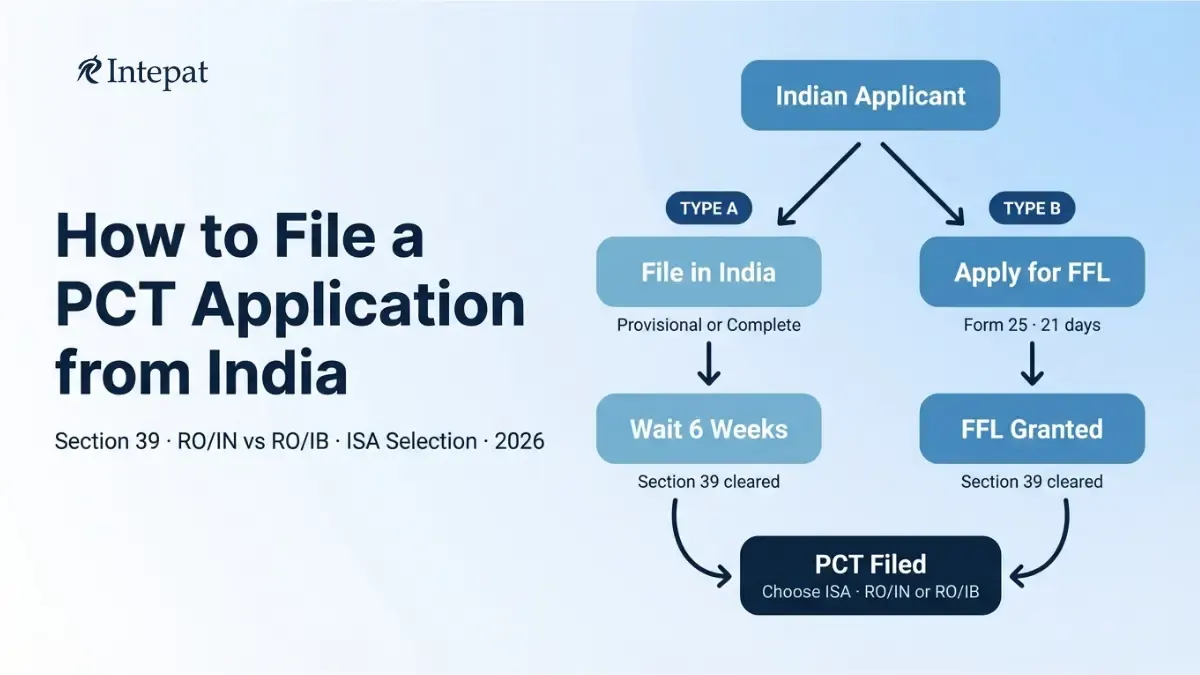
Indian residents cannot file a patent application outside India without prior clearance under Section 39 of the Patents Act, 1970. The restriction has 2 triggers: where no Indian application has been filed at all, or where the PCT application is filed within 6 weeks of the Indian filing date. Once 6 weeks have elapsed from the Indian filing date without any secrecy direction, the restriction is cleared and the PCT application may proceed without Form 25 permission.
Where the 6-week period has not elapsed, or where no Indian application has been filed, 2 lawful options exist: obtain prior written permission from the Controller on Form 25 with the prescribed fee before any international filing; or file the Indian application first (either a provisional or complete specification) and wait for the 6-week window to close with no direction received.
The critical practical risk: filing via RO/IB without a prior Indian application. WIPO cannot check Section 39 compliance; the defect is not flagged during the international phase and surfaces only at national phase entry or enforcement, where it can affect validity. Applications filed this way regularly complete the entire international phase without any notice of the violation. Correcting a Section 39 violation at national phase is more expensive than preventing it before filing. Filing via RO/IN is different: the IPO has visibility into Indian filings and can issue a deficiency notice. The Foreign Filing Licence and the secrecy directions framework under Section 35 are the statutory basis for this restriction.
Filing Through the Indian Patent Office as Receiving Office
Indian nationals and residents can file via 2 routes: the Indian Patent Office (RO/IN) or directly with the International Bureau (RO/IB) via ePCT. Fee structures, payment channels, and Section 39 defect visibility differ between the two.
Via RO/IN, all 4 offices in Kolkata, New Delhi, Chennai, and Mumbai are competent, with the PCT Section in New Delhi (patentin-pct@nic.in). Electronic filing via ePCT is accepted and preferred. Three fees are payable to the RO within one month of the filing date and are due together: the transmittal fee, the international filing fee, and the search fee. The transmittal fee is NIL for e-filing (all applicants); paper filing attracts INR 3,500 for natural persons, startups, small entities, and educational institutions, and INR 17,600 for others. The international filing fee of USD 1,667 (subject to reductions) is remitted in INR via NEFT/RTGS to the CGPDTM account at Central Bank of India. The search fee, where IPO is the ISA, is paid through the IPO e-filing portal; where ISA is any other authority, it is also remitted via NEFT/RTGS to CGPDTM. The application must include the Request on Form PCT/RO/101, description, claims, abstract, and drawings where applicable. Filing language is English or Hindi; the Request form and ISA search are in English only.
Via RO/IB, applicants file directly with WIPO using ePCT and pay all fees in CHF, EUR, or USD through WIPO Pay. Unlike RO/IN where e-filing carries a NIL transmittal fee, the IB transmittal fee of CHF 100 / EUR 107 / USD 125 is always due at RO/IB; the only exemption is for natural persons who qualify for the 90% reduction under Footnote 14 of the PCT Fee Tables. The key operational difference on Section 39: RO/IN can flag a defect at filing because the IPO has visibility into Indian filings. RO/IB has no such visibility and will not flag it, leaving a live legal risk at national phase.
The Fee Reductions Most Applicants Miss
Two separate reduction frameworks apply to PCT fees from India, and conflating them is a common error. The first is the WIPO 90% reduction on the international filing fee: this applies only to natural persons (individuals) who are nationals of and reside in India. India is on the qualifying list. Startups, companies, MSMEs, and educational institutions do not qualify for the WIPO 90% reduction on the international filing fee. The reduction brings the base fee of USD 1,667 down to approximately USD 167 for qualifying individuals. Where there are multiple applicants, every applicant must independently satisfy the natural-person and residency criteria.
90% IB fee reduction applicable to natural persons only. The WIPO 90% reduction on the international filing fee applies to individual inventors (natural persons) who are Indian nationals and residents. It does not apply to startups, companies, MSMEs, or educational institutions under PCT rules. IPO search and examination fee reductions for those entities are set separately by the Indian Patent Office.
Separately, the IPO sets its own entity-based reductions covering natural persons, startups, small entities, and educational institutions. The ISA search fee at IPO for these applicants is INR 2,500 (vs INR 10,000 for others). The preliminary examination fee at IPO as IPEA is INR 2,500 where ISA was also IPO, and INR 3,000 where ISA was another office. These are IPO-set rates confirmed in the PCT Applicant’s Guide India, valid from 1 January 2026.
E-filing reductions apply to all applicants. Filing only the Request in character-coded format (Item 4(b)) reduces the fee by USD 251. Filing the full application (Request, description, claims, and abstract) in character-coded format (Item 4(c)) reduces it by USD 376. These reductions apply after any 90% reduction where both are available. No other Indian IP article currently explains this distinction.
Choosing Your ISA Is a Strategic Decision, Not a Default
Indian applicants can choose from 8 International Searching Authorities: AT (Austrian Patent Office), AU (IP Australia), CN (CNIPA), EP (European Patent Office), IN (Indian Patent Office), JP (JPO), SE (PRV Sweden), and US (USPTO). The choice is not merely a cost variable; it affects the quality, language, and prosecution weight of the search report in your target markets.
IPO as ISA is the lowest-cost option (INR 10,000 for others; INR 2,500 for qualifying applicants) and makes commercial sense when India is the primary target market or budget is the binding constraint. The IPO as ISA is only competent for receiving offices of India, Iran, and Japan, which limits flexibility if you later want an IPEA from a different authority.
EPO and USPTO ISRs carry more prosecution weight in their respective jurisdictions. An EPO ISR shapes European prosecution directly; a USPTO ISR reduces examination friction in the US. If primary targets are the US, EU, Japan, or Korea, the higher search fee typically pays back in reduced prosecution time. A common error is selecting IPO as ISA for cost reasons when the primary market is the US, then discovering during US national phase that the ISR carries less prior-art weight with the USPTO examiner. The India ISA designation and its implications and the Patent Prosecution Highway are worth reviewing alongside this decision.
After Filing: The Chapter II Option
After the ISR and Written Opinion are received, applicants may file a Demand for International Preliminary Examination under Chapter II, before 22 months from the priority date. The IPEA options for Indian applicants are AT, AU, IN, and SE (and EP, CN, JP, or US where the ISA was the same office). The preliminary examination fee at IPO as IPEA is INR 10,000 where IPO was also the ISA, and INR 12,000 otherwise (qualifying applicants: INR 2,500 or INR 3,000 respectively). Chapter II is worth the cost when the ISR raises substantive objections and a formal written opinion before national phase entry improves the PCT application. In practice, it is most useful when key jurisdictions include the US or Europe, where early claim alignment before the IPRP can reduce downstream objections during national prosecution. Where the search is clean, most applicants skip it. Article 19 and Article 34 claim amendments can be filed whether or not Chapter II is pursued.
The 12-Month Filing Window and What Happens If You Miss It
A PCT international application claiming priority from an earlier Indian application must be filed within 12 months of the Indian priority date. Miss that window and the priority claim is lost. The PCT application can still be filed as a direct application without a priority claim, but the earlier filing date no longer protects against intervening disclosures.
RO/IN does not accept restoration of the right of priority. Filing a PCT application directly without a prior Indian application means losing the earlier filing date benefit in all designated states. Options where the deadline is at risk are at detailed options if you have already missed the 12-month deadline.
One practical option where the 12-month window is running short: post-dating the Indian application. Under Section 17 of the Patents Act, 1970, an applicant can request that the Indian application be post-dated to a date up to 6 months after the actual filing date. Where no public disclosure of the invention has occurred before the post-date, the post-date becomes the effective priority date, and a fresh 12-month window runs from it. This is covered in detail at how post-dating works in practice under Section 17. The post-date request must be made before the priority date passes and before any public disclosure of the invention.
When PCT Makes Sense and When It Does Not
PCT makes sense when you are targeting 3 or more countries, when you need the 30-month window to validate commercial potential before committing national phase fees, and when an ISR from a credible authority will strengthen prosecution in your key markets. Qualifying applicants gain the most: the fee reduction means the international phase costs a fraction of what direct national filings in multiple countries would require at month 12.
PCT does not make sense when your target is 1 or 2 countries. Direct filing under the Paris Convention in those countries within 12 months is faster, cheaper, and skips the international phase entirely. The PCT vs Paris Convention trade-offs turn on exactly that number. Budget is also a factor: if you cannot fund national phase entries in at least 3 jurisdictions at month 30, the PCT application will lapse without generating any granted patents, and the international phase fees are non-refundable at that point.
One administrative benefit Indian applicants routinely overlook: India participates in the WIPO Digital Access Service (DAS). Priority documents are transmitted to designated offices at no fee through DAS, eliminating the need for certified paper copies in most jurisdictions. Enrol the Indian priority application in WIPO DAS India at the time of filing to activate this.
What the PCT Route Cannot Do
A granted PCT application does not exist. The international phase produces an ISR, a Written Opinion, and (if Chapter II was pursued) an IPRP. None bind national offices; each examiner conducts an independent examination and can reach different conclusions from the ISR.
National phase deadlines differ by jurisdiction. The US deadline under PCT Article 22(1) is 30 months; the EPO, Korea, and India are 31 months; China and Japan are 30 months. Verify each designated state against the WIPO time limits table (wipo.int/en/web/pct-system/texts/time_limits) before any national phase entry decision.
India’s 31-month deadline is absolute. The Indian Patent Office does not permit reinstatement of rights for a missed national phase entry and does not accept requests for restoration of the right of priority at the national phase stage. Once lapsed, patent rights in India cannot be recovered. Applicants who treat a PCT filing as protection itself often discover this gap only after the deadline has passed. Consequences and limited restoration options at other designated offices are addressed at late PCT national phase entry. Translation costs, national filing fees, and local prosecution expenses are not deferred; they accumulate in full at the applicable national phase deadline, in every jurisdiction designated.
PCT International Phase: Official Fee Reference (India, 2026)
| Fee Item | Qualifying Applicants* | Others |
| Transmittal fee — e-filing | NIL | NIL |
| Transmittal fee — paper filing | INR 3,500 | INR 17,600 |
| International filing fee (base) | ~USD 167 (after 90% reduction — natural persons only) | USD 1,667 |
| E-filing reduction (full application) | USD 376 off base fee | USD 376 off base fee |
| Search fee — IPO as ISA | INR 2,500 | INR 10,000 |
| Prelim. exam fee — IPO as IPEA, ISA was IPO | INR 2,500 | INR 10,000 |
| Prelim. exam fee — IPO as IPEA, ISA was other | INR 3,000 | INR 12,000 |
* 90% reduction on international filing fee: natural persons (individuals) who are nationals of and reside in India (WIPO qualifying state). IPO entity reduction on search/IPEA fees: natural persons, startups, small entities, and educational institutions. E-filing reductions (Item 4(b)/(c)): all applicants. Sources: WIPO PCT Applicant’s Guide India, 1 January 2026; PCT Fee Tables, 1 February 2026; full fee schedule at wipo.int/pct-system/fees.
Receiving office, ISA selection, fee reduction eligibility, and Section 39 clearance are the four decisions that shape cost, validity, and prosecution strategy across every national phase. Each must be aligned before filing, not resolved after a deficiency notice has been issued.
Intepat IP’s patent prosecution team handles PCT international applications from India, including Section 39 clearance, ISA selection, fee reduction eligibility assessment, and coordination across international and national phases.
Frequently Asked Questions
A PCT application establishes an international filing date and produces an International Search Report. It does not grant a patent anywhere. Each country where protection is sought requires a separate national phase entry and independent examination. Applicants who treat the PCT filing itself as protection will find lapsed rights at month 30 if national phase entries were not completed.
The filing requires: the Request on Form PCT/RO/101; description, claims, abstract, and drawings; a priority document if claiming priority (transmittable at no fee via WIPO DAS); a declaration of inventorship; and, if the applicant is not the inventor, a document evidencing the right to file. Where an agent is appointed, a power of attorney on Form PCT/POA is required.
Indian residents cannot file a PCT application outside India without clearance. The lawful options are: file in India first and wait 6 weeks with no secrecy direction, or obtain prior permission on Form 25 (Section 39, Patents Act 1970). Filing via ePCT does not bypass this. RO/IB will not flag the defect; RO/IN may. Non-compliance can affect validity in designated states.
The WIPO 90% reduction applies only to natural persons who are nationals of and reside in a qualifying state (India qualifies). The applicants must also be the sole and true owners of the application, with no obligation to assign or license rights to any party that does not itself qualify; this condition was clarified by the PCT Assembly in October 2017. An employee-inventor required to assign to a non-qualifying company cannot claim the reduction. Each applicant in a multi-applicant filing must independently meet all criteria.
For an individual (natural person) filing electronically via RO/IN with IPO as ISA: transmittal fee NIL, international filing fee approximately USD 167 (after 90% reduction and e-filing discount), search fee INR 2,500. For a company or startup filing electronically: transmittal fee NIL, international filing fee USD 1,291 (after USD 376 e-filing reduction), search fee INR 10,000. Professional fees are additional. See the the patent fees page for full figures.
IPO as ISA is cheapest (INR 2,500 or INR 10,000 depending on entity) and the right choice when India is the primary market. For US, EU, Japan, or Korea as target markets, EPO or USPTO as ISA carries more prosecution weight in those jurisdictions and typically reduces examination friction during national phase. IPO as ISA is only competent for ROs of India, Iran, and Japan, which constrains IPEA choices downstream.
The ISR identifies prior art documents that the ISA considers relevant to the novelty and inventive step of your claims. The accompanying Written Opinion states whether the claimed invention appears to be novel and inventive based on that prior art. Neither document binds any national or regional patent office. An EPO examiner can cite different prior art and reach a different conclusion. The value of the ISR is informational: it tells you, before national phase costs begin, what prior art exists and how strong your claims are likely to be. A negative Written Opinion is not fatal; many applications enter national phase with objections and succeed after amendment. What it does is allow you to amend claims under Article 19 or Article 34 before national phase, rather than responding reactively to each national office separately.
After the 12-month window closes, the priority claim cannot be asserted. The RO/IN will not restore priority rights. A PCT application filed without priority uses the PCT filing date as the effective date, meaning any public disclosure between the original and PCT filings becomes prior art. Some designated offices may restore priority under national law, jurisdiction-specific and not guaranteed. See detailed options are addressed in the article on missed PCT deadlines.
No registered patent agent is required at the PCT international filing stage. Any individual, startup, or company can file directly. An Indian address for service is mandatory; a foreign address does not satisfy this condition. If no Indian address is available, appointing a registered agent who holds one resolves it. Agents are searchable on the IP India portal at iprsearch.ipindia.gov.in. In practice, the combination of Section 39 timing, ISA selection, and fee reduction eligibility means most applicants find value in professional guidance even where it is not legally required.