




The IPO AI guidelines published on 7 August 2026 govern how Indian patent examiners and Controllers may use artificial intelligence during examination. AI may assist with classification, search, translation and drafting support. It may not substitute for the officer’s application of mind, and unpublished applications may not be entered into public AI tools.
This article addresses Indian patent practice only. The document is the Guidelines for the Use of Artificial Intelligence in Patent Examination Procedures, issued by the Office of the Controller General of Patents, Designs and Trade Marks and published on the IP India website on 7 August 2026, the date shown against this item on the Office’s news page. The PDF itself carries no printed issue date. These CGPDTM AI guidelines run to sixteen pages, followed by Annexure I, thirty-four pages of worked examples, and Annexure II, which carries a checklist and a proposed declaration. Two roles recur throughout: the Examiner searches the prior art and prepares the report, and the Controller is the officer who decides the application and takes any hearing.
| Quick answer |
| What changed: The Patent Office has set out rules for how its own officers may use AI while examining your application. What AI may do: Suggest classification codes and search terms, run prior-art searches on the Office’s subscribed search platforms, translate foreign-language documents, produce a first-cut breakdown of claim features for the officer to correct, and tidy the language of a draft office communication. What AI may not do: Replace the officer’s judgment on substantive matters, including novelty, inventive step, industrial applicability, sufficiency, clarity or unity of invention, and it may not receive unpublished application material through a public tool. What you should verify: Every cited document and every quoted passage, in the original, and whether the report itself states that a machine translation was relied on. |
Before going further, the short answer for pending applications. Nothing here requires an applicant or agent to file anything, change a form, pay a fee or amend a specification. The Guidelines are directed at the Patent Office’s own use of AI, not at applicants, and impose no stated filing duty on them. They carry no commencement date and no transitional provision, and they say nothing about reports already issued. What changes is the weight worth placing on verifying citations, quoted passages and translations in any report received from now on.
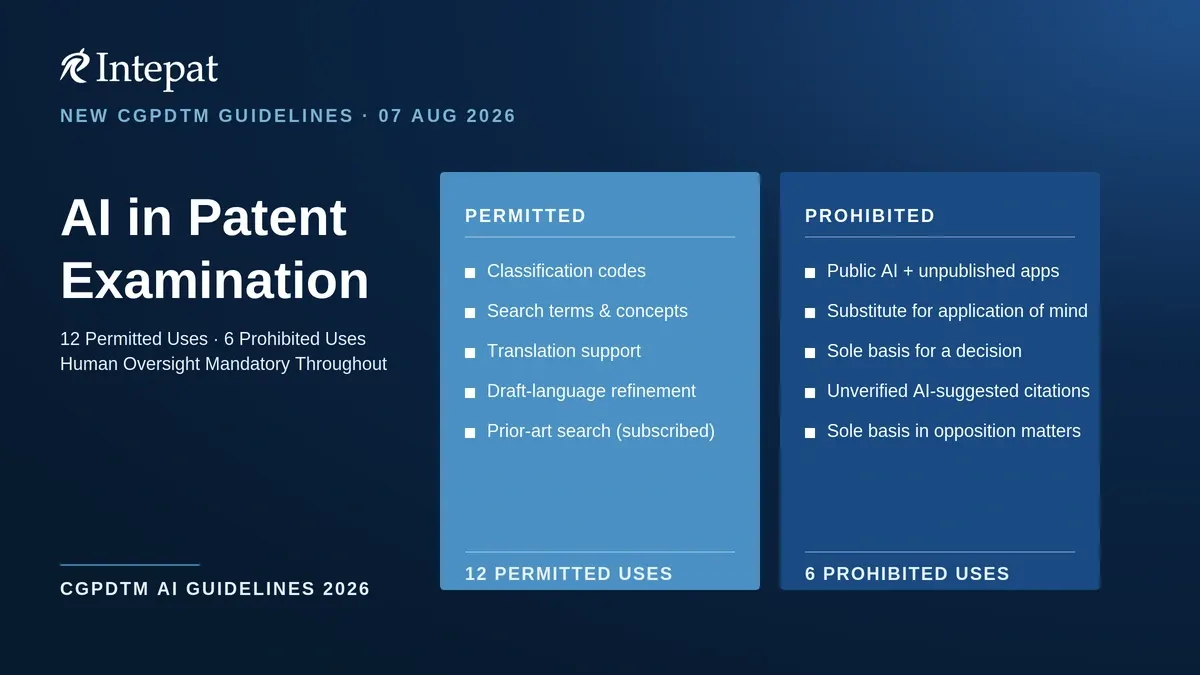
What the IPO AI Guidelines Permit and What They Prohibit
The Guidelines state their objective as supporting efficiency and quality in patent examination while preserving confidentiality, accountability, consistency and the independent application of mind by the Examiner or Controller. They are intended to guide and regulate AI use, and apply to examination tasks including screening, classification, search, translation support, drafting support, technical comparison and knowledge retrieval.
The governing principle is stated plainly: artificial intelligence is intended to assist, and not replace, the functions or the works of the Examiner or Controller. Any use of AI capable of influencing search or examination is made subject to manual review and validation, and the officer remains fully responsible for every official act performed in the course of search and examination that involves the use of AI in any manner. The Guidelines add that the use of AI shall not dilute or transfer that responsibility, and that AI-assisted output is to be adopted only after the officer is personally satisfied as to its correctness, relevance and appropriateness.
Six uses are listed as not permitted:
1. Entering unpublished application contents, confidential office records or internal deliberative material into public AI tools.
2. Using AI as a substitute for the officer’s application of mind on substantive matters, including novelty, inventive step, industrial applicability, sufficiency, clarity or unity of invention.
3. Issuing office actions, examination reports, hearing notices, decisions or other official communications solely on the basis of AI output without adequate human oversight.
4. Citing case law, prior art, scientific literature or other references suggested by AI without independent verification from authentic sources.
5. Using AI-generated content in official communications without review, correction and adoption by the officer.
6. Relying solely on AI for decisions affecting the rights of applicants, patentees or third parties, with opposition proceedings named as the example.
For the separate question of how AI inventions themselves are examined, see our analysis of the CRI Guidelines 2025 and Section 3(k). The document discussed here concerns the examiner’s tools, not the applicant’s subject matter.
Twelve Uses of AI in Examination, Each Carrying Its Own Safeguard
Section 4 of the Guidelines sets out a table of twelve categories of use, each with its possible benefit, its potential risk and the safeguards that attach.
| # | Use of AI in examination | Status, our reading | What the officer must still do |
| 1 | Identifying candidate IPC or CPC classifications (the international and cooperative classification schemes) | Assistive | Check against an authenticated source such as the WIPO IPC or CPC website; verify manually against the claims read with the complete specification; adjust the classification so the search moves in the right direction |
| 2 | Generating search terms and concept clusters | Assistive | Determine and select the final terms personally, judging which remain close to the claimed subject matter, which are technically adjacent but legally or functionally different, which broader terms may be used selectively for exploratory search, and which would import large volumes of irrelevant art |
| 3 | Preliminary claim-feature extraction | Restricted (Annexure I) | Re-read the claim manually; verify numerical ranges and dependencies; run no search or analysis on an unverified feature list |
| 4 | Translation support | Assistive, with recording | Read the translation with the drawings and surrounding disclosure; record reliance on machine translation in the reasoning for patentability |
| 5 | Improving structure or language of a draft office communication | Restricted to language (Annexure I) | Use only after the substantive draft is prepared; limit to grammar and readability; check every statement |
| 6 | Generating legal or technical citations | Preliminary only | Verify each citation in the original source; check the exact passage and context; discard it if independent verification is not feasible |
| 7 | Using a public generative AI tool with unpublished application material | Prohibited (express in Section 4) | Use only approved internal tools or secure authorised environments |
| 8 | Preliminary novelty or inventive step analysis | Preliminary only | Verify each mapped feature against the actual prior-art document; examine distinguishing features, amendments and the applicant’s own submissions independently; reach the final conclusion by own analysis |
| 9 | Quick identification of clarity issues in claims | Preliminary only | Compare the claim manually against the complete specification; determine independently whether the issue arises under the applicable statutory provision; reformulate any objection in official drafting style |
| 10 | Prior-art search using officially subscribed AI tools | Assistive | Frame and refine the query; assess results manually; try different formulations where the search is inadequate; select final results on independent judgment |
| 11 | Preliminary assessment of sufficiency of disclosure | Preliminary only | Examine specification, drawings, examples and common general knowledge manually; assess independently whether the alleged gap is real, material and relevant to the statutory requirement |
| 12 | Understanding case law and related concepts | Preliminary only | Check every quote, ratio decidendi and legal proposition against the primary source; read the judgment in the context of its own facts; discard fabricated or misattributed material |
A status is stated in the source for only three of these uses. Section 4 says of public-tool use with unpublished material that “this use is prohibited”. Annexure I says that claim-feature extraction “may therefore be treated as restricted”, and that language support “may therefore be permitted for formatting and language refinement, but restricted for substantive reasoning”. The other labels in the third column are our compression of the safeguards.
Two entries repay attention from the applicant’s side. Entry 4 requires that where machine translation is relied upon, that fact is recorded in the reasoning for patentability. Entry 8 requires that distinguishing features, amendments and the applicant’s own submissions are examined independently, which is the one safeguard in the document directed squarely at the response you file.
What the Patent Office’s Illustrative Exercises Show
Annexure I is unusual in that the Office records its own illustrative exercises rather than describing risk in the abstract. It is itself titled a non-exhaustive list of illustrative examples, and the main text lists fourteen categories of limitation and risk, expressly non-exhaustive, among them hallucination, false pattern matching, search drift, black-box opacity and bias in training data. The exercises show several of them happening.
On classification, the annexure records an exercise in which the independent claim of each of two applications was put to several AI tools under varying prompts and conditioning parameters, and the outputs compared against the classifications assigned manually. The suggested codes diverged across tools in both number and technical direction, and a set of thirty-one conditions supplied to one tool, instructing it to classify only what is claimed and to draw codes only from official schemes, still produced erroneous classifications. A second exercise, comparing three free generative models against the Classification team, records the suggestions as model-sensitive and inconsistent across models for the same application. The Office describes this comparison as based on a limited sample, while still concluding that human judgment remains necessary in each case.
The example with the sharpest consequence for an applicant concerns novelty. The annexure sets out a claim to a laparoscopic needle holder and a single prior-art document, then records two runs under differently framed prompts. Asked to focus on whether the prior art disclosed the same overall structure, the tool concluded that the claim lacked novelty. Asked to focus on the claimed detachable attachment between the straight proximal and curved distal shaft sections, the exercise produced the opposite conclusion on the same document. The Office observes that both responses appear, prima facie, fluent and persuasive, that the difference between them appears to lie in the treatment of that single feature, and that AI responses may not always be consistent or reproducible.
On case law, a generative tool was asked to supply verbatim quotations from an IPAB decision in a patent matter and produced passages presented as word-for-word extracts. The annexure records that only after repeated prompts about the veracity of those quotations did the tool concede that it had constructed them from secondary sources. It treats this as a typical example of fabricated verbatim quotation, which it describes as a severe form of extrinsic hallucination combined with misattribution, and offers it as the reason extreme caution is required.
The annexure is not uniformly negative. In a sufficiency exercise, a generative tool assessed an application the Office had refused for insufficiency in 2016, and its analysis aligned with the actual outcome.
The Confidentiality Line: Unpublished Applications and Public AI Tools
For in-house teams, this is the section that matters most for any application that has not yet published.
Annexure I directs that an officer shall not copy the claims, description, prior-art note, hearing note or an unpublished document into a public AI tool in order to obtain a summary, chart or draft. The stated reason is that such use risks moving unpublished subject matter, internal comments or sensitive official material outside the approved environment. Where approved internal tools or secure authorised environments exist, those are to be used instead, and where doubt exists about permissibility, the material is not to be entered into the tool at all. The main text carries the same position as prohibited use (a).
The Guidelines distinguish public tools, which are consumer-facing and trained on broad public data, from private tools operating in closed environments on controlled datasets, and note that free and paid versions of a public tool may differ in their data security features. The patent search databases subscribed to by the Office carry in-built AI tools designed for patent search, which the Office describes as offering better data security and a better grasp of prompts in the patent context.
Read alongside the patent examination procedure in India, the exposure is concentrated in the window before publication and in internal material such as hearing notes.
The Checklist and Declaration Annexure II Proposes
Annexure II sets out an eight-question checklist together with a proposed module requiring officers to declare their use of AI. The checklist opens with a rule of construction: if the answer to any of the questions is “No”, the use or output of AI tools should not be relied upon without further verification, or should not be used at all. The eight questions ask:
1. Is the proposed use permitted under the applicable office guidelines?
2. Is the material being entered free from unpublished applications, internal notes, hearing notes, internal draft communications, personal data and other confidential official material?
3. Is the proposed use limited to an assistive purpose and not intended to replace substantive examination or decision-making?
4. Have all technical, factual and legal statements in the output been independently verified from the record and relevant sources?
5. Have all cited prior-art documents, passages, authorities or references been independently checked?
6. Does the output correctly reflect the technical meaning, claim language and reasoning intended to be adopted?
7. Does the final analysis and conclusion remain the result of the officer’s own independent application of mind?
8. Has the use of AI been recorded, wherever such recording is required under office instructions?
The declaration asks whether any AI tool was used and for which purpose, with options covering classification, search support, technical support for preliminary understanding, language refinement and other permitted assistive use. The officer then confirms that no confidential or unpublished official material was entered into any public or unapproved tool, and that the search, citations, analysis, reasoning, conclusions and official text were independently reviewed and adopted on the officer’s own application of mind.
On visibility, the administrative-measures section says that the competent authority may prescribe recording of material AI use, including tool name, nature of use and date, and that such disclosure may be available to stakeholders to improve confidence in the examination process. That is enabling language, not a present right of access, and the declaration module is described as proposed. Applicants should not plan on obtaining an AI-use record for a given file until the Office says otherwise.
The same section contemplates an AI Governance Committee, which the competent authority may establish, drawn from Examiners and Controllers of the Examination Division with officers from the IT Office and the Quality Management System Division. Its listed functions include approving tools, running pilot studies, reviewing quality, errors, complaints and policy breaches, and revising the Guidelines periodically. This too is permissive, and the Guidelines describe no channel through which an applicant could raise such a complaint.
How This Changes the Way You Read an Examination Report
On our reading, the Guidelines create no new ground of objection or challenge. They are addressed to the Office’s own officers and say nothing about the statutory grounds on which an objection may be raised or answered. What they change is the set of checks worth running when an objection looks thin.
The Guidelines name two failure modes that are worth understanding without being worth pleading. They describe false pattern matching, where a document appears relevant on keyword or semantic similarity while being legally or technically irrelevant to the claim under examination, and classification and search drift, where suggested classifications or search terms divert the examination from the correct technical field. These are diagnostic labels for the drafter’s own use. They describe what may have gone wrong; the Guidelines do not themselves specify a new applicant-side remedy. The response still has to explain, on the merits, why the citation does not meet the novelty or inventive step standard.
Three checks follow from the text. First, where a foreign-language citation carries weight, check whether the report states that a machine translation was relied upon. The Guidelines require the officer to record that fact in the reasoning for patentability. The Guidelines do not say how that recorded fact will be surfaced to applicants, so if a translated passage is doing real work and no statement about translation appears on the face of the report, raise the translation squarely in the response and put a reliable translation on record. Second, retrieve and read every cited authority and passage in the original, because the Office has itself recorded a tool fabricating verbatim quotations from a judgment. Third, watch for conversational residue in official text: the annexure warns officers that generative tools append introductory lines and offers of further help, and that such material can damage the credibility of a communication even where the substantive report is correct.
Our guide to the first examination report and how to respond sets out the response mechanics. The Guidelines add a further layer of verification to the citation review that response already requires.
What Applicants Should Do Now, and When the Next Report Arrives
Before a report arrives, the Guidelines create no filing step for applicants; the confidentiality rule binds the Office’s own officers, not what an applicant does with its own material. The one habit worth adopting now is procedural: make citation and translation verification a standing part of every response, rather than something reached for only when a citation looks doubtful.
Four steps apply once a report is in hand.
1. Read every citation in the original before drafting a single argument, and treat any quoted passage as unverified until you have seen it in the source.
2. Where a foreign-language document is central, check whether reliance on machine translation is stated and obtain a reliable translation if the passage is load-bearing.
3. Where the cited art looks semantically adjacent but technically unrelated, structure the response around the specific technical distinction rather than around the search that produced it.
4. And where objections rest on reasoning that reads fluently but does not engage the claim as a whole, a hearing before the Controller remains the route to put the technical position directly.
For applicants prosecuting AI and machine learning inventions, two documents now run in parallel: the CRI Guidelines 2025 govern how such inventions are examined, as covered in our guide to patenting AI and machine learning inventions in India, and these Guidelines govern how AI may be used in examining them.
Verified as of 10 August 2026. The Guidelines state that they may require revision from time to time as the technology develops.
IPO AI Guidelines: Frequently Asked Questions
No. The Guidelines are addressed to the Office’s own officers and impose no obligation on applicants or agents. No form, fee, deadline or drafting requirement changes as a result of this document. What changes is the value of verifying citations, quoted passages and translations in reports received from now on.
Not autonomously. The Guidelines state that AI is intended to assist, and not replace, the functions of the Examiner or Controller. The officer remains fully responsible for every official act in search and examination that involves AI in any manner, and AI-assisted output may be adopted only after the officer is personally satisfied as to its correctness.
No. Entering unpublished application contents, confidential office records or internal deliberative material into public AI tools is listed among the prohibited uses. Officers are directed to use only approved internal tools or secure authorised environments, and to withhold material entirely where permissibility is in doubt.
The Guidelines carry no commencement date and no transitional provision. They describe how officers are to work, and they contain nothing that reopens a report already issued or that creates a route to have one withdrawn. Objections in an existing report are answered in the ordinary way, on their merits.
The Guidelines do not create an automatic disclosure entitlement. The administrative-measures section frames recording of AI use, covering tool name, nature and date, and stakeholder disclosure, as measures the competent authority may prescribe, and Annexure II describes the officer declaration as a proposed module rather than a live one.
No. Although they are issued by the Office of the Controller General of Patents, Designs and Trade Marks, their stated scope is the use of AI in patent examination tasks: screening, classification, search, translation support, drafting support, technical comparison and knowledge retrieval.
Disclaimer
This article explains the position on the use of artificial intelligence in Indian patent examination as at 10 August 2026 and is for general information only. It is not legal advice. Office practice and guidance documents change, and the Guidelines themselves state that they may require revision from time to time. Confirm the current position with the Indian Patent Office before you act. For advice on your specific application, consult a registered patent agent.