




The CRI Guidelines 2025 in India set out how the Indian Patent Office examines computer-related inventions under Section 3(k) of the Patents Act, 1970. Issued by the Controller General of Patents, Designs and Trade Marks (CGPDTM), the 2025 edition does not change the statutory law but introduces a structured examination framework that consolidates more than a decade of High Court jurisprudence and Patent Office practice.
For patent applicants and counsel prosecuting software or AI-related inventions before the Indian Patent Office, the updated guidelines materially clarify how Section 3(k) is applied during examination. In particular, the guidelines confirm that novel hardware is not mandatory to overcome the exclusion, maintain that business methods remain absolutely barred, require algorithm claims to be technically enabled rather than merely procedural, and impose higher disclosure expectations for AI and machine learning inventions compared with the 2017 guidelines.
This guide explains the CRI Guidelines 2025 examination framework, the four analytical limbs of Section 3(k), the implications for drafting and prosecuting software patents in India, and the practical changes practitioners should account for when preparing new CRI filings or responding to examination reports.
The Legal Framework in 2025
The foundation is section 2(1)(j) of the Patents Act, 1970: an invention must be a new product or process involving an inventive step and capable of industrial application. CRIs must clear this bar and then survive the four exclusions in section 3(k).
Section 3(k) excludes: a mathematical method, a business method, a computer programme per se, and an algorithm. These are not new. What the 2025 Guidelines add is a structured, step-by-step decision framework for each limb, incorporating the body of Delhi and Madras High Court rulings issued since 2019.
The anchor concept running through all four limbs is technical effect: a concrete, measurable improvement to an underlying technical system or process. This is not a new test either, but the 2025 Guidelines give it teeth. They require examiners to identify the core problem, map the proposed solution, and determine whether the resulting effect is genuinely technical or merely functional and administrative.
The most significant single clarification the Guidelines carry from recent case law: the Delhi High Court’s ruling in Raytheon Company v. Controller General of Patents and Designs (2023) is now embedded as policy. Requiring novel hardware to establish patentability of a CRI has no basis in law. A technical effect achieved through software running on general-purpose hardware is sufficient.
Master guide: Software patents in India | ipindia.gov.in: CRI Guidelines 2025
The Four-Limb Test: What It Means Strategically
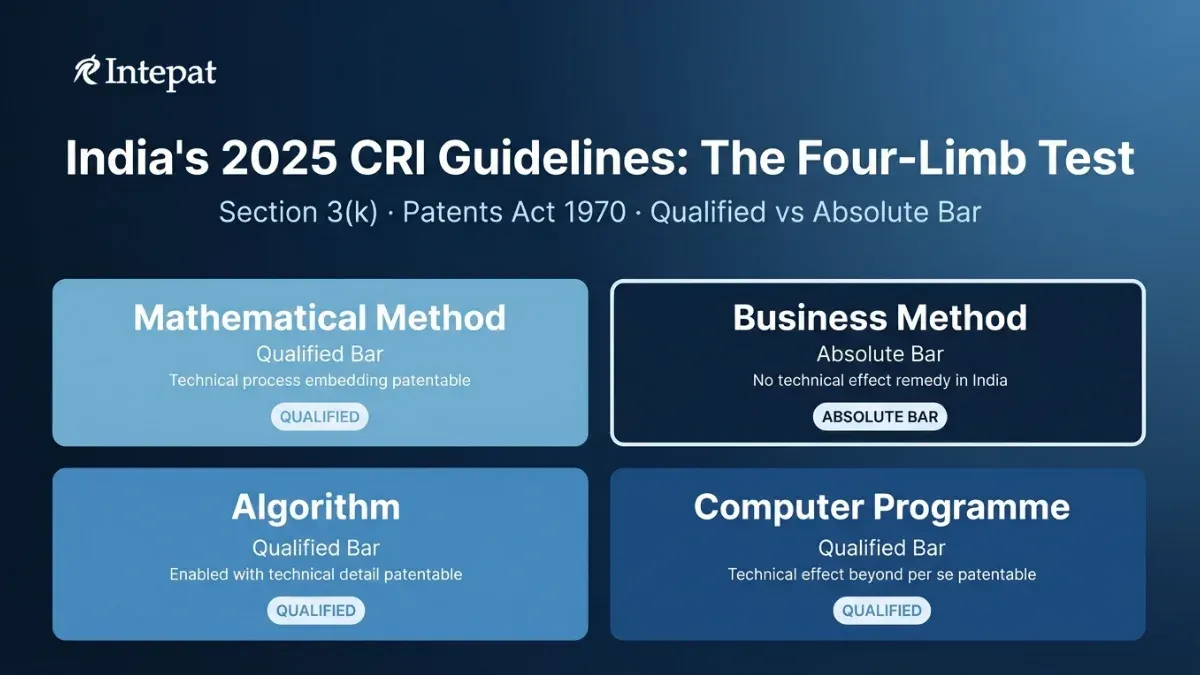
The IPO applies a structured analysis under each of the four limbs of section 3(k). The table below summarises the operative test for each limb and the strategic implication for prosecution.
| Limb | Operative Test | Bar: Absolute or Qualified? | Strategic Implication |
| Mathematical Method | Is mathematical processing the primary objective, or one step within a broader technical process? | Qualified. Maths embedded in a technical process is not excluded. | Claim the technical output and its real-world application. The formula is a means, not the invention. |
| Business Method | Is the core a commercial or administrative strategy, or a technical improvement to an underlying system? | Treated as absolute in Indian jurisprudence. Technical effect does not rescue a business method. This differs from UK and EP law. | If the claim’s substance is commercial logic, it cannot be patented regardless of how it is framed technically. |
| Algorithm | Are the steps abstract and devoid of technical specifics, or enabled with sufficient implementation detail to solve a real-world problem? | Qualified. An enabled algorithm with technical implementation detail and a concrete technical solution is not excluded. | Specify the technical components, data structures, and context. ‘Apply a series of steps’ is not enough. |
| Computer Programme per se | Does the claimed invention produce a technical effect beyond a mere incidental result of running code on hardware? | Qualified. The per se qualifier is intentional: inventions developed upon a computer programme that produce genuine technical effects are not excluded. | Technical effect must be concrete and measurable, not a description of what the software does for the user. |
| Why ‘Per Se’ Matters: The Legislative Intent |
| The 2001 Joint Parliamentary Committee report on the Patents (Amendment) Bill explains that per se was inserted specifically to preserve patentability for inventions ancillary to, or developed upon, a computer programme. The bar is not absolute. An invention that produces a genuine technical effect through software implementation is not excluded. This is the legal foundation for the entire technical effect framework. |
| Critically, per se qualifies only the computer programme limb. Business methods, mathematical methods, and algorithms do not carry this qualifier. The 2025 Guidelines make this explicit, and the Delhi High Court confirmed it in OpenTV Inc v. Controller of Patents and Designs (2023). European and UK arguments about technical effect saving a business method claim do not apply in India. |
What the IPO Actually Looks For: Translating the Test Into Practice
The 2025 Guidelines do not just state the tests. They show how examiners are expected to apply them through worked examples. For practitioners, the practical questions being asked at examination are these.
Is the technical improvement measurable and specific?
Examiners are directed to identify a concrete technical effect: faster processing, reduced memory utilisation, improved throughput, lower latency, enhanced encryption, real-time hardware control. Vague improvements such as ‘more efficient’, ‘enhanced performance’, or ‘improved user experience’ will not satisfy this test. The effect must be demonstrable and tied to the technical architecture of the claimed system.
A recipe management application that organises data for a user’s convenience produces no measurable technical effect on the underlying system. An adaptive network optimiser that dynamically adjusts transmission parameters to achieve quantified throughput gains does.
Is the claim substance business logic, or technical architecture?
The examiner is instructed to look through the technical framing and ask what problem the invention actually solves. A dynamic pricing engine for online advertisements, implemented on a server with a database, applies business rules to commercial data. The server and database are infrastructure, not invention. The core is a revenue strategy, not a technical improvement to the infrastructure itself.
By contrast, an NFC-based contactless payment method that technically improves the operational infrastructure of a POS terminal is not a business method, even though it operates in a commercial context. The business context is a constraint on the invention, not its substance.
Is the disclosure enabling, or is it a use-case scenario?
The 2025 Guidelines raise disclosure requirements significantly, particularly for AI/ML applications. The Madras High Court’s January 2025 judgment in Caleb Suresh Motupalli v. Controller of Patents is instructive: a specification that assembles published literature and describes a proposed use case without enabling implementation fails section 10(4)(a). The court found that working the claimed invention would require undue experimentation entailing the use of inventive faculty. That is not a patent; it is a research proposal.
The test is whether a person skilled in the art can reproduce the invention without inventive contribution of their own. For software inventions, this means the specification must disclose not just what the system does, but how it does it.
Is hardware interaction real or decorative?
Adding ‘a processor and a memory’ to a claim does not transform excluded subject matter into a patentable CRI. Examiners are directed to assess whether the interaction between software and hardware is substantive. Does the software materially change how the hardware performs? Does it enable the hardware to achieve something it otherwise could not? Or is the hardware simply the medium on which excluded software runs?
The Ab Initio Technology judgment (2024) states the standard clearly: if an innovative input in the form of a process, system, or method enhances the computational ability of the processor, the effect is technical. The technical effect connects input to processor at a substantive level, not at the level of specifying that a computer is involved.
Navigating CRIs: Insights from the Raytheon case
Emerging Technologies: AI/ML, Blockchain, and Quantum Computing
The 2025 Guidelines introduce a dedicated chapter on these three categories. The examination approach is consistent across all three: the core question is whether the specification discloses a technically implementable solution or remains at the level of abstract theory.
AI and Machine Learning
AI-assisted inventions, where AI is used as a tool under human direction, are not categorically excluded. AI-generated inventions, produced autonomously by an AI system with minimal human intervention, are not patentable: section 6 of the Patents Act requires a human inventor.
Sufficiency of disclosure is the dominant prosecution risk for AI/ML applications. The specification must enable a person skilled in the art to reproduce the model without inventing their way through the gaps. This requires disclosing the neural network architecture with structural detail, the training dataset’s characteristics, the full pre-processing pipeline, training parameters, and validation results demonstrating that the model achieves the claimed technical effect.
A specification that describes the model’s intended outputs, cites prior literature, and gestures toward the technical approach without enabling implementation will fail. The 2025 Guidelines provide seven detailed scenarios illustrating the standard across different AI invention types: trained model applications, reinforcement learning systems, dataset-centric inventions, and OS-level hardware integration.
Further reading: AI & ML Patents India
Blockchain
Blockchain claims directed to the theoretical concept of a distributed ledger are excluded. A practical implementation that integrates blockchain with physical systems and delivers a concrete technical outcome may not be. The specification must fully disclose the consensus mechanism and its parameters, smart contract logic, data structures including block linkages, and any IoT or oracle integration. The technical effect must be identified with specificity: reduced transaction latency, tamper-proof provenance across a supply chain, automated enforcement without centralised server dependency.
Quantum Computing
Abstract claims invoking superposition or entanglement without specifying a concrete implementation are excluded. A hybrid quantum-classical system with identified qubit architecture, error correction methodology, classical control unit design, and cryogenic specifications may overcome exclusion. The specification must enable a skilled person to reproduce the system, not merely understand the quantum mechanical principles it applies.
Table: Minimum Disclosure Standards for Emerging Technology CRIs
| Technology | Minimum Disclosure for Enablement | Technical Effect That May Overcome Section 3(k) |
| AI / ML / DL | Architecture with layer/activation detail; training dataset characteristics; pre-processing pipeline; training protocol; validation metrics | Measurable improvement in processing accuracy, latency, throughput, or hardware efficiency attributable to the specific implementation |
| Blockchain | Consensus mechanism parameters; smart contract logic and trigger conditions; data and block structures; oracle integration; IoT protocols | Reduced latency, tamper-proof data integrity, automated enforcement without central servers, hardware integration via IoT devices |
| Quantum Computing | Qubit materials and dimensions; control unit architecture; compiler-to-pulse translation flow; cryogenic environment specs; integration block diagrams | Enhanced gate fidelity, reduced decoherence, adaptive qubit control producing measurable computational improvement over classical systems |
Common Rejection Patterns Under the 2025 Guidelines
Based on the examination framework now codified in the 2025 Guidelines and the case law embedded within them, practitioners should anticipate the following objection patterns. Recognising them early shapes both specification drafting and response strategy.
On computer programme per se: “The claimed invention does not demonstrate a technical contribution beyond the conventional use of computing resources. The effect identified is incidental to running the software on hardware and does not constitute a technical effect.” On business method: “The claimed method, in its substance, addresses a commercial or administrative problem and provides a business strategy as the solution. The use of technical means to implement the strategy does not overcome the exclusion.” On algorithm: “The claimed steps describe a sequence of procedural instructions devoid of technical specifics required for implementation. The claim does not detail how the steps are applied in a specific technical context to produce a concrete technical solution.” On AI/ML sufficiency: “The specification does not sufficiently disclose the architecture, training methodology, and validation results to enable a person skilled in the art to reproduce the claimed invention without undue experimentation.”
Each of these objections has a structural cause in the application. Identifying the cause before filing is considerably more efficient than addressing it after first examination.
2017 vs 2025 Guidelines: What Changed for Prosecution Step-by-step decision frameworks: Each of the four section 3(k) limbs now has an explicit numbered analysis sequence with worked examples. Examiners have less discretion, and practitioners can map their claims against the same framework. Novel hardware requirement formally rejected: Embedded from Raytheon (2023). Applications that were previously rejected on hardware grounds should be reassessed. Business method bar clarified as absolute: Explicit divergence from UK and EP law confirmed. Technical effect does not save a business method claim in India. AI/ML chapter introduced: Seven detailed scenarios covering trained model applications, reinforcement learning, dataset-centric inventions, and hardware integration. Disclosure standards are substantially higher than in 2017. Algorithm enablement standard formalised: The abstract/enabled distinction for algorithm claims is now explicit, with worked examples on both sides of the line.
Practical Filing Strategy: What to Do Before You File
Section 3 describes what examiners test for. This section is about how to build an application that withstands that test. The 2025 Guidelines create a clear set of drafting standards that, if applied from the outset, reduce the risk of substantive 3(k) objections materially.
Draft around measurable technical metrics
The strongest CRI applications quantify the technical effect. Do not claim that the system ‘improves performance’: specify that it reduces processing latency by eliminating redundant cache lookups, or achieves lossless compression at a ratio not achievable by prior art methods. Benchmarks, performance comparisons, and architectural diagrams supporting those metrics belong in the specification, not as afterthoughts in the response to examination.
Embed architecture diagrams that show hardware-software interaction
Diagrams that show how the software directly controls, modifies, or enhances the behaviour of specific hardware components provide examiners with the clearest possible evidence that the claimed effect is technical rather than functional. Signal flow diagrams, system architecture drawings with labelled components, and data flow charts are not cosmetic; they are substantive disclosure that addresses the hardware interaction question directly.
Eliminate business-rule language from technical claims
Review every claim for language that describes a commercial or administrative outcome: pricing, billing, customer management, transaction rules, scheduling logic. If such language carries the weight of the claimed improvement, the claim is vulnerable. Restructure so that the technical infrastructure is the subject of the claim, and the business context is expressed as a field of application or a constraint, not as the invention.
Avoid abstract functional claiming
Claims drafted in means-plus-function format without specific structural disclosure, and method claims that describe what happens without specifying how, are the fastest route to a section 3(k) objection. Each step or means should be tied to a specific component or mechanism disclosed in the specification. For algorithm claims in particular, the technical context, the specific implementation, and the real-world problem being solved must all be present in the claim or clearly supported by the specification.
Support AI/ML enablement thoroughly
For AI and machine learning inventions, apply the 2025 Guidelines’ disclosure checklist as a drafting standard, not a post-grant concern. Neural network architecture with layer detail, dataset characteristics, pre-processing methodology, training protocol, and validation results should be drafted into the specification before filing. An application that describes the intended outputs of a model without enabling its reproduction will not survive examination.
Claim comparison: what the difference looks like in practice
The distinction between a claim that survives section 3(k) scrutiny and one that does not is often visible in the language of the claim itself.
Vulnerable: “A system comprising a processor configured to calculate a customer priority index based on transaction history and assign service tiers accordingly.” Why it fails: The substance is a customer management strategy. The processor is infrastructure, not invention. The technical effect claimed is the output of a business rule, not an improvement to a technical system. Stronger: “A system comprising a processor configured to dynamically allocate memory blocks based on real-time cache miss rate analysis, wherein allocation decisions reduce average memory access latency by prioritising high-frequency data structures.” Why it survives: The improvement is to the processor’s internal operation. The technical effect, reduced memory access latency, is measurable and tied to a specific architectural mechanism. The claim discloses how the hardware performs differently as a result of the invention.
Patent filing strategy in India | Patent prosecution in India
The Framework Is Clear: Your Strategy Should Match It
The 2025 CRI Guidelines remove most of the ambiguity that complicated CRI prosecution under the 2017 edition. Examiners now work from structured decision frameworks rather than broad principles, and those frameworks are visible to practitioners. The practical effect is that the gap between a well-prepared application and a poorly prepared one is wider than before: a specification built around measurable technical effects, enabling disclosure, and clear hardware-software interaction will move through examination with far less resistance than one drafted without these elements in mind.
Meeting the 2025 standard is not a higher bar: it is a clearer one.
Preparing or prosecuting a software or CRI patent application in India?
Share your draft claims or application number for a focused review against the 2025 CRI Guidelines, covering technical effect sufficiency and section 3(k) exposure.
Disclaimer
This post is for informational purposes only and does not constitute legal advice. For advice specific to your situation, consult a registered patent or trademark agent.
Frequently Asked Questions – CRI GUIDELINES 2025
No. The statutory framework is unchanged: the Patents Act, 1970 and section 3(k) have not been amended. The Guidelines provide structured decision frameworks that clarify how examiners apply existing law. The practical effect for practitioners is greater predictability: the tests are now explicit, and a well-prepared application can be benchmarked against them before filing.
No. The 2025 Guidelines confirm, drawing on the Delhi High Court’s ruling in Raytheon Company v. Controller General of Patents and Designs (2023), that requiring novel hardware has no basis in law. A technical effect achieved through the interaction of software and general-purpose hardware is sufficient, provided the effect is concrete, measurable, and goes beyond the incidental result of running code.
No. India’s bar on business methods under section 3(k) is absolute and is not qualified by per se. This distinguishes India from the UK and EP frameworks, where a technical effect may rescue a business method claim. In India, if the substance of the claimed invention is a commercial or administrative strategy, the bar applies regardless of the technology used to implement it.
The specification must enable a person skilled in the art to reproduce the invention without undue experimentation. For AI/ML inventions this requires: the neural network architecture with sufficient structural detail; the training dataset’s characteristics and labelling methodology; the complete pre-processing pipeline; training parameters including loss function, optimiser, and epochs; and validation results demonstrating that the model achieves the claimed technical effect in practice.
AI-generated inventions, created autonomously by an AI system with minimal human involvement, are not patentable: section 6 of the Patents Act requires a human to be the true and first inventor. AI-assisted inventions, where a human inventor directs the inventive process using AI as a tool, are not categorically excluded and can qualify for patent protection where the standard patentability criteria and the technical effect requirement are met.
The five changes with the greatest prosecution relevance are: explicit step-by-step decision frameworks for all four limbs of section 3(k); a dedicated chapter on AI/ML, blockchain, and quantum computing with detailed enablement standards; formal rejection of the novel hardware requirement; clarification that India’s business method bar is absolute, unlike UK and EP law; and a new abstractness/enablement test for algorithm claims with worked examples on both sides of the line.
The 2025 Guidelines state they apply with immediate effect. In practice, this means examiners are expected to apply the updated frameworks to applications currently under examination, including those where a first examination report has not yet issued. For applications already in prosecution, this is material: if a pending response to a section 3(k) objection relies on arguments that the 2025 Guidelines now frame more precisely, those arguments should be reviewed and, where necessary, sharpened to align with the current examination standard. The Guidelines do not create new statutory grounds for objection, but they do clarify how existing grounds are to be applied.