




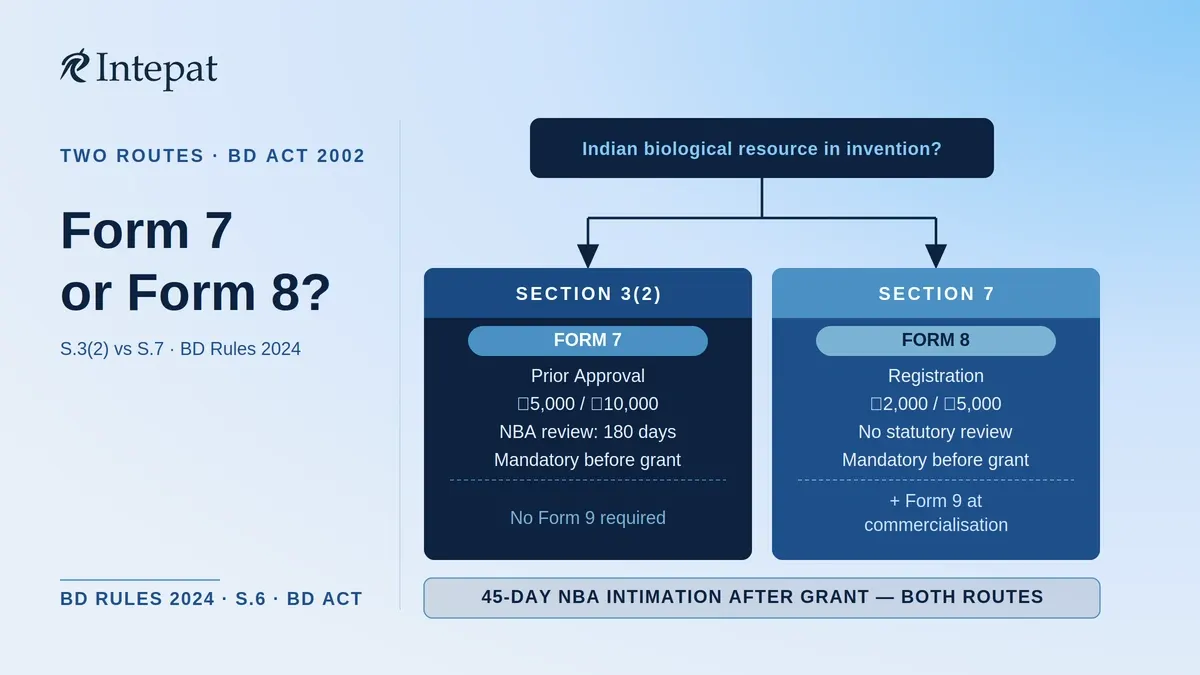
Section 6 of the Biological Diversity Act 2002 requires compliance with the National Biodiversity Authority (NBA) before a patent is granted, wherever the invention draws on biological resources accessed from India. The 2023 Amendment introduced two separate routes: prior approval in Form 7 for applicants covered by Section 3(2), and registration in Form 8 for applicants covered by Section 7, followed by prior approval in Form 9 at commercialisation.
These NBA requirements run in parallel with a separate obligation under Section 10(4)(d)(ii)(D) of the Patents Act 1970 to disclose the source and geographical origin of any biological material used in the invention in the complete specification.
Jurisdictional scope: India, with reference to the Biological Diversity Act 2002 as amended by the Biological Diversity (Amendment) Act 2023 (in force 1 April 2024), the Biological Diversity Rules 2024 (G.S.R. 665(E), notified 22 October 2024, in force 21 December 2024), and the Patents Act 1970. Fees, forms and portal procedures verified as of July 2026.
| At a glance |
| Section 3(2) applicants (non-citizens, NRIs, foreign entities, Indian-registered entities controlled by a foreigner) File Form 7 for prior NBA approval before grant. Fee: ₹5,000 (individual) or ₹10,000 (entity). NBA decides within 180 days. Section 7 route (generally for resident Indian citizens and qualifying Indian entities, subject to the express exclusions in Section 7) File Form 8 to register with the NBA before grant. Fee: ₹2,000 (individual) or ₹5,000 (entity). File Form 9 for prior approval at commercialisation. Fee: ₹5,000 (individual) or ₹10,000 (entity). Both routes Intimate the NBA within 45 days after grant. Patents Act disclosure Where biological material is used in the invention, the complete specification must disclose its source and geographical origin under Section 10(4)(d)(ii)(D) of the Patents Act, irrespective of which NBA route applies. Important Section 6 is the IPR-specific compliance route only. Separate access, research-transfer or State Biodiversity Board obligations may arise under Sections 3, 4 or 7 depending on how the biological resource was accessed. Section 6 does not apply to applications for rights under a law relating to the protection of plant varieties. |
When does Section 6 apply to a patent?
Section 6 becomes relevant where an intellectual property right concerns an invention based on research or information on a biological resource accessed from India, including material deposited in a repository outside India, or on associated traditional knowledge. Rule 16 of the Biological Diversity Rules 2024 also refers to digital sequence information relating to such a biological resource in the Form 7 and Form 8 application procedures. Section 6 itself does not use the phrase “digital sequence information.”
The NBA administers the Section 6 approval and registration framework and the associated access-and-benefit-sharing arrangements.
The scope of Section 6 extends beyond material physically collected in India. A biological resource deposited with a repository in another country, or one from which digital sequence information has been derived, can fall within the Rule 16 procedures. Where the invention also draws on traditional knowledge associated with biological resources, that association falls expressly within Section 6.
Section 6(3) of the BD Act provides that Section 6 does not apply to an application for a right under a law relating to the protection of plant varieties.
Before the 2023 Amendment took effect on 1 April 2024, Section 6(1) required every applicant to obtain prior NBA approval before applying for an intellectual property right. For patent applicants, a proviso allowed that approval to be obtained after acceptance but before sealing. The 2023 Amendment replaced that single framework with the Form 7 and Form 8 routes described below.
Which category applies?
The applicable compliance route depends on whether the applicant falls under Section 3(2) or Section 7. These categories do not map simply to citizenship.
Section 3(2) applicants are:
- persons who are not citizens of India
- citizens of India who are non-residents as defined in clause (30) of Section 2 of the Income-tax Act 1961 (NRIs)
- body corporates, associations or organisations not incorporated or registered in India
- body corporates, associations or organisations incorporated or registered in India but controlled by a foreigner within the meaning of Section 2(27) of the Companies Act 2013
An NRI who holds Indian citizenship falls in this category and must follow the Form 7 prior-approval route. An Indian-registered company falls in this category where it is controlled by a foreigner under Section 2(27) of the Companies Act 2013. The statutory test is control, including control over the board, management or policy decisions, rather than foreign shareholding percentage alone.
The Section 7 route generally applies to persons outside Section 3(2): broadly, resident Indian citizens and qualifying Indian entities. Section 7 contains express exclusions: its provisions do not apply to codified traditional knowledge, cultivated medicinal plants and their products, local people and communities of the area including growers and cultivators of biodiversity, and vaids, hakims and registered AYUSH practitioners practising indigenous medicine for sustenance and livelihood. Because Section 6(1A) applies to “any person covered under section 7,” these exclusions affect the Section 6(1A) registration route as well. The applicable route should therefore be confirmed against both the applicant’s status and the circumstances in which the biological resource was accessed.
Practical example
A resident Indian individual or Indian-incorporated company with no foreign control will ordinarily use the Form 8 route. An Indian citizen who is a non-resident under the Income-tax Act uses the Form 7 route. An Indian company must examine whether a foreigner exercises control under Section 2(27) of the Companies Act rather than relying solely on its place of incorporation.
Section 3(2) applicants: Form 7 approval
A Section 3(2) applicant must obtain prior NBA approval before the patent is granted. The application is filed on the NBA web portal in Form 7 under Rule 16(1)(a) of the Biological Diversity Rules 2024.
Form 7 asks for the common and scientific names of the biological resource, the source of access (including whether access was from a repository outside India), the geographical location at village, taluk, district and State level, and details of any approval already obtained under Section 3 for accessing the resource.
The application fee is ₹5,000 for an individual and ₹10,000 for an entity (First Schedule, entry 7, BD Rules 2024, verified July 2026).
Under Rule 16(1)(c), the NBA decides within 180 days from the date of receipt of the application or from the date it receives any further information it requests, whichever is later. Approval issues as a written agreement on mutually agreed terms. The applicant must sign that agreement within 90 days of the draft being furnished.
After the patent is granted, the Section 3(2) applicant must intimate the NBA within 45 days under Rule 16(1)(e). Rule 16(1)(e) states that failure to give this intimation will attract action as the competent authority considers appropriate; the Rules do not prescribe a fixed automatic penalty for every delayed intimation.
Section 3(2) applicants do not file Form 9, because Section 6(1B) of the BD Act applies only to persons covered by Section 7. However, compliance does not end at grant: the terms of the Form 7 approval agreement continue to apply, and the 45-day post-grant intimation obligation runs regardless of when the approval was obtained.
Section 7 applicants: Form 8 registration
A Section 7 applicant must register with the NBA before the patent is granted. The registration is completed on the NBA web portal in Form 8 under Rule 16(2)(a).
Form 8 asks for the common and scientific names of the biological resource, the access source, and the geographical location at village, taluk, district and State level.
The registration fee is ₹2,000 for an individual and ₹5,000 for an entity (First Schedule, entry 8, BD Rules 2024, verified July 2026). The registration must be in place before the competent authority grants the patent. The Biological Diversity Rules 2024 do not specify a 180-day decision period for Form 8 registration; applicants should file well in advance of the expected grant date.
After the patent is granted, the Section 7 applicant must intimate the NBA within 45 days under Rule 16(2)(d).
Form 9 approval at commercialisation
A Section 7 applicant who has obtained a patent must obtain prior NBA approval before commercialising the patented invention under Section 6(1B) of the BD Act. The application is filed in Form 9 under Rule 16(3)(a).
The application fee is ₹5,000 for an individual and ₹10,000 for an entity (First Schedule, entry 9, BD Rules 2024, verified July 2026). Form 9 requires details of the intellectual property right obtained and revenue generated or likely to be generated. The NBA decides within 180 days from receipt of the application or from receipt of any further information it requests, whichever is later.
Benefit sharing and any other conditions are determined through the resulting approval agreement.
| Section 3(2) applicant | Section 7 applicant | |
| Before grant | Form 7: prior approval | Form 8: registration |
| Fee | ₹5,000 (individual) ₹10,000 (entity) | ₹2,000 (individual) ₹5,000 (entity) |
| NBA decision period | 180 days from application or requested information, whichever later | No statutory period prescribed for registration |
| After grant | Intimate NBA within 45 days; comply with Form 7 agreement terms | Intimate NBA within 45 days |
| At commercialisation | No Form 9; Form 7 agreement terms continue | Form 9 prior approval ₹5,000 individual / ₹10,000 entity 180-day decision period |
Source and geographical origin disclosure in the complete specification
The Patents Act 1970 imposes a disclosure requirement that operates independently of the NBA process. Under Section 10(4)(d)(ii)(D), the complete specification must disclose the source and geographical origin of biological material when that material is used in the invention. An applicant who holds a valid Form 7 approval or Form 8 registration but does not include this disclosure in the specification still fails Section 10(4)(d)(ii)(D).
The current Patent Form 1, the application form under the Patents Rules 2003, continues to use legacy wording: it requires a declaration that the invention uses the biological material from India and the necessary permission from the competent authority shall be submitted before the grant of patent. Form 1 does not separately refer to Form 8 registration or reflect the amended Section 6 structure. The BD Act and Rule 16 determine which route applies; the amended framework is not dependent on Form 1 wording.
Where the biological material is not of Indian origin, the source and geographical origin of that foreign material must still be mentioned in the specification.
Where the biological material cannot be sufficiently described in the specification and is not publicly available, it must be deposited with an international depositary authority under the Budapest Treaty no later than the Indian filing date. The complete specification must identify the depositary institution and state the date and accession number of the deposit. That reference may ordinarily be supplied within three months from the filing date; where a request for early publication under Rule 24A is filed before that three-month period expires, the reference must be furnished on or before the date of that Rule 24A request.
Practical note
Collecting common name, scientific name, access source and geographical location at village, taluk, district and State level is necessary to complete Forms 7 and 8. This is distinct from the statutory Patents Act requirement, which is to disclose the source and geographical origin in the complete specification, without prescribing village or taluk-level granularity. Gathering location detail at that level early is a prudent drafting practice that satisfies both requirements.
What happens after the patent is granted?
Both Section 3(2) and Section 7 applicants must intimate the NBA within 45 days of the patent grant. This is a Rule 16 obligation, separate from the specification disclosure requirement under the Patents Act.
Rule 16(1)(e) states that failure by a Section 3(2) applicant to give the 45-day intimation will attract action the competent authority considers appropriate. Rule 16(2)(d) sets out the 45-day obligation for Section 7 applicants without prescribing a specific consequence in that sub-rule. The post-grant intimation should not be treated as optional.
For Section 3(2) applicants, the terms of the Form 7 approval agreement remain operative after grant and may impose benefit-sharing payments or other continuing conditions.
For a Section 7 applicant, the specific Rule 16 step immediately following grant is the 45-day intimation. Prior approval in Form 9 must then be obtained before commercialisation of the patented invention.
Consequences of non-compliance
Under the Patents Act
Three grounds flow directly from a defect in the Section 10(4)(d)(ii)(D) specification disclosure. Non-disclosure or wrongful mention of the source or geographical origin of biological material used in the invention is a pre-grant opposition ground under Section 25(1)(j), available to any person after publication and before grant. It is a post-grant opposition ground under Section 25(2)(j), available to any interested person within one year from the date of publication of grant. It is also a revocation ground under Section 64(1)(p), available before the High Court on a petition by any interested person or the Central Government.
Where the invention relies on traditional knowledge, anticipation by knowledge available within any local or indigenous community is a pre-grant opposition ground under Section 25(1)(k), a post-grant opposition ground under Section 25(2)(k), and a revocation ground under Section 64(1)(q).
Under the Biological Diversity Act
Section 55, as substituted by the 2023 Amendment, prescribes a monetary penalty of not less than ₹1 lakh and up to ₹50 lakh for contravention of Sections 3, 4, 6 or 7. Where the damage caused exceeds the amount of penalty, the penalty shall be commensurate with the damage caused. In the case of a continuing contravention, an additional penalty may be imposed, not exceeding ₹1 crore.
The penalty is adjudicated by an officer appointed under Section 55A: either an officer not below the rank of Joint Secretary to the Government of India, or a Secretary to a State Government. Appeal against that order lies to the National Green Tribunal.
The 2023 Amendment replaced imprisonment for contraventions of Sections 3, 4, 6 and 7 with this adjudicated monetary-penalty regime. Section 58, which previously made such offences cognizable and non-bailable, was omitted. A contravention of Section 6 therefore no longer attracts imprisonment under Section 55. Other provisions of the Act, including Section 56 (which separately punishes contravention of directions or orders of the Central Government, State Government, NBA or State Biodiversity Boards with a fine), remain in force.
A specification disclosure defect under the Patents Act and a BD Act contravention are distinct: they have separate statutory elements, separate authorities and separate procedures. Depending on the facts, the same conduct may result in separate proceedings under each statute. Liability under one does not automatically establish liability under the other.
Frequently asked questions
No. Under the amended Section 6, the Section 7 route requires only registration with the NBA in Form 8 before grant, not prior approval. Prior approval in Form 7 is required for Section 3(2) applicants under Section 6(1). Prior approval in Form 9 is required for Section 7 applicants at the commercialisation stage under Section 6(1B).
Section 3(2) covers non-citizens; Indian citizens who are non-residents under the Income-tax Act 1961; body corporates not incorporated or registered in India; and Indian-incorporated entities controlled by a foreigner under Section 2(27) of the Companies Act 2013. For Indian companies, the statutory test is control over the board, management or policy decisions, not foreign shareholding percentage alone.
Yes. Section 6 expressly covers biological resources accessed from India, including those deposited in a repository outside India, and associated traditional knowledge. Rule 16 also refers to digital sequence information relating to a biological resource. If the invention draws on Indian biological material through any of these routes, Section 6 and Rule 16 compliance is required.
Non-disclosure or wrongful mention of source or geographical origin is a pre-grant opposition ground under Section 25(1)(j), a post-grant opposition ground under Section 25(2)(j) (which must be filed within one year from publication of grant), and a revocation ground under Section 64(1)(p) of the Patents Act 1970.
Under Rule 16(1)(c) (Form 7) and Rule 16(3) (Form 9), the NBA decides within 180 days from the date of receipt of the application or from the date of receipt of any further information it requests, whichever is later. The applicant must sign the mutually agreed terms within 90 days of the draft being provided.
No. The Biological Diversity Rules 2024 specify a 180-day decision period for Form 7 approval (Rule 16(1)(c)) and Form 9 approval (Rule 16(3)), but not for Form 8 registration. The registration must be completed before the patent is granted, so applicants should file Form 8 well in advance of the expected grant date.
Official sources
| Source | Notes | Link |
| Biological Diversity Act 2002 (consolidated) | Current Act incorporating 2023 Amendment (w.e.f. 1 April 2024) | indiacode.nic.in |
| Biological Diversity (Amendment) Act 2023 | Gazette copy (No. 10 of 2023, in force 1 April 2024) | egazette.gov.in |
| Biological Diversity Rules 2024 | G.S.R. 665(E), notified 22 October 2024, in force 21 December 2024 | nbaindia.org ABS portal |
| NBA ABS e-filing portal | For Forms 7, 8 and 9 | nbaindia.org |
| Patents Act 1970 (consolidated) | Sections 10(4)(d)(ii)(D), 25(1)(j)/(k), 25(2)(j)/(k), 64(1)(p)/(q) | indiacode.nic.in |
| Patents Rules 2003 | Rule 13(8): deposit reference timing; Rule 24A: early publication | ipindia.gov.in |
| Patent Form 1 | Current application form; uses legacy ‘permission’ wording, not updated for Form 8 registration | ipindia.gov.in |
| Patent Office Manual 2019 | Version 3.0, 26 November 2019; predates the 2023 Amendment; does not have force of law | ipindia.gov.in |
This article is for general informational purposes and does not constitute legal advice. NBA forms, statutory fees, portal procedures and timelines may be amended; the current Act, Rules, official notifications and NBA portal should be checked before filing. Statutory references reflect the position as of July 2026.