




A patent invalidity search looks for prior art or procedural defects that could support challenging an already granted patent, in any jurisdiction. Every patent system allows a challenge through its own routes, and a search gathers the needed evidence. This guide compares India, Europe, and the United States, then details India’s grounds and process.
Procedures, deadlines, and grounds differ by country. If your patent was granted somewhere else, the same broad concepts apply: novelty and inventive step are the two grounds used almost everywhere, but confirm the specific rules with local counsel.
Quick answer
- A patent invalidity search checks for prior art or procedural grounds that could support opposing, revoking, or defending against a granted patent, in any jurisdiction.
- It is not the same as a patentability search (run before filing) or a freedom-to-operate search (run before launching a product, to check whether it would infringe someone else’s patent).
- This guide details how it works in India and compares Europe and the United States.
What a Patent Invalidity Search Actually Checks
In India, “invalidity search” is how the market describes this exercise; the law itself never uses the phrase. Its own language is narrower: a patent is “revoked,” or challenged through “opposition.” What the industry calls an invalidity search is, in legal terms, the private groundwork a party does before it uses one of those two routes, or before it raises invalidity as a defence to an infringement claim. Where the open question is which search fits the decision at all, the guide to the types of patent search maps the full set.
That distinction matters because it tells you what a search is actually building toward: in India, a pre-grant representation or a post-grant opposition aims at the Controller of Patents; a revocation petition aims at the High Court; raising invalidity as a defence aims at whichever court is already hearing the infringement suit, unless a counterclaim moves it to the High Court, covered in the next two sections. Europe and the United States route challenges differently again, covered next.
A search also matters for patents that already survived examination. Under Indian law, passing examination is never treated as a guarantee that a patent is valid. In practice, a granted, in-force patent can still carry real invalidity risk, since a patent office’s own search and examination is no guarantee against a later, more targeted search turning up something the examiner missed. Intepat’s patent invalidity search service is built around that gap between grant and guaranteed validity.
How India, Europe, and the United States Compare
A patent invalidity search looks different depending on where the patent was granted: the same invention can often be protected, and challenged, under several separate systems at once. India’s own grounds and routes are covered in full detail later in this guide; this section compares two of the world’s other major systems, the European Patent Office and the United States Patent and Trademark Office, directly against it.
The European Patent Office (EPO)
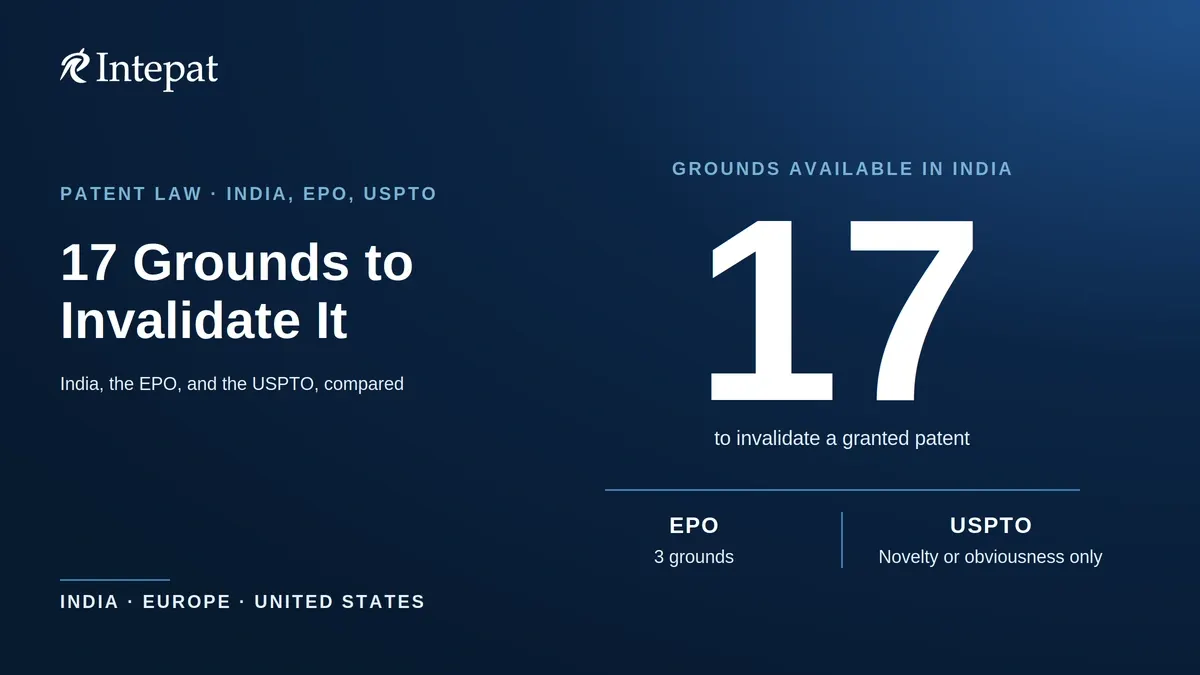
Under European rules, opposition at the EPO must be filed within nine months of the grant being published, on one of three grounds only: lack of patentability, insufficient disclosure, or added subject matter. Any person other than the patent’s own proprietor can file, and a successful EPO opposition applies to the patent in every country where it has effect, a wider reach than a single national ruling.
The United States (USPTO)
In the United States, Inter Partes Review before the Patent Trial and Appeal Board can be filed by anyone other than the patent’s owner, after the later of nine months from grant or the end of any post-grant review, and subject to time bars keyed to an earlier validity suit or infringement suit against the petitioner. The grounds are narrower still: only novelty or obviousness, and only on the basis of patents or printed publications, which can include non-patent literature such as journal articles but rules out undocumented prior use or sale. A final decision is due within one year of the case being accepted, extendable by six months for good cause.
| India (revocation) | EPO (opposition) | USPTO (Inter Partes Review) | |
| Filing window | No fixed deadline | Nine months from grant being published | Later of nine months from grant or end of any post-grant review; barred by an earlier validity suit, or if filed over a year after being served with an infringement suit |
| Grounds | Seventeen | Three | Novelty or obviousness only, on patents or printed publications (may include non-patent documents; excludes undocumented prior use) |
| Who can file | Person interested, or the Central Government | Any person other than the proprietor | Any person other than the patent’s owner |
| Decision deadline | None fixed by law | None fixed by law; internal efficiency targets only | One year from the case being accepted, extendable six months for good cause, with further adjustment if another petition is joined |
India has no equivalent post-grant tribunal for patent revocation: cases go directly to the High Court, a structural difference from the USPTO’s PTAB, which operates under the fixed decision clock shown above; the EPO’s Opposition Division works to internal efficiency targets rather than a comparable fixed deadline. For a licensing or acquisition decision spanning a multi-jurisdiction filing family, this means the same prior art can support a fast, narrowly scoped EPO or USPTO challenge in one country and a broader, less time-bound High Court petition in India.
The Grounds for Invalidating a Patent: India as the Example
Indian patent law recognises seventeen distinct grounds for revoking a granted patent. A revocation petition, or a defence to an infringement claim, can rely on any of them, though in practice only a handful come up often. The table below summarises each ground in plain terms, with the two most commonly searched grounds discussed in more detail afterward.
| Ground | What it covers |
| Same invention claimed earlier | Claimed in a valid claim of earlier priority date in another Indian patent |
| Wrong applicant | Granted to a person not entitled to apply |
| Wrongful obtaining | Obtained wrongfully, in contravention of the petitioner’s rights |
| Not an invention | Subject matter does not count as an invention at all |
| Not new | Anticipated by what was publicly known or used in India, or published anywhere, before the priority date |
| Obvious | Obvious, or lacking an inventive step, over what was publicly known or used in India, or published anywhere, before the priority date |
| Not useful | Not useful |
| Description too thin | Complete specification does not sufficiently and fairly describe the invention or its best method |
| Claims unclear or unsupported | Claim scope not sufficiently or clearly defined, or not fairly based on the disclosure |
| False claims to get grant | Obtained on a false suggestion or representation |
| Not a patentable category | Subject matter falls into a category that cannot be patented |
| Used secretly before filing | Secretly used in India before the priority date, with exceptions for reasonable trial use, Government use following the applicant’s own disclosure to Government, and a third party’s unauthorised use following that same disclosure |
| Hid a foreign filing | Applicant failed to disclose required foreign-application information, or gave materially false information |
| Broke secrecy or early-filing rules | Contravened a secrecy direction, or filed a foreign patent application too early (foreign filing is allowed without permission once a corresponding Indian application has been on file for six weeks) |
| Amendment obtained by fraud | Leave to amend the specification was obtained by fraud |
| Biological source not disclosed | Specification fails to disclose, or wrongly states, the source or geographical origin of biological material used |
| Traditional knowledge | Anticipated by oral or other traditional knowledge, in India or elsewhere |
In practice, most Indian invalidity searches are built around two grounds: novelty and obviousness (also called lack of inventive step). Novelty looks at what was publicly known or used within India before the claim’s priority date, plus what had already been published, in India or elsewhere, in an earlier patent application or specification. Obviousness is worded more broadly: it looks at anything publicly known, used, or published anywhere before that same priority date, without being limited to earlier patent filings. The two grounds overlap heavily as a result, but they are not identical: obviousness casts the wider net. Each claim carries its own priority date, ordinarily the filing date of the first application, provisional or complete, that discloses it. Several of the other grounds (wrongful obtaining, fraud, non-disclosure of foreign applications) turn on the patent’s prosecution history (its record of communications with the Patent Office) rather than on prior art, and are typically established from the file record rather than a literature search.
Not every ground for revoking a patent is a realistic search target for a private party. One further ground, for instance, lets the High Court revoke a patent on the Central Government’s own petition, where the patentee, without reasonable cause, failed to comply with a Government request to work the invention for Government purposes on reasonable terms. It sits outside the seventeen grounds in the table above, applies only on a Government petition, and in practice does not affect how a private search is scoped.
Opposition or Revocation in India: Choosing the Right Route
India gives a party several different points to raise invalidity, and a search should be scoped to the one actually being used.
| Route | Who can raise it | Time limit | Forum | Grounds available |
| Pre-grant opposition | Any person | After publication, before grant | Controller of Patents | Eleven |
| Post-grant opposition | Person interested | Within one year of publication of grant | Controller of Patents, appealable to the High Court | Eleven |
| Revocation petition | Person interested, or the Central Government | No fixed deadline | High Court | Seventeen |
| Infringement defence | Defendant sued for infringement | Within the infringement suit | District Court or higher, moving to the High Court if a counterclaim for revocation is filed | Every ground available on revocation |
Before grant, the law lets any person file a written representation against a pending application once it has been published and before grant; the Controller will only consider that representation once a request for examination has been filed. Separately, no patent can be granted within six months of the application being published, a minimum window rather than a filing deadline, since examination routinely takes longer and representations are commonly filed later, right up to the date of grant.
After grant, any person interested can give notice of opposition at any time after grant but before one year has passed from the date the grant was published. Unlike pre-grant opposition, open to anyone, post-grant opposition requires the opponent to be a person interested in the patent. The Controller then constitutes an Opposition Board of three members with one nominated Chairman, which examines the case and reports its recommendation; the Controller then orders that the patent be maintained, amended, or revoked. That order is not final: either side can appeal it to the High Court within three months, or such further time as the High Court allows under its own rules.
Pre-grant and post-grant opposition each draw on eleven broadly corresponding grounds that overlap heavily with the seventeen available for revocation, though the lists are not simply nested, and the two forms of opposition differ slightly from each other. Missing from opposition but available on revocation: entitlement to apply, “not useful,” secret use, claims that are unclear or unsupported by the disclosure, false suggestion or representation, fraud in an amendment, and the secrecy-direction and early-foreign-filing grounds; opposition’s own disclosure ground also stops short of revocation’s requirement to describe the best method. Opposition also has a ground revocation lacks: an application not made within twelve months of the first application for protection in another country, a window that runs slightly differently before and after grant. A search built only to support an opposition does not need to chase the revocation-only grounds; a search built to support a revocation petition, or a defence to an infringement claim, does.
A revocation petition itself now runs as a statutory proceeding before the High Court, not the Controller (a separate, narrower route for revoking a patent over non-working stays with the Controller). Any person interested, the Central Government, or a defendant counterclaiming in an infringement suit can bring a revocation petition; where a defendant counterclaims, the entire suit, not only the counterclaim, is transferred to the High Court for decision. This is a relatively recent change: the Intellectual Property Appellate Board, which previously heard revocation matters, was abolished on 4 April 2021, and the High Courts took over its functions across patent law. The Delhi High Court’s Intellectual Property Division, created by a Chief Justice’s order in July 2021 and formalised under rules adopted in February 2022, now has exclusive jurisdiction there over IP matters, including revocation; its jurisdiction spans original, infringement, commercial, appellate, revisional, and extraordinary writ IP matters, and it has introduced procedures such as confidentiality clubs and panels of technical experts.
If a patent is found invalid, revocation is not automatically the only outcome. The law lets the High Court permit the patentee to amend the specification instead of revoking the patent outright, though that amendment is limited to a disclaimer, correction, or explanation that adds no new matter and stays wholly within the scope of the original claim, so a search’s findings can lead to a narrowed claim rather than a lost patent. Partial outcomes cut both ways: in an infringement suit, the court can grant relief on any claim that is separately proven valid and infringed, even where another asserted claim in the same patent fails on validity, though absent proof the invalid claim was included in good faith, that relief is ordinarily limited to an injunction rather than damages. This matters for how a search is briefed: an opinion that flags which specific claims are strongest, not only whether the patent survives entirely, gives the client a fuller set of options whichever way the case is heading.
How an Invalidity Search Is Actually Done
An invalidity search generally follows the same sequence regardless of jurisdiction. It starts with parsing the claims of the target patent to fix exactly what is being challenged, since every later step measures prior art against those specific claim elements. From there, the search covers patent literature and non-patent literature (technical papers, product manuals, conference proceedings, and similar public disclosures) for anything published anywhere, or, in India’s case, publicly known or used domestically, before the relevant claim’s priority date, with each reference then classified against the specific ground it can support. Each promising reference is then mapped against the claim, element by element, a technique usually called claim charting, or claim mapping, and closely related to how a patent’s claims get read during claim construction in litigation. The output is a written opinion setting out which grounds the evidence actually supports.
Several databases feed this process. On the official side, India’s own InPASS portal covers granted Indian patents and published applications, and free international tools such as Espacenet and WIPO’s Patentscope extend coverage to foreign-filed patent documents worldwide. Because a meaningful share of invalidating prior art is never itself a patent document, non-patent sources (scientific journals, standards archives, and even archived web pages) are a routine part of the search rather than a backup option.
Search platforms increasingly use AI-assisted or semantic matching to speed the first pass through patent and non-patent literature, surfacing prior art a plain keyword search would miss, particularly where the same idea appears in different words across documents. This does not remove the judgment call at the centre of the process: someone still has to confirm each reference’s actual publication or priority date and decide whether it genuinely supports a specific ground, rather than merely resembling the claimed invention.
When to Commission a Search Before You Act
Four situations call for a search before, not after, a party commits to a position. The clearest is deciding whether to oppose or seek revocation of a competitor’s patent: in India, the search tells you which of the seventeen grounds for revocation, or the narrower eleven available on opposition, the evidence actually supports before money goes into a filing. The second is responding to a cease-and-desist letter or an infringement claim: under Indian law, every ground on which the patent could be revoked is available as a defence to that claim, and knowing the strength of that defence changes how a party negotiates or litigates.
The third is a licensing negotiation or an acquisition, where an invalidity assessment folds into broader patent due diligence. A licensor’s or target’s patent that would not survive a challenge is worth less than its face value on the register, whatever the deal documents assume. The fourth is defending your own granted patent once it is being watched or challenged. In India, once a contested claim has been upheld and certified by the High Court, whoever then wins on that claim in a later suit or revocation petition is ordinarily awarded full costs, unless the court directs otherwise or the challenger shows it withdrew promptly on learning of the certificate. That conditional exposure still raises the price of a weak repeat challenge and rewards a well-supported one.
In each case, the search’s real output is not a yes-or-no verdict. It is a grounds memo or claim chart, tied to specific grounds and specific prior art, that a party can file, negotiate around, or hold in reserve. A search that finds nothing is not proof of validity, only that nothing turned up in what was searched, so a search’s scope matters as much as its outcome. Whether the document is ever used in an opposition or a court petition, having it before the decision is made is what turns invalidity risk from a guess into a documented position.
Frequently asked questions
A patent invalidity search looks for prior art or procedural defects that could undermine an already granted patent, in any country. In India, it gathers evidence for the recognised grounds for challenging a patent, whether to support an opposition, a revocation petition, or a defence to an infringement claim.
Yes, in substance. Every major patent system lets a granted patent be challenged after grant, using its own grounds and forum; this guide covers India in full detail and compares Europe and the United States directly. Novelty and inventive step are the two grounds used almost everywhere, though the specific procedure varies, so confirm details with local counsel.
A patentability search runs before filing, to check whether an invention is new and inventive enough to justify an application in the first place. An invalidity search runs after grant, to check whether the examiner missed prior art, or a procedural defect, that could still support opposing or revoking the already granted patent.
Indian patent law recognises seventeen grounds, from lack of novelty and obviousness to wrongful obtaining and insufficient disclosure. Most invalidity searches concentrate on novelty and obviousness, since these turn on prior art a search can locate, rather than on the patent’s procedural history.
Yes. Indian law makes every ground on which the patent could be revoked available as a defence to an infringement claim. Where the defendant also counterclaims for revocation, the entire suit, not only the counterclaim, is transferred to the High Court for decision.
The Intellectual Property Appellate Board was abolished on 4 April 2021. Revocation petitions and counterclaims now go directly to the High Courts, and the Delhi High Court’s dedicated Intellectual Property Division, created shortly afterward, now has exclusive jurisdiction over IP matters, including patent revocation, at that court.
No. Indian law is explicit that passing examination is never treated as a guarantee that a patent is valid. That gap is precisely why invalidity risk persists after grant, and why parties commission a dedicated search rather than relying on the patent having already survived examination.
Neither is fixed by law in any system; both depend on scope. A search limited to one country’s patent literature takes less time than one that also covers foreign filings and non-patent literature such as technical papers or product manuals. Ask for a scoped estimate before commissioning a search, rather than assuming a standard timeline or fee applies.
This article explains how a patent invalidity search works, using Indian law as a detailed worked example alongside a direct comparison of European and US procedure, as at August 2026, and is for general information only. It is not legal advice. Government fees, forms, and procedures change and vary by country; confirm current figures with the relevant national or regional patent office before you file. For advice on your specific invention and jurisdiction, consult a registered patent agent or attorney. Deadlines in this area are strict, and missing one can result in the loss of rights; the figures and timelines here are indicative and change, so do not rely on them for a specific filing without confirming the current position and, where the stakes warrant it, taking professional advice.