




A collective trademark is owned by an association of persons and used only by its members to distinguish their goods or services from those of non-members. In India it is registered under Chapter VIII of the Trade Marks Act 1999, read with the Trade Marks Rules 2017, and the application must carry regulations governing who may use the mark.
| Quick answer |
| Who owns it: an association of persons that is the proprietor; a partnership firm (under the Indian Partnership Act 1932) cannot own one (Section 2(1)(g)). |
| Who uses it: members of the association, as authorised users; their use of the mark counts as the proprietor’s own use (Section 68, Explanation II). |
| How to file: Form TM-A, accompanied by the draft regulations that govern use of the mark (Rule 131(1)). |
| What it costs: Rs 9,000 per class on e-filing, the rate for an association (First Schedule, Entry 1; verified June 2026); the reduced Rs 4,500 rate applies only where the association itself qualifies as a small enterprise. |
| How long it lasts: ten years, renewable on Form TM-R (Section 25). |
What is a collective trademark?
A collective trademark identifies goods or services as coming from members of a particular association, rather than from a single business. Section 2(1)(g) of the Trade Marks Act 1999 defines a collective mark as a trade mark that distinguishes the goods or services of members of an association of persons, which is the proprietor of the mark, from those of others. The Registry treats the mark’s primary function as indicating a trade connection with the proprietor association, not as a guarantee of quality.
A collective mark is one of the recognised types of trademark. An ordinary trademark works as a badge of origin for one trader. A collective mark works for a group: any member of the owning association may use it, and the public reads the mark as a sign of membership in that group. Chapter VIII, Sections 61 to 68, governs collective marks, and Section 61 applies the rest of the Act to them subject to that Chapter.
Who should consider a collective trademark?
A collective mark suits a group whose members trade under a shared mark governed by common rules, rather than a single business protecting its own brand.
| Typical candidates: producer associations, trade and industry bodies, cooperatives, artisan or craft groups, export promotion bodies, and professional associations whose members use a common membership mark under agreed rules. |
Who can own and use a collective trademark in India
The proprietor of a collective mark is the association of persons itself, not the individual members. The definition carries one specific exclusion: the association must not be a partnership within the meaning of the Indian Partnership Act 1932. Trade associations, producer groups, and cooperatives can hold a collective mark; a partnership firm cannot.
The members are the people who actually use the mark. The Act calls a member who is authorised to use the registered mark an authorised user, and it treats use of the collective mark by an authorised user as use by the registered proprietor (Section 68, Explanations I and II). That rule matters in practice. A registration can be removed for non-use, but the members’ use of the mark counts as the association’s own use, which protects the registration against a non-use challenge.
Collective mark, certification mark, and GI: which protection fits
Collective marks are often confused with certification marks and with geographical indications, and the three protect different things. The distinction decides which application a group should file. A collective mark signals membership of an owning association. A certification mark guarantees that goods or services meet a defined standard. A geographical indication protects products tied to a place, under a separate statute.
| Feature | Collective mark | Certification mark | Geographical indication |
| Governing law | Trade Marks Act 1999, Sections 61 to 68 | Trade Marks Act 1999, Sections 69 to 78 | Geographical Indications of Goods (Registration and Protection) Act 1999 |
| Who owns it | An association of persons (not a partnership) | A person who does not trade in the certified goods or services (Section 70) | An association or authority representing the producers of the region |
| Who may use it | Members of the owning association | Anyone whose goods or services meet the certified standard | Authorised producers from the defined geographical area |
| What it signals | A trade connection with, and membership of, the association | That a defined standard of origin, material, manufacture, quality, or accuracy is met (Section 2(1)(e)) | A quality or reputation attributable to the geographical origin |
Practitioner note. A collective mark does not certify quality. If a group wants its mark to vouch that any trader’s goods meet a standard, regardless of membership, the certification-mark route under Sections 69 to 78 fits better, and the owner must not itself trade in those goods (Section 70). It is also not a way for several businesses to co-own an ordinary commercial brand: joint proprietorship of an ordinary mark is available only where the parties are jointly connected in the trade (Section 24).
Collective trademark registration in India: documents and process
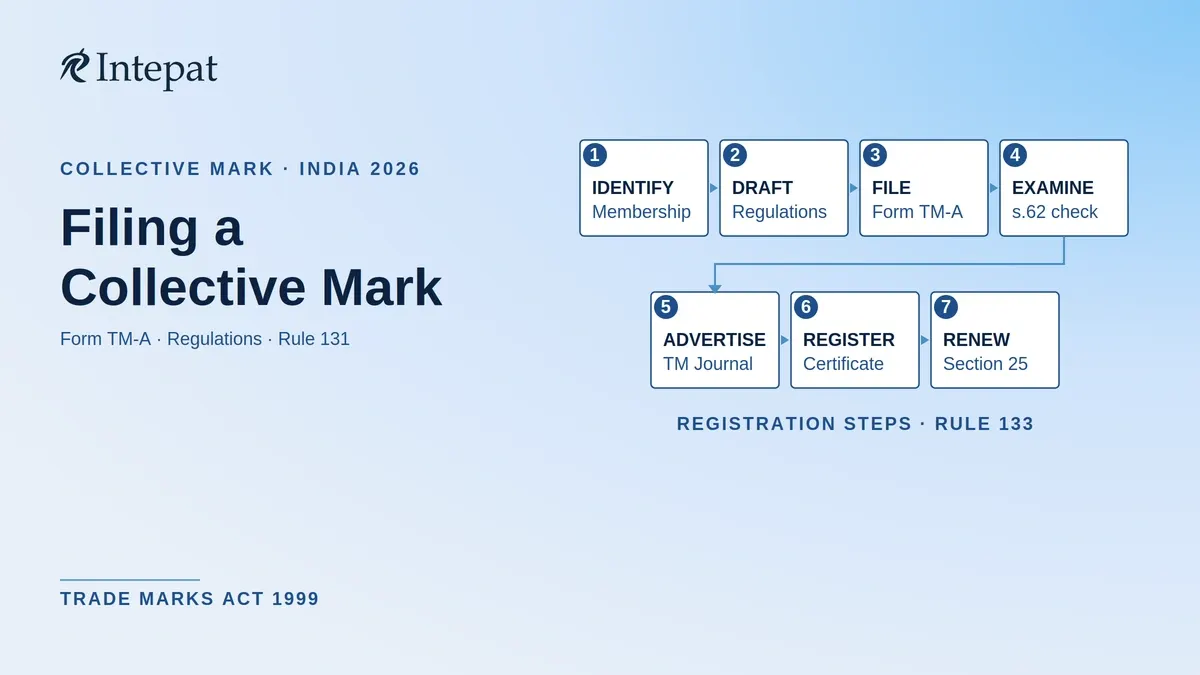
Collective trademark registration in India follows the ordinary trademark route, with two additions: the regulations, and the Section 62 check at examination. The Act itself requires the application to be accompanied by the regulations that govern use of the mark (Section 63); the Rules set out the mechanics. A collective mark is filed on Form TM-A, the same form used for an ordinary trademark, and the application must carry the draft regulations (Rule 131(1)) together with a statement of the grounds the applicant relies on, in duplicate (Rule 132). The regulations are central: the application turns on them, and the Registry examines them alongside the mark.
The regulations must set out who runs the association, who may use the mark, how use is controlled, and what happens on misuse. The required contents are listed in Rule 131(4) of the Trade Marks Rules 2017, read with Section 63(2):
| The regulations must specify | Source |
| Name of the association of persons and their respective office addresses | Rule 131(4)(a) |
| Object of the association | Rule 131(4)(b) |
| Details of the members | Rule 131(4)(c) |
| Conditions of membership and each member’s relation to the group | Rule 131(4)(d) |
| The persons authorised to use the mark and the control the applicant exercises over its use | Rule 131(4)(e) |
| Conditions governing use of the mark, including sanctions | Rule 131(4)(f) |
| Procedure for dealing with appeals against use of the mark | Rule 131(4)(g) |
| Any other particulars the Registrar calls for | Rule 131(4)(h) |
For example. The regulations commonly set who may become a member, when and where members may use the mark (for instance on packaging or in advertising), who approves use, and what sanctions apply for misuse.
Before filing, the association should have the following ready:
| Document to prepare | Notes |
| Name and legal status of the association | Establishes the proprietor’s standing |
| Constitution, bye-laws, or other governing document | Evidence of the association and its objects |
| Draft regulations governing use of the mark | Filed with the application (Rule 131(1)) |
| List of members and the persons authorised to use the mark | Reflected in the regulations (Rule 131(4)) |
| Representation of the mark | Standard application requirement |
| Goods or services and the class or classes | Standard application requirement |
| Statement of case, in duplicate | Filed with the application (Rule 132) |
| Authorisation of the agent on Form TM-M, if filing through an agent | Rule 19 |
Once filed, the application moves through the trademark registration process in the usual way: examination, advertisement in the Trade Marks Journal, any opposition, and registration apply to a collective mark in the same way as to an ordinary trademark (Rule 133). At examination there is an extra requirement specific to collective marks: the mark must not be likely to deceive or cause confusion, and where it might be taken to be something other than a collective mark, the Registrar may require it to carry some indication that it is one (Section 62).
If the requirements for registration are satisfied, the Registrar accepts the application together with the regulations, either as filed or subject to conditions, including amendments to the regulations; otherwise the application is refused (Section 64). After registration, the regulations are open to public inspection (Section 65).
The fees below are the standard trademark registration fees under the First Schedule to the Trade Marks Rules 2017.
| Action | Form | Fee (e-filing / physical) |
| File a collective-mark application, per class, per mark | TM-A | Rs 9,000 / Rs 10,000 (association); Rs 4,500 / Rs 5,000 only where the association qualifies as a small enterprise |
| Amend the regulations under Section 66 | TM-M | Rs 1,800 / Rs 2,000 |
| Renew the registration, per class | TM-R | Rs 9,000 / Rs 10,000 |
| Apply to remove the registration, per class | TM-O | Rs 2,700 / Rs 3,000 |
Fees verified against the First Schedule to the Trade Marks Rules 2017, June 2026. Registry fees can change; confirm the current Schedule before filing. A collective mark must be owned by an association of persons (Section 2(1)(g)), so the individual rate in the First Schedule is not available to a collective-mark applicant; the reduced rate is reached only where the association qualifies as a small enterprise.
Amendment and renewal of the registration
The regulations are not fixed for good. The proprietor can amend them, but an amendment has no effect until it is filed with the Registrar and is accepted and published (Section 66). The amendment is requested on Form TM-M; the Registrar advertises the accepted amendment, and any objection to it is dealt with through the ordinary procedure (Rule 134(a)).
Like any registered trademark, a collective mark lasts ten years and is renewed for further ten-year terms (Section 25, applied through Rule 134(b)). Renewal is filed on Form TM-R. If the renewal date is missed, the mark can still be renewed within six months of expiry on payment of a surcharge, with a further restoration window after that, on the same terms that apply to ordinary marks.
Enforcing and cancelling a collective trademark
Enforcement sits with the association as registered proprietor. In an infringement suit brought by the proprietor, the court takes into account any loss suffered by the authorised users, and may direct how much of any monetary award the proprietor must hold on the members’ behalf (Section 67). The remedy protects the group, not only the registered owner.
A collective registration can also be cancelled. Beyond the grounds that apply to any trademark, Section 68 adds two grounds specific to collective marks: that the way the mark has been used has made it liable to mislead the public, and that the proprietor has failed to observe, or to enforce, the regulations governing its use. Because the general grounds apply as well, a collective mark can additionally be removed for non-use. A removal application is filed on Form TM-O.
Frequently asked questions
A collective mark is owned by an association and used by its members to show group membership. A certification mark, under Sections 69 to 78 of the Trade Marks Act 1999, certifies that goods or services meet a defined standard and can be used by anyone meeting it; its owner must not trade in those goods (Section 70).
No. Section 2(1)(g) of the Trade Marks Act 1999 defines a collective mark as belonging to an association of persons that is not a partnership within the meaning of the Indian Partnership Act 1932. Trade associations, societies, and cooperatives can own one; a partnership firm cannot.
Under Rule 131(4) of the Trade Marks Rules 2017, the regulations must identify the association and the office addresses of its members, its object and conditions of membership, the persons authorised to use the mark and the control over its use, the conditions of use including sanctions, the appeals procedure, and any further particulars the Registrar requires.
Filing on Form TM-A costs Rs 9,000 per class on e-filing, the rate for an association. The reduced Rs 4,500 rate applies only where the association qualifies as a small enterprise, not on the individual basis, because a collective mark must be owned by an association of persons (Section 2(1)(g)). First Schedule, verified June 2026.
A collective trademark is registered for ten years and can be renewed for successive ten-year periods on Form TM-R, under Section 25 of the Trade Marks Act 1999. A missed renewal can be cured within six months of expiry on payment of a surcharge, with a further restoration window after that.
Yes. Under Section 68 of the Trade Marks Act 1999, a collective mark can be removed if its use has become liable to mislead the public, or if the proprietor fails to observe or enforce the regulations. The general grounds, including non-use under Section 47, also apply. Removal is sought on Form TM-O.
This article is general legal information about collective trademarks under Indian law, not legal advice. Fees, forms, and procedure are set by the Trade Marks Registry and can change; the figures here were verified against the First Schedule to the Trade Marks Rules 2017 in June 2026. For a specific collective-mark filing, take advice from a qualified trademark attorney or agent. Intepat IP is a trademark services provider and not a law firm.