




IIn most PCT contracting states, missing the national phase entry deadline triggers a further question: is there a remedy? In many jurisdictions, restoration of rights may be available based on standards such as unintentional delay, all due care, or specific statutory provisions. A comparative overview is set out in our global analysis of late national phase entry.
| Quick answer |
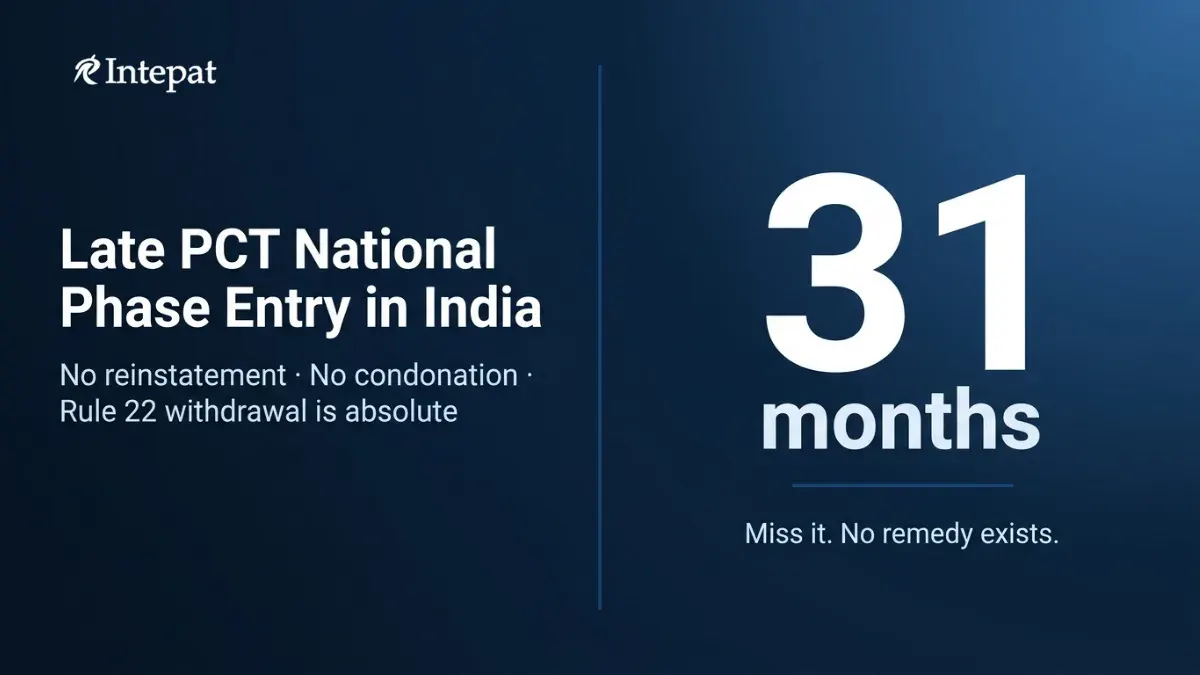
| The Indian Patent Office does not permit reinstatement of rights under PCT Rule 49.6. India has formally opted out of that provision. Rule 138 of the Patents Rules 2003, as amended in 2016 and again in 2024, expressly excludes the national phase filing deadline under Rule 20(4)(i) from any condonation. Once 31 months from the earliest priority date expires, the application is treated as withdrawn under Rule 22. No statutory remedy exists at the Controller level. Sources: PCT Applicant’s Guide – India National Chapter (WIPO, valid from 1 January 2026); Patents (Amendment) Rules 2024, Rule 138 sub-rule (2). |
This article examines the Indian position in detail, including the statutory framework, the scope and limits of Rule 138, and the case law that defines the current legal position.
What the 31-Month Deadline Means Under Indian Patent Law
Rule 20(4)(i) of the Patents Rules, 2003 requires that an international application designating India must enter the national phase within 31 months from the earliest priority date. If this requirement is not met, the application cannot proceed to the national phase in India. The consequence operates automatically, and in practice no prior notice is issued by the Patent Office.
The legal effect of an international application in India arises from a combined reading of Sections 7, 54 and 135 of the Patents Act, 1970 with Rules 20 to 23 of the Patents Rules. The title, description, claims, abstract and drawings filed in the international application are treated as the complete specification, and the international filing date is accorded as the filing date in India. These provisions integrate the PCT application into the Indian statutory framework, but do not qualify or relax the 31-month entry requirement.
The practical starting point for any late entry analysis is priority date calculation. The 31-month period runs from the earliest priority date claimed, not from the international filing date unless no priority is claimed. Miscalculation of the priority date remains a common source of error in practice. The full procedural requirements for timely national phase entry in India are covered separately.
Does India Permit Reinstatement Under PCT Rule 49.6?
PCT Rule 49.6 provides a mechanism by which a designated office may reinstate an applicant’s rights where the national phase entry deadline was missed. Paragraphs (a) to (e) of that rule require the designated office to reinstate rights if it finds the delay was unintentional or, at the office’s option, that the failure occurred despite all due care having been taken.
| Statutory position – India (PCT Applicant’s Guide, January 2026) |
| “Does the Office permit reinstatement of rights (PCT Rule 49.6)? No” Source: WIPO PCT Applicant’s Guide – India National Chapter, valid from 1 January 2026. |
This reflects India’s notified position under the PCT system. Rule 49.6(f) of the PCT Regulations provides that where the restoration provisions under Rule 49.6(a) to (e) are incompatible with the national law applied by a designated Office, those provisions shall not apply to that Office, provided the Office has informed the International Bureau. India has exercised this option, and as a result, the restoration of rights framework under Rule 49.6 does not apply to applications designating India.
This position has been recognised by the Delhi High Court in Diebold Self Service Systems v Union of India, where the Court noted that India had taken the necessary steps under Rule 49.6(f), and accordingly, the restoration provisions under Rule 49.6(a) to (e) are not applicable in the Indian context.
The applicable procedural requirements for India are published in the WIPO PCT Applicant’s Guide (India National Chapter), valid from 1 January 2026.
How Rule 138 Applies – and Where It Does Not
The position under Rule 138 has changed twice since 2011, and each change has materially altered what was available to applicants who missed the 31-month deadline.
| Period | Rule 138 position | Effect on national phase entry |
| Before 16 May 2016 | One-month extension available on sufficient cause shown | Controller had discretion to accept late entry within one additional month (Nokia, 2011; Tryton IPAB, 2015) |
| 16 May 2016 to 14 March 2024 | Rule 20(4)(i) expressly excluded from Rule 138 | No condonation available. Extension expressly barred. Confirmed in Diebold (2022) and Humanity Life Extension (2023) |
| 15 March 2024 onwards (2024 Amendment) | Rule 138 rewritten: up to six months condonation for most acts | Rule 20(4)(i) remains excluded under new sub-rule (2). National phase entry deadline unchanged |
Before 16 May 2016, Rule 138 conferred a limited discretion on the Controller to extend time prescribed under the Rules by one month on sufficient cause shown. In practice, applicants invoked Rule 138 in cases of delayed national phase entry, arguing that it operated independently of Rule 6(5) and the restoration framework under Article 48 of the PCT Regulations.
The judicial position during this period was not entirely settled. While courts and the Patent Office, in certain cases, considered such requests, there was no consistent or authoritative holding that Rule 138 could be used to extend the 31-month national phase entry deadline. The issue remained one of interpretative tension between the domestic extension power under Rule 138 and the PCT framework governing time limits for national phase entry.
The 2016 amendment clarified the position by expressly excluding Rule 20(4)(i) from the scope of Rule 138. As a result, the Controller’s general power to extend time did not apply to the national phase entry deadline. This position has been reaffirmed in decisions such as Diebold Self Service Systems v Union of India and Humanity Life Extension LLC v Union of India, discussed in the following section.
The Patents (Amendment) Rules, 2024, effective 15 March 2024, substantially substituted Rule 138. The amended provision confers a broader discretion on the Controller to extend time or condone delay of up to six months, subject to a request made in Form 4. This expanded power applies to most procedural timelines under the Rules. However, sub-rule (2) of the amended Rule 138 expressly lists the provisions to which this power does not apply. Rule 20(4)(i), which governs the national phase entry deadline, continues to be excluded.
The 2024 amendment therefore does not restore any discretion to condone delay in national phase entry. The extended six-month window applies to post-entry procedural acts such as the request for examination under Rule 24B(1) and the filing of the statement under Section 8 (Form 3), but not to the entry deadline itself. This distinction is critical for practitioners managing PCT filings in India..Practitioners managing the post-entry procedural requirements for PCT applications in India should note this distinction carefully.
What Indian Courts Have Said on Late National Phase Entry
The legal position on late national phase entry in India falls into two distinct periods, separated by the 2016 amendment.
Pre-2016: discretion exercised and contested
In Nokia Corporation v Deputy Controller of Patents and Designs (Madras High Court, 24 January 2011), Nokia’s national phase application was filed approximately 30 days after the 31-month deadline due to a docketing error. The Deputy Controller rejected the application. The Madras High Court held that under the pre-2016 Rule 138, the Controller was vested with power to extend the time by one month on sufficient cause and that this power was independent of PCT Article 48 and Rule 82. The court quashed the order and remanded the matter to the Controller for consideration on merit.
In Tryton Medical Inc v Controller General of Patents (IPAB, OA/10/2014/PT DEL; Delhi HC, W.P.(C) 195/2017), Tryton filed its national phase application eight days late and sought condonation under Rule 138. The IPAB allowed the condonation in its order of 24 March 2015, relying on the Nokia precedent. The Controller did not comply with the IPAB’s direction. The IPAB issued a second order on 7 March 2016 criticising the non-compliance as a deliberate violation of judicial discipline. The Controller still did not comply, and Tryton was required to approach the Delhi High Court for enforcement. The court issued a writ of mandamus directing the Controller to give effect to the IPAB’s orders. Both the Nokia and Tryton decisions turned on the pre-2016 version of Rule 138. That version of the rule no longer exists.
Post-2016: mandatory bar confirmed
In Diebold Self Service Systems v Union of India and Others (Delhi High Court, 22 December 2022, Neutral Citation: 2022/DHC/005743), the petitioner challenged the Patent Office’s refusal to accept a national phase application filed approximately five months after the 31-month deadline. The petitioner argued that Rule 22 of the Patents Rules was inconsistent with the Patents Act and with India’s PCT obligations under Article 48(2)(b), and that the use of “shall” in Rule 22 should be read as “may” to permit flexibility.
The Delhi High Court rejected all grounds. The court held that Rule 22 was in consonance with the Patents Act and with the PCT. It confirmed that India had invoked the reservation under Rule 49.6(f) and that the reinstatement provisions in Rule 49.6(a) to (e) accordingly did not apply. On the mandatory nature of the deadline, the court held that the scheme of the Act and Rules requires time-bound steps, and that relaxation of time limits can only arise where the legislation expressly provides for it. The word “shall” in Rule 22 was not to be read as “may”. The petition was dismissed.
In Humanity Life Extension LLC v Union of India (Delhi High Court, 20 July 2023), the petitioner’s Indian attorney failed to file the national phase application within 31 months despite receiving timely instructions. After the deadline passed, a second agent attempted to file the application, which the Controller declined to take on record. The petitioner argued that the 2016 amendment to Rule 138 was ultra vires the rule-making power of the Central Government and inconsistent with PCT Rule 49.6. The Division Bench referred to and affirmed Diebold. It held that the timelines under the amended Rule 138 are strict timelines without scope for condonation of delay in filing a national phase application. The petition was dismissed.
The Writ Jurisdiction Question
A separate line of Delhi High Court decisions has condoned delays in other mandatory patent deadlines through the exercise of writ jurisdiction under Articles 226 and 227 of the Constitution. These cases are sometimes cited as potential avenues for late national phase entry. The distinction matters.
In The European Union Represented by the European Commission v Union of India (Delhi High Court, 2022, Neutral Citation: 2022:DHC:2301), the court allowed filing of a response to the First Examination Report after the statutory deadline. The patent agent had failed to inform the applicant that the FER had been issued. The court held that writ jurisdiction can be exercised in rare cases where: the applicant had no intent to abandon the application; the delay was attributable entirely to agent negligence without contributory fault on the applicant’s part; and the applicant took prompt action upon discovering the position. The First Examination Report and its procedural requirements operate under a different statutory mechanism from national phase entry.
The same principle was applied in Bry-Air Prokon Sagl & Ors v Union of India & Anr (Delhi HC, 17 October 2022, Neutral Citation: 2022/DHC/004439) for FER response and renewal fee deadlines, and in Saurav Chaudhary v Union of India (Delhi HC, 4 July 2024, Neutral Citation: 2024:DHC:4946) for a missed request for examination deadline.
These cases do not apply to national phase entry. The basis for the FER and RFE condonations is Section 21(1) of the Patents Act, which provides for deemed abandonment on non-compliance with examination requirements. Courts have treated this as a situation where writ jurisdiction can intervene in extraordinary circumstances. Rule 20(4)(i) and Rule 22 operate differently: a non-compliant international application is deemed withdrawn, not abandoned, and no court has granted writ relief for a missed national phase deadline since the 2016 amendment, to date. The EU Commission line of cases addresses a distinct set of facts and a distinct statutory provision.
What to Consider When the Deadline Is Approaching or Has Passed
If the 31-month period has not yet expired, several steps remain available. Filing the national phase application as early as possible before the deadline removes the risk entirely. For applicants who want earlier examination, an express request for examination under Section 11B is permitted. For qualifying applicants who designated India as the ISA or IPEA, an expedited examination request may be available. Where the international phase examination produced a negative written opinion, filing a Chapter II demand under PCT Article 31 before the national phase entry provides an opportunity to amend and obtain a more favourable preliminary report, which can assist prosecution in India and other designated states.
If the 31-month period has apparently passed, a priority date calculation should be verified before any conclusion is drawn. Errors in calculation are not uncommon. The period runs from the earliest valid priority date, not the international filing date where priority is claimed. If the international application did not claim priority, the period runs from the international filing date. Whether any claimed priority dates were withdrawn during the international phase should also be confirmed. Where the period falls on a non-working day in India, the next working day may apply.
If the 31-month deadline has genuinely passed and these checks do not change the conclusion, no statutory remedy exists at the Controller level. The application designating India is treated as withdrawn under Rule 22 – a Rule 22 withdrawal that is jurisdiction-specific in effect: failure to enter in India does not affect national phase rights in other designated states where entry was completed within time. Decisions on whether and how to proceed should be based on advice specific to the circumstances. The common procedural errors in PCT filings targeting India cover the deadline calculation errors that practitioners encounter most frequently.
Disclaimer
This article provides general information on Indian patent law and procedure. It does not constitute legal advice. Statutory provisions and judicial positions may change. Readers should obtain advice specific to their circumstances from a registered patent agent or attorney.
Frequently Asked Questions
No. Once 31 months from the earliest priority date has expired – even by one day – the application is treated as withdrawn under Rule 22 of the Patents Rules 2003. The Indian Patent Office has no statutory power to accept a late national phase application. India has opted out of the PCT Rule 49.6 reinstatement mechanism, and Rule 138 expressly excludes the Rule 20(4)(i) deadline from condonation.
No. The Patents (Amendment) Rules 2024 rewrote Rule 138 to permit up to six months of condonation for most procedural acts. However, the new sub-rule (2) of the substituted Rule 138 expressly excludes Rule 20(4)(i) – the national phase filing deadline – from the scope of that condonation power. The 2024 amendment changed the position for many other deadlines, but not for national phase entry.
The international application designating India is deemed to have been withdrawn under Rule 22 of the Patents Rules 2003. No examination commences, and no national phase rights arise in India from that application. The loss of rights applies only to India – it does not affect national phase entries that were completed within time in other designated states.
Before the 2016 amendment to Rule 138, courts and the IPAB allowed late entry in limited cases on the basis that Rule 138 gave the Controller a one-month discretionary extension. The Madras High Court did so in Nokia Corporation v Deputy Controller of Patents and Designs (2011), and the IPAB did so in Tryton Medical Inc v Controller General of Patents (2015). Since the 2016 amendment removed Rule 20(4)(i) from the scope of Rule 138, no court has granted relief for a missed national phase deadline. The Delhi High Court confirmed the mandatory bar in Diebold (2022) and Humanity Life Extension (2023).
No. Most major PCT jurisdictions – including the United States, EPO member states, Japan, and the United Kingdom – provide some form of corrective mechanism after a missed national phase deadline, either through a grace period, a petition for reinstatement on unintentional delay grounds, or further processing. India does not. It is one of a smaller group of jurisdictions that has formally opted out of PCT Rule 49.6 reinstatement and that applies the national phase entry deadline as an absolute bar.
At the Controller level, no. The statutory bar applies regardless of the reason for the delay. Indian courts have condoned delays in FER responses and examination requests through writ jurisdiction in cases of agent negligence with no fault on the applicant’s part, but no court has applied this principle to the national phase entry deadline since the 2016 amendment. The European Union v Union of India (2022:DHC:2301) and related cases address a distinct statutory provision. The bar applies irrespective of cause. The appropriate course is to obtain advice specific to the facts of the case.