




FFrom 26 January 2026, the Indian Patent Office began publishing granted patent specifications in a new B1 format. The Office of the Controller General of Patents, Designs and Trade Marks (O/o CGPDTM) confirmed the change through a public notice introducing the B1 kind code for granted patents in India, aligning Indian publication practice with WIPO Standard ST.16 and the systems used by the USPTO, EPO, and JPO.
The first publicly visible example under the new system is IN 576575 B1, granted on 26 December 2025 and filed jointly by IIT Indore, the Indian Council of Medical Research, and IIT Palakkad.
The change is not merely a new label. Under the updated practice, the Indian Patent Office now publishes a single consolidated granted specification document containing the final description, the allowed claims, and the accepted drawings. Earlier prosecution documents remain available separately, but the B1 publication now represents the authoritative granted specification in one consolidated record.
This guide explains what the B1 format means for Indian patents, how it differs from the earlier publication structure, how practitioners should interpret the consolidated specification, and what the change implies for prior art review, patent analytics, and prosecution record analysis..
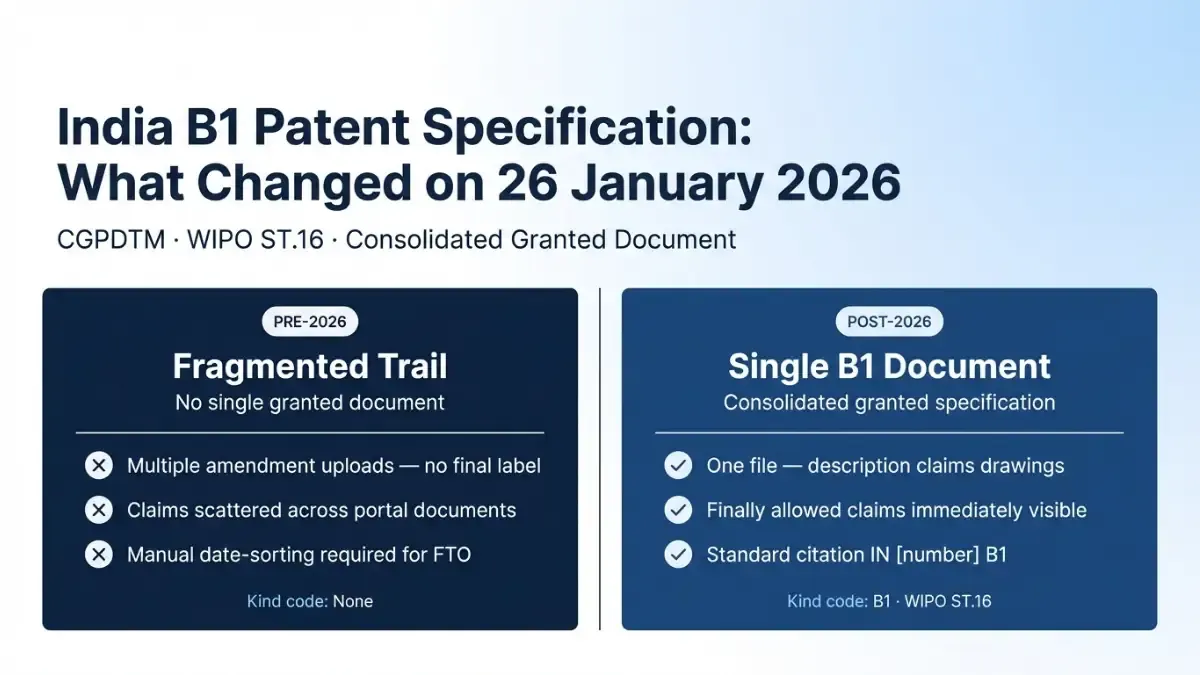
The Problem B1 Solves: Reconstructing the Granted Scope
To understand why the B1 specification matters, it is necessary to understand what existed before it.
When a patent application is filed with the Indian Patent Office, the complete specification is uploaded at the time of filing. Over the course of prosecution, that specification and its claims may be amended multiple times: in response to a First Examination Report (FER), in subsequent office action responses, at an oral hearing, or following a controller’s directions before grant. Each amendment was uploaded to the application file individually, timestamped by upload date alone, with no label indicating whether it represented an interim or final version.
The result was a chronological stack of documents in the “view documents” section of the IP India patent application status portal. A practitioner reviewing a granted patent would encounter the filed specification, one or more versions of amended claims, possibly amended drawings, and the grant order. All were listed by date, none labelled as the definitive granted version. Identifying which version of the claims was the finally allowed version required working backward through the upload sequence, cross-referencing amendment filings against the grant order, and manually assembling the granted scope from these separate pieces.
This was not a theoretical inconvenience. For foreign counsel conducting freedom-to-operate analyses and for in-house teams assessing Indian patent portfolios during acquisitions, the absence of a single authoritative granted document created real friction. For practitioners citing Indian patents in foreign filings, it created real risk of error.
For a full understanding of the prosecution process that generates this document trail, including FER responses, claim amendments, and hearing procedures, see Intepat’s patent prosecution services in India.
What the B1 Specification Contains
The B1 specification is a single consolidated document published by the Indian Patent Office upon grant. Each element addresses a specific gap from the pre-B1 system. It contains:
- A standardised first page carrying full bibliographic data: publication number (e.g., IN 576575 B1), date of grant, application number, date of filing, title of invention, International Patent Classification (IPC), applicant name, inventor name, and journal number.
- The complete specification as granted: the final description of the invention as accepted by the Controller.
- The finally allowed claims: the claims as amended and approved through prosecution, not the claims as originally filed.
- The accepted drawings: in their final accepted form.
The B1 kind code on the first page is the internationally recognised signal that this document is a granted patent specification. Under WIPO Standard ST.16, the B series designates granted patent documents. The number 1 indicates the first publication at grant stage. The combination IN [number] B1 now functions as a complete, unambiguous citation for an Indian granted patent, equivalent to US [number] B1/B2, EP [number] B1, or JP [number] B1.
The CGPDTM public notice (31 January 2026) confirms that B1 applies to all patents granted on or after 26 January 2026. Patents granted before this date remain valid in their original format and will not be reissued in B1 form.
How India’s B1 Specification Now Aligns With Major Patent Offices
The following comparison frames the B1 reform accurately. The relevant question for practitioners is not simply whether India uses kind codes, but whether Indian granted patents are published as a single definitive document equivalent to what other major offices produce. Before 26 January 2026, they were not.
| USPTO | EPO | JPO | India | |
| Granted document format | Single consolidated B1 or B2 | Single consolidated B1 | Single consolidated B1 or B2 | Pre-2026: Fragmented prosecution trail | Post-2026: Single consolidated B1 |
| Finally allowed claims visible without file inspection | Yes | Yes | Yes | Pre-2026: No — required date-sorting of portal documents | Post-2026: Yes |
| Kind code on document face | Yes — since 2001 | Yes | Yes | Pre-2026: No | Post-2026: Yes — B1 |
| Standard citation format | US [no.] B1/B2 | EP [no.] B1 | JP [no.] B1/B2 | Post-2026: IN [no.] B1 |
The table makes clear that B1 is not merely a cosmetic label. The USPTO adopted WIPO ST.16 kind codes in January 2001 precisely because the kind code on the document face, combined with the single consolidated granted specification, makes the legal status of a patent document self-evident without requiring external verification. With this reform, India now mirrors the documentation architecture long adopted by major offices.
What the B1 Format Does Not Change
The B1 specification is a publication standard, not a legal classification. The following remain unchanged:
- Rights of the patentee. Section 48 of the Patents Act, 1970 continues to govern the exclusive rights conferred by a granted patent.
- Term of protection. Twenty years from the date of filing. Renewal obligations under the First Schedule of the Patents Rules, 2003 apply from the date of grant. See Intepat’s guide to patent renewal in India.
- Post-grant opposition. Under Section 25(2), a post-grant opposition may be filed within one year from the date of publication of the grant. The B1 publication date is now the relevant date for that calculation. The B1 specification does not constitute a separate publication event from the journal publication of grant; the journal publication date governs the one-year window. For a detailed overview, see patent opposition proceedings in India.
- Examination and prosecution procedure. B1 applies at the point of publication of the grant. Nothing in the examination or prosecution process has changed. For procedural changes effective from March 2024, see the Patent Amendment Rules 2024.
- Revocation. A granted patent may still be challenged under Section 64 at any time during its 20-year term. The B1 format does not confer additional protection against revocation proceedings. See Intepat’s guide to revocation of patents in India.
- Patent register. The register maintained under Section 67 of the Patents Act, 1970 remains the authoritative record of all granted patents, their legal status, ownership, and encumbrances.
- Patents granted before 26 January 2026. These remain valid in their original format. There is no retroactive reissuance of pre-B1 patents in the new format.
Common Compliance Errors to Avoid
- Assuming B1 applies retroactively. The kind code applies only to patents granted on or after 26 January 2026.
- Citing pre-B1 patents as IN [number] B1. Patents granted before 26 January 2026 carry no kind code and must not be cited in B1 format.
- Miscalculating the Section 25(2) opposition window. The 1-year period runs from journal publication of grant, not from the B1 document date.
- Mis-tracking renewal deadlines. The B1 grant date triggers renewal obligations under the First Schedule. Confirm the grant date from the B1 first page, not from portal status alone.
Practical Implications for Foreign Counsel and Portfolio Teams
Freedom-to-Operate Analysis
FTO searches covering Indian patents previously required either local agent assistance or manual portal navigation to identify the finally allowed claims. From 26 January 2026, patents granted under the new system yield a single B1 document in which the granted scope is immediately visible. For patents granted before this date, the prosecution trail approach remains necessary for claim verification.
Prior Art Citations in Foreign Filings
The citation format for Indian granted patents issued from 26 January 2026 is now standardised: IN [patent number] B1. This is consistent with citation formats used for USPTO, EPO, and JPO grants and requires no additional qualification in international filings.
Patent Management Systems
Corporate IP teams using patent management or docketing software that auto-generates citations or ingests database feeds should confirm that their systems are configured to recognise and correctly record the IN [number] B1 identifier. This is not a legal requirement but avoids citation inconsistencies in portfolio reports and litigation documents.
Renewal Tracking
The B1 specification confirms grant status and grant date, both of which are inputs for renewal fee calculation and deadline tracking under the First Schedule of the Patents Rules, 2003. Teams receiving B1 specifications for newly granted patents should ensure renewal schedules are updated accordingly.
International Database Visibility
Whether and when the B1 kind code appears in Espacenet, PatentScope, Google Patents, and other international databases depends on each provider’s data ingestion schedule from the Indian Patent Office. Practitioners should not assume immediate global database visibility and should verify directly on the IP India portal (ipindia.gov.in) for recently granted patents.
The Gap That Closed on 26 January 2026
The B1 specification reform is the most significant change to how Indian patents are published and accessible since the introduction of online filing. It closes a practical gap that has existed for years between India and every other major patent office: the absence of a single, self-contained document definitively representing the granted scope of an Indian patent.
For foreign counsel and portfolio teams, the change is immediately actionable. Patents granted from 26 January 2026 onward can be reviewed, cited, and analysed from a single B1 document without reference to the prosecution file. The kind code on the first page confirms grant status at a glance, consistent with the document standards of the USPTO, EPO, and JPO.
India’s participation in the international patent documentation ecosystem has materially improved. That benefits everyone who files in India, searches Indian patents, or assesses Indian IP in cross-border transactions.
Need assistance verifying granted scope under the new B1 system?
Our team assists foreign counsel and portfolio teams with Indian patent review, claim verification, and prosecution strategy.
Frequently Asked Questions
No. Patents granted before 26 January 2026 remain valid in their original format. They will not be reissued in B1 form. For those patents, the granted claims and specification continue to be verified by reviewing the prosecution document trail on the IP India portal.
No action is required. The B1 format is applied automatically by the Patent Office at the time of grant. No additional forms, fees, or requests are needed. Applicants should simply note that the specification they receive upon grant will be in the new B1 consolidated format.
Granted B1 specifications are published by the Indian Patent Office and accessible through the IP India public search portal at ipindia.gov.in. Search by application number or patent number and access the published granted specification document directly.
For pre-B1 patents, the prosecution trail approach remains necessary. Navigate to the application status on the IP India portal, access the “view documents” section, and identify the most recent amended claims filed prior to the grant order, cross-referenced against the grant order itself. Local patent agent support is advisable for this exercise.
This depends on each database provider’s data ingestion schedule from the Indian Patent Office. The kind code is present on the published B1 document. However, the timing of its appearance in Espacenet, PatentScope, Google Patents, or commercial databases will vary. For recently granted patents, verify directly on the IP India portal.
The 1-year window for filing a post-grant opposition under Section 25(2) runs from the date of publication of the grant in the official journal. The B1 specification does not create a separate publication event; the journal publication date governs the calculation. The mechanism and grounds for opposition are unchanged.