




Designating India as the International Searching Authority (ISA) in a PCT application can determine whether expedited examination is available when the application enters the Indian national phase. Under Rule 24C of the Patents Rules, 2003, applicants who select the Indian Patent Office (IPO) as ISA or elect India as the International Preliminary Examining Authority (IPEA) become eligible to request expedited examination through Form 18A after national phase entry. For a detailed explanation of how the fast-track procedure works, see our guide on expedited patent examination in India.
The IPO has acted as a competent ISA and IPEA since 15 October 2013, allowing applicants filing through the PCT system to obtain an international search report and written opinion from India at the international stage. For applicants planning protection in India, this designation has a practical procedural consequence. Selecting India as ISA or IPEA can unlock access to the expedited examination track, which can significantly shorten prosecution timelines at the Indian Patent Office.
This guide explains how ISA designation affects expedited examination eligibility in India, when applicants should choose the IPO as ISA during PCT filing, and how the decision influences prosecution strategy at the Indian national phase stage.
What the ISA and IPEA Designations Mean
Every PCT application is searched by an ISA, which issues an International Search Report (ISR) and Written Opinion on patentability. If a Chapter II Demand is filed, an IPEA conducts international preliminary examination and issues an International Preliminary Report on Patentability (IPRP Chapter II). Both the ISA and IPEA are designated by the applicant — the ISA at filing, the IPEA when the Demand is filed.
The ISA designation is fixed at the time of filing and cannot be changed. India’s competence as ISA and IPEA is confirmed in WIPO PCT Applicant’s Guide Annexes D(IN) and E(IN) at pctlegal.wipo.int.
India’s competence as ISA and IPEA is confirmed in the PCT Applicant’s Guide (India), Annex D and Annex E, published by WIPO at pctlegal.wipo.int. The current version (effective 1 September 2025) governs the fees and eligibility rules described in this post.
Who Can Choose India as ISA
The ISA that an applicant can choose depends on the Receiving Office (RO) where the PCT application is filed. This is a firm constraint set by the PCT system — not every ISA is available to every applicant.
Applicants filing at RO/IN (Indian Patent Office as Receiving Office)
Nationals and residents of India who file at RO/IN may choose India (IPO) as ISA. They may also choose the Austrian Patent Office (AT), Australian Patent Office (AU), China National Intellectual Property Administration (CN), European Patent Office (EP), Japan Patent Office (JP), Swedish Intellectual Property Office (SE), or the United States Patent and Trademark Office (US).
Foreign applicants filing at RO/IB (International Bureau of WIPO as Receiving Office)
RO/IB accepts filings from nationals and residents of any PCT Contracting State. India (IPO) is available as an ISA when filing at RO/IB, subject to the competence rules in Annex C(IN) of the WIPO PCT Applicant’s Guide — availability depends on applicant nationality and residence, not the RO alone. Foreign applicants from major jurisdictions (US, Europe, Japan, Korea, China) who file at their home RO typically cannot select India as ISA from those offices. Verify Annex C(IN) at pctlegal.wipo.int before relying on RO/IB + India ISA as a filing strategy.
Key Points For Foreign Applicants: If you are a US, European, Japanese, Korean, or Chinese applicant and you want to choose India as ISA, you must file your PCT application at RO/IB (the International Bureau of WIPO). Filing at your national RO — such as the USPTO as RO/US or the EPO as RO/EP — will not give you access to India as ISA. Verify your available ISAs with your patent agent before filing.
The Strategic Case for India as ISA
Form 18A eligibility — the primary benefit
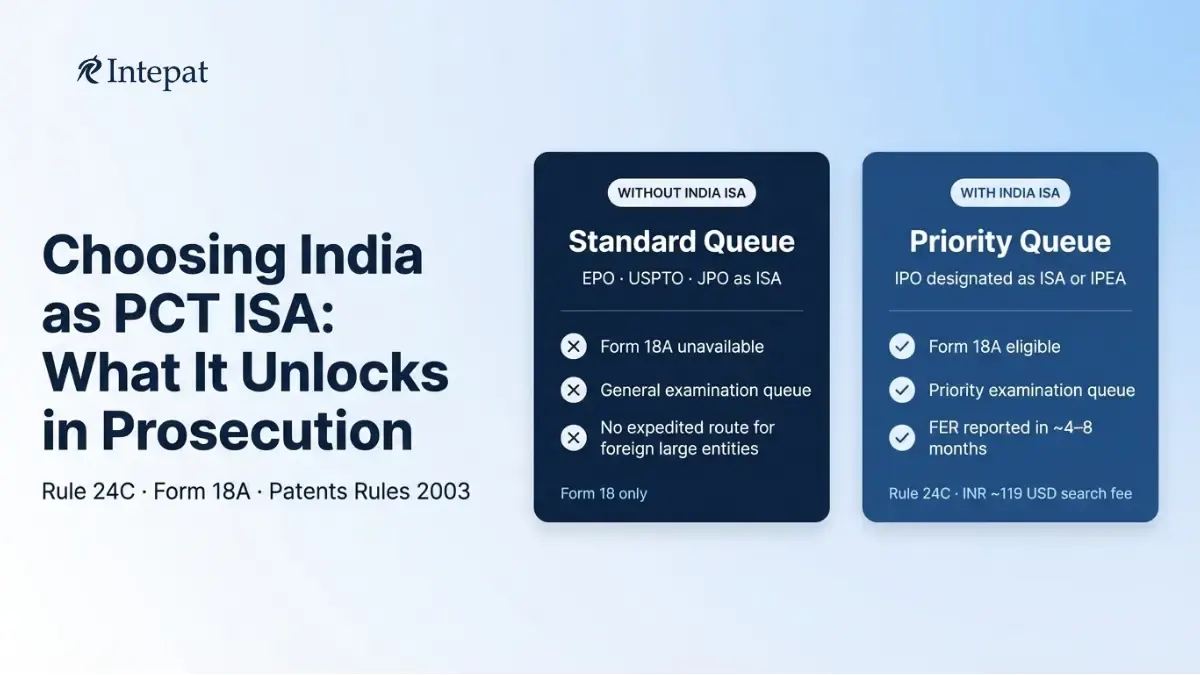
Under Rule 24C of the Patents Rules, 2003, foreign applicants and large entities qualify for Form 18A (expedited examination) only if they designated India as ISA or elected India as IPEA in the corresponding PCT application. Form 18A places the application in a priority examination queue; under the standard Form 18 route, PCT applications filed on or after 15 March 2024 enter a general queue with materially longer wait times.
In practice, applicants who have filed Form 18A and satisfied the eligibility requirements have reported receiving a First Examination Report within approximately four to eight months. These are reported observations from Indian patent practice, not guaranteed timelines — IPO workload and application complexity both affect actual issuance. What Form 18A guarantees is priority queue placement; the speed advantage flows from that.
Illustrative Scenario: A US-based medical device company files a PCT application at RO/IB in January 2025 and selects the EPO as ISA to support European prosecution. By the time India becomes a priority market, the application has already entered the Indian national phase at 31 months without India having been designated as ISA and without a Chapter II Demand electing India as IPEA having been filed within the Rule 54bis.1 deadline. As a result, Form 18A is unavailable and the application proceeds under the standard examination queue. The decisive point was the PCT filing stage; once the ISA was selected and the Chapter II deadline passed, expedited examination in India could no longer be secured for that application.
This eligibility link is not retrospective. If India was not designated as ISA at PCT filing, there is no mechanism to correct that choice — Form 18A will not be available to that applicant unless the Chapter II Demand route is used (see Section 7).
Search fee advantage
The IPO-ISA search fee is substantially lower than the fees charged by the EPO, USPTO, and JPO. The following table compares ISA search fees effective from 1 September 2025 (WIPO PCT Applicant’s Guide, Annex D). All non-INR equivalents are approximate based on the INR amounts stated in the official schedule.
| ISA | Large Entity (USD equiv.) | Startup / Natural Person (USD equiv.) | Language |
| India (IPO) | ~119 USD (10,000 INR)* | ~30 USD (2,500 INR)* | English, Hindi |
| EPO | EUR 1,845 (~USD 2,054) | EUR 1,845 (no reduction for entity type) | Many EU languages |
| USPTO | ~2,300 USD | ~920 USD (60% reduction, micro entity) | English |
| JPO | ~1,400 USD | ~1,400 USD (no reduction) | Japanese / English |
* Source: WIPO PCT Applicant’s Guide, Annex D(IN), effective 1 September 2025. INR amounts are exact; USD equivalents are approximate. Natural person, startup, small entity, and educational institution rates apply subject to correct classification and filing of Form 28 where required. Verify the current schedule at pctlegal.wipo.int before filing, as fees are updated periodically.
Language
The IPO-ISA conducts searches in English. For applicants filing in English at RO/IN, there is no translation requirement for the international search. Filing at RO/IN with India as ISA in English is the most straightforward procedural route.
Applications filed in Hindi at RO/IN must be accompanied by an English translation for ISA purposes under PCT Rule 12.3. For foreign applicants filing at RO/IB, English is the accepted language for international applications intended for the IPO-ISA.
Prior art coverage considerations
The IPO-ISA searches major patent databases including WIPO PatentScope and international patent literature. Applicants in technology areas with significant Asian-language prior art may consider a supplementary international search (PCT Rule 45bis.1) with a second ISA after the primary ISR is issued — this attracts a separate fee and supplements, not replaces, the IPO search. The ISR is a non-binding written opinion; a favourable result can support prosecution arguments at national phase entry across all designated offices.
When NOT to choose India as ISA
Choosing India as ISA is not always the right decision. Consider an alternative where: European prosecution is the primary commercial objective and EP grant takes precedence over Indian timeline; the technology involves dense EPO/USPTO prior art literature (biotechnology, complex pharmaceuticals); or India is a long-term or speculative market rather than an immediate priority.
For applicants where India is a genuine priority market, Form 18A access typically justifies the ISA designation. Where India is a future option, the prior art coverage trade-offs warrant deliberate analysis.
Key Deadlines: From PCT Filing to Form 18A
The table below maps the critical procedural milestones from PCT filing through to Form 18A at Indian national phase entry. All deadlines marked in the right column are hard deadlines — no general grace period applies in India for national phase entry or for the RFE.
| Milestone | Deadline | Statutory Basis |
| PCT international filing at RO/IN | Any time (ISA designation at this stage) | PCT Rule 4.1; PCT Rule 19 |
| ISR and Written Opinion issued by IPO-ISA | By 16 months from priority date | PCT Rule 42.1 |
| Application published by WIPO | 18 months from earliest priority date | PCT Article 21 |
| National phase entry in India | 31 months from earliest priority date | PR Rule 20(4); PCT Article 22(3) |
| Form 18 / Form 18A (RFE) — applications filed on or after 15 March 2024 | 31 months from earliest priority date | PA Sec. 11B; PR Rule 24B(1)(i) (eff. 15 March 2024) |
| Form 18 / Form 18A (RFE) — applications filed before 15 March 2024 | 48 months from earliest priority date | PR Rule 24B(1)(vi) (pre-amendment) |
Note: The 31-month RFE deadline under Rule 24B(1)(i) applies to applications filed on or after 15 March 2024 (the effective date of the Patents (Amendment) Rules, 2024). Applications filed before that date continue to be governed by the 48-month RFE deadline under Rule 24B(1)(vi). For a complete guide covering national phase entry, the 2024 RFE rule change, and documentation, see Intepat’s PCT National Phase India: 31-Month Deadline and RFE Rule guide.
Form 18A Eligibility at a Glance
Form 18A is available under Rule 24C of the Patents Rules, 2003. The table below summarises eligibility by applicant category. Note: Form 18A may be filed at any point after filing, but examination cannot commence before publication — file a request for early publication (Form 9) alongside Form 18A where publication is pending. For IP protection strategies for DPIIT-recognised startups, see Intepat’s guide on IP protection for startups in India.
| Applicant Category | ISA/IPEA Requirement for Form 18A | Notes |
| Startup (DPIIT-recognised, India-incorporated) | Not required — startup status alone qualifies | Recognition must be valid on date of filing Form 18A |
| Small entity / natural person / female applicant | Not required — category alone qualifies | Prescribed declaration required |
| Foreign applicant or large entity | India (IPO) must have been designated as ISA or elected as IPEA in the corresponding international application | This is the only Form 18A route available to foreign large entities |
| Government-supported institution | Not required — category qualifies | Documentary evidence of government support required |
Source: Rule 24C, Patents Rules, 2003 (as amended). Fee amounts per Annex IN.I, WIPO PCT Applicant’s Guide (India), effective 1 September 2025. Form 18A must be filed electronically. The fee for large entities / others is INR 60,000; for startups, small entities, natural persons, and educational institutions it is INR 8,000, subject to entity classification at date of filing. For a detailed guide on the Form 18A procedure, see Expedited Patent Examination in India — Rule 24C Guide.
How to Designate India as ISA: Step-by-Step
The ISA designation is made in the PCT Request Form at the time of international filing. The following steps apply to applicants filing at RO/IN or RO/IB. For the broader context on how PCT applications are filed in India and the foreign filing licence requirement under Section 39, see Intepat’s guide on how to file a PCT International application from India.
| Step | Action |
| 1 | Confirm eligibility: the application must be filed at RO/IN (the Indian Patent Office as Receiving Office) or, for foreign applicants, at RO/IB (International Bureau of WIPO). India as ISA is available when filing at RO/IN or RO/IB provided the applicant meets nationality or residence requirements or files via RO/IB. |
| 2 | In the PCT Request Form (Form PCT/RO/101), locate Box No. VIII (Request to Search by a Particular International Searching Authority). Enter: International Searching Authority — Indian Patent Office (IN). |
| 3 | Pay the ISA search fee to the RO at the time of filing. If filing at RO/IN, payment is in INR via the IPO’s e-filing portal (ipronline.ipindia.gov.in). If filing at RO/IB, check accepted currencies with IB. |
| 4 | File the PCT application in English (or Hindi if filing at RO/IN, with English translation). The IPO-ISA conducts searches in English; applications in other languages require an English translation for search purposes under PCT Rule 12.3. |
| 5 | Retain the ISA/IPEA designation record. When entering the Indian national phase at 31 months, this designation is the basis for Form 18A eligibility. The IPO cross-references the international application number against ISA/IPEA records. |
Practitioner Note: In practice, applicants commonly include the ISA designation and entity classification in their filing instructions to their patent agent at the outset of a PCT filing engagement — not at national phase entry. By the time the national phase deadline approaches, the ISA choice is fixed and cannot be changed. Agents acting for foreign applicants with Indian national phase intentions should flag the ISA choice explicitly in their filing instructions.
The IPEA Route: Chapter II Demand With India as IPEA
If India was not selected as ISA at PCT filing, one option remains: filing a Chapter II Demand with India as IPEA. The Demand must be filed within three months from transmittal of the ISR and Written Opinion, or 22 months from the earliest priority date, whichever is later (PCT Rule 54bis.1). An IPEA examination fee is payable to the IPO.
Current IPEA fees (effective 1 September 2025, per WIPO PCT Applicant’s Guide Annex E(IN)):
- INR 12,000 — large entity/other, where the ISR was prepared by an authority other than IPO
- INR 10,000 — large entity/other, where the ISR was prepared by IPO (reduced rate)
- INR 3,000 — startup, natural person, small entity, educational institution (ISR by other authority)
- INR 2,500 — startup, natural person, small entity, educational institution (ISR by IPO)
Electing India as IPEA confers Form 18A eligibility on the same basis as ISA designation, but at additional cost and subject to the Chapter II deadline. It is a remedy, not a first-choice strategy.
Common Pitfalls and How to Avoid Them
| Pitfall | What Goes Wrong | How to Avoid It |
| Choosing EPO or USPTO as ISA on a PCT application that will enter India | The applicant loses Form 18A eligibility at national phase entry in India. The application joins the standard examination queue regardless of how commercially urgent the Indian grant is. | If India is a priority market, designate India as ISA at the PCT filing stage. This decision cannot be changed after filing. |
| Assuming Form 18A eligibility transfers from the international phase without verification | Applicants sometimes believe that filing a Chapter II demand with any IPEA qualifies them for Form 18A. Only India as ISA or IPEA qualifies. | Verify at national phase entry that the original PCT application record shows IN as ISA or IPEA before filing Form 18A. |
| Filing Form 18A without confirming publication status | Form 18A cannot be processed until the application is published. Applicants who file Form 18A before publication face procedural delay. | If the application has not yet been published under Section 11A, file a request for early publication (Form 9) alongside Form 18A. |
| Missing the 31-month RFE deadline for post-March 2024 applications | Under Rule 24B(1)(i) (effective 15 March 2024), Form 18 or Form 18A must be filed within 31 months. Missing this deadline renders the application liable to be treated as withdrawn. | Plan to file both the national phase application and the RFE (Form 18 or Form 18A) simultaneously at or before the 31-month deadline. India does not have a general restoration mechanism for missed national phase deadlines — unlike some other jurisdictions, late entry is not routinely available. |
| Overlooking entity classification at Form 18A filing | Filing Form 18A at the large entity rate when the applicant qualifies as a startup or small entity results in overpayment. The reverse — claiming a concessional rate without supporting declaration — triggers a formal objection. | File Form 28 (small entity declaration) or confirm DPIIT startup recognition before filing Form 18A. Ensure entity classification in Form 18A matches all other filed forms. |
Strategy, Not Formality
For applicants with India as a target market, designating the IPO as ISA is a filing-stage decision with direct prosecution consequences. It is the primary route to Form 18A eligibility for foreign large entities, and it comes with a materially lower search fee than the EPO, USPTO, or JPO. The decision cannot be changed after filing.
ISA selection is prosecution strategy, not a filing formality. It should be addressed with the patent agent before the PCT application is submitted — not discovered at national phase entry. If India was not designated as ISA, the Chapter II Demand route via India as IPEA remains available within the Rule 54bis.1 deadline, at additional cost. For the full national phase entry framework, see Intepat’s PCT National Phase Entry in India guide.
Disclaimer
This article is for general informational purposes only and does not constitute legal advice. Reading this content does not create an attorney–client or agent–client relationship with Intepat IP. For advice on a specific matter, consult a qualified patent professional.
Frequently Asked Questions
Yes, where the PCT application is filed at RO/IN (Indian Patent Office as Receiving Office) or at RO/IB (International Bureau of WIPO), subject to ISA competence rules under Annex C(IN) of the WIPO PCT Applicant’s Guide. Applicants who file at their home country’s Receiving Office — such as RO/US or RO/EP — typically cannot select India as ISA from those offices. Verify the current Annex C(IN) at pctlegal.wipo.int before filing.
The ISR and Written Opinion from the IPO-ISA are transmitted to all designated offices as part of the PCT file. Each national office independently assesses patentability under its own law; the weight given to the IPO-ISA Written Opinion varies by office. ISA choice does not restrict prosecution strategy in any designated country.
Yes. Eligibility for expedited examination under Form 18A can still be obtained through the Chapter II Demand route.
If you file a Demand for international preliminary examination and elect the Indian Patent Office (IPO) as the International Preliminary Examining Authority (IPEA) within the applicable deadline under PCT Rule 54bis.1 (3 months from the transmittal of the International Search Report and Written Opinion, or 22 months from the priority date, whichever is later), the application can qualify for Form 18A expedited examination when entering the Indian national phase.
No. Choosing India as ISA makes you eligible to file Form 18A, which places the application in a priority examination queue. It does not guarantee grant within a fixed timeframe. The overall timeline to grant depends on IPO workload, the number and complexity of objections raised in the First Examination Report (FER), and how promptly the applicant responds to those objections. Expedited examination accelerates queue position; it does not eliminate substantive examination.
Form 18A is filed electronically on the IPO’s e-filing portal. For PCT applications filed on or after 15 March 2024, Form 18A must be filed within 31 months from the earliest priority date, the same deadline as Form 18 under Rule 24B(1)(i) (effective 15 March 2024). For applications filed before that date, the 48-month deadline continues to apply. The application must also be published (or a request for early publication filed) before Form 18A can be processed.
As at 1 September 2025, the India ISA search fee is INR 10,000 (approximately USD 119) for large entities and INR 2,500 (approximately USD 30) for startups, natural persons, small entities, and educational institutions — among the lowest available under the PCT system. Fees are updated periodically; verify the current schedule at pctlegal.wipo.int before filing.
No. ISA designation affects only Form 18A eligibility and the ISA search fee at the international stage. National phase filing fees, RFE fees, examination fees, and annual renewal fees are governed by the First Schedule of the Patents Rules, 2003, and apply equally regardless of which ISA was chosen. Current fees: ipindia.gov.in.
Entity classification under PCT and under Indian patent law must be assessed separately. An Indian subsidiary may qualify for the reduced ISA fee as a startup (under DPIIT recognition norms), natural person, small entity, or educational institution. A registered patent agent should advise on classification based on the specific corporate structure.