




India is one of the most restrictive jurisdictions globally for post-filing amendments. Most PCT jurisdictions allow applicants to enter the national phase with amended claims. In India, IPO practice requires the national phase application to correspond exactly to the publicly available WIPO record at the date of filing, with one narrow exception: deletion of claims.
Every other amendment, whether claim merging, narrowing, restructuring, or any change to the description or drawings, must wait until after entry. Post-entry amendments are then governed by Section 59 of the Patents Act, 1970, which imposes strict scope limits. These constraints mean that India forces the amendment decision upstream: the international phase, not the national phase, is where meaningful claim alignment must happen.
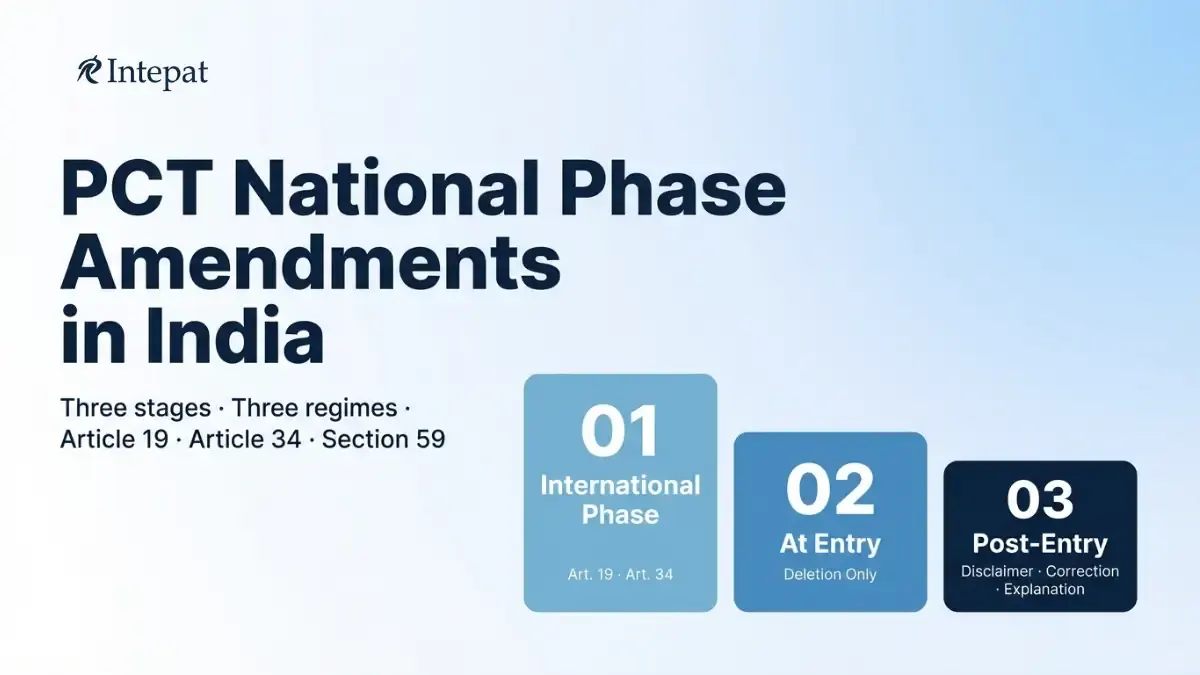
This guide maps the three stages at which PCT national phase amendments in India are available: the international phase under Article 19 and Article 34 of the PCT; the entry itself under Rule 20 of the Patents Rules, 2003; and post-entry prosecution under Section 59. Each stage has a different scope, different timing, and different consequences. Getting PCT national phase amendments in India right requires knowing which stage each decision belongs to.
For a detailed treatment of India’s national phase entry requirements and deadlines, including the 2024 RFE rule, see our dedicated guide.
Stage 1: The International Phase: Your Only Window for Substantive Claim Alignment
Before a PCT application enters any national phase, two provisions allow substantive amendments during the international phase: Article 19 and Article 34. For applicants targeting India, these are not optional prosecution tools. They are the only opportunity to align claims with Indian patentability standards before Section 59’s strict ceiling locks in.
Article 19: Claims Only, One Opportunity
After receiving the International Search Report (ISR) and Written Opinion, an applicant has one opportunity to amend the claims under Article 19. The window is the later of 16 months from the priority date or two months from the date of transmittal of the ISR. No fee is required. Amendments must be filed with the International Bureau (IB), not with the receiving office or the International Searching Authority.
The amended claims are published alongside the original claims, which means both sets remain on the WIPO record and form part of the prosecution history visible to Indian examiners. The original claim scope may later be referenced to assess whether a post-entry Section 59 amendment in India remains within the claims as filed.
Article 19 is limited to claims only: it permits applicants to amend claims but cannot be used to amend the description or drawings. Where prior art cited in the ISR requires adjustment of supporting embodiments, or where claim language must be restructured to address an Indian-specific patentability concern, Article 19 alone is insufficient.
Article 34: The India-Specific Preparation Tool Most Applicants Under-Use
Article 34 is available only to applicants who file a Chapter II Demand requesting International Preliminary Examination. The Demand must be filed by the later of three months from transmittal of the ISR and Written Opinion, or 22 months from the priority date. Unlike Article 19, Article 34 permits amendment of the claims, description, and drawings, subject to the constraint that amendments cannot introduce new matter beyond the original disclosure.
For pharmaceutical applicants facing exposure under Section 3(d), which covers new forms of known substances without enhanced efficacy. Software applicants facing Section 3(k) risk, which covers mathematical methods, algorithms, and computer programmes per se. For these applicants, Article 34 is the most direct route to address India-specific concerns before entry.
The Written Opinion issued under Chapter II does not directly raise Section 3 objections; those arise during Indian prosecution. However, the WO reasoning on novelty and inventive step can be leveraged to anticipate and pre-emptively address Section 3 objections, creating a prosecution record that Indian counsel can deploy during examination.
This use of the Article 34 window to build India-specific positioning is systematically under-used: most applicants treat Chapter II as generic optionality rather than targeted preparation for PCT national phase prosecution in India. The distinction between the international phase and the national phase is precisely what makes this preparation valuable. Once the application enters India, the amendment ceiling drops sharply. Unlike the EPO, which permits auxiliary requests, or the USPTO, which allows continuation practice, India provides no equivalent post-entry flexibility.
Claim architecture decisions made at the PCT stage also have lasting consequences in India. Where India is a target jurisdiction, including multiple independent claim types: product, process, composition, and device, in the original PCT filing gives Indian counsel more to work with under Section 59’s scope-based ceiling. Fallback dependencies that anticipate the narrowing likely to be required in India should be drafted into the original specification, not added later.
The WIPO Public-Record Constraint: A Pre-Filing Checklist Item
Amendments made under Article 19 or Article 34 during the international phase can be reflected in the Indian national phase application only if they are publicly available on the WIPO record on the date of entry. This is not a formality point; it is a filing constraint with real consequences.
An Article 19 amendment filed with the IB but not yet reflected on the WIPO record at the date of Indian entry cannot be reflected at entry. The IPO requires the filing to correspond exactly to what is publicly visible on PATENTSCOPE at that date.
The practical instruction: verify the WIPO record on PATENTSCOPE before instructing Indian counsel to file. If an amendment is pending publication, the correct path is to enter the national phase reflecting the currently public record, then file a voluntary amendment under Form 13 after entry. For the official procedural framework, see the WIPO PCT Applicant’s Guide for India.
Stage 2: At Entry: What India Permits and What It Does Not
At the moment of PCT national phase entry in India, IPO practice under Rule 20 of the Patents Rules, 2003 requires the national phase application to correspond exactly to the international application as publicly available on the WIPO record. No amendments to the claims, description, abstract, or drawings are permitted at entry, with one exception: deletion of claims.
At-Entry Amendment Reference: India
| Permitted at Entry | Not Permitted at Entry |
| Deletion (cancellation) of claims to reduce excess claim fees or remove non-patentable subject matter Bibliographic details matching the publicly available WIPO record Art. 19 or Art. 34 amended claims, but only if already visible on the WIPO record at the date of filing | Merging, narrowing, or restructuring claims Adding new claims or new limitations Amendments to the description or drawings Applicant or inventor name/address changes not yet on the WIPO record Art. 19 or Art. 34 amendments pending WIPO publication |
Claim Deletion: The Only Amendment Available at Entry
The baseline official fee for filing a PCT national phase application in India is modest, but excess claim fees apply for each claim above ten. The excess claim fee is approximately USD 12 per claim for large entities, with lower rates for small entities and startups.
For applications with 30, 40, or 50 claims, which are common in pharmaceutical and technology filings. The excess claim cost at entry is material. Deletion at entry removes the obligation to pay the excess fee for those claims.
Claims that are plainly non-patentable in India are appropriate candidates for deletion at entry. These include: method of treatment claims under Section 3(i), which bars methods of treatment of humans and animals; method of agriculture claims under Section 3(h); and use claims under Section 2(1)(j), which limits patentable subject matter to products and processes. Swiss-type claims typically face objections under Sections 3(d) or 3(e), or on novelty and inventive step grounds, rather than under a single statutory provision. Applicants can also delete claims to align the Indian claim set with the scope allowed or granted in another jurisdiction.
| Claim Deletion at Entry: The Irreversibility Rule |
| Deleted claims cannot be reinstated at any subsequent stage of prosecution. The IPO treats deleted claims as disclaimed: the subject matter is considered relinquished and open for public use. This has a specific downstream consequence for divisional applications.Where claims are deleted in a parent application, Controllers and courts have held that a divisional based on that disclaimed subject matter is significantly weakened and often refused. The Delhi High Court in Boehringer Ingelheim International v. The Controller of Patents applied this principle to reject a divisional whose claims were drawn from voluntarily abandoned subject matter in the parent. The law on this point is not fully settled and outcomes vary by Controller, but the risk is substantial. |
| The practitioner instruction: file any divisional application before cancelling claims in the parent. Once claims are deleted at entry, the divisional option for that subject matter is significantly weakened and often refused. If there is any possibility of later pursuing the deleted subject matter, do not delete. Retain the claims, pay the excess fee, and address scope through voluntary amendment after entry. |
| Reviewing a PCT application before India entry? |
| Intepat IP advises foreign counsel and in-house IP teams on claim deletion decisions and filing strategy at the moment of entry. Discuss India Filing Strategy before the 31-month deadline. |
Amendment Reference: Three Stages, Three Regimes
The table below sets out what is available at each stage of PCT national phase prosecution in India, the permitted amendment types at each stage, and the key constraint or deadline that applies. Use this as a quick reference when planning a filing.
| Amendment Stage | What Is Permitted | Key Constraint / Deadline |
|---|---|---|
| International phase (Art. 19 / Art. 34) | Art. 19: claim amendments only. Art. 34: claims, description, and drawings (requires Chapter II Demand). | Art. 19: by 16 months from priority or 2 months from ISR, whichever is later. Art. 34 Demand: by 22 months from priority or 3 months from ISR. No new matter. |
| At national phase entry (Rule 20, Patents Rules 2003) | Deletion of claims only. Art. 19 / Art. 34 amendments already publicly visible on WIPO record. | Application must match WIPO public record exactly. Deleted claims permanently disclaimed. File divisional before deleting. |
| Post-entry prosecution (Section 59, Patents Act 1970) | Disclaimer (narrowing), correction (clerical errors), explanation (clarification). Via Form 13 or in response to FER. | Amended claims must fall wholly within scope of as-filed claims. No new matter. Scope cannot be broadened. Cancelled claims cannot be reinstated. |
Stage 3: Post-Entry Amendments Under Section 59
PCT national phase amendments in India that arise after entry are governed by Sections 57 to 59 of the Patents Act, 1970. Section 57 provides the procedure: voluntary amendments are filed using Form 13 with the prescribed fee, or submitted in response to a First Examination Report (FER). Section 59 defines what those amendments may contain.
The Three Permitted Amendment Types
Section 59(1) permits amendments by way of disclaimer, correction, or explanation only. Each type operates within a common ceiling: the amended claims must fall wholly within the scope of the claims as filed, and no amendment may introduce subject matter not already disclosed in the original specification.
Disclaimer means narrowing the claim by adding a limitation, merging dependent claims into an independent claim, or removing subject matter from the claim’s scope. This is the most frequently used and most reliably allowed type. Adding a feature from the description to narrow an independent claim has been permitted where the feature was already part of the original disclosure, including where support was found in drawings (Prism Cement Ltd. v. Controller of Patents).
Correction is limited to obvious clerical errors. It cannot be used to make substantive changes. Courts have consistently held that corrections must be confined to rectifying mistakes of expression, not errors of judgment in drafting.
Explanation covers clarification of scope without changing it. In practice this is the most contested category. An amendment framed as clarificatory will be assessed against the scope test: if the effect is to broaden the claim, even inadvertently, it will be rejected regardless of stated intent.
The Scope Test: How Courts Apply It
The operative test under Section 59 is not the amendment type label but the scope effect. The Delhi High Court’s decision in Ovid Therapeutics v. Assistant Controller (February 2024) is instructive: the applicant amended method of treatment claims to composition claims to overcome a Section 3(i) bar.
The court found that removing the disease-specific limitation from the original method claim, while recasting it as a composition claim, broadened scope rather than explained or disclaimed it. The amendment was refused even though the intent was to address a non-patentability objection. The mechanism of the amendment matters less than its scope effect as assessed against the original claims.
By contrast, the Delhi High Court in Allergan v. Controller (January 2023) and the Madras High Court in Starpharma v. Assistant Controller (October 2023) allowed method-to-product amendments where the amended claims were fully supported by the original specification and the scope was held narrower than the original.
The distinction between Ovid and Allergan is not the claim type change; it is whether the amendment, read against the full specification, remained within the bounds of the original disclosure. For a detailed analysis of the Section 59 amendments India practitioners rely on, see our dedicated article.
The case law on scope makes one point unavoidable: the correction space available post-entry is narrow, and the procedural timeline within which that space must be used has also compressed significantly since 2024.
The 2024 RFE Co-Deadline: What It Means for Amendment Planning
For applications filed on or after 15 March 2024, Form 18 (Request for Examination) must be filed within 31 months from the earliest priority date, the same window as national phase entry. This is a significant change from the previous 48-month RFE deadline that applied to earlier applications. Filing the RFE at entry initiates examination earlier, which means less time between entry and the FER.
An earlier FER means the voluntary amendment window under Section 59 opens sooner. It also means the period for putting the application in order for grant runs sooner.
Under the Patents (Amendment) Rules 2024, that period is 6 months from the FER date, extendable by 3 months via Form 4. Foreign counsel should instruct Indian agents on amendment strategy at the time of entry. Waiting until after entry to develop a Section 59 amendment plan carries a real risk that examination will already have commenced before instructions are received.
The practical instruction: if the claim set at entry requires post-entry refinement, align on amendment strategy before the filing, not after. The consequences of missing the 31-month deadline are severe. Arriving at the FER without a considered plan, given Section 59’s strict scope ceiling, compounds that risk.
| Need to plan PCT national phase amendments in India? |
| Intepat IP’s prosecution team advises foreign counsel and in-house IP teams on amendment strategy at and after Indian national phase entry, including claim deletion decisions, Section 59 voluntary amendments, and FER responses. Discuss India Filing Strategy with our team. |
What This Means for Your Filing Decisions
India’s amendment regime operates differently from the USPTO, EPO, and most other major national phase destinations. The constraint on substantive amendments at entry is not a procedural technicality; it is the central fact that shapes how PCT applications should be managed from the international phase forward.
Three decisions shape PCT national phase amendment strategy in India and require attention before or at entry, not after.
First, use the Article 19 and Article 34 windows actively, and treat them as India-specific preparation rather than generic claim polishing, particularly for pharmaceutical and software inventions where Section 3 exposure is foreseeable. Second, verify the WIPO record on PATENTSCOPE before instructing Indian counsel, so that the correct claim set is reflected at the moment of entry. Third, make claim deletion decisions with the irreversibility rule front of mind: any subject matter that might be pursued in a divisional should not be deleted until after the divisional application is filed.
Post-entry, Section 59 provides a real but narrow amendment space. The scope test is applied strictly, and the case law confirms that the intent behind an amendment does not determine its permissibility. The scope effect does.
Frequently Asked Questions
Filing the amendment with the IB is not the same as the amendment being publicly available on the WIPO record. There is a processing and publication gap between submission and appearance on PATENTSCOPE.
IPO practice requires that the Indian application correspond to what is publicly visible on the WIPO record on the date of filing, not what is on file with the IB. If the amendment has not yet been published, it cannot be reflected at entry.
The path forward is to file the PCT national phase entry against the currently public record, then file a voluntary amendment under Form 13 after entry, referencing the Art. 19 amendment as the basis.
This is the situation the PCT national phase claim deletion irreversibility rule is designed to prevent. The IPO’s Manual of Practice and Procedures applies the principle that what is not claimed stands disclaimed.
Once claims are deleted at entry, a divisional application based on that disclaimed subject matter is significantly weakened and often refused. Courts have upheld such objections. Whether a particular Controller will permit the divisional is fact-specific and a matter of discretion, but the legal ground is contested and the risk of refusal is real.
The cost of the excess claim fee is predictable; the cost of losing divisional rights over commercially significant subject matter is not.
No. Section 59 does not permit broadening of claims after PCT national phase entry in India. The amended claims must fall wholly within the scope of the claims as filed.
An amendment that removes a limitation, expands a claim category, or adds subject matter not within the scope of the original claims will be refused. This applies whether the amendment is filed voluntarily, in response to a FER, or at a hearing.
This is one reason why claim drafting for the original PCT filing should, where India is a target jurisdiction, anticipate Indian patentability standards from the outset. The post-entry correction space for Section 59 amendments in India is narrow.
Sometimes, but the outcome depends on the specification. The Delhi High Court in Allergan and the Madras High Court in Starpharma have allowed method-to-composition amendments where the composition was fully described in the original specification and the amended claims fell within the scope of the original claims read as a whole.
The Delhi High Court in Ovid Therapeutics refused the same category of amendment because removing the disease-specific limitation from the method claim had the effect of broadening scope, even though the purpose was to overcome the Section 3(i) bar.
The deciding factor is whether the amended composition claim can be shown to fall wholly within the scope of the original claims when the specification is read in its entirety. This requires detailed analysis of the original disclosure before the amendment is filed. A method-to-composition recast is not a safe assumption.
Yes, but the same constraints apply. Amendments to the description are governed by Section 59 of the Patents Act, 1970, which permits changes only by way of disclaimer, correction, or explanation. The amended description must not introduce new matter not already disclosed in the original specification, and it must not be used to broaden the scope of the claims.
In practice, description amendments are most commonly filed to correct clerical errors, to align the description with amended claims to remove inconsistency, or to clarify a technical term. Unlike some jurisdictions, India does not allow an applicant to rewrite the description to add new technical content or new embodiments post-filing.
Where the description and claims are inconsistent after a claim amendment under Section 59, the description should be amended to reflect the narrower claim scope. Controllers may raise an objection if the description still supports the broader pre-amendment scope after the claims have been narrowed.