




Every PCT application receives an International Search Report and a Written Opinion from the International Searching Authority. What happens next is a decision, not a formality. The applicant can accept that Written Opinion as the basis for national phase prosecution, or file a Chapter II Demand to engage the examiner, amend the claims and specification under Article 34, and obtain an International Preliminary Report on Patentability before national phase entry. Most guidance frames this as a cost-versus-prosecution-dialogue trade-off. The more consequential question is which IPEA to choose and what the IPRP actually does once it reaches each designated office, particularly at the Indian Patent Office.
This article is written for foreign IP counsel and in-house IP teams managing PCT portfolios where India is one of the national phase targets. It covers the decision logic for filing a Chapter II Demand, the IPEA selection question in detail, the India-specific consequences of the IPRP, and the one structural constraint that closes the India IPEA route before many applicants realise it exists.
PCT Chapter I vs Chapter II: What the Difference Means for Your Application
Chapter I requires no action from the applicant beyond the initial filing. The ISA conducts the international search, issues the International Search Report and Written Opinion, and the International Bureau transmits the Written Opinion to all designated offices as the International Preliminary Report on Patentability (Chapter I) at 30 months from the priority date. Each national office then conducts independent examination under its own law. The IPRP Chapter I is non-binding, but it shapes what national examiners see when they first open the file.
Chapter II begins when the applicant files a formal Demand (Form PCT/IPEA/401) with a competent International Preliminary Examining Authority, together with amendments under Article 34 and arguments responding to the Written Opinion. The IPEA examines the application on that basis and issues an IPRP Chapter II, which replaces the Chapter I report for the purposes of transmission to designated offices. The key difference is not the report itself, since both are non-binding, but what the applicant can submit before the report is finalised. Article 34 allows amendment of claims, description, and drawings, not only claims as under Article 19. That broader scope is the mechanism through which international prosecution can meaningfully shape national phase outcomes.
Article 34 amendments are not mandatory when filing a Demand. An applicant can file a Demand without amendments, but doing so when the Written Opinion is negative removes the one mechanism that makes the process valuable. The IPEA will examine on the basis of the claims as filed and, absent any response to the objections, is likely to issue an IPRP that mirrors the Written Opinion. Where the Written Opinion raises objections, the Demand should always be filed together with targeted amendments and arguments.
How to Choose the Right IPEA for a PCT Chapter II Demand
The choice of IPEA is not automatic. The applicant nominates the IPEA when filing the Demand, and the available options depend on which Receiving Office accepted the PCT application. Each RO publishes a list of competent IPEAs. Getting this wrong has consequences: a Demand filed with an incompetent IPEA will be forwarded by the International Bureau to a competent authority under PCT Rule 59.3, but the forwarding introduces delay and cannot be treated as a reliable fallback.
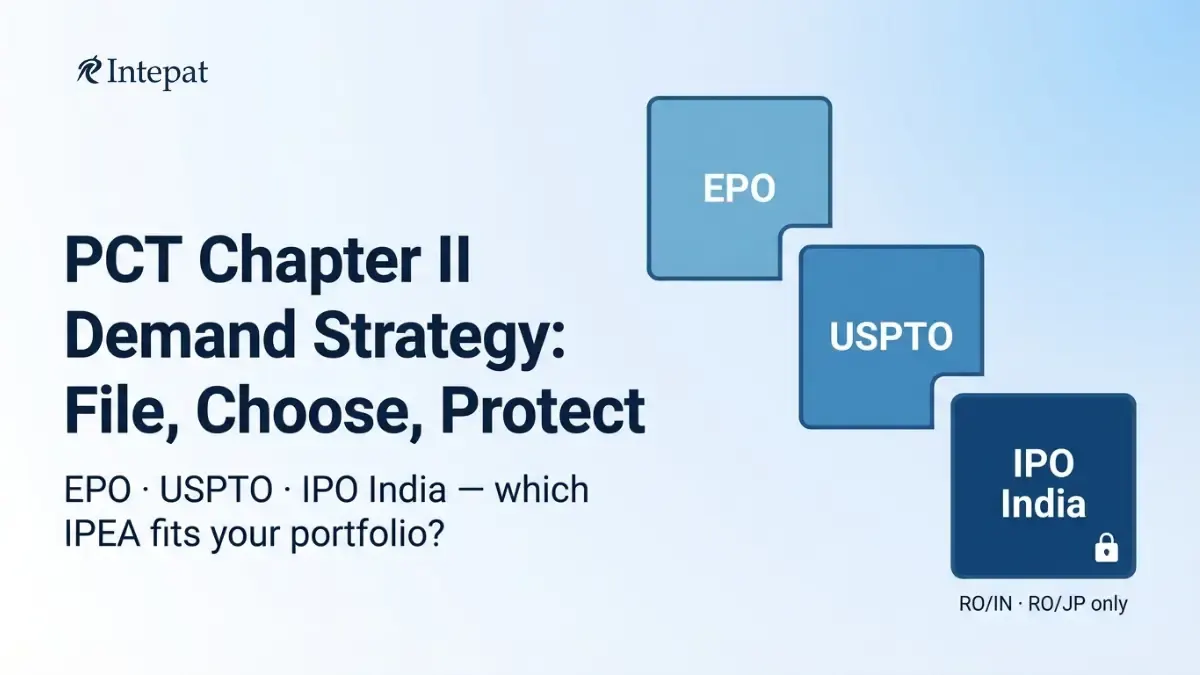
The right IPEA depends on where prosecution value is greatest. The comparison below maps the three major authorities against portfolio objectives.
| IPEA | Primary Strength | Best for |
| EPO | Thorough prior art search; PACE fast-track in EP national phase; widely respected by other offices | Europe-primary portfolios; applicants where EPO grant quality is the benchmark for downstream offices |
| USPTO | Strong PCT-PPH leverage; positive IPRP supports expedited examination at PPH-participating offices worldwide | Multi-jurisdiction portfolios where US and PPH-member offices are the primary commercial targets |
| IPO (India) | Lowest IPEA fee among major authorities; unlocks Form 18A expedited examination eligibility at the Indian Patent Office | India-priority portfolios filed at RO/IN or RO/JP; applicants who did not designate India as ISA at filing |
EPO as IPEA
A positive IPRP Chapter II from the EPO is treated as a basis for expedited processing under the PACE programme, and EPO examination in the national phase tends to proceed from where the IPEA examination concluded. The EPO preliminary examination fee is approximately EUR 1,915 for large entities, the highest among major authorities. For applicants where European grant quality is the benchmark that other offices follow, the EPO as IPEA is typically the strongest choice.
USPTO as IPEA
A positive IPRP from the USPTO allows applicants to request expedited examination at all participating Patent Prosecution Highway offices, which currently includes the major commercial jurisdictions. This makes the USPTO as IPEA the most efficient choice for portfolios spread across multiple PPH-participating offices where no single jurisdiction dominates.
IPO as IPEA: eligibility constraint
The IPO as IPEA is competent only for applications filed at three Receiving Offices: RO/IN (Indian Patent Office), RO/IR (Iranian Intellectual Property Center), and RO/JP (Japan Patent Office). Applications filed at RO/US, RO/EP, RO/KR, RO/IB, or any other Receiving Office not on this list cannot elect India as IPEA. This is not a discretionary condition. It is a competency restriction published in Annex E(IN) of the WIPO PCT Applicant’s Guide (valid from 1 January 2026; fees within that annex effective from 1 September 2025). Foreign applicants who filed their PCT application at their home Receiving Office, which for US, European, and Korean applicants means RO/US, RO/EP, or RO/KR, will find this route unavailable regardless of their national phase intentions.
| COMPETENCY CHECK — REQUIRED BEFORE FILING: |
| India (IPO) as IPEA is competent only for international applications filed at RO/IN (Indian Patent Office), RO/IR (Iranian Intellectual Property Center), and RO/JP (Japan Patent Office). Applicants who filed at RO/US, RO/EP, RO/KR, RO/IB, or any other Receiving Office cannot elect India as IPEA. Verify the current list at pctlegal.wipo.int (Annex E(IN)) before filing the Demand. |
For applicants who filed at RO/IN or RO/JP and have India as a national phase target, the IPO as IPEA carries a distinct procedural benefit covered in the next section. The preliminary examination fee payable to the IPO is INR 12,000 (approximately USD 143) for large entities where the ISR was prepared by an authority other than the IPO, and INR 10,000 (approximately USD 119) where the IPO also prepared the ISR. For natural persons, startups, small entities, and educational institutions, the fees are INR 3,000 and INR 2,500 respectively. All Demands also attract the WIPO handling fee of USD 251, subject to a 90% reduction for applicants from UN-classified least developed countries. Fees verified against WIPO PCT Applicant’s Guide Annex E(IN), effective 1 September 2025; verify current rates at pctlegal.wipo.int before filing.
How a PCT Chapter II Demand Affects Indian Patent Prosecution
What Form 18A is and why it matters
Form 18A is the mechanism for expedited examination under Rule 24C of the Patents Rules 2003 (as amended by the Patents Amendment Rules 2024). For a foreign large entity that did not designate India as ISA at the PCT filing stage, filing a Chapter II Demand with India as IPEA is the remaining route to Form 18A eligibility. Form 18A places the application in a priority examination queue. Applicants who have satisfied the eligibility requirements and filed Form 18A within the applicable deadline have reported receiving a First Examination Report within approximately four months. The standard Form 18 route carries a considerably longer wait. For PCT applications filed on or after 15 March 2024, the Request for Examination under Form 18 or Form 18A must be filed within 31 months from the earliest priority date, with no post-deadline cure available. For the full Form 18A procedure and eligibility conditions, see Intepat’s PCT national phase entry in India guide.
What the IPO actually uses from the international phase
The IPRP Chapter II is non-binding on the Indian Patent Office as it is on every designated office. The IPO conducts independent examination under the Patents Act 1970 and Patents Rules 2003. What the IPRP does in practice is shape the prior art record the examiner works from. When the ISA issues a negative Written Opinion citing prior art documents and raising novelty and inventive step objections, those same documents typically reappear in the First Examination Report. Where the applicant has responded with targeted amendments and arguments and obtained a positive IPRP, the IPO examiner opens a file where the prior art has already been addressed and the claims have been narrowed. That does not guarantee grant, but it reduces the scope of objections the examiner needs to raise independently.
What the IPRP does not do
A positive IPRP does not override India’s specific patentability exclusions. Section 3(d) of the Patents Act 1970, which bars patents for new forms of known substances without enhanced efficacy, applies to pharmaceutical applicants regardless of what the IPEA concluded. Section 3(k), which excludes computer programmes per se and mathematical methods, applies to software and computer-implemented invention applicants independently of any IPEA finding. Both exclusions are applied by the Indian examiner from the outset of national phase prosecution and are not addressed by the IPRP. Claim drafting strategy for Indian prosecution needs to anticipate these exclusions before the First Examination Report is issued, not in response to it.
For applicants who designated India as ISA at the PCT filing stage, the IPEA election through Chapter II adds Form 18A value only if the Written Opinion is negative and the broader Article 34 scope is needed. The full ISA designation strategy is covered in Intepat’s guide on choosing India as your PCT ISA.
When Should You File a PCT Chapter II Demand? Decision Matrix
The matrix below maps the six principal scenarios a foreign applicant or IP counsel will encounter. Each recommendation reflects both procedural eligibility and the practical cost-benefit balance.
| Scenario | File Demand with India as IPEA? | Rationale |
| Negative WO-ISA; India is a priority market; ISA was not India; filed at RO/IN, RO/IR, or RO/JP | YES — strong case | Elects India as IPEA, unlocking Form 18A. Amendments and arguments filed with the Demand give the IPEA examiner a basis to issue a positive IPRP, reducing the prior art citations the FER will rely on. |
| Positive WO-ISA; India is a priority market; ISA was not India; filed at RO/IN, RO/IR, or RO/JP | CONSIDER — Form 18A value only | Chapter II adds no patentability benefit when the WO-ISA is positive. The Demand is worth filing only if the Form 18A prosecution speed at the IPO justifies the cost. |
| India (IPO) was already ISA | OPTIONAL — limited additional benefit | Form 18A eligibility is already established by the ISA designation. Chapter II adds value only if the WO-ISA is negative and broader Article 34 amendments would materially improve prosecution across designated offices. |
| Filed at RO/US, RO/EP, RO/KR, or RO/IB | NO — India is not a competent IPEA | India (IPO) as IPEA is competent only for RO/IN, RO/IR, and RO/JP. Applicants filing at any other Receiving Office cannot elect India as IPEA and cannot access Form 18A through this route. |
| India is not a target national phase jurisdiction | NO | The primary benefit of electing India as IPEA is Form 18A eligibility at the IPO. If the applicant does not intend to enter the Indian national phase, choose an IPEA aligned with other priority jurisdictions. |
| Chapter II deadline has passed (PCT Rule 54bis.1(a)) | NO — deadline missed | A Demand filed after the Rule 54bis.1(a) deadline is treated as not filed. The Form 18A route is permanently closed for that application. |
PCT Chapter II Demand Deadline and Key Milestones
The Chapter II Demand deadline under PCT Rule 54bis.1(a) is the later of:
- Three months from the date of transmittal of the ISR and Written Opinion to the applicant, or
- 22 months from the earliest priority date.
In practice, the ISR is typically issued at around 16 months from the priority date. Three months from that point is approximately 19 months, which falls earlier than the 22-month backstop. Where the ISR is delayed, the three-month window from transmittal may push the operative deadline beyond 22 months. The safest approach is to docket both dates on receipt of the ISR and treat whichever falls later as the operative deadline. A Demand filed after this point is treated as not filed. There is no extension and no grace period.
Filing the Demand early, with amendments and arguments already prepared, avoids a separate risk. PCT Rule 66.4bis allows the applicant to file arguments and amendments with the Demand or in response to the IPEA’s first written opinion, but only until the IPEA actually begins drawing up the IPRP. That start point is not published in advance. The practical standard is to file the Demand together with the Article 34 amendments and arguments at the same time, not in two separate steps.
Article 19 amendments, which are limited to claims only, remain available until two months from the date of transmittal of the ISR under PCT Rule 46.1. The Article 19 window is independent of the Chapter II Demand decision. An applicant can file Article 19 amendments and later file a Chapter II Demand with Article 34 amendments if the scope of the Written Opinion requires changes to the description or drawings.

The IPRP Chapter II is transmitted to designated offices at 28 months from the priority date and made available at 30 months. National phase entry in India falls at 31 months from the earliest priority date under Section 22(3) of the Patents Act 1970 and Rule 20(4) of the Patents Rules 2003. Form 18A must be filed within that same 31-month window for applications filed on or after 15 March 2024. For the complete national phase filing sequence, see Intepat’s PCT national phase entry in India guide.
Common Mistakes in Filing a PCT Chapter II Demand
Missing the Rule 54bis.1(a) deadline
A Demand filed after the deadline is treated as if not filed and the IPEA will issue a formal declaration to that effect. The Form 18A route through the IPEA election is permanently closed for that application. The deadline does not always fall at 22 months. Where the ISR is issued late, three months from transmittal may be the operative date and will be later than 22 months. Docket both calculations on the day the ISR arrives.
Assuming RO/IB opens the India IPEA route
Filing at the International Bureau as Receiving Office is a common strategy for applicants wanting ISA flexibility. RO/IB is not listed in Annex E(IN) as a Receiving Office for which India (IPO) is a competent IPEA. Applicants who file at RO/IB and did not designate India as ISA cannot elect India as IPEA for the Chapter II Demand. The Form 18A route through this mechanism is unavailable to them.
Filing the Demand without amendments when the WO-ISA is negative
A Demand filed without amendments when the Written Opinion is negative produces a Chapter II process without the one element that makes it useful. The IPEA will examine on the basis of the claims as filed and is likely to issue an IPRP that mirrors the Written Opinion. Always file the Demand together with targeted Article 34 amendments and arguments addressing the specific objections raised.
Treating a positive IPRP as immunity from India-specific objections
A positive IPRP Chapter II is non-binding. The IPO applies the Patents Act 1970, including the Section 3(d) and Section 3(k) exclusions, to every application regardless of what the IPEA concluded. A positive IPRP strengthens the prosecution position at the IPO on prior art grounds but does not resolve these India-specific exclusions. Claim drafting strategy must anticipate them from the outset.
The Decision in Plain Terms
The Chapter II Demand is worth filing when at least one of two conditions is present: the Written Opinion raises objections that Article 34 amendments can address before national phase entry, or India is a priority national phase jurisdiction and the applicant needs to establish IPEA eligibility for Form 18A. The two conditions often coincide, but each independently justifies the cost of the Demand.
The IPEA eligibility condition is the one most frequently missed. Applicants who filed at RO/US, RO/EP, or RO/KR cannot access it at all, because India is not a competent IPEA for those Receiving Offices. Applicants who filed at RO/IN or RO/JP have the option, but must act before the Rule 54bis.1(a) deadline, a date that does not always fall where it appears to.
The deadline is the governing constraint. Docket it the day the ISR arrives, file the Demand with amendments where the Written Opinion is negative, and do not rely on the Rule 59.3 forwarding mechanism as a safety net for a competency error that should have been verified before filing.
For further reading: the Article 19 vs Article 34 amendment decision is covered in Intepat’s article on PCT amendments under Article 19 and Article 34. The broader PCT filing process from India is covered in the PCT international application filing guide.
Frequently Asked Questions
No route through Chapter II is available. India is not a competent IPEA for applications filed at RO/IB, and this cannot be remedied after filing. Form 18A eligibility for a large entity requires either an ISA or IPEA designation to India, and both opportunities close at the PCT filing stage and the Chapter II Demand deadline respectively. The application will enter India through the standard Form 18 route. The lesson for future filings is that the ISA designation decision and the RO selection are prosecution strategy decisions with Indian national phase consequences, not administrative choices.
Yes, but indirectly and only on prior art grounds. A positive IPRP Chapter II produced after responding to the Written Opinion with targeted amendments means the IPO examiner opens a file where prior art objections have already been addressed. The scope of the First Examination Report is often narrowed as a result. However, Chapter II does not affect India’s Section 3(d) or Section 3(k) exclusion analysis, which the IPO applies independently. For pharmaceutical and software applicants, the IPRP outcome is not a reliable predictor of Indian examination success on those specific grounds.
No. Once a Demand is filed with a specified IPEA, that election is binding. PCT Rule 59.3 allows the International Bureau to forward a Demand to a competent IPEA if the nominated one is incompetent for the Receiving Office, but that is a correction mechanism for errors, not a mechanism for changing strategy after the fact. An applicant cannot withdraw one Demand and file another with a different IPEA after the Rule 54bis.1(a) deadline has passed.
No. The Demand can be filed without amendments. But filing without amendments when the Written Opinion is negative means the IPEA will examine on the claims as originally filed and is likely to reach the same conclusions as the ISA. The practical result is a negative IPRP that mirrors the Written Opinion, with the cost of the Demand added. Where the Written Opinion is positive and the only reason for filing is Form 18A eligibility, the Demand without amendments may be a reasonable choice, since there are no objections to address.
Under PCT Rule 59.3, the International Bureau will forward the Demand to a competent IPEA if the one originally nominated is incompetent for the application’s Receiving Office. The Demand is processed based on the date of receipt at the original IPEA, provided a competent IPEA accepts it. This safeguard has practical limits: delay is introduced, and if no competent IPEA accepts the forwarded Demand in time, the examination may not be completed before 28 months. It cannot be treated as a reliable remedy for a competency error that should have been verified before filing.
Yes, and this is the default position under Chapter I. The ISR and Written Opinion are transmitted to the IPO as the IPRP Chapter I at 30 months, and the IPO examiner will use them as a starting point for the First Examination Report. If the Written Opinion is positive and Form 18A eligibility is not required, proceeding under Chapter I is often the right choice. The additional cost of a Demand is justified primarily when: the Written Opinion raises objections that Article 34 amendments can address, or India as IPEA is needed for Form 18A eligibility. Neither condition is present in every application.
Each office decides independently how much weight to give the IPRP. The EPO conducts its own substantive examination and treats the IPRP as one input rather than a definitive assessment. A positive IPRP from the IPO as IPEA does not qualify an applicant for Patent Prosecution Highway acceleration at the EPO in the same way that a positive IPRP from the EPO would. For applicants where EPO prosecution is the primary commercial objective, electing the EPO as IPEA is typically the stronger choice. India as IPEA is the right election when Indian national phase speed is the priority and the RO eligibility condition is satisfied.
No. India has always applied a 31-month national phase deadline under PCT Article 22(3), and this applies whether or not a Chapter II Demand has been filed. The historical function of the Demand in extending national phase from 20 to 30 months, used before April 2002, is irrelevant for virtually all PCT contracting states including India, which never operated on a 20-month deadline. Filing a Demand does not extend, shorten, or otherwise alter the 31-month national phase entry deadline.
Working on a PCT portfolio with India in the national phase?
Intepat’s registered patent agents file Chapter II Demands, manage IPEA elections, and handle national phase entry and prosecution at the Indian Patent Office. Speak with our team to assess Form 18A eligibility and the right Demand strategy for your application.