




Not every new idea qualifies for a patent in India. Even a genuinely novel invention may be excluded if it falls within a category the Patents Act 1970 expressly bars. Sections 3 and 4 of the Act define this subject matter. This article covers each exclusion in plain terms, with examples, so you can identify statutory bars before you file.
Quick Answer
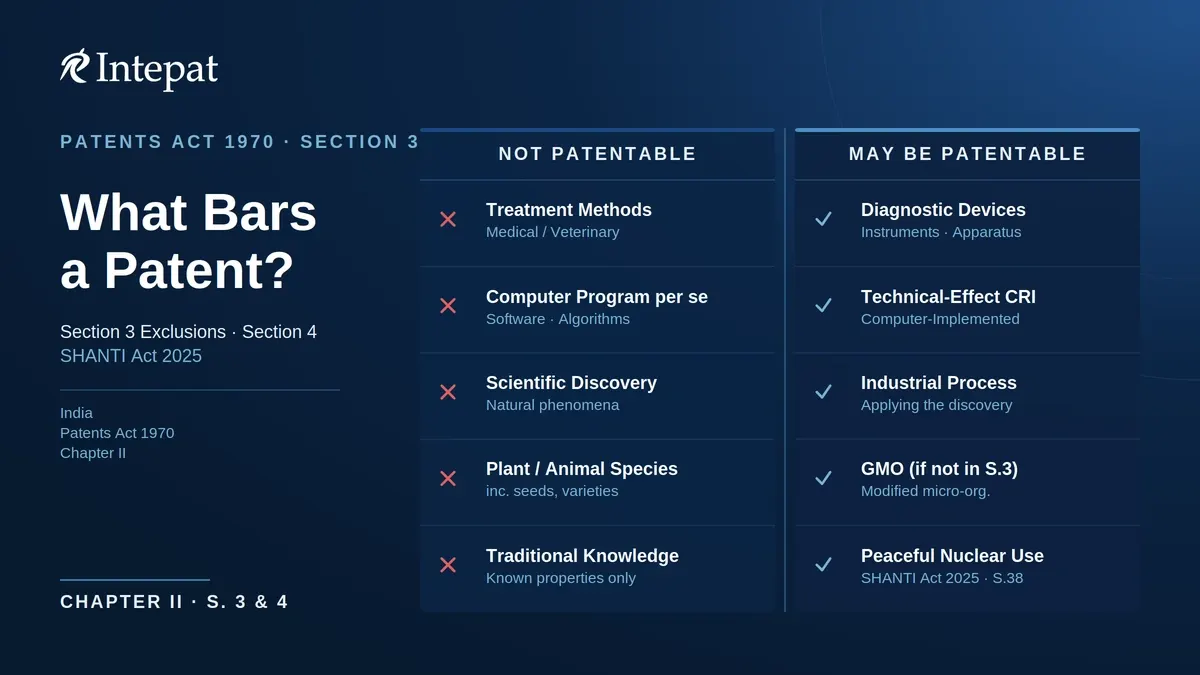
Sections 3 and 4 of the Patents Act 1970 list the subject matter that cannot be patented in India. The exclusions range from frivolous inventions and mere scientific discoveries to software programs as such, medical treatment methods, plants and animals, traditional knowledge. Section 4 previously barred all atomic-energy inventions; the SHANTI Act, 2025 (in effect from 21 December 2025) substituted Section 4 and now allows patents for peaceful nuclear-energy uses subject to Central Government clearance. If your invention falls entirely within a Section 3 category, it cannot be granted a patent regardless of how novel or useful it is. Where an invention combines patentable and excluded elements, the outcome depends on the claims as drafted.
Why Indian Patent Law Has Exclusions
An “invention” under the Patents Act 1970 means a new product or process involving an inventive step and capable of industrial application. Beyond that definition, Chapter II of the Act lists subject matter that is not an invention at all, or that is otherwise not patentable, regardless of novelty or utility. An application that falls squarely within Section 3 will be refused at examination. Knowing these boundaries in advance helps you structure claims correctly, or identify which aspect of your work should rely on a different form of IP protection.
Section 3: What Are Not Inventions
Section 3 of the Patents Act 1970 sets out the subject matter that is not an invention.
| Excluded subject matter | Plain example | What may still be patentable |
| Frivolous or contrary to natural laws | Perpetual-motion machine | Any machine with a physically achievable mechanism |
| Contrary to public order or morality | Burglary device; counterfeiting method | Inventions whose primary use is not harmful |
| Mere discovery of a scientific principle | Discovery of a new element | Industrial process based on the principle |
| New form of known substance without enhanced efficacy | New polymorph of a drug without better therapeutic effect | New form that demonstrably enhances efficacy |
| Mere admixture (aggregation only) | A blend with no combined effect | Synergistic formulation with effect beyond its parts |
| Mere arrangement of known devices | Clock + radio in one cabinet, each working independently | Combined device producing a new or improved result |
| Method of agriculture or horticulture | Wheat cultivation process | Agricultural machinery and equipment |
| Medical/veterinary treatment method | Surgical procedure; diagnostic protocol | Surgical instruments; diagnostic devices |
| Plants, animals, seeds, varieties | Plant variety; animal clone | Genetically modified micro-organisms |
| Mathematical method, business method, algorithm, computer program per se | Pricing algorithm; set of software instructions | Computer-implemented system producing a defined technical effect |
| Literary, dramatic, musical, artistic works | Novel; film; painting | (Protected by copyright instead) |
| Scheme for mental act or game | Chess rules; language-learning method | Apparatus implementing the game |
| Presentation of information | Railway timetable | (Not patentable in any form) |
| Topography of integrated circuits | Chip layout design | (Protected under SICLD Act, 2000 instead) |
| Traditional knowledge / known properties | Antiseptic use of turmeric | Novel process using traditional knowledge that produces a new product |
Frivolous inventions or claims contrary to established natural laws
An invention that is frivolous, or that claims anything obviously contrary to well-established natural laws, is not patentable. A machine claimed to produce perpetual motion, or one asserted to deliver more output than input, falls here. The same applies to any machine alleged to achieve 100% efficiency.
Inventions contrary to public order, morality, or the environment
An invention whose primary or intended use or commercial exploitation would be contrary to public order or morality, or which causes serious prejudice to human, animal, or plant life, health, or the environment, is excluded. Examples include devices designed for burglary, methods for counterfeiting currency, and inventions whose intended use would cause serious prejudice to human or animal life. Where an invention’s primary purpose is not causing such prejudice, it may remain patentable.
Mere discovery of a scientific principle, abstract theory, or natural substance
The mere discovery of a scientific principle, the formulation of an abstract theory, or the discovery of any living thing or non-living substance occurring in nature is not an invention. Identifying a naturally occurring mineral or a wild micro-organism is a discovery, not an invention. Where a discovery leads to a specific product or industrial process that is itself new and useful, that product or process may qualify even if the underlying discovery does not.
Mere discovery of a new form of a known substance (Section 3(d))
This exclusion is most often discussed in pharmaceutical and chemical patent applications. The mere discovery of a new form of a known substance is not patentable unless the new form results in enhancement of the known efficacy of that substance. The mere discovery of a new property or new use for a known substance, or the mere use of a known process or apparatus, is also excluded unless the known process results in a new product or employs at least one new reactant.
The Act’s Explanation to this clause treats salts, esters, ethers, polymorphs, metabolites, pure forms, particle sizes, isomers, mixtures of isomers, complexes, combinations, and other derivatives of a known substance as the same substance unless they differ significantly in properties with regard to efficacy.
Substances obtained by mere admixture
A substance obtained by a mere admixture that results only in the aggregation of the properties of its components, and the process for producing it, are excluded. A formulation that produces a synergistic effect, where the combined result exceeds the sum of the individual components, is not mere admixture and may be patentable.
Mere arrangement or re-arrangement of known devices
The mere arrangement, re-arrangement, or duplication of known devices, where each device functions independently of the others in a known way, is not patentable. Placing a torch on a bucket, or combining a clock and radio in one cabinet, falls within this exclusion. Where the combined arrangement produces a new or improved result through the interaction of the components, there may be patentable subject matter.
Methods of agriculture or horticulture
A method of agriculture or horticulture is not patentable. Processes for producing or cultivating plants, including greenhouse methods and soil treatment methods directed at plant growth, fall here. Agricultural equipment and machinery are not excluded; the exclusion applies to methods, not to physical apparatus.
Medical and veterinary treatment methods
Any process for the medicinal, surgical, curative, prophylactic, diagnostic, therapeutic, or other treatment of human beings, or any similar treatment of animals to render them free of disease or to increase their economic value or that of their products, is excluded. The exclusion applies to treatment methods, not to instruments, devices, or apparatus. A surgical instrument or diagnostic device may be patentable even when the treatment process performed using it is not.
Plants, animals, seeds, varieties, and essentially biological processes
Plants and animals, in whole or in any part, are not patentable. The exclusion covers seeds, varieties, and species, as well as essentially biological processes for the production or propagation of plants and animals. Micro-organisms are expressly carved out: genetically modified micro-organisms that do not otherwise fall within Section 3 may be patentable.
Plant varieties in India are separately protectable under the Protection of Plant Varieties and Farmers’ Rights Act, 2001.
Mathematical methods, business methods, algorithms, and computer programs as such
A mathematical method, business method, algorithm, or computer program per se is not an invention. The phrase “per se” qualifies only the computer-program limb of this exclusion: it signals that the exclusion targets the program in isolation, not a broader technical invention that happens to involve a computer program. Business methods, by contrast, carry an absolute bar with no “per se” qualifier; no technical-effect analysis applies to them. A claim directed purely at code, a set of instructions, or a computer program product stored on a medium will generally be refused. A computer-implemented system or process that produces a defined technical effect may fall outside the computer-program exclusion depending on how the claims are drafted.
The Indian Patent Office’s Guidelines for Examination of Computer-Related Inventions, 2025 (released 29 July 2025) provide structured tests for each Section 3(k) limb, including algorithm, business method, mathematical method, and computer program per se, along with illustrative examples and coverage of AI, machine learning, blockchain, and quantum computing inventions.
A computer program, as a standalone creative work, may be protected as a literary work under the Copyright Act 1957.
Literary, dramatic, musical, artistic, and other aesthetic creations
Literary, dramatic, musical, and artistic works, and any other aesthetic creation, including cinematographic works and television productions, are not inventions. These works are protected under the Copyright Act 1957.
Mere schemes or rules for performing mental acts or playing games
A mere scheme, rule, or method of performing a mental act, or a method of playing a game, is not patentable. Teaching methods, language-learning schemes, and methods of solving puzzles fall within this exclusion. An apparatus designed to play a game is not excluded; only the method or rule itself is.
Presentation of information
Any manner, means, or method of presenting information, whether through words, codes, signals, symbols, diagrams, or any other mode of representation, is excluded.
Topography of integrated circuits
The topography of integrated circuits is not patentable. Protection for three-dimensional configurations of electronic circuits in microchips and semiconductor chips is governed separately by the Semiconductor Integrated Circuits Layout-Designs Act, 2000.
Traditional knowledge and known properties of traditionally known components
An invention that is, in effect, traditional knowledge, or that is an aggregation or duplication of known properties of traditionally known components, is not patentable. The antiseptic properties of turmeric and the pesticidal properties of neem are examples cited in the Patent Office Manual. Examiners use the Traditional Knowledge Digital Library to check this. A value-addition using a traditionally known component that results in a new product or process meeting the patentability requirements remains open to patent protection.
Section 4: Nuclear-Energy Inventions
Section 4 of the Patents Act 1970, as it stood before December 2025, barred the grant of any patent for an invention relating to atomic energy falling within sub-section (1) of Section 20 of the Atomic Energy Act, 1962. That was an absolute bar: no patent could be granted regardless of the nature of the invention.
The Sustainable Harnessing and Advancement of Nuclear Energy for Transforming India (SHANTI) Act, 2025, received presidential assent on 20 December 2025 and came into effect on 21 December 2025. The SHANTI Act repeals the Atomic Energy Act, 1962 and substitutes Section 4 of the Patents Act 1970. Under the new framework, patents may be granted for inventions relating to the peaceful uses of nuclear energy and radiation, subject to the provisions of the SHANTI Act and, specifically, Section 38 of that Act. Section 38 requires the Controller to refer questions about an invention’s sensitivity or strategic relevance to the Central Government; if the Government considers the invention sensitive or having national-security implications, a patent cannot be granted.
Activities reserved exclusively to the state, including nuclear fuel enrichment, spent-fuel reprocessing, heavy-water production, and reactor design for weapons purposes, remain non-patentable under the SHANTI Act. Peaceful civilian applications, such as nuclear medicine, food irradiation, radiation safety equipment, and small modular reactor technology not touching reserved activities, may now be patentable subject to the Government’s clearance process.
Before advising on or filing a patent application for a nuclear-energy invention, confirm the current operative position and any commencement notifications under the SHANTI Act, 2025.
What the Exclusions Do Not Cover
The exclusions target methods, mere discoveries, and abstract creations, not every product or process connected to those fields. Some specific distinctions that matter in practice:
- Medical and diagnostic devices and instruments are patentable, even though treatment methods are not.
- Genetically modified micro-organisms that do not otherwise fall within Section 3 may be patentable.
- A computer-implemented invention that produces a defined technical effect may be patentable, depending on how the claims are drafted.
- Synergistic formulations are patentable, even though a mere admixture is not.
- Agricultural equipment is patentable, even though agricultural methods are not.
- Nuclear-energy inventions relating to peaceful uses may now be patentable under the SHANTI Act, 2025, subject to Central Government clearance under Section 38 of that Act.
Before You File: A Practical Check
Before filing, consider:
- Whether the core of what you want to protect is a product or process, or a method, scheme, discovery, or creation.
- Whether it falls within any category in Section 3. If so, the application is likely to face a statutory objection.
- Whether a different IP right applies: copyright for original expression, design registration for visual features, trade secret for confidential information.
- Whether a patent agent can structure claims around the patentable aspects if excluded and non-excluded elements are combined.
For a detailed look at what qualifies for patent protection, see what can be patented in India.
Related Reading
- What Can Be Patented in India
- Software Patents in India
- AI and Machine Learning Patents in India
- Patent Filing Procedure in India
- Patent Strategy: Why and What You Should Patent
Frequently Asked Questions
Section 3 of the Patents Act 1970 lists subject matter that is not an invention within the meaning of the Act. The exclusions cover frivolous inventions, mere scientific discoveries, new forms of known substances without enhanced efficacy, abstract methods, medical treatment processes, plants and animals, computer programs as such, and traditional knowledge. An application falling squarely within Section 3 will be refused at examination.
A computer program per se cannot be patented in India. A computer-implemented invention that produces a defined technical effect may be patentable if the claims reflect the technical character of the invention rather than the program as such. The Indian Patent Office’s Guidelines for Examination of Computer-Related Inventions, 2025 (released 29 July 2025) explain how examiners evaluate such applications, including AI and blockchain inventions.
No. Section 3 of the Patents Act 1970 excludes medical, surgical, curative, prophylactic, diagnostic, and therapeutic treatment methods for humans and animals. It does not exclude the instruments, devices, or apparatus used to carry out those treatments. A surgical instrument, a diagnostic machine, or a medical device may be patentable, provided it meets the general requirements of novelty, inventive step, and industrial applicability.
Plants and animals in whole or in any part, including seeds, varieties, and species, are not patentable under Section 3 of the Patents Act 1970. Essentially biological processes for their production or propagation are also excluded. Micro-organisms are expressly carved out and may be patentable. Plant varieties may be separately protected under the Protection of Plant Varieties and Farmers’ Rights Act, 2001.
An invention that is, in effect, traditional knowledge, or that aggregates or duplicates known properties of traditionally known components, is not patentable under Section 3 of the Patents Act 1970. The exclusion reflects the policy position that knowledge already existing in public or community domains should not be appropriated through patents. India’s Traditional Knowledge Digital Library supports examiners in identifying such prior art.
Section 4 of the Patents Act 1970 previously barred all patents for atomic-energy inventions. The SHANTI Act, 2025 (in effect from 21 December 2025) substituted Section 4 and removed the absolute bar. Patents may now be granted for inventions relating to peaceful uses of nuclear energy under Section 38 of the SHANTI Act, subject to Central Government clearance. State-reserved and security-sensitive activities remain non-patentable.
A new form of a known drug is not patentable unless it results in significant enhancement of the known efficacy of that substance. The Supreme Court held in Novartis AG v. Union of India (Civil Appeal Nos. 2706–2716 of 2013, (2013) 6 SCC 1) that for medicines, efficacy means therapeutic efficacy; improved physical or chemical properties without demonstrated therapeutic benefit are insufficient.
This article explains the law on non-patentable subject matter in India as at June 2026 and is for general information only. It is not legal advice. Government fees, forms, and procedures change; confirm current positions with the Indian Patent Office before you file. For advice on your specific invention, consult a registered patent agent.