




Late entry into the national phase is sometimes possible, but it is entirely jurisdiction-dependent. In most countries, the deadline for national phase entry under the PCT is either 30 months or 31 months from the earliest priority date. Once that deadline expires, the application is normally treated as withdrawn in that country. Certain patent offices provide limited procedural remedies. Others do not.
The decisive factor is not whether the deadline was missed, but whether the relevant jurisdiction provides a legally recognised mechanism to cure the default.
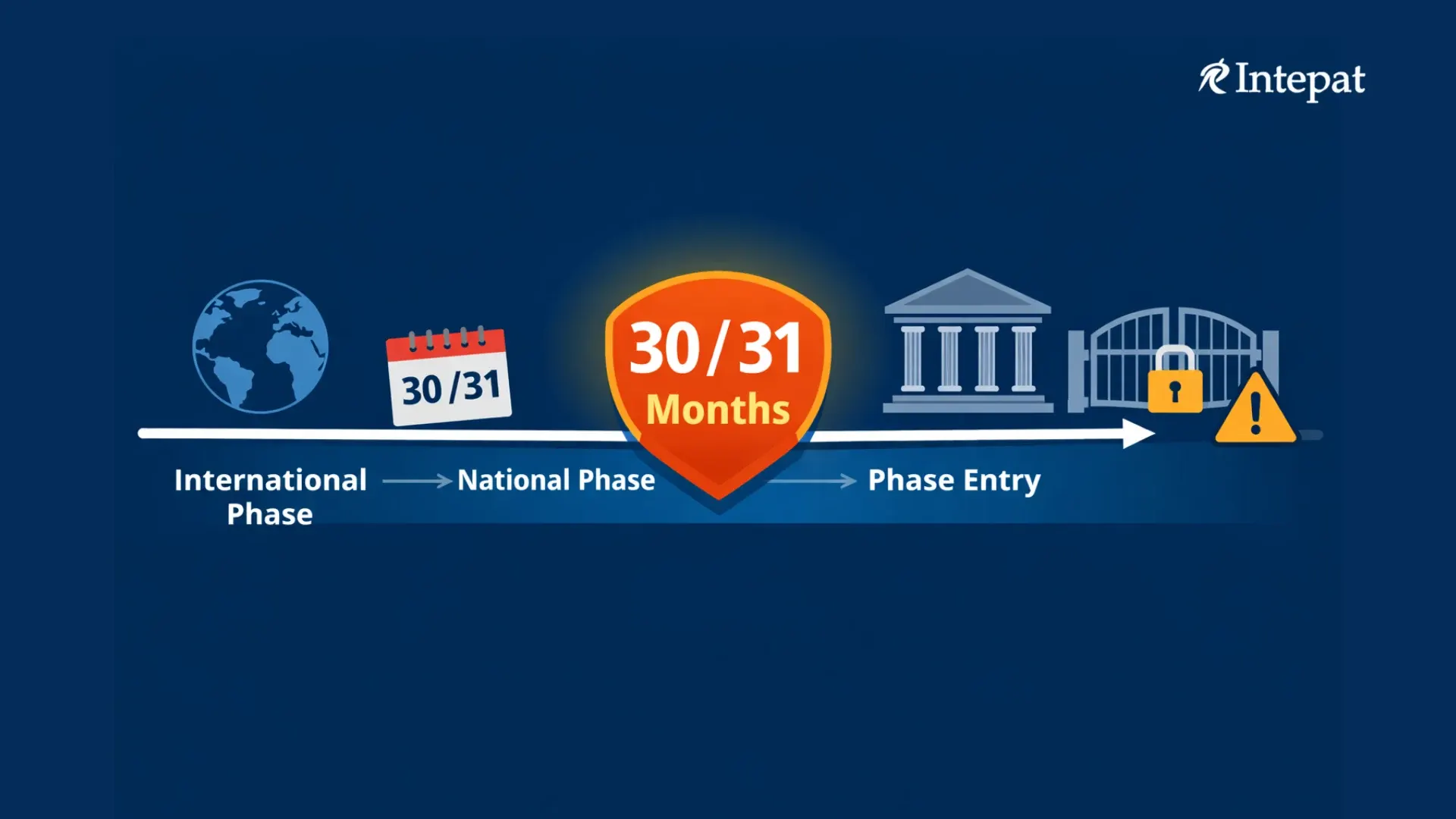
What Is the National Phase Deadline Under the PCT?
Under the PCT framework, an international application must enter the national or regional phase within 30 months from the earliest priority date, unless the designated Office applies a 31-month limit. The applicable deadline for each jurisdiction is officially published in the WIPO PCT Applicant’s Guide and reflected in national legislation.
The calculation always begins from the earliest claimed priority date. It does not begin from the international filing date unless no priority was claimed.
National phase entry generally requires completion of several procedural acts before the expiry of the 30 or 31-month limit. These acts typically include filing a request for national entry, payment of national fees, submission of translations where required, and appointment of a local patent agent where mandated by domestic law.
Failure to complete the required acts within the prescribed time results in the application being treated as not having entered the national phase in that jurisdiction.
What Happens When the 30 or 31-Month Deadline Is Missed?
Once the national phase deadline passes, the legal consequence in most jurisdictions is automatic loss of rights in that country. The application is considered withdrawn or deemed not to have entered the national phase. No examination will commence.
At that stage, the applicant’s position depends entirely on whether the national law of the designated state provides any corrective mechanism.
In practice, jurisdictions fall into three procedural categories:
- Some provide a short statutory grace period, usually conditioned on payment of a prescribed additional fee. In such systems, the extension operates automatically if the applicant completes the required acts within the additional window.
- Others allow reinstatement or revival of rights upon filing a petition. In these cases, the patent office evaluates whether the delay meets a defined legal standard. The most common standards are “unintentional delay” or “all due care.”
- A third category does not permit any late entry mechanism at all. In those jurisdictions, missing the deadline typically ends the possibility of entering the national phase through the PCT route.
Determining which category applies requires reference to the national law and official procedural guidance of the specific country involved. General assumptions are unreliable and frequently incorrect.
How National Phase Deadlines Work
Under the PCT framework, entry into the national phase marks the transition from the international procedure to country-specific prosecution. The applicable time limit is generally 30 months from the earliest priority date. Certain jurisdictions extend this to 31 months. These time limits derive from PCT Articles 22 and 39 and are reflected in the national law of each designated Office. The official reference for jurisdiction-specific deadlines remains the WIPO PCT time limit tables.
The calculation always runs from the earliest priority date. It does not run from the international filing date unless no priority was claimed.
National phase entry is not a single act. It typically requires filing a request for entry, payment of national fees, submission of translations where required, and compliance with local representation rules. Failure to complete these acts within the prescribed time usually results in the application being deemed withdrawn in that jurisdiction.
In India, for example, the national phase entry deadline is 31 months from the earliest priority date, and procedural compliance within that window is mandatory under the Patents Act and Rules. The practical implications of this framework are discussed in detail in the analysis of PCT national phase entry in India.
It is important to distinguish between the international phase and national phase obligations. The international phase provides centralized processing, but once the application transitions to national law, each Office applies its own procedural consequences for non-compliance. A structured comparison of the international and national phase mechanisms provides context to this distinction.
What Happens After the 30 or 31-Month Deadline Is Missed?
Once the national phase deadline expires, the application is typically treated as withdrawn or deemed not to have entered the national phase in that jurisdiction. Examination does not commence, and the file moves into a loss-of-rights position.
The legal consequence is automatic in most countries. The real question becomes whether national law offers any corrective mechanism.
1. Jurisdictions with a Statutory Grace Period
Certain patent offices allow a short extension beyond the 30 or 31-month deadline if the applicant completes the required acts within a defined additional window and pays a prescribed surcharge.
In these systems, the extension mechanism is procedural rather than discretionary. The Office does not generally examine the reason for delay. If the formal requirements are satisfied within the extended period, national phase entry is accepted.
The availability and length of such grace periods vary by jurisdiction and must be verified against the national chapter of the PCT Applicant’s Guide.
2. Jurisdictions Allowing Reinstatement or Revival
In other countries, late entry is not automatic but may be permitted through a petition for reinstatement or revival of rights.
These mechanisms require the applicant to satisfy a defined legal standard. The most common standards are:
- Unintentional delay
- All due care
The distinction is material. An unintentional standard typically requires a declaration that the failure was not deliberate. A due-care standard requires evidence that reasonable systems were in place and that the deadline was missed despite proper precautions.
Where due care applies, documentary support may become critical. Internal docketing systems, communication timelines, and explanations of exceptional circumstances are often examined carefully.
Relief in such jurisdictions is discretionary. Approval is not guaranteed.
3. Jurisdictions Providing No Late Entry Mechanism
A third category of jurisdictions does not permit late national phase entry at all. In these countries, once the 30 or 31-month deadline passes, entry through the PCT route is no longer available.
Any remaining options would depend entirely on domestic law and the factual context of the case. In many situations, rights are effectively lost.
Practical Advisory Note
The availability of corrective mechanisms is determined by national law, not by the PCT itself. While the PCT sets the framework, each designated Office defines how missed deadlines are treated.
Immediate action after a missed deadline is critical. In jurisdictions permitting reinstatement, the time window to file a petition is often short and may begin running automatically upon expiry or upon issuance of a loss-of-rights notification.
Late National Phase Entry: Position in the Top 10 PCT Filing Countries
The availability of late national phase entry is governed by national law, not by the PCT alone. While the PCT framework establishes the 30 or 31-month timeline, the corrective mechanisms after expiry depend entirely on domestic implementation.
The jurisdictions below are the top PCT filing origins globally and represent the most commercially relevant entry points.
United States
The United States applies a 30-month national phase deadline from the earliest priority date.
If the national phase requirements are not completed within that period, U.S. law permits a petition to revive the application on the basis that the delay was unintentional. The applicant must complete the omitted national phase acts and file a petition accompanied by the prescribed fee. The unintentional standard is declaration-based, but the statement must be accurate and made in good faith.
Revival restores the application to pending status. However, the timing of revival can affect procedural posture, including examination scheduling and potential prior art exposure during the intervening period.
Because U.S. revival is discretionary and fee-based, prompt action after a missed deadline is critical.
European Patent Office (EPO) Including Germany, France and the Netherlands
For most European designations, PCT applications enter the regional phase before the European Patent Office. The applicable deadline for Euro-PCT entry is 31 months from the earliest priority date.
Entry into the European phase requires completion of the prescribed procedural acts within that 31-month period. These typically include payment of required fees and, where applicable, filing of a translation if the international application was not filed in English, French or German.
If the required acts are not completed within 31 months, the EPO will issue a formal loss-of-rights communication.
In certain circumstances, the applicant may request further processing within the prescribed time period after that communication. Further processing generally permits completion of omitted acts upon payment of an additional fee.
Where further processing is unavailable or insufficient, the applicant may request re-establishment of rights, provided it can be demonstrated that the failure occurred in spite of all due care required by the circumstances. The due-care standard applied by the EPO is stringent and requires substantiated explanation of how the deadline was missed despite appropriate internal systems.
Because Germany, France and the Netherlands are accessed through the EPO regional route for PCT national phase purposes, the EPO procedural framework governs late-entry analysis for those jurisdictions.
China
China applies a 30-month deadline from the earliest priority date, with limited statutory extension provisions under defined circumstances.
Where late entry mechanisms are available, they are strictly procedural and time-bound. Failure to act within the additional permitted window generally results in loss of the right to enter.
Given the commercial significance of China for manufacturing and enforcement strategy, docketing precision is critical.
Japan
Japan applies a 30-month national phase deadline. Relief after expiry may be available through a petition-based mechanism subject to defined statutory standards.
Japanese practice requires procedural accuracy at the time of national entry, particularly regarding translations and formal documentation. The standard applied in reinstatement contexts may differ from other jurisdictions and should be evaluated carefully before filing a petition.
Republic of Korea
Korea applies a 31-month national phase deadline. The Korean Intellectual Property Office follows a structured procedural regime, and corrective options after expiry are limited and highly dependent on statutory interpretation.
Given Korea’s importance in technology sectors, applicants should treat the 31-month deadline as operationally strict.
United Kingdom
The United Kingdom applies a 31-month deadline from the earliest priority date. Where the deadline is missed, UK law permits reinstatement under defined statutory standards.
The UK’s procedural framework emphasizes declaration-based relief mechanisms, and the approach differs from continental European due-care analysis.
Switzerland
Switzerland applies a 30-month deadline and follows a procedural structure similar to European due-care standards in revival contexts.
Because Switzerland forms a patent union with Liechtenstein, entry into Switzerland carries implications for both territories.
India
India applies a 31-month national phase deadline from the earliest priority date.
The statutory framework for PCT national phase entry in India requires strict compliance within that period. The procedural requirements for entry, including filing, fees, and request for examination timing, are governed by the Patents Act and Rules.
A detailed breakdown of the Indian national phase process is available in the PCT India analysis.
Applicants should note that Indian law treats statutory deadlines conservatively, and reliance on post-expiry remedies should not be assumed.
Strategic Observations Across Jurisdictions
Two practitioner-level observations emerge:
First, jurisdictions differ significantly in the legal standard applied to revival mechanisms. Some use an unintentional framework; others apply a stricter due-care test.
Second, even where reinstatement is theoretically available, the time window to file corrective petitions is often short. Delay after expiry can eliminate available remedies.
For a broader structural comparison between international phase obligations and national phase consequences, see the detailed analysis of their interaction.
Immediate Action After Missing the 30 or 31-Month Deadline
Missing the national phase deadline does not automatically mean rights are permanently lost. However, delay after the missed deadline can materially reduce available remedies. The first 7 to 14 days after discovery are often decisive.
1. Confirm the Exact Priority Date and Deadline Calculation
Errors in deadline calculation are more common than expected. The 30 or 31-month period runs from the earliest priority date, not the international filing date unless no priority was claimed.
Before assuming default, confirm:
- The earliest valid priority date
- Whether any priority claim was withdrawn
- Whether the jurisdiction applies 30 or 31 months
- Whether the deadline fell on a non-working day in that jurisdiction
A recalculation sometimes reveals that the deadline has not yet expired or that a statutory extension applies automatically.
2. Identify the Specific Jurisdiction and Applicable Legal Standard
Late entry analysis must be jurisdiction-specific.
Some countries provide a statutory grace period conditioned on fee payment. Others allow reinstatement only upon satisfying a defined legal standard, typically either “unintentional delay” or “all due care.” A third category provides no remedy at all.
The applicable standard determines the nature of the response. An unintentional framework generally requires a declaration. A due-care framework may require documentary explanation of internal systems and exceptional circumstances.
This distinction directly affects strategy.
3. Assess Whether a Loss-of-Rights Communication Has Issued
In certain jurisdictions, particularly regional systems, the patent office may issue a formal communication noting the loss of rights. The time window to request further processing or re-establishment often begins from the date of that notification.
Failure to act within that secondary window can permanently eliminate available remedies.
Understanding the procedural posture of the file is therefore critical before any corrective submission is made.
4. Preserve Internal Evidence Where Due Care May Be Relevant
Where reinstatement depends on demonstrating due care, contemporaneous evidence matters.
Internal docketing records, communication logs, calendaring systems, and explanations of unusual circumstances may become legally relevant. Reconstruction after the fact is often less persuasive than documentation created contemporaneously.
Even in jurisdictions applying an unintentional standard, accuracy and good faith in declarations remain essential.
5. Evaluate Strategic and Commercial Relevance Before Filing a Petition
Not every missed jurisdiction warrants corrective action. The cost of reinstatement, translation, and local representation must be weighed against commercial relevance.
Budgeting for national phase entry is often analysed earlier in the PCT lifecycle, and cost-stage planning can affect decisions about whether revival is commercially justified.
A structured assessment of market importance, enforcement value, and competitive exposure should inform whether corrective steps are pursued.
Practitioner Observation
In most cases, the critical error is not missing the 30 or 31-month deadline itself. It is waiting too long after discovery of the miss. Jurisdictions that permit reinstatement typically impose short procedural windows. Delay compounds risk.
Common Misconceptions About Late National Phase Entry
Misunderstanding the national phase deadline is one of the most common causes of irreversible loss of patent rights. The following misconceptions frequently arise in practice.
“The PCT Automatically Gives Me 31 Months Everywhere”
This is incorrect.
While many jurisdictions apply a 31-month deadline, some apply 30 months. The applicable time limit is jurisdiction-specific and must be confirmed for each designated Office.
The authoritative reference remains the WIPO PCT time limit tables, which publish the applicable national phase deadlines for each country.
Assuming a uniform 31-month rule can result in unintended default in 30-month jurisdictions.
“If I Miss 30 or 31 Months, I Can Always Pay a Late Fee”
Not every country provides a statutory grace period.
Some jurisdictions permit entry after expiry upon payment of a surcharge. Others require a formal petition subject to legal standards. A third category provides no late-entry mechanism at all.
The availability of a remedy depends entirely on national law.
“Unintentional Delay Is Easy to Prove Everywhere”
The legal standard varies significantly across jurisdictions.
An unintentional delay standard generally requires a declaration that the failure was not deliberate. A due-care standard requires demonstrating that reasonable systems were in place and that the delay occurred despite proper precautions.
The due-care threshold is materially stricter and often requires documentary support.
Conflating these standards can result in unsuccessful reinstatement petitions.
“Further Processing and Reinstatement Are the Same Thing”
They are not.
Further processing typically allows completion of omitted procedural acts within a defined additional period, usually upon payment of a fee. It is procedural and often does not require explanation of fault.
Reinstatement or re-establishment of rights is discretionary and requires satisfaction of a defined legal standard.
Understanding the distinction is critical when assessing available remedies.
“If National Phase Entry Is Missed, the Entire PCT Is Lost”
The loss is jurisdiction-specific.
Failure to enter the national phase in one country does not affect rights in other designated states where entry was timely completed.
Each national phase operates independently once the international phase concludes.
Practitioner Note
Most irreversible losses arise not from the initial missed deadline, but from incorrect assumptions about available remedies. Jurisdiction-specific verification is essential before concluding that revival is available or unavailable.
National Phase Deadlines Require Jurisdiction-Specific Analysis
The 30 or 31-month national phase deadline is not a routine procedural milestone. In many jurisdictions, it determines whether patent protection remains legally available at all.
Some countries provide statutory grace periods or petition-based reinstatement mechanisms. Others do not. The availability of relief depends entirely on national law and the timing of corrective action.
The legal standard applied after expiry varies significantly. An unintentional delay framework differs materially from a due-care standard, and the evidentiary burden may influence whether revival is granted.
Equally important, the window for corrective action is often short. Delay after discovering a missed deadline can eliminate available remedies, even where reinstatement is technically available.
A careful, jurisdiction-specific review of the priority date, designated states, and procedural posture is often necessary before concluding whether rights can still be preserved.
If uncertainty exists regarding a missed or approaching national phase deadline, a structured review at the earliest opportunity can clarify the realistic options available.