




A PCT national phase in India is initiated by filing the Indian national phase application within 31 months from the earliest priority date. India is a Contracting State of the Patent Cooperation Treaty (PCT), allowing applicants to designate India and later pursue protection through national phase entry.
For foreign applicants and international patent counsel, entering the Indian national phase is primarily a deadline-driven and form-sensitive process. Indian patent practice offers limited flexibility once statutory timelines expire, making early docketing and coordinated filings important for preserving patent rights.
Where the applicant does not have a residence or place of business in India, a PCT national phase entry in India is typically filed through a registered Indian patent agent together with an address for service in India. The filing generally involves submission of PCT bibliographic details as published by WIPO, English translations where the international application is not in English, and completion of prescribed statutory forms under the Indian Patents Act and Rules.
After filing, the Indian national phase application proceeds through publication, filing of a Request for Examination (Form 18), examination by the Patent Office, and issuance of a First Examination Report (FER), ultimately leading to grant subject to compliance with Indian patent law.
This guide explains the timelines, documentation, procedural steps, and official fee considerations involved in PCT national phase entry in India, enabling foreign applicants and law firms to plan filings with greater certainty.
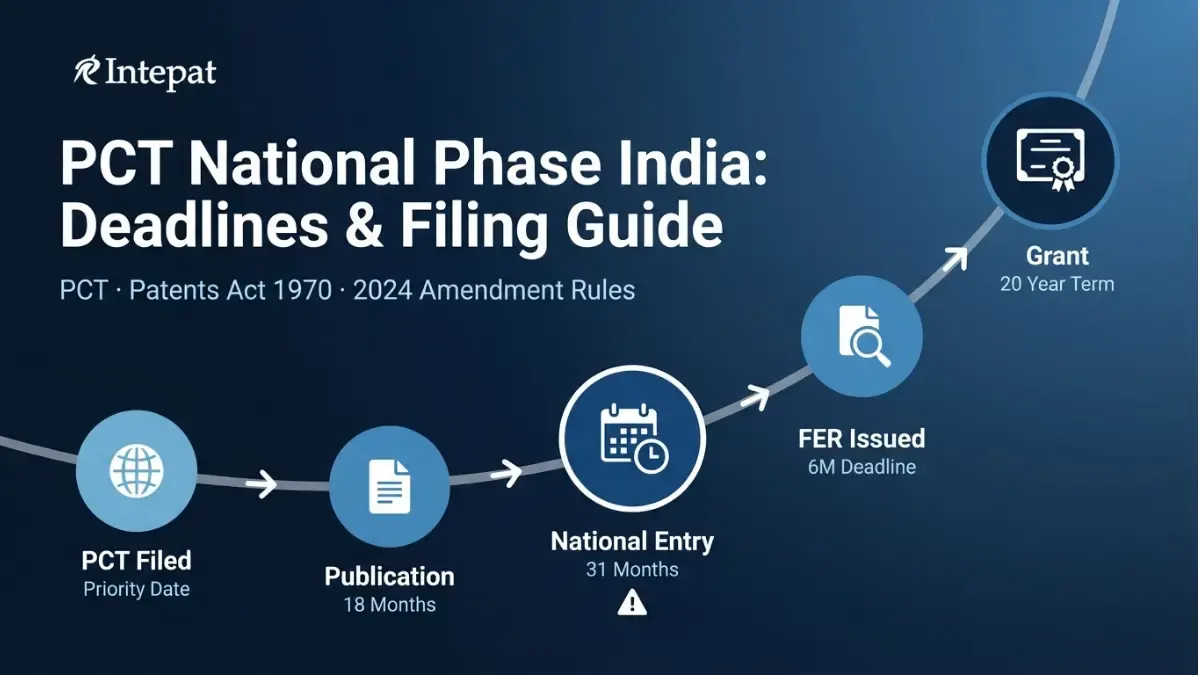
Key Timeline for PCT National Phase Entry in India
Missing a national phase or examination deadline can permanently forfeit patent rights in India regardless of the invention’s merit or commercial value. For applicants managing multi-jurisdictional portfolios, Indian deadlines are therefore typically monitored with particular care.
National Phase Entry
A PCT application must enter the Indian national phase within 31 months from the earliest priority date. If the national phase application is not filed within this period, the application is treated as withdrawn in India. Indian law does not provide a general restoration mechanism for failure to meet this deadline. Given the strict statutory bar, practitioners commonly apply dual-verification docketing and advance filing buffers to ensure the national phase is secured well before the cutoff.
Request for Examination (Form 18)
Under the Patents (Amendment) Rules, 2024 effective 15 March 2024, the examination timeline has been shortened for applicable cases.
For applications filed on or after 15 March 2024, a Request for Examination (RFE) in Form 18 must be filed within 31 months from the earliest priority date where priority is claimed, or from the Indian filing date where no priority is claimed, as prescribed under Rule 24B(1)(i). Under the revised framework, many applicants adopt a concurrent filing approach by submitting the RFE together with national phase entry to minimize deadline risk.
For applications filed before 15 March 2024, the earlier 48-month examination timeline continues to apply.
Where Form 18 is not filed within the standard period for applicable cases, an extension of up to 6 months can be available under amended Rule 138 upon request and payment of the prescribed fee. The availability of extension is discretionary and should not be treated as routine planning.
For official procedural guidance under the PCT framework, applicants may refer to the WIPO Guide for India.
Publication
An Indian national phase application is ordinarily published at 18 months from the earliest priority date unless early publication is requested.
First Examination Report (FER)
Once a First Examination Report is issued, the application must be placed in order for grant within 6 months from the FER date. A 3-month extension can be obtained through Form 4 if requested before expiry of the initial period. Failure to meet the final deadline results in deemed abandonment under Section 21(1) of the Patents Act.
Timeline Summary [National Phase to Grant]
| Stage | Deadline / Timing |
|---|---|
| National Phase Entry | 31 months from earliest priority date |
| Request for Examination (Form 18) | 31 months (or 48 months for pre-15 March 2024 filings) |
| Publication | 18 months from earliest priority date |
| FER Compliance | 6 months from FER date |
| FER Extension (Form 4) | Up to 3 months |
For many recent PCT filings, applicants commonly coordinate national phase entry and Form 18 filing within the same 31-month framework to reduce deadline exposure.
Compared to jurisdictions where certain deadline relief mechanisms may exist, Indian practice places greater emphasis on strict statutory compliance. For this reason, applicants managing multi-country portfolios often plan Indian filings conservatively and align them with broader global prosecution strategy to maintain cross-border consistency.
Documents Required for PCT National Phase Entry in India
Entering the PCT national phase in India requires submission of prescribed documents under the Indian Patents Act and Rules. While many elements originate from the international phase, Indian national phase filings involve specific local forms and formalities that must be properly completed at the time of entry.
Core Filing Documents
An Indian national phase filing begins with the national phase application in Form 1, referencing the corresponding PCT application number. The filing is accompanied by the complete specification comprising the description, claims, abstract, and drawings as filed during the international phase.
Where amendments were made under Article 19 or Article 34 of the PCT, both the originally filed specification and the amended version are generally submitted to the Indian Patent Office so that the examination record reflects the full prosecution history.
Translation Requirements for PCT Applications in India
If the PCT application was filed in a language other than English, a complete English translation of the description, claims, abstract, and any text matter contained in drawings must be filed in India. Examination proceeds on the English text submitted, so translation accuracy can influence clarity assessment and claim interpretation during prosecution.
For technical subject matter, consistent terminology across the specification and claims is typically reviewed before filing to reduce interpretational issues during examination.
Statutory Forms
A Request for Examination in Form 18 is required for the application to be examined. Many applicants choose to coordinate this filing together with national phase entry for administrative certainty.
A Form 3 statement and undertaking under Section 8 relating to corresponding foreign applications must also be filed as part of Indian compliance practice. Although the 2024 amendments reduced repetitive update requirements, accurate disclosure of foreign filings remains important.
Where a patent agent is appointed, a Power of Attorney in Form 26 is required under Rule 135. This authorizes the agent to act before the Indian Patent Office.
Case-Specific Documents
Certain documents are required only where applicable. These can include an assignment deed where the applicant differs from the inventor, proof of change of name where relevant, sequence listings in electronic format for biotechnology-related inventions, and a priority document where it has not been transmitted by the International Bureau.
Because document preparation often involves coordination across jurisdictions, applicants commonly review document readiness in advance to avoid formal deficiencies at filing.
Step-by-Step Process for PCT National Phase Entry in India
While statutory timelines determine when actions must be taken, the effectiveness of a PCT national phase in India often depends on how the filing and prosecution stages are handled in practice. This section outlines the typical procedural flow followed after deciding to enter the Indian national phase. Deadline calculations and statutory cut-offs are addressed separately in the timeline section.
Step 1: National Phase Filing Preparation
The process usually begins with assembling the national phase filing package based on the PCT record. This includes verifying applicant details, inventorship, priority claims, and bibliographic data for consistency with the international application. Discrepancies between PCT records and Indian filings can lead to formal objections, so a preliminary review is commonly undertaken before submission.
Where amendments under Article 19 or Article 34 exist, applicants often determine which claim set should form the basis for prosecution in India. Early alignment can help maintain consistency with parallel filings in other jurisdictions.
Step 2: Translation and Text Review
Where English translations are required, the text is typically reviewed for technical and terminological consistency before filing. Because examination in India proceeds on the English-language submission, clarity and uniform terminology across the specification and claims can influence examination outcomes.
For certain technologies, applicants may also consider whether claim presentation aligns with Indian examination practice.
Step 3: Form Coordination and Compliance Review
Indian national phase filings involve multiple statutory forms and declarations. In practice, these are often coordinated together to avoid fragmented compliance. Entity status, inventorship details, and foreign filing information are commonly cross-checked at this stage to reduce the likelihood of later queries from the Patent Office.
Section 8 disclosures relating to foreign filings are also reviewed for accuracy and consistency with corresponding applications in other jurisdictions.
Step 4: Examination Stage
After examination is requested and taken up by the Patent Office, objections may relate to novelty, inventive step, clarity, or support in the specification. Responses generally combine legal submissions, technical explanation, and, where appropriate, claim amendments consistent with Indian prosecution norms.
Examination in India is substantive and citation-driven, and First Examination Reports frequently combine prior-art analysis with clarity and support objections. Well-prepared responses typically address both legal and technical aspects in a consolidated manner.
Where applicants maintain filings in multiple jurisdictions, prosecution positions are often reviewed for cross-border consistency.
Indian procedure also provides an expedited examination pathway for certain categories of applicants and qualifying circumstances, which may be considered where faster prosecution is commercially important.
Step 5: Hearing and Grant Formalities
If written submissions do not fully address examination objections, the Controller can schedule a hearing. Hearings typically focus on specific outstanding issues, and preparation centers on clarifying technical and legal positions.
Once objections are resolved, the application proceeds to grant and publication, followed by payment of renewal fees to maintain the patent in force.
Official Government Fees for PCT Entry in India
Official fees for entering the PCT national phase in India are prescribed under the First Schedule of the Patents Rules, 2003.
Government fees depend primarily on applicant category, number of claims, and total specification pages. The basic filing fee covers up to 10 claims and 30 pages, with additional official fees payable for each extra claim or page.
The basic filing fee covers up to 30 pages and 10 claims. Additional official fees are payable for each claim beyond 10 and each page beyond 30.
A separate statutory fee is payable for filing the Request for Examination (Form 18). This fee must be paid within the 31-month statutory deadline.
Foreign applicants are generally classified under the “large entity” category unless they qualify under Indian startup or small entity definitions. Incorrect entity classification may result in fee deficiency notices and procedural delay.
Because official fees vary depending on claim count and page length, cost estimation should be completed before national phase entry. A broader overview of patent filing and prosecution costs in India may also assist in budgeting decisions.
To estimate the official government fee payable for your PCT national phase application in India, use our Patent Fee Calculator. The calculator allows selection of entity category and input of claim and page details to generate a statutory fee estimate.
Common Compliance Issues in Indian National Phase Filings
Foreign applicants entering the Indian national phase often assume procedural flexibility similar to other jurisdictions. Indian practice, however, is timeline-driven and form-sensitive. Most complications arise from missed statutory deadlines or incomplete procedural compliance rather than substantive patentability issues.
31-Month Framework and RFE Misinterpretation
A frequent misconception is that national phase entry and examination operate under separate timelines. Following the Patents (Amendment) Rules, 2024, for applicable applications filed on or after 15 March 2024, the Request for Examination under Section 11B must be filed within the same 31-month statutory framework that governs national phase entry. The earlier 48-month examination window no longer applies to such cases. Failure to file Form 18 within the prescribed period results in the application being treated as withdrawn.
Translation Accuracy and Certification
Where the PCT application was originally filed in a language other than English, a complete English translation of the description, claims, abstract, and any text matter contained in the drawings must be filed at the time of national phase entry. The translation must accurately reflect both the application as originally filed and any amendments made under Article 19 or Article 34 of the PCT.
In practice, the translation is accompanied by a certificate or verification from the translator confirming its correctness. Inaccurate or incomplete translations may lead to formal objections and, in certain circumstances, may affect claim interpretation during examination.
Section 8 and Form 3 Compliance After the 2024 Amendment
The 2024 amendment rationalised the earlier continuous Form 3 update burden. While repeated periodic updates during prosecution are no longer expected in the earlier manner, Form 3 must still be filed at the prescribed stage and updated within the stipulated period after issuance of the First Examination Report, where required.
Non-compliance with Section 8 obligations may result in examination objections and delay in prosecution.
Entity Classification and Fee Risk
Foreign corporate applicants are generally treated as large entities unless they qualify under the Indian statutory definitions of startup or small entity. Incorrect entity declaration may result in fee deficiencies, procedural objections, and processing delays.
FER Response Timeline
Once the First Examination Report is issued, the applicant must comply within 6 months from the date of issuance. Failure to respond within this statutory period results in deemed abandonment. Indian practice does not provide a broad restoration mechanism for missed prosecution deadlines.
Practitioner Note
In Indian national phase practice, procedural risk most often arises from insufficient planning ahead of the 31-month deadline rather than from substantive patentability issues. Early coordination of translations, entity classification, Section 8 disclosures, and examination requests generally supports smoother prosecution.
Experience shows that structured preparation and consistency across filings help minimize avoidable formal objections and procedural delay. For multi-jurisdictional portfolios, coordinated handling of these steps is widely regarded as prudent practice in Indian national phase filings.Experience shows that structured preparation and consistency across filings help minimize avoidable formal objections and procedural delay. For multi-jurisdictional portfolios, coordinated handling of these steps is widely regarded as prudent practice in Indian national phase filings.
Strategic Planning for PCT Entry in India
Entering the Indian national phase under the PCT framework requires strict adherence to statutory timelines and prescribed procedural requirements.
The 31-month deadline now governs both national phase entry and, for applicable applications, the Request for Examination under the 2024 amendments. Translation accuracy, Form 3 compliance, correct entity classification, and timely response to examination objections are critical to maintaining rights.
Unlike certain jurisdictions, Indian patent practice offers limited flexibility for missed deadlines. Advance planning and structured compliance before the 31-month mark are essential.
Considering Indian National Phase Entry?
Share your PCT number and priority date for a preliminary India-specific filing and deadline review.
Frequently Asked Questions on PCT National Phase Entry in India
The national phase application must be filed within 31 months from the earliest priority date. If not filed within this period, the application is treated as withdrawn in India.
No. Under the Patents (Amendment) Rules, 2024, for applicable applications filed on or after 15 March 2024, the Request for Examination (Form 18) must be filed within 31 months from the earliest priority date (or Indian filing date if no priority is claimed). The earlier 48-month framework does not apply to such cases.
No. If the applicant does not have a residence or place of business in India, the application must be filed through a registered Indian patent agent, and an address for service in India is mandatory.
If the PCT application was filed in a language other than English, a complete English translation must be filed. In practice, the translation should be accompanied by a certificate or verification from the translator confirming accuracy. Inaccurate translations may lead to objections during examination.
Form 3 is a statement regarding corresponding foreign patent applications under Section 8 of the Patents Act. Following the 2024 amendments, continuous repetitive updates are not required in the earlier manner; however, Form 3 must be filed at the prescribed stage and updated within the stipulated period after issuance of the First Examination Report (FER).
The applicant must put the application in order for grant within 6 months from the date the FER is forwarded. Failure to comply within this period or within the permitted 3-month extension, results in the application being deemed abandoned.
The timeline depends on examination workload and complexity of objections. In practice, prosecution may take several years. Early publication and timely response to examination objections can help streamline the process.
Under the Paris Convention, a patent application must be filed in India within 12 months from the earliest priority date if priority from an earlier foreign filing is to be claimed.
Under the PCT route, India may be designated in the international application and entered at the national phase stage within 31 months from the earliest priority date, thereby extending the decision window for commercial evaluation and portfolio planning.
For a structured comparison, see our Paris Convention (Direct) Vs PCT filing strategy guide.