




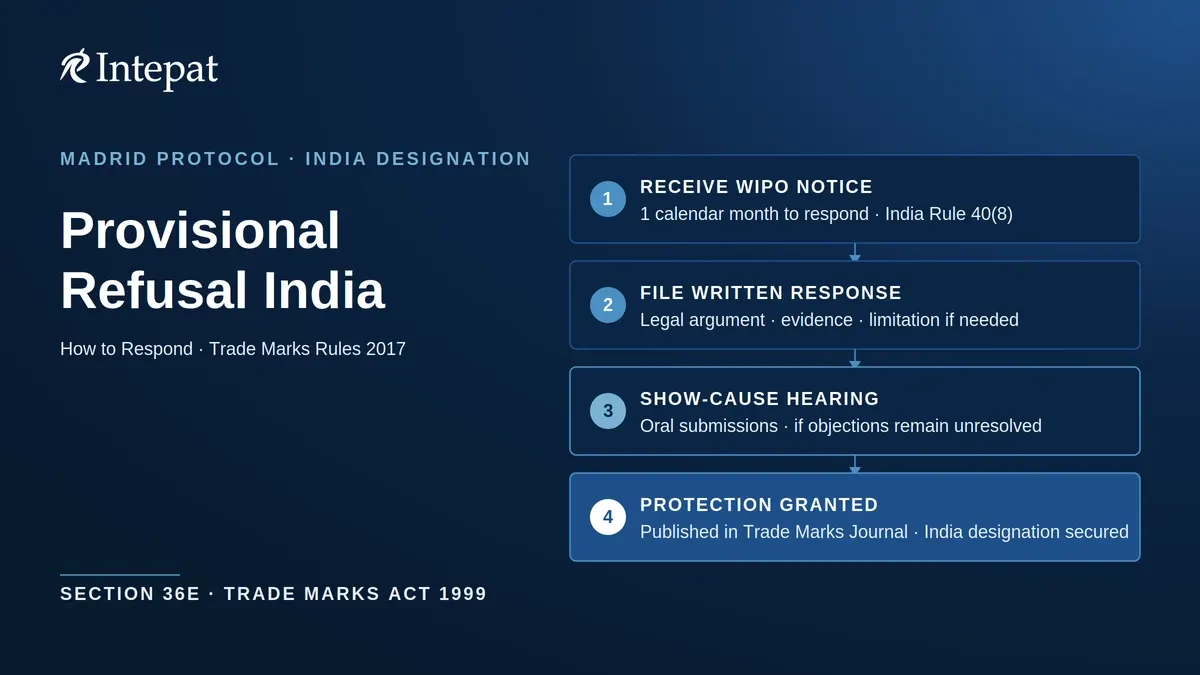
A Madrid Protocol provisional refusal in India is not a final rejection. The holder usually has one calendar month from receipt of the WIPO-transmitted notice to respond before the Indian Trade Marks Registry. The notice may refuse all goods and services or only some of them, so the first step is to read its scope and deadline exactly.
This guide covers an ex officio provisional refusal issued during examination in India. A refusal based on a third-party opposition follows the Indian opposition procedure after publication.
| Quick answer |
| Deadline: Usually one calendar month from the holder’s receipt of the WIPO-transmitted notice. Use the period and starting event stated in the notice. India exception: India has declared that the newer two-month minimum under the Madrid Regulations does not apply to it. Extension: The Registrar may allow up to one additional month under Section 131 and Rule 109. The request is discretionary and should be made promptly. Section 131 permits consideration even after the original period has expired. Representation: The Indian notice requires the response to be filed through an agent or representative with an address in India. Scope: A refusal may be total or partial. Division of an international registration designating India is not available. |
Read the Notice Before Preparing the Response
The WIPO communication and the attached Indian notification determine what must be answered. Record the date of receipt before calculating the response period. One calendar month should not automatically be converted into 30 days.
The following points change the response strategy:
| Point to check | Why it matters |
| Is the refusal total or partial? | A total refusal covers all designated goods or services. A partial refusal affects only the goods or services identified in the notice. |
| Is it based on examination or opposition? | An ex officio refusal requires a response to Registry objections. An opposition-based refusal follows the contested opposition procedure. |
| Which sections are cited? | Section 9 generally concerns the mark itself. Section 11 generally concerns conflict with an earlier mark. |
| Are earlier marks cited? | Each citation should be checked for status, proprietor, filing date, mark representation and specification. |
| Is a limitation commercially acceptable? | Narrowing goods or services may reduce overlap, but it also reduces the scope of protection in India. |
That distinction should be settled before the holder commissions evidence or negotiates a limitation.
A partial refusal should not be described as a refusal of the entire India designation. If the holder does not contest the refused portion, the unaffected goods or services may continue, subject to the terms of the notice and the Indian procedure.
Response Deadline and Extension in India
IP India’s official Madrid guidance states that the response period is one month from receipt of the provisional refusal by the holder. The specific WIPO-transmitted notice should be treated as the controlling docketing document.
The newer two-month minimum introduced under the Madrid Regulations does not presently apply to India. India is listed under Rule 40(8) on WIPO’s current declarations and notifications page.
Can the one-month period be extended?
Rule 109 of the Trade Marks Rules, 2017 permits an application in Form TM-M for an extension under Section 131. The Registrar may extend the period by no more than one month if the circumstances justify it.
Section 131 expressly allows the Registrar to consider an extension application whether the relevant time has expired or not. A post-deadline request is therefore not barred merely because the original period has expired. It remains discretionary, requires sufficient cause and should not be treated as a substitute for timely filing.
| Fee note (verified July 2026): |
| First Schedule Entry 13 of the Trade Marks Rules 2017 covers extension of time requests in Form TM-M. Physical filing: Rs. 1,000. E-filing: Rs. 900. Because Rule 64 requires responses concerning an international registration designating India to be electronic, Rs. 900 is the practically relevant amount. Confirm the current fee on the IP India forms-and-fees page before filing. |
| Need response support? Send the WIPO notice, cited-mark details and receipt date for an India-specific assessment. Request Review |
Who Should File the Indian Response?
The model Indian notification states that the response must be filed through an agent or representative whose address is in India. Rule 17 also requires an address for service in India, including an Indian postal address and a valid email address.
For an overseas holder, the usual route is to appoint an Indian legal practitioner or registered trade marks agent. Section 145 of the Trade Marks Act also recognises a person in the sole and regular employment of the principal as an authorised representative. The appointment of an agent is executed in Form TM-M under Rule 19.
The authorisation should be arranged immediately. The response period should not be consumed while the holder gathers evidence or decides whether a limitation is acceptable.
How a Madrid Protocol Provisional Refusal in India Works
Under Section 36E(2) of the Trade Marks Act 1999, India may notify an ex officio provisional refusal within 18 months of receiving the international registration advice from the International Bureau. Section 36E(4) applies Sections 9 to 21 of the Trade Marks Act to the designation as though it were a national trademark application. For an overview of the Madrid Protocol system and how India designations work, that guide covers the filing and protection framework in detail.
India has also made an Article 5(2)(c) declaration permitting an opposition-based refusal to be notified after the 18-month period where the Madrid requirements are met.
The International Bureau records and transmits the refusal. It does not decide whether the Indian objections are correct, extend the Indian response period or determine the merits of the response. Substantive prosecution proceeds before the Indian Trade Marks Registry.
Match the Response to the Objection
A written response should address each objection separately. The appropriate route depends on the objection and the available evidence.
| Objection | Main question | Possible response route |
| Section 9 distinctiveness or descriptiveness | Does the mark identify one trade source, or merely describe the goods or services? | Argue inherent distinctiveness, or rely on acquired distinctiveness supported by Indian evidence. |
| Section 11 cited earlier mark | Are the marks and their goods or services sufficiently close to create a likelihood of confusion? | Compare each citation separately; address appearance, sound, meaning, goods, services and trade context. |
| Overlapping specification | Can the commercial scope be narrowed without undermining the India filing objective? | Consider a formal limitation through WIPO and explain its effect to the Indian Registry. |
| Consent or coexistence | Has the earlier-rights owner agreed to registration, and does the document cover the relevant marks and goods or services? | Rely on Section 11(4) and, where applicable, Section 12, subject to Registrar discretion. |
| Honest concurrent use | Is there substantiated concurrent use in India? | File evidence directed to Indian use and the circumstances of adoption and coexistence. |
Section 9 objections
Section 9 objections may concern lack of distinctiveness, descriptiveness, customary trade expressions, deceptive matter, prohibited matter or other absolute grounds for trademark refusal in India. The response should identify the precise objection instead of treating every Section 9 citation as a distinctiveness issue.
Where inherent distinctiveness is relied upon, explain why the mark does not directly describe the designated goods or services. Where acquired distinctiveness is relied upon, the evidence should establish recognition in India before the legally relevant filing or designation date.
Section 11 objections
Each cited mark should be addressed individually. A response should not assume that every citation is valid or presently in force. The official record should be checked for the cited mark’s status, proprietor, priority or filing date, mark representation and goods or services.
The comparison should remain tied to the statutory likelihood-of-confusion test. Differences in spelling alone may not resolve an objection where the marks remain close in sound, meaning or overall impression. Conversely, a shared element does not automatically establish confusion if the marks and commercial scope differ materially. The procedure for a trademark objection reply under a national Indian application differs in some procedural respects from an IRDI (international registration designating India) response, though the substantive grounds may overlap.
Evidence for Acquired Distinctiveness or Concurrent Use
Section 129 provides that evidence before the Registrar is given by affidavit, subject to the Registrar’s power to take oral evidence. The affidavit should be sworn by a person competent to verify the facts and explain the source of the records relied upon. A separate guide on trademark user affidavits for Indian registration proceedings covers the preparation and content requirements in detail.
Evidence should be organised around what it proves. Depending on the objection, useful material may include:
- dated invoices showing sales into or within India;
- advertising and promotional material directed at Indian consumers;
- India-specific revenue or sales figures supported by underlying records;
- website or marketplace records showing Indian availability and use;
- media coverage, awards or independent references connected to India;
- documents explaining adoption, continuity and the absence or nature of confusion; and
- consent or coexistence documents that identify the parties, marks, territory and affected goods or services.
Worldwide registrations, global turnover and overseas advertising may provide background, but they do not by themselves establish that the mark had acquired distinctiveness or use in India by the relevant date.
Limiting Goods or Services Without Dividing the India Designation
A limitation can reduce the list of goods or services for India. The holder may request the limitation through WIPO’s eMadrid limitation procedure. The limitation cannot add goods or services or broaden the recorded scope.
The Indian response should explain the proposed or recorded limitation and identify the corresponding WIPO request or recordal where available. Merely inserting narrower wording in the Indian response does not itself amend the International Register.
Division is different from limitation. India has declared under Rule 40(6) that Rule 27bis(1), which concerns division of an international registration, is incompatible with Indian law. The India designation therefore cannot be divided into separate applications so that selected classes or goods proceed independently. For applicants weighing the two routes, the comparative analysis of Madrid filing versus direct national filing in India covers this and other procedural differences.
Filing the Response in Sequence
The following sequence reduces avoidable delay:
- Record the holder’s date of receipt and the exact deadline stated in the WIPO communication.
- Confirm whether the refusal is total or partial and whether it is ex officio or opposition-based.
- Appoint an India-based representative and arrange the Form TM-M authorisation.
- Verify every cited mark from the official Indian database.
- Decide whether the case relies on legal argument, evidence, consent, limitation or a combination of these.
- Prepare any affidavit and exhibits with clear exhibit references.
- File the response electronically and retain the filing acknowledgement.
- Where additional time is required, file a reasoned Form TM-M extension request without delay.
Rule 64 requires the response to an international-registration communication to be received electronically. The filing should identify the international registration number and the Indian IRDI (international registration designating India) reference correctly.
What Happens After the Response?
The Registry considers the written response and evidence. If the objections are resolved, the designation may proceed to advertisement in the Trade Marks Journal. If objections remain, the Registry may schedule a show-cause hearing before deciding whether protection should be granted, limited or refused.
| Stage | Possible result |
| Written response accepted | The refusal is withdrawn wholly or partly and the designation proceeds for the accepted goods or services. |
| Hearing scheduled | Oral submissions are made on the unresolved objections. Further material should be filed only in accordance with the applicable procedure and hearing directions. |
| Advertisement | The accepted designation is published in the Trade Marks Journal and becomes open to opposition. |
| Opposition | A third party may oppose within four months from advertisement under Section 21. |
| Final refusal | India communicates the final disposition to WIPO. A total refusal affects the India designation, not the international registration in other members. |
A hearing is a continuation of the Indian examination process, not a new Madrid filing. The written response remains the starting record for the hearing. Where a hearing is scheduled, preparation for a trademark show-cause hearing in India should focus on the unresolved grounds and the record already filed. Where the designation proceeds to publication and a third party opposes it, the trademark opposition procedure in India applies to the India designation.
Common Errors to Avoid
- Calculating one month as a fixed 30-day period without reading the notice.
- Assuming India’s response period automatically became two months.
- Treating a partial refusal as a refusal of the entire India designation.
- Sending substantive arguments to WIPO instead of filing before the Indian Registry.
- Filing a generic response to several cited marks without checking each official record.
- Relying on worldwide figures without evidence connected to India and the relevant date.
- Proposing narrower goods or services only in the Indian response without coordinating formal WIPO recordal.
- Assuming the India designation can be divided.
- Treating an extension as automatic or waiting until the extension request is decided before preparing the substantive response.
Frequently Asked Questions
The Indian notification usually provides one calendar month from the holder’s receipt of the WIPO-transmitted provisional refusal. India has declared that the Madrid Regulations’ newer two-month minimum does not apply. The exact period and starting event in the specific WIPO communication should be used for docketing.
Section 131 allows the Registrar to consider an extension application whether the relevant time has expired or not. Rule 109 limits an extension under that route to one month and makes it discretionary. A post-deadline request should explain sufficient cause and should not be assumed to preserve the designation automatically.
As verified in July 2026, First Schedule Entry 13 of the Trade Marks Rules 2017 covers Form TM-M extension requests: Rs 900 for e-filing and Rs 1,000 for physical filing. Because Rule 64 requires responses concerning an international registration designating India to be electronic, Rs 900 is ordinarily the relevant amount. Confirm on the IP India forms-and-fees page before filing.
The Indian model notice requires the response to be filed through an agent or representative with an address in India. Overseas holders usually appoint an Indian legal practitioner or registered trade marks agent and execute the Form TM-M authorisation. Section 145 also recognises a duly authorised regular employee of the principal.
Yes. A holder may request WIPO to record a limitation for India, provided the change only narrows the existing list. The Indian response should identify and explain that limitation. Proposed wording in the Registry response alone does not change the International Register, so the WIPO recordal must be coordinated separately.
No. India has declared under Rule 40(6) that the Madrid provision permitting division is incompatible with Indian law. An international registration designating India cannot therefore be divided into separate Indian applications. A limitation through WIPO may narrow the goods or services, but limitation and division are legally different procedures.
The result depends on whether the refusal is total or partial. A total provisional refusal may be confirmed for all goods and services. A partial refusal may be confirmed only for the affected goods or services, while the unaffected scope may continue. The final Indian disposition does not cancel protection in other Madrid members.
| Disclaimer: |
| This article explains the Indian procedure for responding to an ex officio Madrid Protocol provisional refusal as verified in July 2026. It is general information, not legal advice. Deadlines in this area are strict; missing a response period can result in the loss of protection in India. The applicable deadline, grounds, affected goods or services and available procedural steps depend on the specific WIPO communication and Indian notice. Confirm the current Rules, fees and filing requirements before acting. For advice on a specific matter, consult a qualified trademark attorney or registered trade marks agent. |