




A supplementary international search is an optional second prior art search on a PCT application, carried out by an Authority other than the one that ran the main search. The request must reach WIPO before 22 months from the priority date. It produces an extra search report, not a second opinion on patentability.
This article covers the PCT Regulations in force from 1 January 2026, for applicants and agents filing from India. The priority date is normally the filing date of the earliest application whose priority is claimed, or the international filing date where no priority is claimed. Where the international application went in at the end of the priority year, the 22-month deadline falls roughly ten months after international filing. The request goes to WIPO’s International Bureau, and the search is carried out by a participating International Searching Authority, called a Supplementary International Searching Authority or SISA in this role. No Indian form or Indian Patent Office fee is involved.
| Before you read further |
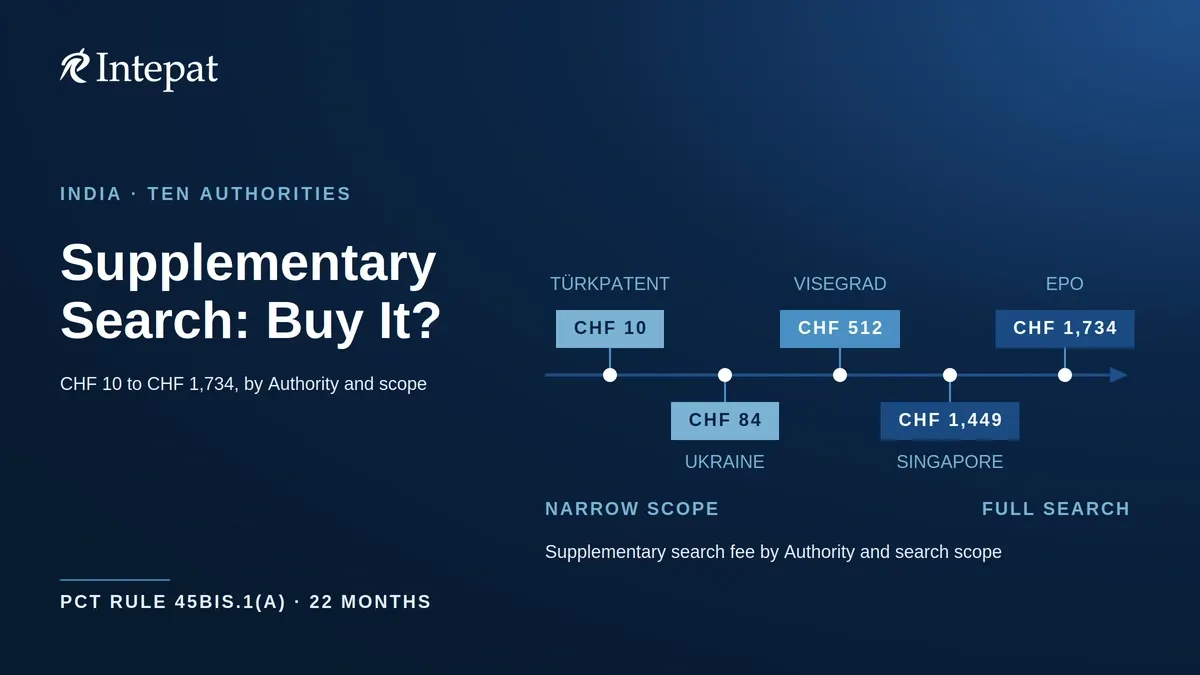
| • Deadline: the request must reach the International Bureau before 22 months from the priority date expire. • Fees: a CHF 200 handling fee to the International Bureau, plus the chosen Authority’s own search fee, which currently ranges from CHF 10 to CHF 1,734 depending on Authority and search scope. • Who cannot do it: the Authority that carried out your main international search. • Eligibility: language, subject matter, search scope and capacity conditions differ by Authority and are set out in Annex SISA of the WIPO PCT Applicant’s Guide. • Search basis: the international application as filed, not later Article 19 or Article 34 amendments. • Report: must be established by 28 months from the priority date. |
What a supplementary international search actually buys you
A PCT application ordinarily undergoes one main international search, though the searching Authority may in limited cases declare under Article 17(2)(a) that no search report will be established. Rule 45bis adds an optional second search, on the same application, by a different Authority, at the applicant’s expense.
The report identifies additional prior art documents. It does not decide whether the invention is patentable, and no written opinion accompanies it, though the Authority may explain the documents cited and the scope searched.
The value is coverage. No single office searches the whole body of prior art in its original language, and WIPO describes the service as particularly relevant where the second Authority has language specialisations the first does not. A second search brings that discovery forward, before most filing, translation and agent costs are incurred.
It is a different instrument from Chapter II preliminary examination, which produces a reasoned patentability assessment and can take amended claims into account. The two answer different risks and are sometimes used together, hence the sequencing point below.
For communication to designated Offices it is treated as part of the international search report, so every designated Office receives it.
Which Authorities can do it, and the one that cannot
Two constraints narrow the field. Only an Authority that has told the International Bureau it is prepared to carry out supplementary searches can be specified, and its agreement may limit what it searches. And the Authority that carried out your main search is not competent to carry out the supplementary one.
Ten Authorities appear in WIPO’s current PCT fee tables: the Austrian Patent Office, the European Patent Office, the Finnish Patent and Registration Office, Rospatent, the Swedish Intellectual Property Office, the Intellectual Property Office of Singapore, TÜRKPATENT, the Ukrainian National Office for Intellectual Property and Innovations, the Nordic Patent Institute and the Visegrad Patent Institute. The list and each Authority’s conditions change; Annex SISA carries the current position.
If the Indian Patent Office carried out your main search, no listed Authority is excluded by Rule 45bis.9(b) alone. That is not the same as every Authority taking the case: you must still satisfy its language, subject matter, search scope and capacity conditions. Our guide to choosing an International Searching Authority from India covers the earlier decision that shapes this one.
You may request more than one supplementary search from different Authorities, each with its own request and fees.
The 22-month request deadline and the 28-month reporting deadline
The request must reach the International Bureau before 22 months from the priority date expire. Rule 45bis carries no ordinary extension and no restoration mechanism, and a late request is declared not to have been submitted. Rule 82quater can excuse a delay caused by war, civil disorder, strike, natural calamity, epidemic or a general communications outage, on evidence filed within six months. Do not plan around it.
The other end is slower than expected. The Bureau transmits the file once it has the search report, or after 17 months from priority, whichever occurs first. The Authority may then delay starting until it also has the search report and written opinion, or until 22 months, whichever occurs first. The report must be established within 28 months.
Twenty-eight months is an outer limit, not a delivery date, and a report may come earlier. Plan for the late case: India’s national phase deadline is 31 months, so a report completed near the deadline leaves roughly three months to absorb it and decide whether the entry list still holds.
| Milestone | Timing from priority date | Rule |
| Request must reach the International Bureau | Before 22 months | 45bis.1(a) |
| Fees payable | Within 1 month of receipt of the request | 45bis.2(c), 45bis.3(c) |
| Bureau transmits file to the Authority | On receipt of the search report or 17 months, whichever first | 45bis.4(e) |
| Authority may defer starting the search until | Search report and written opinion received, or 22 months, whichever first | 45bis.5(a) |
| Supplementary report must be established | Within 28 months | 45bis.7(a) |
Verified as of July 2026 against the PCT Regulations in force from 1 January 2026.
What it costs, and the reduction that does not reach it
Two fees, both collected by the International Bureau, both due within one month of the Bureau receiving the request. The handling fee is fixed at CHF 200 by the PCT Schedule of Fees. The search fee is set by each Authority for its own benefit, with no ceiling in the Regulations. Pay late and the Bureau invites payment within one month with a late payment fee of half the handling fee; miss that and the request is treated as never submitted.
Authority fees are not comparable, because the Authorities are not selling the same thing. Some offer a full search of their entire documentation; others confine it to a language collection and price accordingly. The scope you buy matters more than the Authority’s name.
Now the reductions, where two separate schemes are easy to confuse. The PCT Schedule of Fees gives a 90% reduction to a natural person who is a national of and resides in a qualifying State, and India is on that list. It reaches the international filing fee, the supplementary search handling fee and the Chapter II handling fee, so a qualifying Indian individual pays CHF 20 rather than CHF 200. It does not reach an Authority’s own search fee, which is not a Schedule item.
That is not the end of it, because an Authority may reduce its own fee separately. The EPO reduces its supplementary search fee by 75% on conditions set out in Annex D (EP), which turn on every applicant being a natural person, national and resident of a state outside the EPC that the World Bank classifies as low-income or lower-middle-income. An Indian individual who qualifies pays roughly a quarter of EUR 1,885, moving the arithmetic far more than the CHF 180 saved on the handling fee. Check the Annex before assuming either way, and do not generalise: the Austrian Patent Office’s 75% reduction attaches to its main search fee, not its supplementary one.
Both schemes share two conditions. Where there are several applicants, each must qualify independently. And under an Understanding adopted by the PCT Assembly, the reduction is meant for applicants who are the sole and true owners of the application, under no obligation to assign or license the rights to a party that would not qualify. A founder who has assigned to the company does not.
| Authority | Search scope offered | Fee |
| TÜRKPATENT (TR) | Turkish-language documents in its collection | CHF 10 |
| Ukraine (UA) | Russian-language documentation of the former USSR and Ukrainian documentation | CHF 65 |
| Ukraine (UA) | Own collection including PCT minimum documentation, or European and North American only | CHF 84 |
| Rospatent (RU) | Standard search, or CHF 197 where an Article 17(2)(a) declaration was made on methods-of-treatment grounds | CHF 125 |
| Nordic Patent Institute (XN) | Danish, Icelandic, Norwegian and Swedish documentation | CHF 499 |
| Visegrad Patent Institute (XV) | Czech, Hungarian, Polish and Slovak documentation | CHF 512 |
| Austrian Patent Office (AT) | German-language documentation | CHF 792 |
| Austrian Patent Office (AT) | European and North American documentation | CHF 1,109 |
| Singapore (SG) | Full search | CHF 1,449 |
| Austrian Patent Office (AT) | PCT minimum documentation | CHF 1,584 |
| EPO, Finland, Sweden, TÜRKPATENT, Nordic and Visegrad | Full search | CHF 1,734 (EUR 1,885) |
WIPO PCT fee tables, amounts on 1 June 2026, with the Rospatent figures in force from 1 July 2026. The CHF 200 handling fee is payable to the International Bureau in addition, in every case.
Four limits that decide whether the search is useful to you
The search runs on the application as filed. The basis is the international application as filed, or a translation of it, taking due account of the search report and written opinion where the Authority has them before it starts. WIPO’s stated reason is that searching the original text produces a more genuinely complementary result. The commercial consequence: if the claim set you now care about came from an Article 19 or Article 34 amendment, the supplementary Authority will not search it.
Claims left out of the first search may be left out again. An Authority may exclude claims it would not itself search, for clarity or subject matter reasons or a missing sequence listing. Where the international search report is available before the supplementary search starts, it may also exclude claims not covered by the main search. A separate rule governs an Article 17(2)(a) declaration that no search report would be established: where that declaration is available, the Authority may decide not to establish a supplementary report at all.
Only the main invention is assured of coverage. Where a report can be established and the Authority finds a lack of unity, it establishes the report on the invention first mentioned in the claims and notifies you with reasons. Unlike the main international search, there is no right to pay additional fees for the other inventions. One exception matters: where the first Authority already found a lack of unity, your request may ask for the search to be directed at one of the other identified inventions instead. Use it, because it does not come round again. A review may be requested within one month, against a review fee refundable if the opinion was entirely unjustified. Our guide to unity of invention and divisionals at Indian national phase covers what a unity finding does downstream in India.
The Authority’s own limits apply. Its agreement with the Bureau may restrict searching by subject matter, by the number of searches it runs in a period, or by the number of claims. If a limitation excludes your case entirely, the request is treated as never submitted and the search fee refunded as the agreement provides.
Four questions that decide whether to buy one
Wider coverage is valuable in the abstract, which helps nobody decide. These four questions do.
1. Is there an identifiable search gap? Not “could there be more prior art”, which is always true, but a specific collection your first Authority does not reach. If you cannot name it, you are buying reassurance rather than coverage.
2. Could additional prior art change a commercial decision? Dropping a jurisdiction, narrowing claims, opening a licensing conversation, discontinuing. If you would enter the same countries with the same claims regardless, it does not earn its cost.
3. Are the original claims still the commercially important ones? The search runs on the application as filed, so a position resting on amended claims gets less from it.
4. Will the Authority you want take the case? Check its language requirement, subject matter limits, search scope, claim limits and any capacity cap in Annex SISA first.
One sequencing point sits across all four. A preliminary examining Authority need not take the supplementary report into account if it arrives after that Authority has begun drawing up its opinion or report, so an applicant doing both should set the order deliberately. Where the first written opinion was negative, read this alongside our note on responding to a negative PCT written opinion at the FER stage.
Requesting one: what to send, and where
The request goes to the International Bureau, not to the Indian Patent Office and not to the Authority that will search. It is made on Form PCT/IB/375, naming the Authority and stating which text is the basis of the search. Where that Authority accepts neither the language of filing nor a translation already on file, a translation into an accepted language must accompany the request, with a sequence listing in electronic form where required. A defect draws an invitation to correct within a month.
You can withdraw at any time before the report is transmitted to you and to the Bureau, and the search is then discontinued. Refunds are narrower. If withdrawal takes effect before the Bureau has sent the file to the Authority, both fees are refunded. After transmittal there is no general entitlement under Rule 45bis; any refund depends on the Authority’s own practice and on whether search work has begun.
For the cost picture at the other end, see our breakdown of Indian national phase entry fees; for the earlier decisions, our guide to filing a PCT application from India and the Patent Cooperation Treaty in India guide.
Deciding before the 22-month mark
Put a date in the docket at 20 months from priority. By then the search report and written opinion should be in hand, leaving two months to identify the gap, confirm the Authority will take the case, and clear the fees.
Run the four questions with the report in front of you. If the gap is real and could move a decision, the request is cheap relative to what it protects. If not, spend the money on the national phase. What you cannot do is defer it past 22 months: a later request will ordinarily be treated as not submitted.
Frequently asked questions
A supplementary international search is an optional second prior art search on a PCT international application under Rule 45bis of the PCT Regulations. It is carried out by an International Searching Authority other than the one that performed the main search, at the applicant’s request, and produces a supplementary international search report.
The request must reach the International Bureau before 22 months from the priority date expire, under Rule 45bis.1(a). A request received after that date is declared not to have been submitted. Older sources citing a 19-month deadline reflect the pre-2017 position and should not be relied on.
Ten Authorities offer it in WIPO’s current fee tables: Austria, the EPO, Finland, Rospatent, Sweden, Singapore, TÜRKPATENT, Ukraine, the Nordic Patent Institute and the Visegrad Patent Institute. The Authority that carried out the main search is never among the options. Each Authority’s languages, scope and limitations sit in Annex SISA.
No. Under Rule 45bis.9(b), the International Searching Authority that carried out the main international search is not competent to carry out a supplementary international search on the same application. The applicant must specify a different Authority from those that have stated their preparedness to offer the service.
Two fees apply: a handling fee of CHF 200 to the International Bureau under Rule 45bis.2, and the Authority’s own search fee. That second fee ranges from CHF 10 for a Turkish-language search to CHF 1,734 for a full search at several Authorities. No Indian Patent Office fee is payable.
No. The supplementary international search report contains citations and may include explanations about those citations and the scope of the search. It does not carry a written opinion on novelty or inventive step. An applicant seeking a reasoned patentability assessment, particularly of amended claims, files a Chapter II demand instead.
No. The Indian Patent Office acts as Receiving Office, International Searching Authority and International Preliminary Examining Authority. WIPO’s PCT Applicant’s Guide index shows no Annex SISA entry for India, so it does not offer supplementary international search. Verified as of July 2026.
No. Under Rule 45bis.5(b) the search is carried out on the international application as filed, or on a translation of it. Amendments made under Article 19 or Article 34 do not form the basis of the search, although the Authority takes due account of the earlier search report and written opinion.
Sources: WIPO, Regulations under the PCT, Rule 45bis and Schedule of Fees, in force from 1 January 2026; PCT International Search and Preliminary Examination Guidelines, paragraphs 15.76 to 15.88; WIPO PCT Applicant’s Guide, Annex SISA; current WIPO PCT fee tables.
Disclaimer: This article explains the law on supplementary international search under the Patent Cooperation Treaty as at July 2026 and is for general information only. It is not legal advice. Fees, search scopes and the list of participating Authorities change without notice; confirm the current position in Annex SISA and the WIPO fee tables before you instruct. Deadlines in this area are strict, and missing one closes the option entirely. For advice on your specific application, consult a registered patent agent.