




An invention lacks novelty if the invention was disclosed anywhere in the world before the priority date of the patent application. A single earlier disclosure containing all essential features of a claimed invention can defeat patentability.
Most patent systems apply an absolute novelty standard, meaning prior art is not confined to the country where the patent is filed but includes disclosures made anywhere in the world.
Many patent applications fail not because the invention lacks technical merit, but because the invention was disclosed too early.
For researchers, startups, and companies filing internationally, understanding how novelty is assessed across jurisdictions is critical. Differences in grace periods and prior-art rules can determine whether patent protection survives or is permanently lost.
This guide explains how novelty is assessed in patent law, what qualifies as prior art, how grace periods differ across jurisdictions, and how early disclosures can affect patent protection.
What Is the Legal Standard for Patent Novelty?
Patent novelty is assessed by asking a straightforward but strict question: Was the claimed invention disclosed to the public before the priority date? If the answer is yes, novelty is lost.
Across major jurisdictions, the assessment follows four core principles:
1. Absolute Novelty
Prior art includes disclosures made anywhere in the world. Geographic boundaries are irrelevant in modern patent systems.
2. Single-Reference Anticipation
Novelty is destroyed only if a single prior disclosure contains all essential features of the claimed invention. Multiple documents cannot be combined to attack novelty; that analysis belongs to inventive step or obviousness.
3. Direct and Unambiguous Disclosure
The prior art must clearly disclose the claimed subject matter. Implicit or speculative interpretation is insufficient unless the disclosure is inherent and inevitable.
4. Enabling Disclosure
The prior art must enable a person skilled in the art to perform the invention without undue experimentation. A vague or incomplete description does not anticipate.
It is important to distinguish novelty from inventive step. Novelty is a binary inquiry focused on complete prior disclosure. Inventive step evaluates whether differences over prior art are obvious. Conflating the two leads to analytical errors during prosecution.
What Constitutes Prior Art Worldwide?
Prior art includes any information made available to the public before the priority date, regardless of the country in which the disclosure occurred. Modern patent systems apply a global standard of public accessibility.
In practical terms, prior art can include:
1. Written Publications
Patent applications, granted patents, journal articles, research papers, product manuals, technical blogs, white papers, and searchable online databases.
2. Oral Disclosures
Conference presentations, academic lectures, webinars, or public speeches where enabling technical details are communicated.
3. Public Use
Demonstration of a product, commercial exploitation, or any non-confidential use accessible to the public.
4. Sale or Offer for Sale
Commercial transactions or offers before the filing date can qualify as prior art in several jurisdictions.
5. Online Disclosure
Website publications, GitHub repositories, preprint archives, social media announcements, or digital product launches. Once accessible without confidentiality restriction, global prior art is triggered.
The decisive question is not how widely the information was circulated, but whether it was publicly accessible without an obligation of secrecy. Even limited disclosure to a small audience can destroy novelty if confidentiality protection is absent.
Because prior art operates globally and retrospectively, inventors should conduct a structured prior art search before filing to evaluate potential novelty risks and avoid irreversible disclosure errors.
Novelty Test in India
India follows a strict absolute novelty standard. An invention must not have been anticipated by publication, public use, or any other public disclosure anywhere in the world before the priority date. Territorial boundaries are irrelevant; a disclosure in any jurisdiction can defeat novelty in India.
Statutory Basis Under the Patents Act, 1970
Novelty in India is grounded in:
- Section 2(1)(l) – defining a “new invention” as one that has not been anticipated by publication in any document or used anywhere in the world before the filing date.
- Section 13 – requiring the Controller to investigate prior publications and prior claims during examination.
- Sections 29–32 – providing limited statutory exceptions where certain disclosures may not destroy novelty.
These provisions collectively establish India’s global prior art standard.
Single-Reference Anticipation
Indian law applies the principle that novelty is destroyed only where a single prior disclosure contains all essential features of the claimed invention. Multiple documents cannot be combined to attack novelty; that analytical exercise belongs to inventive step.
Courts have consistently required that the prior publication disclose the invention clearly and completely. If even one essential claim element is absent, novelty may survive, although inventive step may still be examined separately.
Enabling Disclosure Requirement
For anticipation to succeed, the prior art must be enabling. It must disclose the invention in a manner sufficient to allow a person skilled in the art to perform it without undue experimentation. A vague or incomplete disclosure does not anticipate merely because it resembles the claimed subject matter at a high level.
This principle frequently becomes decisive during prosecution, particularly where examiners rely on broad technical documents.
Public Use and Commercial Exploitation
Public use in India does not require large-scale commercialisation. Even limited public demonstration without confidentiality protection can destroy novelty. Commercial exploitation prior to filing may also defeat patent rights unless covered by a statutory exception.
Confidential disclosures under binding non-disclosure agreements generally do not constitute prior art. However, the existence and enforceability of confidentiality may become a factual issue during opposition or litigation.
Limited Exceptions Under Sections 29–32
India recognises narrowly tailored exceptions, including:
- Display at government-notified exhibitions
- Communication to learned societies
- Public working for reasonable trial purposes
These exceptions typically operate within a 12-month period prior to filing and are interpreted strictly. India does not provide a broad, automatic grace period for all inventor-originated disclosures.
Reliance on these provisions is therefore risky, particularly for applicants intending to pursue protection in stricter jurisdictions.
Practical Implication for Indian Filings
During examination under the Indian patent filing process, novelty is usually the first substantive requirement assessed based on prior art identified under Section 13.
In practice, novelty objections commonly arise from conference publications, early academic papers, product brochures, and online technical disclosures. Even where novelty is technically preserved, related grounds such as inventive step or subject-matter exclusions may still arise under separate statutory provisions.
For applicants filing in India, the safest strategy remains straightforward: file before any public disclosure.
Novelty Test in the United States (35 U.S.C. §102)
The United States applies an absolute novelty standard under the America Invents Act (AIA). Under 35 U.S.C. §102(a)(1), an invention is not patentable if it was patented, described in a printed publication, in public use, on sale, or otherwise made available to the public before the effective filing date.
Section 102(a)(2) further includes prior-filed U.S. patent applications that later publish, even if they were not publicly accessible at the time of filing.
Like other major jurisdictions, novelty requires that a single prior art reference disclose all elements of the claimed invention. The disclosure must enable a person skilled in the art to practice the invention.
On-Sale Bar and Public Use
The United States expressly recognises public use and commercial sale as novelty-destroying events. Even confidential commercial transactions can raise complex issues depending on factual circumstances.
The “otherwise available to the public” language under the AIA reinforces the global and accessibility-based nature of U.S. novelty analysis.
12-Month Grace Period
Under §102(b)(1), disclosures made by the inventor (or derived from the inventor) within 12 months prior to filing do not destroy novelty. This grace period applies broadly to publications, presentations, and sales.
While protective domestically, reliance on the grace period may create risk when seeking protection in Europe or other stricter jurisdictions. For international strategies, pre-disclosure filing remains the safest course.
Novelty Under the European Patent Convention (Article 54 EPC)
The European Patent Convention applies a strict absolute novelty standard under Article 54 EPC. An invention is new only if it does not form part of the state of the art before the filing or priority date.
Article 54(2) defines the state of the art as everything made available to the public by written or oral description, by use, or in any other way. There is no territorial limitation.
European practice focuses on whether the claimed subject matter is directly and unambiguously derivable from a single prior disclosure. Public accessibility, not the extent of dissemination, is the decisive factor.
Public Availability and Strict Interpretation
Conference proceedings, academic publications, online disclosures, and product demonstrations can all qualify as prior art if accessible without confidentiality restrictions. Even limited public access may suffice.
Limited Grace Period
Europe does not recognise a general grace period. Article 55 EPC provides narrow exceptions for evident abuse and certain officially recognised exhibitions within a six-month window. These exceptions are interpreted restrictively and are rarely relied upon successfully.
Because of its limited safety mechanisms, Europe is widely regarded as the most stringent jurisdiction for novelty preservation.
Comparative Overview: Novelty Standards Across Major Jurisdictions
Although most major patent systems follow an absolute novelty standard, procedural nuances differ in how prior art is defined, how public disclosure is assessed, and how enabling disclosure is evaluated.
The table below summarises the core novelty framework across key jurisdictions:
| Jurisdiction | Absolute Novelty | Single Reference Required | Oral Disclosure | Public Use | Enabling Disclosure Required |
|---|---|---|---|---|---|
| India | Yes | Yes | Yes | Yes | Yes |
| United States | Yes (AIA) | Yes | Yes | Yes (On-sale bar) | Yes |
| Europe (EPC) | Yes | Yes | Yes | Yes | Yes |
| China | Yes | Yes | Yes | Yes | Yes |
| Japan | Yes | Yes | Yes | Yes | Yes |
| United Kingdom | Yes | Yes | Yes | Yes | Yes |
| Australia | Yes | Yes | Yes | Yes | Yes |
| Canada | Yes | Yes | Yes | Yes | Yes |
Key Observations
- Absolute novelty is now the global norm. Territorial novelty systems have largely disappeared among major jurisdictions.
- Single-reference anticipation is universally applied. Novelty cannot be attacked using a mosaic of documents.
- Public accessibility is decisive. Written, oral, and use-based disclosures are all capable of destroying novelty.
- Enabling disclosure is a universal requirement. A non-enabling reference does not anticipate.
The real point of divergence among jurisdictions is not the core novelty test — it is the scope and breadth of available grace periods. The next section examines those differences in detail.
Grace Period Rules Across Major Jurisdictions
While novelty standards are structurally aligned worldwide, grace period protection varies significantly. Some jurisdictions offer broad protection for inventor-originated disclosures. Others recognise only narrow statutory exceptions.
The table below highlights the critical differences:
| Jurisdiction | Grace Period Length | Scope of Protection | Declaration Required | Practical Filing Risk if Disclosure Occurs |
|---|---|---|---|---|
| India | 12 months (limited) | Exhibitions, learned societies, limited public working | Often required | High |
| United States | 12 months | Broad inventor-originated disclosures | No declaration at filing | Moderate |
| Europe (EPC) | None (general) | Only evident abuse or official exhibitions (6 months) | Strict evidentiary burden | Very High |
| China | 6 months | Exhibitions, academic meetings, non-consensual disclosure | Required | High |
| Japan | 12 months | Inventor-originated disclosures | Declaration required within timeline | Moderate |
| Australia | 12 months | Broad self-disclosure protection | No strict declaration regime | Lower (domestically) |
| Canada | 12 months | Applicant-originated disclosures | No immediate declaration | Moderate |
Key Strategic Observations
- Europe provides virtually no general grace period.
- India’s protection is exception-based, not automatic.
- The United States, Australia, Canada, and Japan offer broader inventor-protection regimes.
- China limits protection to specific categories of disclosure.
- Reliance on grace periods complicates multi-jurisdictional filing strategies.
For applicants targeting multiple jurisdictions, filing before any public disclosure remains the only universally secure approach.
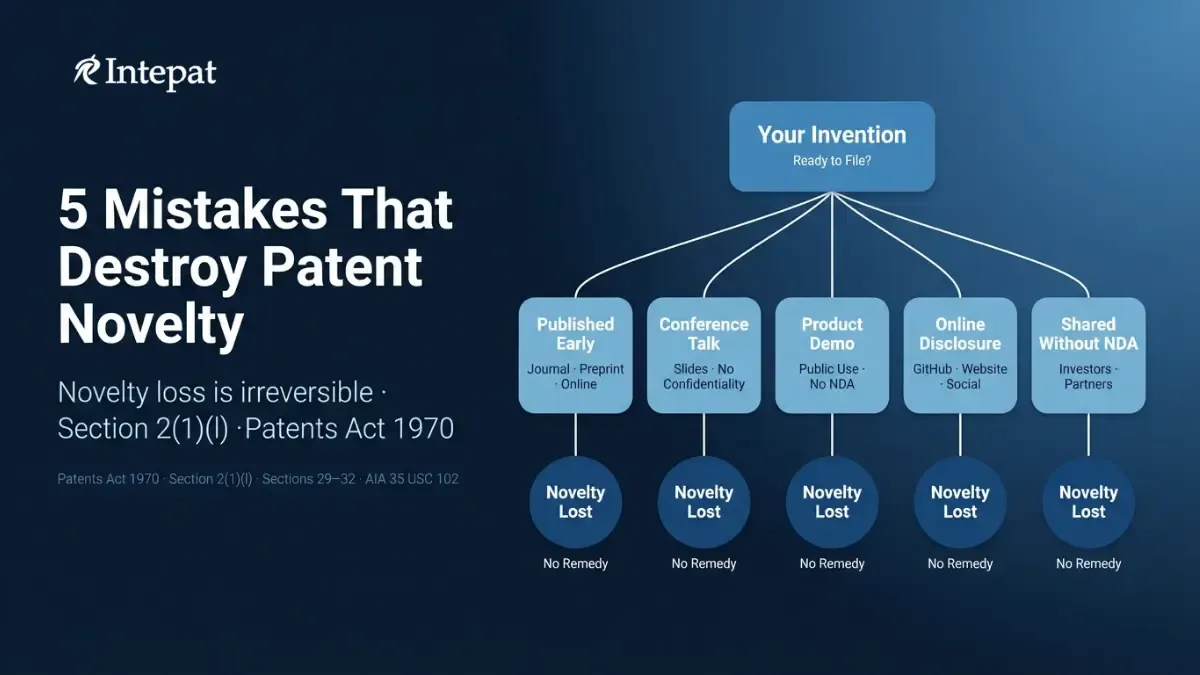
Common Mistakes That Destroy Patent Novelty
In practice, novelty is rarely lost because of obscure prior patents. It is more often destroyed by the applicant’s own premature disclosure. The following situations frequently create irreversible novelty issues across jurisdictions.
1. Publishing Before Filing
Uploading a research paper to a journal, preprint server, institutional repository, or online platform can immediately become global prior art once publicly accessible. Even if the manuscript is under review, early online publication may destroy novelty.
Jurisdictions without a broad grace period, particularly Europe, treat such disclosure as fatal.
2. Conference Presentations and Technical Talks
Presenting technical details at conferences, webinars, or symposiums without confidentiality protection can qualify as oral prior art. Slides circulated to attendees or later uploaded online strengthen the evidentiary basis against novelty.
Limited audience size does not preserve confidentiality unless a binding secrecy obligation exists.
3. Product Demonstration or Commercial Launch
Public demonstration of a prototype, marketing of technical features, distributor communication, or early commercial sale before filing can constitute public use or trigger on-sale bars. Novelty analysis does not depend on scale; even limited exploitation may be sufficient.
4. Online Technical Disclosure
Publishing source code, technical specifications, product announcements, or feature descriptions on websites or platforms such as GitHub creates timestamped global prior art. Once accessible without restriction, the disclosure cannot be reversed.
5. Informal Disclosure Without Confidentiality Protection
Sharing technical information with investors, manufacturers, collaborators, or partners without a valid non-disclosure agreement can jeopardise novelty if confidentiality cannot later be established.
Why These Errors Are Difficult to Remedy
Grace period protection varies across jurisdictions and often involves procedural conditions. Europe provides virtually no general protection. India recognises limited statutory exceptions. Other jurisdictions may offer broader relief, but international filings become complex when disclosure has already occurred.
For applicants seeking protection in multiple countries, the most reliable safeguard remains clear: file before disclosure.
Special Indian Considerations: Interaction with Patentability Requirements
Novelty is only one component of patentability under the Patents Act, 1970. Even where an invention satisfies Section 2(1)(l), the application must independently comply with the remaining statutory requirements.
Novelty and Inventive Step
An invention that is new may still fail under Section 2(1)(ja) if it lacks an inventive step. Novelty asks whether the claimed subject matter has been disclosed in a single prior reference. Inventive step examines whether the differences over the prior art would have been obvious to a person skilled in the art.
These inquiries are doctrinally distinct. A claim may survive novelty because no single document discloses all elements, yet still be rejected for obviousness if the combination of teachings would have been routine.
A deeper examination of this distinction is discussed in our analysis of the inventive step requirement in Indian patents.
Section 3 Exclusions and Eligibility
Compliance with novelty does not override the subject-matter exclusions under Section 3. An invention that is new and non-obvious may still be refused if it falls within statutory exclusions such as mere discovery of a new form of a known substance under Section 3(d), traditional knowledge under Section 3(p), or certain categories of abstract or business-related subject matter.
Section 3(p) is particularly relevant in the context of novelty because traditional knowledge databases may operate as prior art sources. Where an invention is anticipated by traditional knowledge or aggregation thereof, patent protection may be denied irrespective of technical novelty arguments.
A broader discussion of eligibility standards can be found in our articles on what can be patented in India and what cannot be patented in India.
Limited Exceptions to Anticipation
Sections 29 to 32 provide narrowly tailored exceptions where certain disclosures do not destroy novelty. These include government-notified exhibitions, communication to learned societies, and public working for reasonable trial purposes. These provisions are interpreted restrictively and must be supported by evidence.
They do not constitute a broad grace period. Applicants should avoid assuming that disclosure can be retroactively cured.
Practical Position for Indian Applicants
Novelty, inventive step, and subject-matter eligibility must be assessed together. While inventive step and eligibility may sometimes be argued through technical refinement, loss of novelty is generally irreversible if a complete prior disclosure exists.
For applicants pursuing protection domestically and internationally, the most reliable approach remains filing before any public disclosure and conducting a structured prior art assessment in advance.
Protecting Patent Novelty Across Jurisdictions
Patent novelty remains the foundational requirement of patent protection worldwide. Although major jurisdictions apply broadly harmonised principles — absolute novelty, single-reference anticipation, and enabling disclosure — the consequences of premature disclosure differ significantly across countries. Europe offers virtually no general grace period, India recognises narrow statutory exceptions, and other jurisdictions provide varying levels of inventor protection. These differences can materially affect international filing strategy.
In cross-border filings, novelty analysis must therefore extend beyond identifying prior art. Applicants must evaluate disclosure history, timing of public communication, and intended jurisdictions. A disclosure that may be defensible in one country can be fatal in another. Once novelty is destroyed by a complete prior disclosure, corrective strategies are limited and often unavailable.
For inventors, startups, research institutions, and multinational applicants alike, the most reliable strategy remains straightforward: conduct a structured prior art assessment and file before any public disclosure. Conference presentations, journal publications, product demonstrations, online uploads, or early commercialisation should only proceed after filing strategy has been carefully aligned with international protection objectives.
A disciplined approach to timing and disclosure management is not merely procedural — it is central to preserving patent rights globally.
Frequently Asked Questions on Patent Novelty
Absolute novelty means that an invention must not have been disclosed anywhere in the world before the filing or priority date. Most major jurisdictions, including India, the United States, Europe, China, and Japan, follow this standard.
In most jurisdictions, voluntary public disclosure before filing destroys novelty. Some countries provide limited grace periods, but reliance on these provisions carries risk, particularly for international filings. A detailed discussion is available in our article on whether an idea can be patented after it has been made public.
Disclosure made under a valid confidentiality agreement generally does not constitute prior art. However, if confidentiality is not properly documented or the information becomes publicly accessible, novelty may be affected.
No. Novelty requires that no single prior art reference disclose all elements of the claimed invention. Inventive step examines whether the differences over prior art would have been obvious to a person skilled in the art. Both requirements must be satisfied for patentability.