


A well-drafted patent application decides the fate of an invention. A patent claim decides the scope of protection granted on the invention. Different jurisdictions have different requirements for drafting a patent claim.
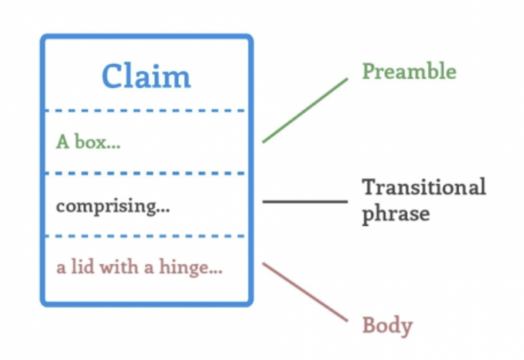
Basic structure of claims:

The basic structure of the claims remains more or less the same, across jurisdictions. A claim consists of:
PREAMBLE- the introductory section that indicates the required class of the invention.
TRANSITION TERM– the term between the preamble and the body of the claim. The two most common transition terms are “comprising” and “consisting of”.
CLAIM BODY- consists of all the elements of the claim.
The following discussion envisages the comparison of drafting patent claims in Europe, US, and Indian patent office.
Comparision:
1.Types of claims:
i) Omnibus claims
It is a claim including a reference to the description or the drawings without stating explicitly any technical features of the product or process claimed. Omnibus claims are common in the UK and Indian Patent Practice. However, they are not allowed in the US patent applications and will be rejected by the patent examiner as indefinite claims.
ii) Two-part claims
A two-part claim is also known as an improvement claim or a Jepson claim. In a two-part claim, the body contains first part prior art statements and the second part or “characterizing portion” should state the features which the invention adds to the prior art. The EPO has a preference for two-part claims. The USPTO does not follow the two-part claims system. The IPO is flexible i.e. it is not mandatory to follow the two-part claim system during claim construction.
2.Reference number in claims
The reference numbers are enclosed within a pair of parenthesis in the patent document. The EPO and IPO strongly emphasize the usage of the reference numerals in order to obtain a better clarity about the subject matter at hand. In contrast to this, the USPTO does not involve the usage of reference numbers.
3.Number of independent claims allowed
According to the IPO, there may be more than one independent claim in a single patent document if the claims fall under a single inventive concept. The EPO limits it to one independent claim per category. On the other hand, the USPTO allows up to three independent claims in a single patent document without the additional fee.
4. Product by process claims
In IPO, the product must be characterized by its composition and not by the process by which it is made. Whereas in Europe, while product by process claims are permissible for a new and inventive product it must be shown that the product can only be described by its process of manufacture. In the USPTO the claim must highlight the new and non-obvious product regardless of the process steps.
5.Placement of claims
In USPTO and IPO, the claims are placed at the end of the patent specification. In the EPO, not mandatory, but before preferred.
Patent claims are the heart of the patent or patent application and hence utmost care must be taken while drafting these claims.