




The minimum PCT entry fee in India for a large entity is ₹28,000 (~$318 / ~€280) in official government charges for an application with up to 30 pages and 10 claims: the combined Form 1 filing charge and the standard Form 18 Request for Examination under Rule 24B, typically filed along with national phase entry for applications filed on or after 15 March 2024.
That figure covers government charges only. The total PCT cost in India for a foreign applicant also includes mandatory agent fees and, for non-English PCT applications, verified English translation costs that often exceed government charges. For foreign in-house counsel and agents building India budgets across a PCT portfolio, this guide sets out every official government charge payable to the Office of the Controller General of Patents, Designs and Trade Marks (CGPDTM), identifies the variables that move the cost, and presents total cost scenarios for the most common filing profiles.
Currency, fee, and forex note: USD and EUR equivalents are approximate, calculated at ₹88/USD and ₹100/EUR as of March 2026. All official PCT fees in India are denominated in INR and governed by the First Schedule to the Patents Rules, 2003 as amended by the Patents (Amendment) Rules, 2024. Banks and patent agents typically apply a forex markup of 2–5% above the mid-market rate, plus wire transfer fees. Budgeting exactly $318 for a ₹28,000 charge may underfund the actual invoice. Add a 5% buffer to all USD/EUR equivalents in this guide.
Applicant Categories and PCT Fee Slabs
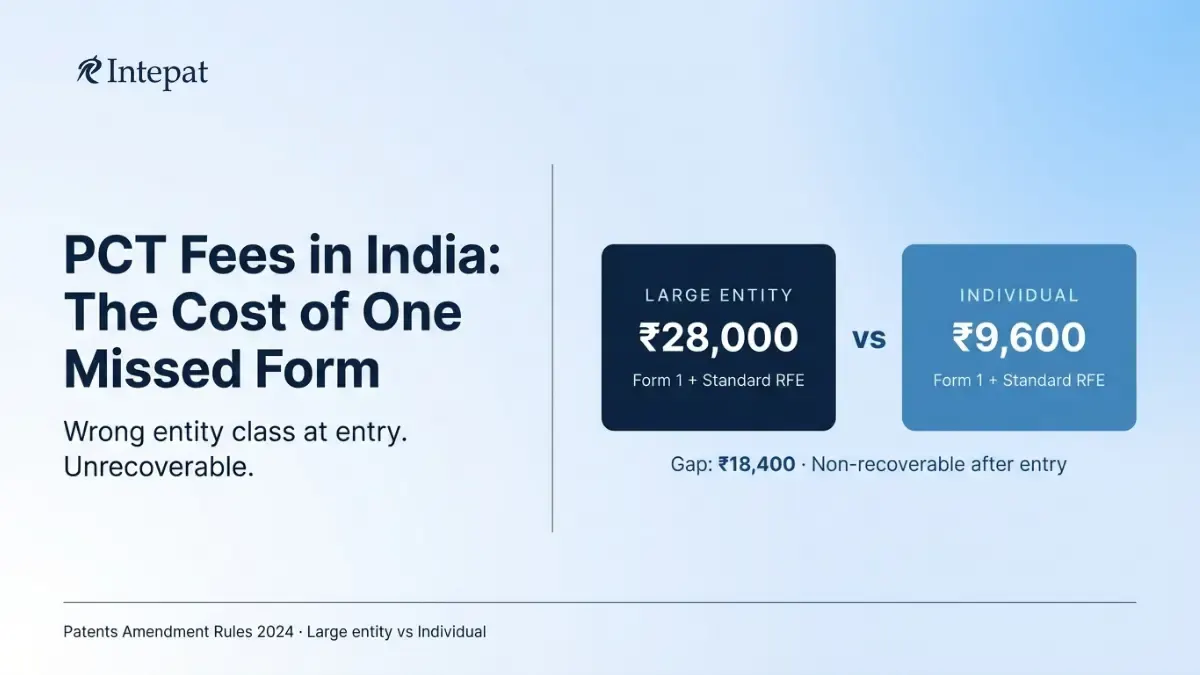
Every PCT entry fee in India is determined first by applicant category, before any form is filed. The PCT official fee in India for a large entity is roughly five times the reduced category rate for the same application. The difference between the two slabs on a standard filing is ₹18,400, unrecoverable after entry.
Large Entity: Default Classification for Foreign Corporations
Foreign companies, multinationals, and corporate IP holders are classified as large entity (referred to as ‘Others’ in the First Schedule) by default. This is the higher fee slab. Most foreign applicants pay large entity charges for all PCT fee events in India.
Reduced Category: Who Qualifies Among Foreign Applicants
The reduced fee slab applies to natural persons (individual inventors regardless of nationality), small entities meeting Indian MSME definitions, educational institutions, and DPIIT-recognised startups. Foreign corporations incorporated abroad rarely qualify. DPIIT recognition requires incorporation in India as a Private Limited Company, LLP, or Registered Partnership Firm. A foreign corporation incorporated abroad cannot directly obtain it.
Form 28: File at Entry or Forfeit the Reduced Rate
Form 28 must be filed at the time of national phase entry with valid supporting documents to claim any reduced category status. It cannot be backdated. The cost of omission for a standard 30-page, 10-claim, single-priority application is ₹18,400 (~$209 / ~€184), being the difference between the reduced and large entity slabs, unrecoverable after entry.
Joint applicant rule: Where the PCT application names both an individual inventor and a corporate co-applicant, the entire application is classified as large entity. No exception applies.
Official PCT Fees in India at National Phase Entry (2026)
The table below sets out every official PCT fee in India payable to the CGPDTM at national phase entry and during initial prosecution: the statutory PCT cost figures in India as of 2026. Figures apply to e-filing. Where physical filing is permitted, a 10% surcharge applies. Form 18A is electronic-only. Agent fees and translation costs are not included.
| Charge Item | Form | Reduced (e-file) | Large Entity (e-file) |
| A. Application Filing — Form 1 | |||
| Base charge: up to 30 pages, 10 claims, 1 priority | Form 1 | ₹1,600 | ₹8,000 |
| Each page beyond 30 | Form 1 | ₹160 | ₹800 |
| Each claim beyond 10 | Form 1 | ₹320 | ₹1,600 |
| Each additional priority (multiplied on base charge) | Form 1 | +₹1,600 | +₹8,000 |
| B. Request for Examination | |||
| Standard RFE — Rule 24B | Form 18 | ₹4,000 | ₹20,000 |
| Express Request before 31 months — Rule 20(4)(ii) | Form 18 | ₹5,600 | ₹28,000 |
| Expedited Examination — Rule 24C (electronic only) | Form 18A | ₹8,000 | ₹60,000 |
| Conversion: Form 18 → Form 18A (balance fee, electronic only) | Form 18A | ₹4,000 | ₹40,000 |
| C. Optional and Zero-Fee Items at Entry | |||
| Early Publication (optional) | Form 9 | ₹2,500 | ₹12,500 |
| Power of Attorney | Form 26 | No charge | No charge |
| Statement and Undertaking under Section 8 | Form 3 | No charge | No charge |
| D. Post-Entry: Extensions and Amendments | |||
| FER response extension — standard track, Rule 24B(6), per month, max 3 months | Form 4 | ₹1,000/mo | ₹4,000/mo |
| FER response extension — expedited track, Rule 24C(11), per month, max 3 months | Form 4 | ₹2,000/mo | ₹10,000/mo |
| General extension or condonation of delay — Rule 138, per month, max 6 months | Form 4 | ₹10,000/mo | ₹50,000/mo |
| Voluntary amendment before grant — Form 13 | Form 13 | ₹800 | ₹4,000 |
Cost Variables: What Moves the PCT Entry Fee in India
For large entity foreign filers, cost variance in PCT fees in India at entry is driven primarily by priority count and claim count, not the base filing fee. A standard 30-page, 10-claim, single-priority application costs ₹28,000. Two priorities: ₹36,000. Each claim beyond 10 adds ₹1,600. The examination route adds between ₹0 and ₹40,000.
Priority Count: The Multiplier Most Budgets Miss
The Form 1 base charge is multiplied by the number of priority documents claimed. A single-priority application pays ₹8,000 (large entity). An application asserting two priorities pays ₹16,000. Three priorities: ₹24,000. This multiplication applies to the base charge only, not to excess page or claim charges. Budgets prepared on single-priority assumptions will be deficient by ₹8,000 per additional priority, the most common underquote in PCT cost estimates for India.
Worked example: two priorities, 30 pages, 10 claims, large entity: Form 1 ₹16,000 + Form 18 ₹20,000 = ₹36,000 at entry (~$409 / ~€360), against ₹28,000 for the same application with one priority.
Claim Count: Excess Claim Charge per Claim Beyond 10
Each claim beyond 10 adds ₹320 (reduced) / ₹1,600 (large entity) at filing. A PCT application with 18 claims carries 8 excess claims: ₹2,560 (reduced) / ₹12,800 (large entity) in excess claim charges alone. Deletion saves ₹1,600 per deleted claim (large entity) but risks irreversible loss under Section 59: the CGPDTM treats deletion as a voluntary narrowing of scope and has refused reinstatement. Delete only clearly non-patentable claims; retain borderline claims and address them at the First Examination Report stage.
Page Count: Excess Page Charge per Page Beyond 30
Each page beyond 30 adds ₹160 (reduced) / ₹800 (large entity). A 40-page specification carries 10 excess pages: ₹1,600 (reduced) / ₹8,000 (large entity) added to the Form 1 charge.
PCT Fee Comparison by Examination Route in India
The PCT official fee in India for examination depends on which route is chosen at entry. Three routes are available: the cost difference between the standard Form 18 (₹20,000) and expedited Form 18A (₹60,000) is ₹40,000 (large entity). Choosing the wrong route at entry also risks a ₹40,000 conversion balance fee to upgrade later.
Standard RFE — Form 18, Rule 24B: ₹20,000 (Large Entity)
The standard RFE charge is ₹4,000 (reduced) / ₹20,000 (large entity). Available to all applicants. For applications entered under the 2024 Rules, the RFE deadline falls at 31 months, the same as national phase entry.
Express Request: Form 18, Rule 20(4)(ii): ₹28,000 (Large Entity)
PCT-exclusive. Charge: ₹5,600 (reduced) / ₹28,000 (large entity). Available to any PCT national phase applicant; no eligibility criteria apply. The Controller retains full discretion to decline early processing. The ₹28,000 charge is non-refundable if early processing is declined. Applicants needing a guaranteed faster timeline should assess Form 18A eligibility first.
Expedited Examination: Form 18A, Rule 24C: ₹60,000 (Large Entity)
Charge: ₹8,000 (reduced) / ₹60,000 (large entity). Once accepted, examination proceeds on a mandatory priority basis, unlike the discretionary express request. Eligibility is restricted: India must have been designated as ISA or IPEA for the PCT application (the primary route for most foreign large entities), or the applicant must qualify as a DPIIT startup, small entity, female natural person, government body, or under a PPH arrangement with the IPO. For eligibility details, see Choosing India as Your PCT ISA and Expedited Patent Examination in India.
Converting Form 18 to Form 18A After Entry: ₹40,000 Balance Fee (Large Entity)
An applicant who files Form 18 at entry and subsequently upgrades to expedited examination pays a balance fee of ₹4,000 (reduced) / ₹40,000 (large entity), bringing the total to ₹60,000, the same as filing Form 18A directly. Converting is not cheaper than filing Form 18A at entry. The conversion is electronic-only.
PCT Extension Fee in India: Rule 24B(6), Rule 24C(11), and Rule 138 Compared
Three rules set the PCT extension fee in India for time extensions during prosecution. The cost difference between them is substantial: Rule 24B(6) costs ₹4,000/month (large entity), Rule 24C(11) costs ₹10,000/month, and Rule 138 costs ₹50,000/month. Applying the wrong rule produces overpayment of up to ₹46,000 per month.
Rule 24B(6): Standard Track FER Response Extension: ₹4,000/Month (Large Entity)
Applies to the standard examination track (Form 18). Extends the FER response period by up to 3 months on Form 4. Fee: ₹1,000/month (reduced) / ₹4,000/month (large entity). Maximum cost: ₹3,000 (reduced) / ₹12,000 (large entity).
Rule 24C(11): Expedited Track FER Response Extension: ₹10,000/Month (Large Entity)
Applies to the expedited examination track (Form 18A). Same 3-month extension, same Form 4. Fee: ₹2,000/month (reduced) / ₹10,000/month (large entity). Maximum cost: ₹6,000 (reduced) / ₹30,000 (large entity). The track that generated the first statement of objections determines which rule applies.
Rule 138: General Condonation: ₹50,000/Month (Large Entity) — Do Not Apply to FER Extensions
Rule 138 is a general extension and condonation mechanism at ₹10,000/month (reduced) / ₹50,000/month (large entity) for up to 6 months. It is not the correct vehicle for FER response extensions where Rule 24B(6) or Rule 24C(11) applies. Applying Rule 138 where Rule 24B(6) is correct results in overpayment of ₹46,000 per month (large entity).
| Cost exposure note: |
| The national phase entry deadline is excluded from the Controller’s power to condone irregularity under Rule 137. Rule 138 is not accepted in practice for a missed national phase entry deadline. The only cost-effective approach is filing before month 31. See Late PCT National Phase Entry. |
Five PCT Fee Errors Foreign Applicants Make in India
These five errors consistently inflate PCT cost in India for foreign applicants beyond what the First Schedule requires. Each is avoidable, each has a precise rupee consequence, and each occurs at or before the moment of national phase entry. Understanding them is as important as knowing the PCT official fee in India itself.
1. Omitting Form 28 at entry. Cost of omission: ₹18,400 (~$209 / ~€184) for a standard 30-page, 10-claim, single-priority filing, unrecoverable. Form 28 cannot be backdated. Large entity charges apply from the entry date.
2. Quoting Form 1 at single-priority rate for multi-priority applications. Financial exposure: ₹8,000 (large entity) per additional priority: a fee deficiency the IPO will raise. Two priorities: ₹16,000, not ₹8,000.
3. Applying Rule 138 rates to FER response extensions. Overpayment: ₹46,000/month (large entity) where Rule 24B(6) is the correct vehicle. Rule 24B(6) costs ₹4,000/month; Rule 138 costs ₹50,000/month.
4. Deleting borderline claims at entry without a Section 59 analysis. Fee saving: ₹1,600 per deleted claim (large entity). Risk: reinstatement via Form 13 (₹4,000 large entity) may be refused by the CGPDTM on Section 59 grounds, making the deletion irreversible. The saving does not justify the risk for borderline claims.
5. Paying ₹28,000 for a Rule 20(4)(ii) express request without assessing Form 18A eligibility. The ₹28,000 charge is non-refundable if the Controller declines early processing. Form 18A at ₹60,000 (large entity) delivers mandatory priority examination once accepted. Where ISA designation or other Form 18A eligibility exists, the ₹60,000 route is more certain value than the discretionary ₹28,000 route.
Hidden PCT Cost Triggers in India: Quick Reference
These are the PCT cost variables in India that most budget estimates miss. Each item below represents a charge that either multiplies the base PCT fee in India unexpectedly, or a non-government cost that no official fee calculator captures. Foreign in-house counsel should verify each trigger against their specific application profile before the 31-month deadline.
| Hidden PCT Cost Triggers in India |
|---|
| Multiple priorities: +₹8,000 per additional priority (large entity). The Form 1 base filing charge is multiplied by the number of priorities claimed. |
| Excess claims: +₹1,600 per claim beyond 10 (large entity). |
| Excess pages: +₹800 per page beyond 30 (large entity). |
| Wrong extension rule: Overpayment of +₹46,000 per month if Rule 138 is used instead of Rule 24B(6) for FER response extensions (large entity). |
| Missing Form 28: +₹18,400 unrecoverable difference between reduced category and large entity charges for a standard entry. |
| Late proof of right: Rule 138 condonation fee of ₹50,000 per month (large entity) if filed beyond the prescribed period after entry. |
| Form 18 → Form 18A conversion: ₹40,000 balance fee (large entity) when upgrading to expedited examination after filing Form 18. |
| Non-English PCT application: Verified English translation required at entry; translation costs often exceed government fees. |
| Stamped assignment deed: Stamp duty required under Indian law; varies by state and may cause delays if the deed is not pre-stamped before the 31-month deadline. |
| Section 8 compliance: No government fee, but ongoing agent costs for monitoring foreign prosecution, filing Form 3 updates, and translating foreign documents when requested. |
Total PCT Cost Scenarios in India: Government Charges Only
Most foreign filings fall between ₹28,000 and ₹68,000 in PCT fees in India depending on priority count, claim count, and examination route. These six scenarios show the full range of official PCT cost in India for the most common large entity and reduced category filing profiles, all calculated from the First Schedule to the Patents Rules, 2003.
Government fees are typically the smallest component of total PCT cost in India; translation and prosecution costs dominate total spend for non-English origin applications and complex portfolios.
The scenarios below show total official PCT entry fees in India, e-filing only. Agent fees, translation costs, and drawing costs are excluded from all figures. Exchange rates: ₹88/USD, ₹100/EUR with a recommended 5% forex buffer on USD/EUR equivalents. All amounts from the First Schedule to the Patents Rules, 2003. For a complete estimate including agent fees, contact Intepat for a full India PCT cost estimate.
| Applicant | Key Variables | INR Total | USD (~) | EUR (~) |
| Large entity | 1 priority · 30 pages · 10 claims · standard RFE | ₹28,000 | ~$318 | ~€280 |
| Large entity | 2 priorities · 30 pages · 10 claims · standard RFE | ₹36,000 | ~$409 | ~€360 |
| Large entity | 1 priority · 30 pages · 18 claims · standard RFE | ₹40,800 | ~$464 | ~€408 |
| Large entity | 2 priorities · 35 pages · 15 claims · standard RFE | ₹48,000 | ~$545 | ~€480 |
| Large entity | 1 priority · 30 pages · 10 claims · expedited (Form 18A) | ₹68,000 | ~$773 | ~€680 |
| Reduced category (DPIIT startup / natural person) | 1 priority · 30 pages · 10 claims · expedited (Form 18A) | ₹9,600 | ~$109 | ~€96 |
Beyond Government Charges: What the Total PCT Cost in India Actually Includes
The PCT official fee in India set by the First Schedule covers only what the CGPDTM charges. The real PCT cost in India for a foreign applicant is higher once mandatory agent fees, translation costs for non-English applications, Section 8 compliance costs, and stamp duty on assignment deeds are factored in.
Mandatory Agent Fees
Foreign applicants are required by law to appoint a registered Indian patent agent to file and prosecute the application before the IPO. Agent fees are not regulated and vary between firms. Typical structures include a flat fee for national phase entry filing and a per-response fee for First Examination Report responses, with grant stage fees charged separately. Agent fees are not included in any scenario in this guide. For a complete India PCT cost estimate including agent fees, contact Intepat.
Translation Costs for Non-English PCT Applications
Where the original PCT application was filed or published in a language other than English (Japanese, German, Chinese, Korean, or other), a verified English translation of the complete specification must be filed at entry. Translation costs for a full technical patent specification often exceed government charges. The verification statement confirming the translation is complete and accurate must be signed by the applicant or authorised agent. This cost variable is absent from most India PCT fee guides and should be budgeted separately for any non-English origin application.
Section 8 Lifecycle Costs
The government fee for filing Form 3 (Statement and Undertaking under Section 8) is zero. The agent cost of maintaining Section 8 compliance is not. Section 8 requires disclosure of all corresponding foreign applications for the same or substantially the same invention, updated within 3 months of the First Examination Report. For a PCT application with designations across multiple jurisdictions (the US, EP, CN, JP, KR), this means monitoring prosecution across all designated offices throughout the Indian prosecution lifecycle, preparing Form 3 updates whenever a foreign examination report issues or a foreign application is granted or refused, and occasionally translating foreign prosecution documents to satisfy Controller requests under Section 8(2). These are ongoing agent time costs that run from entry to grant.
Stamp Duty on Assignment Deeds
Where proof of right is established through a worldwide assignment deed rather than inventor signatures on Form 1, the deed must be stamped under Indian law to be legally effective. Stamp duty on assignment deeds is a state subject and varies by state; it is typically calculated ad valorem on the consideration stated in the deed, or on the estimated value of the patent rights being assigned. Foreign counsel who execute and notarise an assignment deed abroad frequently assume it is sufficient at entry. It is not: stamping must occur under Indian law, and a deed that arrives unstamped will not be accepted as valid proof of right. Arranging Indian stamping before the 31-month deadline adds both cost and logistical time that must be built into the filing timeline.
Plan Your India PCT Cost Budget Before the 31-Month Deadline
The PCT entry fee in India starts at ₹28,000 in official government charges for a large entity standard single-priority filing, rising predictably from there. Priority count and examination route are the two largest PCT cost drivers in India at entry.
The 20-year patent term runs from the international PCT filing date, not the national phase entry date, so entering at month 29 carries no term cost. Entity classification, Form 28 filing at entry, and claim count review are cost decisions, not just administrative ones. Cost planning at entry directly impacts prosecution flexibility and total lifecycle spend. Once the entry date passes, most options close or become significantly more expensive.
For the full lifecycle of patent fees from year 2 renewal onwards, see Patent Fees and Costs in India and Patent Renewal in India. For entry procedures and documentation requirements, see PCT National Phase Entry in India.
Frequently Asked Questions
Yes. The standard Form 18 charge is ₹4,000 (reduced) / ₹20,000 (large entity) for both PCT national phase and domestic applications. The charge differs only when an express request under Rule 20(4)(ii) is filed (₹5,600 / ₹28,000), a PCT-exclusive option unavailable to domestic applicants.
Filing Form 18 (standard) costs ₹20,000. Filing Form 18A (expedited) costs ₹60,000, a difference of ₹40,000. Converting after filing Form 18 requires a balance fee of ₹40,000, bringing the total to ₹60,000, the same as filing Form 18A at entry. Converting is not cheaper; it defers the decision.
Yes. On the standard track (Form 18), Rule 24B(6) costs ₹1,000/month (reduced) / ₹4,000/month (large entity), maximum 3 months at ₹3,000 / ₹12,000. On the expedited track (Form 18A), Rule 24C(11) costs ₹2,000/month (reduced) / ₹10,000/month (large entity), maximum 3 months at ₹6,000 / ₹30,000. Both filed on Form 4. Applying Rule 138 (₹50,000/month) where Rule 24B(6) applies results in overpayment of ₹46,000 per month (large entity).
Yes. The balance fee is ₹4,000 (reduced) / ₹40,000 (large entity), e-filing only. This is the difference between the Form 18 and Form 18A rates. The conversion must be accompanied by a request for publication under Rule 24A unless the application has already been published or such a request is already on file.
Form 13 before grant costs ₹800 (reduced) / ₹4,000 (large entity) via e-filing. After grant, the charge increases to ₹1,600 (reduced) / ₹8,000 (large entity). Each Form 13 amendment is assessed against Section 59 of the Patents Act. Where a claim deleted at entry is sought to be reinstated via Form 13, the ₹4,000 filing charge applies alongside the Section 59 scrutiny risk.
Rule 24B(6) on the standard track costs ₹1,000/month (reduced) / ₹4,000/month (large entity). Rule 138 costs ₹10,000/month (reduced) / ₹50,000/month (large entity). Applying Rule 138 where Rule 24B(6) is correct results in overpayment of ₹9,000/month (reduced) or ₹46,000/month (large entity). The track that generated the first statement of objections determines which rule applies.
This article provides a general overview of official government charges for PCT national phase entry in India as of March 2026 and does not constitute professional IP advice; verify all figures against the current First Schedule to the Patents Rules, 2003 before filing.