




A PCT application that proceeds smoothly in the United States, Europe, or Japan can still fail in India for purely procedural reasons. Most failures are not substantive; they arise from missed statutory deadlines, incorrect docketing assumptions, or compliance gaps that other jurisdictions may accommodate, but the Indian system generally does not.
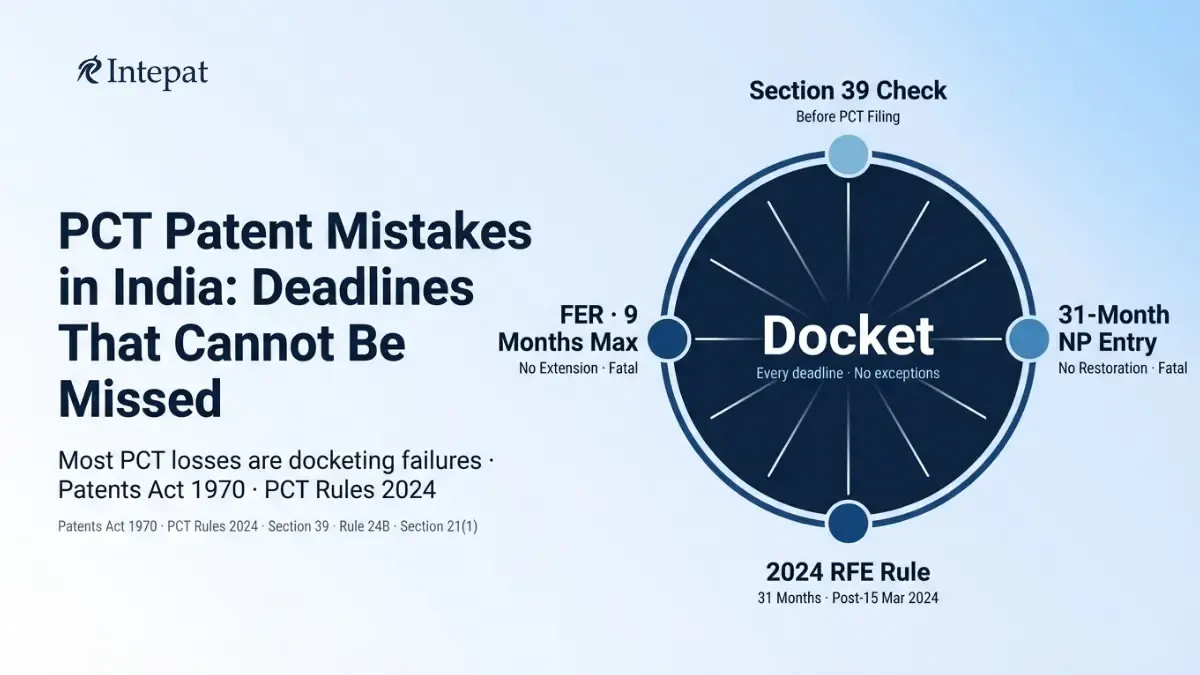
India operates one of the most stringent national phase regimes within the PCT framework. Certain procedural lapses result in loss of rights with no reliable mechanism for restoration in practice. The most critical include: missing the 31-month national phase deadline, non-compliance with Section 39 prior to foreign filing, and failure to apply the 2024 amendment that aligns the examination request deadline with the 31-month timeline for applications filed on or after 15 March 2024. This guide addresses these and seven other recurring mistakes that most consistently compromise PCT applications in India.
Key Takeaways
- Three failures routinely result in loss of rights in India: missing the 31-month national phase deadline, non-compliance with Section 39, and failure to respond to the FER within the statutory 6-month period (extendable by 3 months) under Section 21(1).
- The 2024 amendment to Rule 24B is frequently misapplied. For applications filed on or after 15 March 2024, Form 18 or Form 18A must be filed within 31 months from the priority date. The applicable extension mechanism is Rule 24B(6). Rule 138 does not apply to examination requests. I
- ISA selection is fixed at the time of PCT filing. While it can impact eligibility for expedited examination (Form 18A) for certain applicants, additional eligibility routes exist and should be assessed independently.
- India does not provide a statutory restoration mechanism equivalent to PCT Rule 49.6 for late national phase entry. The 31-month deadline should be treated as absolute in practice.
- Form 3 compliance is mandatory. File within 6 months of national phase entry and update within 3 months of the FER. Non-compliance constitutes a ground for revocation under Section 64(1)(m).
- Where the PCT application is not in English, a verified English translation must be filed at national phase entry along with Form 1. Translation timelines must be built into the filing strategy.
- In practice, most losses arise from docketing failures rather than substantive patentability issues. A disciplined docketing system combined with a pre-filing residency check under Section 39 mitigates the majority of these risks.
Quick Reference: 10 PCT Mistakes at a Glance
Certain procedural failures result in loss of rights once the statutory deadline expires. In practice, most failures arise from docketing errors rather than substantive issues.
| Mistake | Phase | India Consequence |
|---|---|---|
| Section 39 (FFL) not checked | Pre-filing | ⚠ High risk — Criminal liability (Section 118); application liable to be abandoned (Section 40); granted patent vulnerable to revocation |
| ISA selected without India in mind | Pre-filing | Strategic limitation — Expedited examination (Form 18A) may be unavailable for certain applicants; ISA choice is irreversible |
| Priority claim error left uncorrected | International | Priority date may shift to PCT filing date; limited correction possible under Rule 26bis within prescribed timelines |
| ISR / Written Opinion not acted on | International | Objections must be addressed independently in each jurisdiction; increases prosecution cost and risk |
| NP data and translation not verified | National Phase Entry | Formal objections; non-English PCT applications require verified English translation at entry |
| 31-month deadline treated as flexible | National Phase Entry | ⚠ Critical — Application treated as withdrawn; no statutory restoration mechanism equivalent to PCT Rule 49.6 in India |
| 2024 RFE rule not applied | National Phase Entry | Application deemed withdrawn if Form 18/18A not filed within 31 months; extension available only under Rule 24B(6) |
| Entity classification error | National Phase Entry | Fee deficiency or incorrect fee category; correctable with supporting declaration (Form 28) |
| Form 3 / Section 8 non-compliance | NP Entry + Prosecution | Ground for revocation (Section 64(1)(m)); also triggers opposition under Section 25 |
| FER response deadline missed | Post-entry | ⚠ Critical — Application deemed abandoned under Section 21(1) beyond 6 + 3 month window |
| Facing an upcoming 31-month deadline for India? |
| A quick review can identify critical issues before they result in loss of rights. Share your PCT number and priority date for a preliminary check of the 31-month deadline, translation requirements, Form 18/18A applicability, entity classification, and Form 3 compliance status. |
| Request an Indian National Phase Review |
Phase 1: Pre-Filing
Mistake 1: Section 39 Foreign Filing Licence Not Checked
Critical — No reliable post-filing remedy: Non-compliance can result in criminal liability under Section 118 (up to two years imprisonment), exposure to abandonment under Section 40, and revocation risk even after grant. Recommended practice: Verify the residency status of every inventor before the PCT filing date.
Section 39 of the Patents Act, 1970 prohibits any person resident in India from filing, or causing to be filed, a patent application outside India without prior permission from the Controller, unless an Indian application has been filed at least six weeks earlier and no secrecy direction is in force. A PCT application filed outside India or through a Receiving Office constitutes a foreign filing for this purpose, as affirmed by the Delhi High Court in Puneet Kaushik & Anr. v. Union of India (W.P.(C) 1631/2013).
Residency is determined under the Income Tax Act, 1961, not citizenship. An individual is considered a resident if present in India for 182 days or more in the relevant financial year, or for 60 days or more in that year and 365 days or more in the preceding four years. Accordingly, an Indian national working abroad (for example, on an H-1B visa) may still qualify as a resident if these thresholds are met.
Once a PCT application is filed without compliance with Section 39, there is no clear statutory mechanism to regularise the violation retrospectively, and the application remains exposed to consequences under Sections 40 and 118.
Where residency is confirmed prior to filing, two compliant routes are available:
- File an Indian application and wait six weeks before filing the PCT application (in the absence of a secrecy direction), or
- Obtain prior permission from the Controller by filing Form 25.
Under Rule 71 of the Patents Rules, 2003, the Controller is required to dispose of a Form 25 request ordinarily within 21 days.
| How this fails in practice: |
| A US company files a PCT application at RO/US with three inventors: two US residents and one engineer who has spent substantial time working in Bangalore in the preceding year. If the engineer qualifies as a “person resident in India” under the Income Tax Act, Section 39 applies. No Foreign Filing Licence is obtained. At Indian national phase entry or during examination, the Indian Patent Office may identify the Indian address disclosed in the PCT publication. The application is exposed to consequences under Section 40, including potential abandonment, and post-grant revocation risk. There is no clear statutory mechanism to regularise the defect after filing. |
For the full FFL procedure and Form 25 requirements: Procedure for obtaining Foreign Filing License (FFL) in India.
Mistake 2: ISA Selected Without Considering India Prosecution Consequences
ISA selection can directly impact eligibility for expedited examination (Form 18A) at Indian national phase entry for certain applicants, particularly large entities. Recommended practice: Assess all Form 18A eligibility routes before selecting the ISA.
The ISA designation is made once in Box VIII of the PCT Request Form and cannot be changed after filing. For foreign large entities, the ISA-linked route to expedited examination typically requires either designation of the Indian Patent Office as ISA or election of India as IPEA through a Chapter II Demand filed within the prescribed timelines under Rule 54bis.1(a).
What is often overlooked is that Form 18A eligibility is not limited to ISA selection. Independent eligibility routes exist, including DPIIT-recognised startups, small entities, female applicants (or joint applicants with at least one female), government departments, government-owned or controlled institutions, government companies, government-financed institutions, applicants in notified sectors, and applicants eligible under a Patent Prosecution Highway (PPH) arrangement with the Indian Patent Office. These categories should be evaluated before concluding that expedited examination is unavailable.
From a cost perspective, the IPO search fee for large entities is significantly lower than other major ISAs (for example, EPO and USPTO). However, ISA selection should be driven by prosecution strategy, prior art exposure, and downstream national phase objectives rather than fee alone. Form 18A must be filed electronically, and the prescribed fee for large entities is INR 60,000.
For the full ISA decision framework read: PCT ISA: What It Unlocks in Prosecution.
Once filing decisions are locked in, risk shifts to the international phase, where timing and amendment strategy determine how expensive national prosecution becomes.
Phase 2: International Phase
Mistake 3: Priority Claim Errors Left Uncorrected
Errors in the priority claim, including incorrect application number, incorrect priority date, wrong country, or filing the PCT application after expiry of the 12-month priority period, are correctable only within prescribed time limits. Under PCT Rule 26bis.1, a priority claim can be corrected or added within 16 months from the priority date. Where the PCT application is filed after the 12-month period, Rule 26bis.3 permits restoration of priority, provided the application is filed within 14 months from the earliest priority date.
The applicable restoration standard depends on the Receiving Office. RO/IB and RO/US apply both the “due care” and “unintentional delay” standards, whereas RO/EP and RO/GB apply only the “due care” standard. RO/KR applies both standards. Where timing is marginal, the choice of Receiving Office can directly affect the availability and outcome of priority restoration.
If priority is not restored, any disclosure in the intervening period, including publication of the priority application, can become citable prior art against the PCT application..
| How this fails in practice: |
| A German applicant files a PCT application 13 months after the earliest priority date, having incorrectly docketed the deadline from the intended PCT filing date instead of the priority filing date. The application is filed at RO/IB, and restoration is requested under the “unintentional delay” standard. If the same application had been filed at RO/EP, where only the “due care” standard applies, restoration may not have been available. The choice of Receiving Office can therefore be outcome determinative in marginal cases. |
For the full priority restoration procedure under Rule 26bis.3: see Restoration of Priority Explained.
Mistake 4: ISR and Written Opinion Treated as Information Only
This is one of the most expensive passive mistakes in PCT practice. Each objection raised in the Written Opinion, if not addressed during the international phase, must be addressed separately in every designated national office. This multiplies prosecution cost and increases the risk of adverse outcomes across jurisdictions.
Two amendment opportunities arise upon receipt of the International Search Report. Under Article 19, amendments are limited to claims and must be filed with the International Bureau within 16 months from the priority date or 2 months from the date of transmittal of the ISR, whichever is later. No fee is required. Under Article 34, amendments to claims, description, and drawings can be filed through a Chapter II Demand within 22 months from the priority date or 3 months from the date of transmittal of the ISR, whichever is later. A prescribed fee is payable. Both amendment opportunities close before entry into the national phase.
Common errors include filing Article 19 amendments without a supporting statement of basis, filing Article 34 amendments after issuance of the International Preliminary Report on Patentability, introducing new matter in Article 19 amendments that is later objected to at national phase entry, and treating Article 19 and Article 34 as interchangeable when only Article 34 permits amendment of the description and drawings. For biotechnology and pharmaceutical applications, it is also relevant that the Indian Patent Office, when acting as IPEA, examines only in English and does not examine subject matter excluded under PCT Rule 67.1.
| How this fails in practice: |
| A Korean applicant receives an ISR from the EPO citing three X documents against the independent claim. No Article 19 amendment is filed. During national phase prosecution, both the Indian Patent Office and the USPTO raise objections based on the same prior art. The applicant incurs separate prosecution costs in each jurisdiction for objections that could have been addressed during the international phase through a timely amendment. |
For the full Article 19 and 34 amendment procedure: see PCT Amendment Under Article 19 vs Article 34.
The international phase concludes at 31 months. The next stage is the Indian national phase, where procedural compliance becomes outcome determinative and multiple independent risks arise.
Phase 3: National Phase Entry
Two requirements apply at filing. First, the national phase application must match the WIPO record as on the date of entry. Any change not reflected at WIPO, including applicant or assignment details, cannot be incorporated at filing and must be addressed post-entry, including through Form 13 where required. Second, where the PCT application is not filed or published in English, a verified English translation must be filed with Form 1 at national phase entry.
Mistake 5: National Phase Filing Data and Translation Not Verified
Changes made during the international phase that are not reflected in the WIPO record at the time of entry cannot be included in the Indian national phase filing. Review the live WIPO record in advance of the 31-month deadline to ensure alignment of all details.
The translation requirement frequently affects applications from non-English jurisdictions. Under Rule 20(3) of the Patents Rules, 2003, the complete specification must be filed in English at entry. Verification requires a statement by the applicant or authorised agent confirming that the translation is complete and accurate. Translation preparation should be built into the filing timeline rather than left to the final stage.
Mistake 6: The 31-Month Deadline Treated as Flexible
Critical — No statutory restoration mechanism: India does not provide a restoration mechanism equivalent to PCT Rule 49.6 for late national phase entry. The 31-month deadline should be treated as absolute in practice.
Once the 31-month deadline passes without filing, the application is treated as withdrawn and cannot be revived under the Patents Act and Rules. While some practitioners attempt to rely on Rule 138 prior to expiry of the deadline, such reliance is not uniformly accepted and carries risk. Other jurisdictions permit limited late entry. The US allows revival based on unintentional delay. The EPO permits further processing under Rule 159 EPC. China and Singapore provide limited grace periods. India does not provide a comparable post-deadline remedy.
The risk typically arises from docketing systems that treat the 31-month deadline as flexible, or from delayed instructions from foreign counsel that do not account for translation timelines, engagement of Indian agents, and preparation of Form 1 and supporting documents.
Within 3 months of your 31-month deadline? Request a quick India filing check
Share your PCT number and priority date for a preliminary deadline and entry requirements review.
For a country-by-country late NP entry comparison: Read Late PCT National Phase Entry.
Mistake 7: The 2024 RFE Deadline Collapse Not Applied to Post-15 March 2024 Applications
High frequency since March 2024. Docketing systems must be updated. For applications filed on or after 15 March 2024 under Rule 24B(1)(i), Form 18 or Form 18A must be filed within 31 months from the priority date. For applications filed before 15 March 2024 under Rule 24B(1)(vi), the earlier 48-month deadline continues to apply. The only extension mechanism is Rule 24B(6). Rule 138 does not apply to examination requests.
The Patents (Amendment) Rules, 2024 align the examination request deadline with the national phase entry timeline for applicable applications. For example, a PCT application filed in April 2024 with a priority date of April 2022 requires filing of Form 18 or Form 18A by November 2024, not April 2026.
Rule 24B(6) permits a six-month extension, which must be requested before expiry of the 31-month deadline. Failure to file the request for examination within the prescribed period, including the extended period where applicable, results in the application being deemed withdrawn.
As a practical approach, for PCT applications governed by Rule 24B(1)(i), the national phase application and Form 18 or Form 18A should be filed together at or before the 31-month deadline.
For the full NP entry checklist and 2024 rule context: Read PCT National Phase Entry in India.
Mistake 8: Entity Classification Error at National Phase Entry
Indian patent fees are tiered based on applicant category. The concessional category, including natural persons, DPIIT-recognised startups, small entities, and educational institutions, pays reduced fees at each stage. For large entities, the electronic filing fee for Form 1 is INR 8,000, Form 18 is INR 20,000, and Form 18A is INR 60,000. For the concessional category, the corresponding fees are INR 1,600, INR 4,000, and INR 8,000.
Errors occur in both directions. Applicants eligible for concessional status, including through qualifying Indian entities, may default to large-entity classification without verifying eligibility. Conversely, applicants claiming concessional status without filing the required declaration in Form 28 will receive a deficiency notice. Entity classification must remain consistent across Form 1, Form 18 or Form 18A, Form 26, and Form 28. A DPIIT startup recognition valid at the time of PCT filing may lapse before national phase entry if not renewed.
Mistake 9: Form 3 / Section 8 Non-Compliance — The Latent Revocation Risk
Post-grant risk — non-disclosure can affect validity
Non-compliance can give rise to revocation under Section 64(1)(m) and post-grant opposition under Section 25(2).
Recommended practice: File Form 3 at national phase entry with a complete family schedule and docket the FER-triggered update.
Section 8 of the Patents Act, 1970 requires every applicant to disclose details of all corresponding applications filed in any country for the same or substantially the same invention. Form 3 must be filed within 6 months of national phase entry. No fee is prescribed. The scope includes PCT applications, Paris Convention filings, divisionals, continuations, and continuation-in-part applications.
Under the Patents (Amendment) Rules, 2024, the update requirement is defined. Applicants must update Form 3 within 3 months of issuance of the First Examination Report. The Controller may also require submission of a fresh Form 3 under Section 8(2) at any stage, with a 2-month compliance period. Revocation under Section 64(1)(m) is not time-barred, while post-grant opposition under Section 25(2) must be filed within one year from the date of publication of grant.
In Chemtura Corporation v. Union of India (CS(OS) 930/2009), the Delhi High Court vacated an interim injunction where adverse foreign prosecution history had not been disclosed under Section 8. Wilful suppression is viewed more seriously, but even incomplete disclosure can create vulnerability.
For Form 3 requirements in the national phase context: Statement and Undertaking Under Section 8
A successful national phase entry is not the end of risk. Post-entry compliance continues to determine enforceability.
Phase 4: Post-Entry Prosecution
Mistake 10: FER Response Deadline Missed Due to Instruction Lag
Critical beyond 9 months – no further extension available :Application is deemed abandoned under Section 21(1) of the Patents Act.
Recommended practice: Docket the FER response deadline from the IPO-stamped date of issuance, not the date of receipt by foreign counsel.
Once the First Examination Report is issued, the applicant has 6 months from the date of issuance to place the application in order for grant. An extension of up to 3 months is available through Form 4, provided the request is filed before expiry of the initial period. Beyond the 9-month period, the application is deemed abandoned under Section 21(1), with no provision for restoration.
The failure is typically procedural. The FER is transmitted through the Indian agent to foreign counsel, followed by internal review, instruction, drafting, and approval. If the timeline is calculated from the date of receipt rather than the IPO-stamped issue date, the available time reduces materially. For large PCT portfolios, a common practice is to file Form 4 upon receipt of the FER to secure the full 9-month window.
ndia Strictly Enforces Procedural Compliance: Plan Accordingly
IIndia rewards disciplined preparation and consistently penalises procedural gaps. The ten mistakes outlined above share a common feature: they are avoidable, but only if identified and addressed before statutory deadlines expire.
For counsel managing PCT portfolios with Indian designations, the key review points include: inventor residency prior to PCT filing; ISA selection and Form 18A eligibility at the time of filing; preparation of English translations well before the 31-month deadline; verification of the live WIPO record in advance of national phase entry; and correct application of the 2024 amendment to Rule 24B, including use of the Rule 24B(6) extension mechanism where applicable.
In India, procedural compliance is not administrative. It directly determines whether rights are preserved or lost.
| Beyond the Ten Mistakes: |
| Form 27 (Statement of Working) Post-grant, Form 27 must be filed within six months from the end of each financial year for every patent that has been in force for at least three years from the date of grant. Non-compliance can be relied upon as a ground in compulsory licensing proceedings under Section 84 of the Patents Act. This requirement should be docketed at the time of grant and monitored annually. |
Facing an upcoming 31-month deadline for India?
A quick review can identify critical issues before they result in loss of rights. We review the 31-month deadline, translation requirements, applicability of Rule 24B(1)(i) and 24B(1)(vi), entity classification, and Form 3 compliance.
Request an Indian National Phase Review
Response within 24 hours. All consultations remain 100% confidential.
This article is for informational purposes only and does not constitute legal advice. Patent law and procedure, including fee schedules and rules, are subject to change. Verify all figures against current official sources before relying on them. For advice specific to your application, consult a registered Indian patent agent.
Frequently Asked Questions
Yes. A PCT application is treated as a filing outside India for the purposes of Section 39, irrespective of the Receiving Office.
The Delhi High Court in Puneet Kaushik & Anr. v. Union of India (W.P.(C) 1631/2013) clarified that a PCT application constitutes a foreign filing. Where any inventor is a person resident in India, compliance with Section 39 is required. This can be achieved either by filing an Indian application at least six weeks prior with no secrecy direction in force, or by obtaining prior permission from the Controller through Form 25. The Controller is required to dispose of such requests ordinarily within 21 days under Rule 71 of the Patents Rules, 2003.
No. It applies only to PCT applications filed on or after 15 March 2024.
Applications filed before that date continue to be governed by the 48-month deadline under Rule 24B(1)(vi). For applications filed on or after 15 March 2024, the 31-month deadline under Rule 24B(1)(i) applies. The extension mechanism for such applications is Rule 24B(6). Rule 138 does not apply to examination requests..
Yes. The update obligation continues, but the trigger is now event-based.
Applicants must update Form 3 within 3 months of issuance of the First Examination Report. The Controller may also require a fresh Form 3 under Section 8(2) at any stage during prosecution, with a 2-month compliance period. The recommended practice is to file Form 3 at national phase entry with a complete family schedule and docket the FER-triggered update.
No. Once the 31-month deadline expires without filing, the application is treated as withdrawn.
India does not provide a statutory restoration mechanism equivalent to PCT Rule 49.6. While some practitioners attempt to rely on Rule 138 prior to expiry of the deadline, such reliance is not uniformly accepted. In practice, the deadline should be treated as absolute.
There is no procedural bar to national phase entry without amendment. However, the cost and risk increase.
Each objection raised in the Written Opinion must be addressed during Indian prosecution within the prescribed timeline under Section 21(1). An Article 19 amendment during the international phase could have addressed the same objections across jurisdictions at lower cost. Where no Article 19 amendment or Chapter II Demand is filed, objections must be addressed separately in each jurisdiction.
Only if the amendment is reflected in the WIPO record at the time of entry.
Article 19 amendments that are not yet visible in the WIPO published record cannot be incorporated at the time of national phase filing. Such amendments must be submitted after entry through the appropriate procedure, including Form 13 where applicable. Early filing of amendments is therefore important to ensure alignment with the WIPO record before the 31-month deadline..
Yes, where the PCT application is not filed or published in English.
A verified English translation must be filed along with Form 1 under Rule 20(3) of the Patents Rules, 2003. Verification consists of a statement by the applicant or authorised agent confirming that the translation is complete and accurate. Failure to file the translation at entry can result in formal objections and delay processing.