



What is a Provisional Patent Application in India?
A provisional patent application in India is a filing under Section 9 of the Patents Act, 1970 that allows an inventor or startup to secure a priority date before the invention is fully developed. The provisional specification records the initial disclosure of the invention and gives the applicant 12 months to file the complete specification containing formal claims.
Filing a provisional application is often the first strategic step for startups and inventors who want to protect an idea while continuing research, product development, or investor discussions. Securing the priority date early ensures that later improvements can be developed without losing the original filing position.
This guide explains what a provisional patent application in India must contain, how the filing process works, which forms must be submitted, the official fees involved, and the key procedural changes introduced by the Patents (Amendment) Rules, 2024 that applicants should understand.
Provisional Patent Application: Key Facts at a Glance
| Item | Detail |
| Governing law | Section 9 & 10, Patents Act, 1970; Rule 13, Patents Rules, 2003 |
| Filing forms | Form 1 (application) + Form 2 (provisional specification) |
| Claims required? | No. Claims are not required in a provisional specification |
| Deadline for complete spec | 12 months from provisional filing date (non-extendable) |
| E-filing fee: Startup / Natural Person | ₹1,600 (up to 30 pages, 10 claims) |
| E-filing fee: Large Entity | ₹8,000 (up to 30 pages, 10 claims) |
| “Patent Pending” status | Permitted from the date of filing the provisional application |
| SIPP scheme (DPIIT startups) | Facilitator fees borne by government; startup pays statutory fees only |
What Is a Provisional Patent Application?
A patent application in India can be filed with either a provisional specification or a complete specification. Think of the provisional specification as a detailed technical sketch: it tells the Patent Office what you have invented, but without the formal claims that define the legal boundary of your patent. You file claims later, in the formal filing.
Under Section 9(1) of the Patents Act, 1970, if you file a provisional specification, you must follow it with the complete specification within 12 months. Miss that deadline and the application is treated as abandoned: the priority date is permanently lost with no provision for revival.
The provisional specification is governed by Section 10(1) and Section 10(2) of the Patents Act, 1970 and Rule 13 of the Patents Rules, 2003. It is filed using Form 1 (Application for Grant of Patent) and Form 2 (Specification).
Provisional vs. Complete Specification: How to Decide
The most common question first-time applicants ask is: “Should I file a provisional or go straight to a complete specification?” The answer depends on how developed your invention is and what you need to do in the next 12 months.
| Factor | File Provisional If… | File Complete Directly If… |
| Invention readiness | Concept works but design/parameters still evolving | Invention is fully defined and tested |
| Claims | You need time to identify full claim scope | Claims are already drafted or nearly ready |
| Timeline pressure | A competitor appears active in the same space | No immediate competitive threat |
| Market testing | You need to pitch to investors or test commercially first | You are ready to move directly to prosecution |
| Cost at filing | Lower drafting cost (no claims required) | Higher upfront cost, but saves one filing cycle |
In practice, applicants commonly file provisionally when they want to lock in a date before a product launch, trade show, or investor presentation. The 12-month window is genuinely valuable, but only when the provisional is drafted with sufficient technical depth to support the full application you will file later.
What Must a Provisional Specification Contain?
The requirements for a provisional patent specification in India are set out in Section 10(1) and Section 10(2) of the Patents Act, 1970. A provisional specification must include:
- Title of the invention: brief, clear, and indicative of the subject matter. The Manual of Patent Office Practice and Procedure recommends keeping it within 15 words.
- Description of the invention: an enabling disclosure sufficient for a person skilled in the relevant field to understand the invention. This is the most critical element.
- Best method of working: to the extent known at the time of filing. This ensures the disclosure is substantive, not merely conceptual.
- Preamble: the specification must begin with the words: “The following Specification describes the invention.”
- Drawings: not mandatory, but strongly recommended where the invention has a physical form, mechanism, or process flow.
What you do NOT need in a provisional: formal patent claims. Claims, which define the legal scope of protection, are filed only in the complete specification.
A critical requirement that first-time applicants often underestimate: the invention described in the provisional specification must be substantially the same as the invention in the complete filing. You may elaborate, add detail, and refine, but you cannot introduce entirely new subject matter in the formal application that was absent from the provisional. If you do, those new elements will not benefit from the provisional’s priority date.
Think of it this way: the provisional is the foundation. The formal filing builds on it; it cannot shift to a different plot of land entirely.
For a detailed explanation of how a complete specification is structured, including abstract, description, drawings, and claims, see: Understanding the Patent Specification of an Invention. For claims structure and types, see: Patent Claims: Structure and Types
Which Patent Office Do You File At?
India has four Patent Offices: Mumbai, Delhi, Chennai, and Kolkata. The office you file at is determined by your territorial jurisdiction, based on where the applicant resides or has their principal place of business.
| Patent Office | Territorial Jurisdiction |
| Mumbai | Maharashtra, Gujarat, Madhya Pradesh, Goa, Chhattisgarh, and Union Territories of Daman & Diu and Dadra & Nagar Haveli |
| Delhi | Haryana, Himachal Pradesh, Jammu & Kashmir, Punjab, Rajasthan, Uttar Pradesh, Uttarakhand, Delhi, and Union Territory of Chandigarh |
| Chennai | Andhra Pradesh, Karnataka, Kerala, Tamil Nadu, Telangana, and Union Territories of Pondicherry and Lakshadweep |
| Kolkata | Rest of India, including West Bengal, Bihar, Jharkhand, Odisha, Assam, and other north-eastern states |
Foreign applicants file at the Patent Office where their registered Indian patent agent is located.
Step-by-Step: How to File a Provisional Patent Application
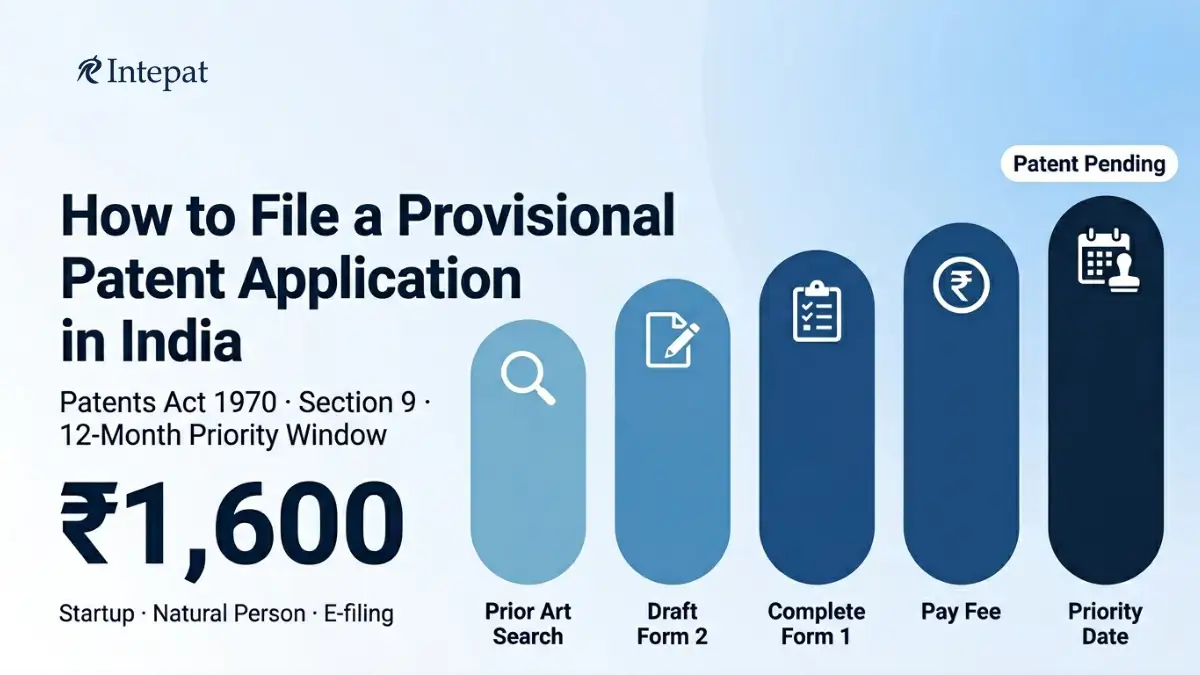
Here is how to file a patent application in India using the provisional route. All official filings are handled through the IP India e-filing portal (ipindia.gov.in). Physical filing is permitted but attracts a 10% surcharge on applicable government fees.
- Conduct a prior art search: search Indian and international databases before filing to verify novelty. Use InPASS (the Indian Patent Advanced Search System) and WIPO’s Patentscope.
- Draft the provisional specification (Form 2): prepare a clear, enabling description covering the title, best mode of working, and relevant drawings. Write broadly enough to accommodate improvements during the 12-month window.
- Complete Form 1: the Application for Grant of Patent, capturing the applicant’s name and address, inventor details, and title.
- Complete Form 5: Declaration as to Inventorship, identifying all natural persons who contributed inventively. File with Form 1 or within one month of the application date.
- Complete Form 28 (if applicable): for natural persons, DPIIT startups, small entities, or educational institutions, file with supporting documentation to claim the concessional fee rate.
- Appoint an agent and file Form 26 (if applicable): a Power of Attorney must be submitted within 6 months of the application date.
- Pay the official filing fee: payable online at the time of filing, based on your entity classification.
- Submit and collect your application number: you receive an Application Number immediately. The date of filing is your priority date. From this date, you may use the term “Patent Pending”.
Forms Required to File a Provisional Patent Application
The table below lists every form relevant to the provisional application stage. Forms 9, 18, and 18A are not applicable at the provisional stage, they become relevant only after the full application has been filed.
| Form | Purpose | When to File | Fee |
| Form 1 | Application for Grant of Patent | At the time of filing | Covered in filing fee |
| Form 2 | Provisional Specification | At the time of filing | Covered in filing fee |
| Form 5 | Declaration as to Inventorship | With Form 1 or within 1 month | No fee |
| Form 26 | Power of Attorney (if using a patent agent) | Within 6 months of filing | No fee |
| Form 28 | Concessional fee claim (startup / small entity / natural person) | At the time of filing | No fee |
| Form 3 | Statement under Section 8: corresponding foreign applications (if any) | Within 6 months of Indian filing; then within 3 months of First Examination Report | No fee |
Provisional Patent Filing Fees in India
Fees are drawn from the First Schedule to the Patents Rules, 2003 (as amended). All figures below are for e-filing (up to 30 pages and 10 claims). Physical filing attracts a 10% surcharge.
| Entity Category | E-Filing Fee | Physical Filing Fee |
| Natural person | ₹1,600 | ₹1,760 |
| DPIIT-recognised startup | ₹1,600 | ₹1,760 |
| Small entity | ₹1,600 | ₹1,760 |
| Educational institution | ₹1,600 | ₹1,760 |
| Large entity | ₹8,000 | ₹8,800 |
Estimate your total filing cost using the Patent Fees Calculator.
- Worked Example:
- Startup Filing a 30-page, 10-claim Provisional Application (E-filing)
- Government filing fee (Form 1 + Form 2): ₹1,600
- Form 5 (Declaration as to Inventorship): ₹0
- Form 28 (concessional fee claim): ₹0
- Total statutory fee payable to Patent Office: ₹1,600
Patent agent drafting and filing charges: separate professional fee (varies by agent)
DPIIT-Recognised Startups: The SIPP Scheme
If your startup is recognised by the Department for Promotion of Industry and Internal Trade (DPIIT), you may be eligible for support under the Scheme for Facilitating Startups Intellectual Property Protection (SIPP): a flagship government programme that significantly reduces the cost and complexity of patent filing. Intepat IP is an empanelled IP facilitator under the SIPP scheme.
What SIPP provides:
- Government pays facilitator fees entirely: the Central Government bears the complete professional fees of the empanelled IP facilitator for filing and prosecuting your patent, trademark, or design application. The startup pays only the statutory government fees.
- 80% rebate on patent filing fees: DPIIT-recognised startups already receive an 80% rebate on filing fees vis-à-vis large entities, reducing the statutory fee to ₹1,600 for e-filing.
- Fast-tracking of examination: startup applications are eligible for expedited examination, helping you receive a First Examination Report faster.
- Empanelled IP facilitators (IP Mitras): DPIIT has empanelled approximately 2,200 patent and trademark attorneys as IP Mitras authorised to provide services under the scheme.
Eligibility for SIPP: your company must be recognised by DPIIT under GSR 127(E) (Gazette of India, 19 February 2019). You must not have already received funds under another government scheme to pay your IP facilitator. A self-declaration to that effect is required.
The SIPP scheme is currently extended through 31 March 2026. Verify current status and find empanelled facilitators at the IP India SIPP portal (ipindia.gov.in)
12-Month Deadline: What Happens After You File Your Provisional Patent
Setting the patent priority date in India is the single most important outcome of your provisional patent filing. From that date, several statutory clocks start simultaneously. The table below covers what is directly triggered by your provisional filing date.
| Milestone | Deadline | Statutory Basis |
| File Complete Specification (Form 2) | Within 12 months (non-extendable) | Section 9(1), Patents Act 1970 |
| File Form 3: foreign applications (if applicable) | Within 6 months of Indian filing date | Section 8, Patents Act 1970 |
| Application deemed abandoned if formal filing not submitted | Day after 12-month deadline | Section 9(1): no revival possible |
What if your invention changes significantly during the 12 months? You may refine, improve, and add detail to what you disclosed in the provisional specification. However, if the direction of your invention changes substantially, you should discuss with a registered patent agent whether to file a fresh provisional or proceed to the formal application covering both approaches. Introducing entirely new matter in the formal application that was absent from the provisional does not benefit from the earlier priority date.
Key Advantages of Filing a Provisional Application
- Priority date secured immediately: from the moment of filing, your invention is on record. Any similar invention filed after your date cannot take precedence, regardless of when the other party actually made their discovery.
- Lower initial cost: drafting a provisional is typically less expensive than a complete specification because formal claims are not required. The statutory fee is the same, but professional drafting costs are lower.
- 12 months to refine and test: continue developing the invention, conduct market research, seek investors or co-founders, and build your business case before committing to the full cost of prosecution.
- “Patent Pending” as an investor and commercial signal: use this designation immediately after filing. For pre-seed and seed-stage startups, “Patent Pending” signals that the core technology is being protected and puts potential infringers on notice.
- International filing foundation: the Indian provisional filing date can serve as the priority date for a PCT application or a convention application filed in other countries, provided the international filing is made within 12 months of the Indian filing.
- Freedom to publish or present: once your provisional is filed, you can present at conferences, submit research papers, or exhibit at trade shows without compromising your priority date in India.
5 Provisional Patent Filing Mistakes to Avoid
1. Filing a thin or vague provisional specification
The most common, and most damaging, mistake. A provisional specification consisting of a brief concept note or a few paragraphs is not legally sufficient. Under Section 10(1), the description must be enabling. If the provisional is too thin to support the claims you wish to file in the complete specification, those claims face challenge. In practice, applicants commonly treat the provisional as a near-final technical document, adding only the formal claims later.
2. Missing the 12-Month Provisional Patent Deadline
There is no extension available for the 12-month complete specification deadline under Section 9(1). If you miss it, the provisional patent application is abandoned and the priority date is gone permanently. Build in a drafting and review buffer of at least 6 to 8 weeks before the deadline.
3. Disclosing Your Invention Before Filing Your Provisional Patent
India follows a strict novelty standard under Section 2(1)(l). Any public disclosure — conference paper, investor pitch deck without NDA, social media post, product listing, before your filing date can destroy novelty. File the provisional patent before any public disclosure. A limited grace period exists under Section 31 for specific disclosures, but this is a narrow exception requiring formal documentation via Form 31.
4. Assuming the provisional and complete specs can diverge freely
The full application must be substantially based on the provisional. This is not a formality; it is substantively enforced during examination. If the examiner determines that claims in the full application are not fairly based on the provisional, the priority date benefit for those claims may be refused.
5. Confusing India’s provisional with a US provisional application
India’s provisional specification requires an enabling description and best mode of working. A bare-outline approach that might be acceptable in the US system does not meet Indian requirements. Draft accordingly from the outset.
Patents (Amendment) Rules, 2024: What Changed
For applications filed on or after 15 March 2024, several procedural changes apply. These affect the complete specification stage, not the provisional filing itself, but every applicant who files a provisional today will be subject to these rules when they proceed:
- Request for Examination deadline reduced to 31 months: down from 48 months (Rule 24B). The RFE must be filed within 31 months of the priority date for applications filed from 15 March 2024.
- Grace period under Section 31 formalised: applicants claiming the grace period for a prior public disclosure must now file Form 31 with documentary evidence.
- Extension fees revised: condonation of delay under Rule 138 now costs ₹10,000/month for natural persons/startups/small entities, and ₹50,000/month for large entities.
- Form 8A: Certificate of Inventorship introduced: a new post-grant certificate (Rule 70A) available to inventors of granted patents. Fee: ₹900 for natural persons and startups.
- Divisional applications: may now be filed based on disclosure in either the provisional or the complete specification where a plurality of inventions is present.
For a practical walkthrough of what happens after your formal application is filed — examination, hearing, and grant– see: Patent Prosecution Services
Start Your Provisional Patent Application Today
A provisional patent application is one of the most practical tools available to Indian inventors and startups. It costs ₹1,600 to e-file for a startup or natural person, secures your priority date on day one, and gives you 12 months to develop your invention, without requiring you to finalise your claims immediately. For DPIIT-recognised startups, the SIPP scheme further reduces the burden by covering facilitator fees entirely.
The key to making the provisional route work is drafting the specification with genuine technical depth. A well-drafted provisional is the foundation of a strong patent. A thin one creates risk that follows you all the way through examination. If you are ready to file, or want to understand whether a provisional or a complete specification is the right starting point, a registered patent agent can assess your situation and prepare a specification that supports the protection you need.
Ready to File Your Provisional Patent Application?
Share your invention details for a preliminary filing assessment.
Get a response within 24 hours. All consultations remain 100% confidential.
Legal Disclaimer: This post is for informational purposes only and does not constitute legal advice. For advice specific to your situation, consult a registered patent agent.
Frequently Asked Questions
Yes. Any Indian citizen may file directly through the IP India e-filing portal without appointing a registered patent agent. However, drafting an enabling provisional specification requires technical and legal precision. In practice, applicants commonly engage a registered patent agent to ensure the description is sufficiently detailed and structured to support the complete specification they will file within 12 months.
A provisional specification on its own is not published. Publication occurs after the full application is filed. The application is then published automatically at 18 months from the priority date under Section 11A of the Patents Act. Early publication can be requested only after a complete specification is on file, using Form 9.
The application is deemed abandoned under Section 9(1). The priority date is lost and cannot be recovered. There is no extension or revival available for this specific deadline. Treat the 12-month window as a hard deadline and calendar it from day one.
You may expand on and add detail to what was already described in the provisional. You cannot introduce entirely new subject matter — meaning inventions or technical elements with no foundation in the provisional — and expect those to benefit from the provisional’s priority date. Claims relying on new matter will be treated as having a later priority date, or may be refused.
Filing the provisional is only the first step. After filing the complete specification (within 12 months), the full prosecution process begins: publication at 18 months, Request for Examination (must be filed within 31 months for applications filed from 15 March 2024), issuance of a First Examination Report, response period, and grant. End-to-end, the grant of a patent in India typically takes 3 to 6 years from the filing date, depending on the technology area and complexity of examination.
Yes — under the SIPP scheme. The Central Government bears the complete professional fees of the empanelled IP facilitator for filing and prosecution. The startup pays only the statutory government fees (₹1,600 for e-filing a provisional application). The scheme is currently valid through 31 March 2026. Find empanelled facilitators at the IP India SIPP portal.
“Patent Pending” is a public notice, not an enforceable right. It informs the market that a patent application has been filed. It does not prevent others from using the invention during the pending period. Legal rights, including the right to sue for infringement, arise only once the patent is granted. However, once granted, protection is backdated to the date of publication of the complete specification.