




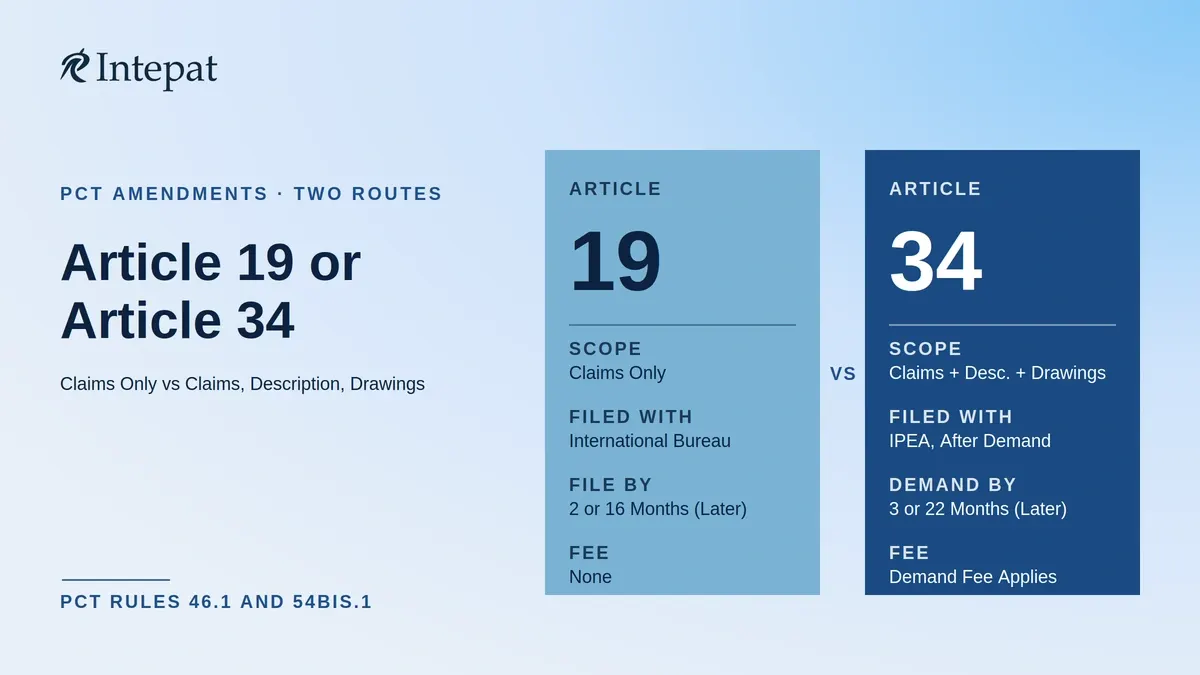
A PCT application has two principal routes for voluntary amendment during the international phase, and each does a different job: Article 19 gives a single, early opportunity to amend the claims alone; Article 34 reaches the claims, description and drawings, but only after a Chapter II Demand, and can involve more than one round of amendment before the examination report is established. The exact deadlines for each route are set out below.
This is an international-phase guide under the Patent Cooperation Treaty (PCT) and applies whichever country you eventually enter. For the complete national phase framework once India is one of your target states, see Intepat’s guide to the Patent Cooperation Treaty in India. Where the position changes at Indian national phase entry specifically, that is flagged separately near the end of this guide.
The deadlines below run from the priority date. Under PCT Article 2(xi), this is the filing date of the earliest application whose priority is claimed in the international application; where no priority is claimed, it is the international filing date itself.
Quick answer
- Article 19 amends claims only, filed with the International Bureau, within the later of two months from ISR transmittal or sixteen months from priority (PCT Rule 46.1).
- Article 34 amends claims, description and drawings, once a Chapter II Demand is filed. The Demand itself must be filed within the later of three months from transmittal of the ISR (or the declaration that no ISR will be established) and Written Opinion, or twenty-two months from priority (PCT Rule 54bis.1); the amendments may follow with the Demand or later, until the examination report is established, though the IPEA’s obligation to consider a given amendment narrows once it starts drawing up a particular opinion or the report (see below).
- Neither route may add subject matter beyond what the application disclosed as filed.
- Neither amendment carries an official PCT filing fee, though the Demand carries its own handling fee and preliminary examination fee.
Article 19: Amending Claims Only After the International Search Report
Once the International Searching Authority transmits the International Search Report (ISR) and Written Opinion, PCT Article 19 gives the applicant one opportunity to amend the claims. The amendment goes to the International Bureau directly, not to the receiving Office and not to the International Searching Authority the applicant selected at filing (see Intepat’s guide on choosing your International Searching Authority from India). The description, drawings and abstract stay as filed; Article 19 has no reach beyond the claims.
The time limit is the later of two months from the date the ISR and Written Opinion were transmitted, or sixteen months from the priority date. An amendment that arrives at the International Bureau after that window is still treated as timely if it reaches the Bureau before technical preparations for international publication are complete. Article 19 is unavailable where the International Searching Authority has declared, under Article 17(2), that no search report will be established at all.
Filing Requirements Under Article 19
An Article 19 amendment is filed as a complete replacement set of claims, not a mark-up of the existing set. It must be accompanied by a letter that states, claim by claim, whether each is unchanged, cancelled, new, or a replacement, and gives the specific basis for every amended or new claim by referencing precisely where the amendment is supported in the application as filed, for example by original claim number, paragraph number, or page and line. A general reference such as “see the description as filed” does not meet this requirement, per WIPO’s own guidance on Article 19 and Article 34 filings.
The applicant may also file a brief statement explaining the amendment and its effect on the description or drawings. This statement is optional, capped at 500 words if in English or when translated into English, must be identified by a heading, preferably “Statement under Article 19(1)” or its equivalent in the language of the statement, and must not contain disparaging comments on the ISR or the relevance of its citations; a citation may be referenced only in connection with an amendment to the specific claim it was raised against (PCT Rule 46.4). Both the replacement claims and any statement are published with the international application.
When Article 19 Is Worth Filing
Since amended claims under Article 19 are published, the principal reason to use this route is to place a revised claim set in the international publication record. If the amendment reaches the International Bureau before technical preparations for publication are complete, it appears in the initial publication; if it arrives later but still within the Rule 46.1 window, it is published subsequently together with a revised front page. This matters where a designated state grants provisional protection from the publication date, though the availability and scope of that protection depends on the national law of the state in question.
Filing under Article 19 does not need to be repeated once a Chapter II Demand follows: amendments filed before the Demand are automatically taken into account for the international preliminary examination unless a later Article 34 amendment supersedes or reverses them (PCT Rule 66.1(c)), and Article 34(2)(b) gives the same right to amend the claims regardless of whether Article 19 was used first. Where the amendment is filed after the Demand, WIPO’s guidance recommends also filing a copy directly with the IPEA at the same time, rather than relying solely on the International Bureau’s transmission (PCT Rule 62). Applicants heading straight to Chapter II can usually skip the Article 19 step and amend once, under Article 34, with the description and drawings brought into line at the same time.
Article 34: Broader Amendment Through the Chapter II Demand
Article 34 only becomes available once the applicant files a Demand for international preliminary examination under Chapter II. Once the Demand is filed, Article 34(2)(b) gives the applicant the right to amend the claims, the description and the drawings before the International Preliminary Examining Authority (IPEA). These amendments may be filed with the Demand itself or subsequently, until the international preliminary examination report is established. That right is qualified document by document, not by a single cut-off date: for any particular written opinion or the final report, the IPEA need not take an amendment into account if it is received after the examiner has begun drawing up that specific document, though the same amendment can still be taken into account for a later written opinion or the report if it is submitted before work on that later document begins (PCT Rule 66.4bis).
The Demand itself must be filed within the later of three months from the date the ISR (or a no-ISR declaration under Article 17(2)(a)) and the Written Opinion were transmitted, or twenty-two months from the priority date. A Demand filed after that window is treated as if it had never been filed, and the IPEA issues a formal declaration confirming this. A no-ISR declaration does not excuse the applicant from this deadline, though claims for which no search was carried out need not themselves be examined. Where the earlier Written Opinion raised objections that reach beyond claim language, an unsupported embodiment, an inconsistency in the description, a drawing that needs correcting, Article 34 is the only route that can address them during the international phase, by clarifying, reconciling or deleting the relevant passage. It cannot be used to add technical matter that was missing from the application as filed; the new-matter limit discussed below applies equally here.
Filing Requirements Under Article 34
Amendments under Article 34 are filed as a replacement sheet for every page that changes, each with the same differences-and-basis letter required under Article 19, applied here to whichever part of the specification is amended. Where a sheet is cancelled outright, no replacement sheet is needed; a letter explaining the cancellation is enough. Minor deletions or additions can be marked directly on a copy of the existing sheet, provided the result stays legible and reproducible. No official fee applies to filing Article 34(2)(b) amendments themselves, though the Demand carries its own handling fee and preliminary examination fee (PCT Rules 57 and 58).
A related but separate risk sits in the accompanying letter itself, not in the amendment’s substance. Where replacement sheets are filed without the required letter, or the letter does not identify the basis for the amendment, the omission is not usually checked during Chapter I of the international phase. Once a Chapter II Demand is filed, though, the International Preliminary Examining Authority may treat the amendment as if it had not been made, and a designated or elected office can raise the same point again at national phase.
Article 19 vs Article 34 at a Glance
| Feature | Article 19 | Article 34 |
| Scope of amendment | Claims only | Claims, description and drawings |
| Precondition | ISR and Written Opinion issued | Chapter II Demand filed |
| Filed with | International Bureau | International Preliminary Examining Authority |
| Filing deadline | Later of 2 months from ISR transmittal or 16 months from priority (one opportunity) | Demand: later of 3 months from transmittal of the ISR (or no-ISR declaration) and Written Opinion, or 22 months from priority. Amendments: with the Demand or later, until the report is established, subject to the Rule 66.4bis document-by-document limit explained above |
| Official fee | None | None for the amendment itself; the Demand carries a handling fee and preliminary examination fee |
| New matter | Not permitted beyond original disclosure | Not permitted beyond original disclosure |
Deadlines and fee position verified against the PCT Regulations as of July 2026.
Choosing the Right Amendment Route
The choice turns on what the Written Opinion actually objects to, not on cost alone. If the objections are confined to claim language, narrowing or clarifying the claims is a drafting exercise in its own right (see Intepat’s guide on amending and deleting patent claims for the considerations that apply regardless of which PCT route is used), and an Article 19 amendment can place a narrower, supported claim set on the record without the cost of a Demand. It does not, on its own, trigger a fresh assessment of that claim set; the ISA does not re-examine amended claims during Chapter I. If the objections reach the description or drawings, an unsupported embodiment, a drawing inconsistency, a definition that needs tightening, Article 19 cannot fix it; only a Chapter II Demand and Article 34 amendment can, and always within the same disclosure-as-filed limit discussed below.
Where multiple national phase entries are planned and the Written Opinion is substantive, timely Article 34 amendments can provide a common amended text that is considered during international preliminary examination and annexed to the report, rather than one fixed separately at each national phase. Whether and how that text becomes operative in a particular national phase still depends on that office’s own translation, filing and examination requirements, and on whether the amendment was itself taken into account under the rules above; the common text is a starting point, not a guaranteed outcome. Where the objections are narrow and the priority is publishing a corrected claim set rather than obtaining a further examination opinion, Article 19 is usually the lower-cost route.
The New Matter Limit Under Both Articles
Both provisions carry the same restriction: an amendment “shall not go beyond the disclosure in the international application as filed” (Article 19(2); Article 34(2)(b), in near-identical terms). This is not, however, checked automatically at the point of filing. WIPO’s guidance notes that the limit is not directly enforced during Chapter I of the international phase, but a claim that oversteps it can draw adverse findings at international preliminary examination, and can be challenged again by each designated or elected office at national phase. An amendment that clears the International Bureau’s formal check today can still be found unsupported many months later, in a country the applicant has already paid to enter.
What Happens to These Amendments When You Enter India
Rule 20 of the Patents Rules 2003 defines the Indian “corresponding application” to expressly include Article 19 amendments communicated to India as designated Office under Article 20 of the Treaty, and any amendments made under Article 34(2)(b). Separately, Section 138(6) of the Patents Act 1970 provides that an amendment proposed by the applicant before the competent international searching or preliminary examining authority may, if the applicant so desires, be taken as an amendment made before the Indian Patent Office.
What has to be translated and filed to make that carry-in count is a separate question from the amendment decision covered here. For the full translation and carry-in checklist at Indian entry, see Intepat’s guide on PCT national phase translation requirements for India. For the decision on whether a Chapter II Demand is worth filing at all, including IPEA selection, see Intepat’s PCT Chapter II Demand strategy guide. Amendments made after national phase entry, under Indian domestic procedure rather than PCT Article 19 or 34, are covered separately in Intepat’s guide to PCT national phase amendments in India.
Frequently Asked Questions on PCT Amendments Under Article 19 and Article 34
No. Article 19 permits amendment of the claims only, giving the applicant one opportunity to file a complete replacement claim set with the International Bureau. The description, drawings and abstract are not open to amendment under this provision. Where those parts need to change, the applicant must file a Chapter II Demand and proceed under Article 34.
Article 19 amendments must reach the International Bureau within the later of two months from the date the International Search Report and Written Opinion were transmitted, or sixteen months from the priority date, under PCT Rule 46.1. Amendments received after this window are still treated as timely if they arrive before technical preparations for international publication are complete.
No official PCT fee applies to filing an Article 19 amendment; the PCT Regulations prescribe no charge for it. Professional drafting and filing costs charged by a patent agent may still apply, depending on the complexity of the claim amendment and the accompanying letter required under Rule 46.
A Chapter II Demand must reach the competent International Preliminary Examining Authority within the later of three months from transmittal of the International Search Report, or the declaration that none will be established, and the Written Opinion, or twenty-two months from the priority date, under PCT Rule 54bis.1. A Demand filed after this window is treated as if it had never been filed.
No. Both Article 19 and Article 34 amendments must stay within the disclosure of the application as originally filed, under Article 19(2) and Article 34(2)(b). This limit is not directly enforced when the amendment is filed, but an amendment that oversteps it can later be found unsupported at international preliminary examination or at national phase.
No. International preliminary examination under Chapter II produces a non-binding opinion on novelty, inventive step and industrial applicability, not a grant decision. Each designated or elected office, including the Indian Patent Office, examines the application independently once it enters the national phase and may raise its own objections regardless of the preliminary opinion.
Not necessarily. Article 19 suits a narrow objective: publishing a revised claim set without further international assessment, since it does not cause the ISA to reconsider the amended claims. A Chapter II Demand is the more appropriate route where the applicant wants the amended claims examined before national phase entry, or where the description or drawings need amendment too.
Disclaimer: This article explains the PCT amendment framework under Article 19 and Article 34 as at July 2026 and is for general information only. It is not legal advice. An Article 19 amendment should reach the International Bureau within the ordinary Rule 46.1 period; one received later is still treated as timely only if it arrives before technical preparations for international publication are complete, and the opportunity is lost once that window closes. Missing the Rule 54bis.1 deadline prevents a valid Chapter II Demand from being filed at all; where a Demand has been filed in time, Article 34 amendments should still be filed promptly, given the Rule 66.4bis document-by-document limit explained above. The figures here are indicative and should be confirmed against the current PCT Regulations before you rely on them for a specific filing. For advice on your specific application, consult a registered patent agent.