




A registered user is a third party formally recorded at the Trade Marks Registry as an authorised user of someone else’s trade mark. Among third parties authorised to use a mark, only a registered user has the statutory right to sue for infringement independently. A person using the mark under a private agreement alone does not get that protection.
This article covers Indian law only, under the Trade Marks Act 1999 and the Trade Marks Rules 2017.
Quick Answer
- A registered user differs from a written-consent licensee: entry in the Trade Marks Registry converts a contractual permission into a statutory right to sue for infringement independently.
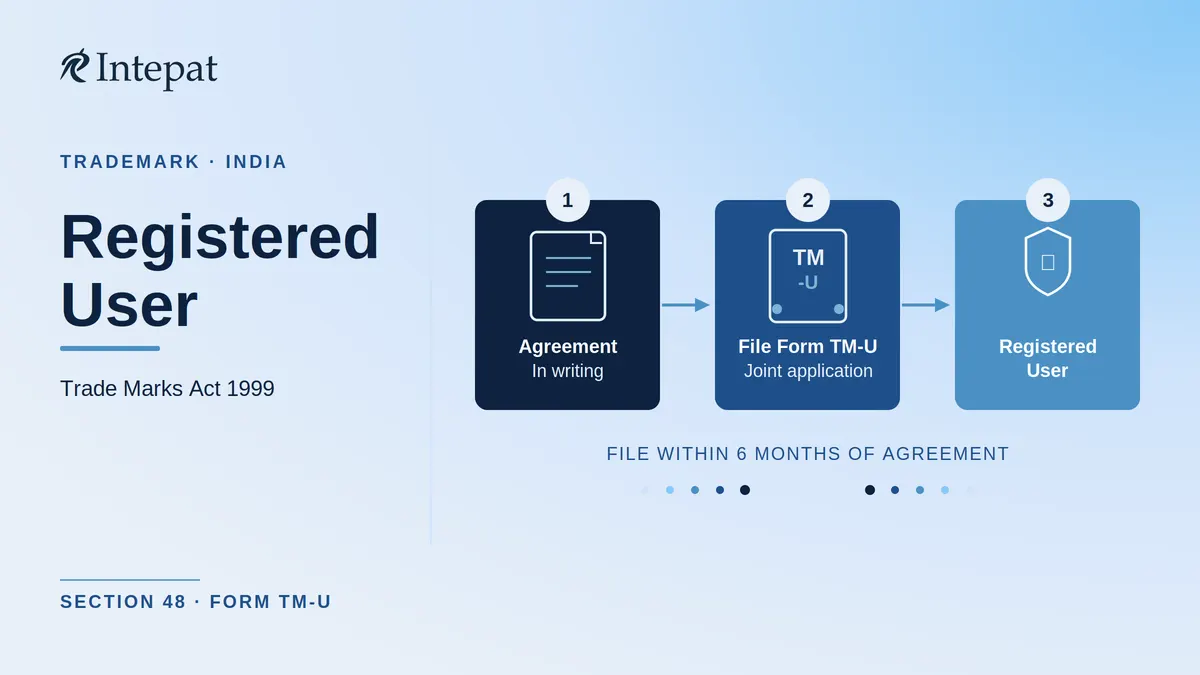
- Both the proprietor and the proposed user must jointly apply on Form TM-U within six months of signing the agreement.
- The government fee is Rs 4,500 per mark (e-filing) or Rs 5,000 per mark (physical filing), verified as of June 2026.
- A registered user has no assignable or transmissible right to use the trade mark.
What Is a Registered User of a Trade Mark?
The Trade Marks Act 1999 defines a registered user as any person who is for the time being registered as such under the Act. The key word is “registered”: the status comes from an entry in the Trade Marks Registry, not from a private contract.
Section 48(1) states that a person other than the registered proprietor may be registered as a registered user in respect of any or all of the goods or services for which the trade mark is registered. The arrangement can cover the full scope of the registration or only part of it.
’Example:‘ If a food brand permits a contract manufacturer to use its mark only for packaged snacks, the manufacturer may be recorded as registered user only for those goods, while the proprietor retains ownership of the mark across all registered classes.
The arrangement is common in manufacturing and franchise structures, where the owner of the mark wants a third party to use it on products or services but needs to maintain quality control and legal standing over the mark.
Registered User vs. Written-Consent Licensee
The Act recognises two forms of authorised third-party use. A registered user is a person entered in the Trade Marks Register under Section 49. A written-consent licensee is a person who uses the mark under the proprietor’s written agreement but is not entered in the Register. Both uses are lawful, but the rights they carry differ significantly.
A registered user may bring an infringement action in their own name, treating the registered proprietor as a co-defendant. A person who holds only a written-consent arrangement has no such right: the Act expressly provides that such a person has no right to institute any proceeding for infringement. If a competitor copies the mark, a written-consent licensee must ask the proprietor to sue; a registered user can act directly. For a detailed account of available remedies, see our guide to trademark infringement remedies in India.
| Registered user | Written-consent licensee | |
| Registry entry | Yes | No |
| Written agreement required | Yes | Yes |
| May use the mark lawfully | Yes | Yes, if statutory conditions are met |
| May sue for infringement independently | Yes, subject to any agreement | No |
| Use may count as proprietor’s use | Yes | Yes, if use qualifies as permitted use |
How Authorised Use Can Help Preserve the Proprietor’s Registration
Registration with the Trade Marks Registry also serves the proprietor’s interest, not just the user’s. Under Section 48(2), the permitted use of a trade mark is treated as use by the proprietor for the purposes of the non-use removal provisions of the Act.
A registered trade mark may be removed from the register if there has been no bona fide use for a continuous period of five years from the date the mark was actually entered in the register. Both registered-user use and valid written-consent use can count as the proprietor’s own use for this purpose, provided the use qualifies as permitted use under the Act.
The specific value of registered-user recordal goes beyond non-use protection. It gives the user a statutory right to bring infringement proceedings independently, creates a formal public record in the Trade Marks Register, and establishes a clearer quality-control framework that the proprietor can enforce.
How to Register Someone as a Registered User
Who applies and how
The registered proprietor and the proposed registered user must jointly apply in writing to the Registrar. The application is made on Form TM-U under Rule 86(1) of the Trade Marks Rules 2017. The full text of the relevant provisions is available in the Trade Marks Act 1999 on India Code.
What must accompany the application
The application must be accompanied by:
- the agreement between the proprietor and the proposed user, or a duly authenticated copy of it
- an affidavit by the registered proprietor setting out: the nature of the relationship between the parties and the degree of control the proprietor will exercise over the use; the goods or services covered; any conditions or restrictions on the mode or place of use; and whether the arrangement is for a fixed period or without limit of period
The Registrar may also call for additional documents or evidence. The applicant may separately request that information filed with the application, other than matters entered in the register, be kept confidential from trade rivals.
The six-month deadline
The application must be filed within six months of the date of the agreement. An application filed after that window will not be entertained.
Fee (verified as of June 2026)
| Method | Fee per mark |
| E-filing | Rs 4,500 |
| Physical filing | Rs 5,000 |
The fee applies per mark. Where multiple marks of the same proprietor and proposed user are covered by one agreement, supporting documents may be filed with one application, with cross-references in the others.
After registration
Once satisfied, the Registrar enters the registration in the register, publishes it in the Trade Marks Journal, and sends written confirmation to the proprietor, the registered user, and any other existing registered users of the same mark.
Rights and Limits of a Registered User
Right to sue for infringement
Subject to any agreement between the parties restricting this right, a registered user may institute infringement proceedings in their own name, as if they were the registered proprietor. The registered proprietor is joined as a defendant, though not liable for costs unless they enter an appearance and take part in the proceedings. For context on trademark licensing structures more broadly, see our article on trademark licensing in India.
No right to assign or transmit
A registered user has no assignable or transmissible right to use the trade mark. The use right is personal to the registered user and cannot be passed to another entity. Any onward use by another entity should be separately authorised by the proprietor and structured under the Act and the licence documents. The Act does provide limited exceptions where a registered user who is an individual forms a partnership or where a registered user firm changes its constitution, but in each case the right continues only while an original registered user remains a member or partner.
This is distinct from a full assignment of a trade mark, which transfers ownership of the mark itself from one party to another.
When a Registered User’s Status Can End
The Registrar has powers to vary or cancel a registered user entry in several situations. The registered proprietor may apply to vary the scope of goods or services. The proprietor, the registered user, or any other registered user of the mark may apply to cancel the entry. Any person may apply to cancel on specific grounds: that the registered user has used the mark contrary to the agreement or in a way likely to cause deception or confusion; that material facts were misrepresented in the original application; or that circumstances have changed so that registration would no longer be justified.
The Registrar may also cancel on their own motion, or on any person’s application, if the quality control obligations in the agreement are not being enforced or complied with.
Where the registered user was recorded for a fixed period, the Registrar cancels the entry at the end of that period and notifies the registered users whose permitted use is affected and the registered proprietor.
Additionally, the Registrar may at any time require the proprietor to confirm in writing that the underlying agreement remains in force. If the proprietor fails to provide that confirmation within one month, the registered user’s entry lapses automatically from the day after the deadline expires.
Frequently Asked Questions
A registered user is a person who is entered in the Trade Marks Registry as an authorised user of someone else’s trade mark, in respect of some or all of the goods or services for which the mark is registered. The status arises from registration under the Trade Marks Act 1999, not from a private agreement alone.
A licensee who is not registered at the Trade Marks Registry holds only a written-consent arrangement. That person may use the mark lawfully under their written agreement but has no right to bring infringement proceedings in their own name. A registered user holds that right under the Trade Marks Act 1999.
No. A written trademark licence can create authorised use even without Registry recordal, provided the conditions in the Act are met. Registering the user gives the additional benefit of statutory standing to sue for infringement independently and creates a formal Registry record.
It can, if the use qualifies as permitted use under the Trade Marks Act 1999. Where it does, the Act treats that use as use by the proprietor for the purposes of non-use removal provisions. Both registered-user use and valid written-consent use may qualify, subject to the conditions in the Act.
Form TM-U is the prescribed form for registration of a registered user, variation of the registration scope, cancellation of the registration, and intervention in variation or cancellation proceedings. The filing fee is Rs 4,500 per mark (e-filing) or Rs 5,000 per mark (physical filing), verified as of June 2026.
The registered proprietor and the proposed user must jointly file Form TM-U with the Trade Marks Registry, together with the written agreement and a proprietor’s affidavit. The application must be filed within six months of the date of the agreement.
No. The Trade Marks Act 1999 provides that a registered user has no assignable or transmissible right to use the trade mark. Any onward use by another entity must be separately authorised by the registered proprietor.
Where the arrangement was for a fixed period, the registered user entry ends at the expiry of that period. Separately, the Registrar may require the proprietor to confirm in writing within one month that the agreement continues. If the proprietor does not provide that confirmation, the registered user entry ceases from the day after the one-month period expires.
Yes. The registered user may apply for cancellation of their own entry under the Trade Marks Act 1999. The registered proprietor and any other registered user of the same mark are notified of such an application.
Disclaimer: This article explains the law on registered users of trade marks in India as at June 2026 and is for general information only. It is not legal advice. Registry fees, forms, and timelines change; confirm current details with the Trade Marks Registry before you act. For advice on your specific mark or arrangement, consult a trademark attorney.