




A patent specification filed in India must describe the invention fully enough for a person with average skill in the relevant field to work it, without having to invent anything new. Fall short and the Patent Office can refuse the application; after grant, any person interested may raise the same deficiency in post-grant opposition or revocation proceedings.
Key Points
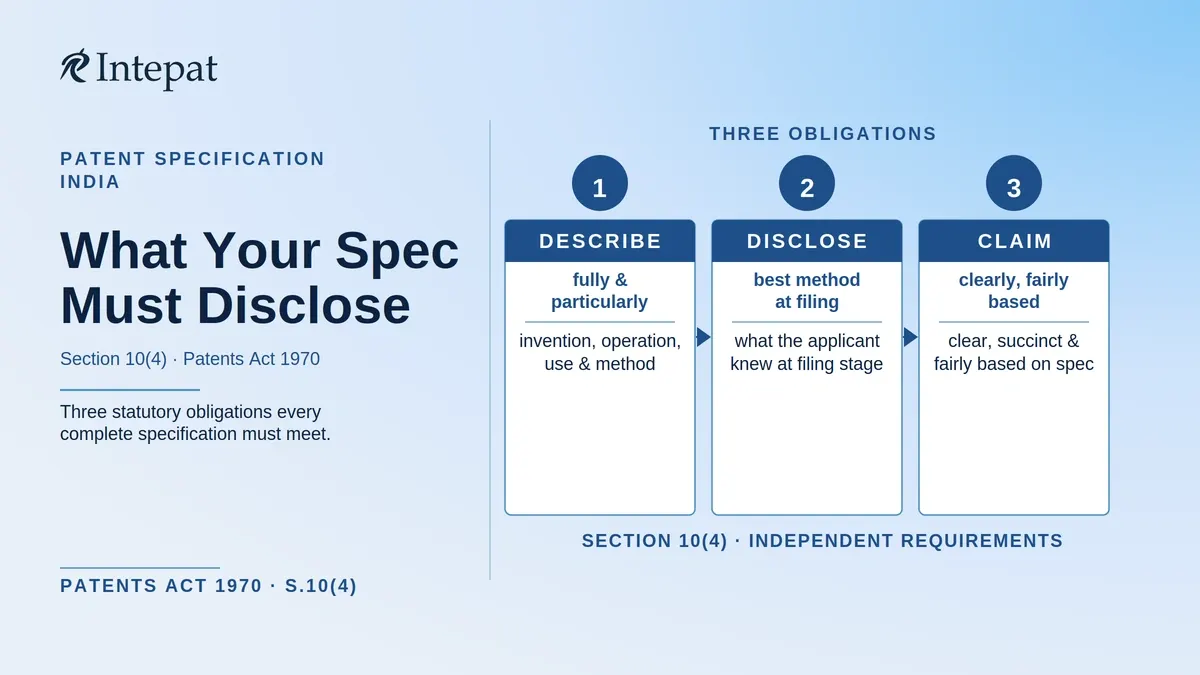
• A complete specification must describe the invention fully, disclose the best method the applicant knows, and end with clear claims.
• The test is whether a skilled person in India, using the information in the specification, can perform the invention based on what is disclosed.
• Insufficient disclosure is a ground for pre-grant opposition, filed by any person after publication and before grant, and for post-grant opposition or revocation by any person interested.
• The standard in India, Europe, and the US differs in form but shares the same core logic: the public receives enough to practise the invention in exchange for the monopoly the patent grants.
Why Disclosure Is the Price of a Patent
A patent grants the holder a right to exclude others from making, using, offering for sale, selling, or importing the invention for a fixed term. That right comes with a corresponding obligation: the applicant must place enough technical information into the public domain for anyone to practise the invention once the patent expires. This is what keeps the technology in the state of the art.
If applicants could keep the technical workings secret while holding a monopoly, the patent system would give without receiving. The disclosure requirement prevents that outcome. It is not a filing formality; it is the consideration for which the patent is granted.
What Section 10 Requires
Every complete specification must, under Section 10(4) of the Patents Act 1970:
- fully and particularly describe the invention and its operation or use and the method by which it is to be performed;
- disclose the best method of performing the invention which is known to the applicant and for which the applicant is entitled to claim protection;
- end with a claim or claims defining the scope of the invention for which protection is claimed; and
- be accompanied by an abstract that provides technical information on the invention.
Each of these four items carries independent weight. Satisfying three of the four does not cure a failure in the fourth.
The table below summarises all five requirements extracted from Sections 10(4) and 10(5):
| Requirement | Section 10(4) sub-clause | What it means |
| Full description | 10(4)(a) | Fully and particularly describe the invention, its operation or use, and the method of performing it. |
| Best method | 10(4)(b) | Disclose the best method of performing the invention known to the applicant at filing. |
| Claims | 10(4)(c) | End with a claim or claims defining the scope of protection sought. |
| Abstract | 10(4) proviso | Accompany the specification with an abstract providing technical information. |
| Clear and fairly based claims | 10(5) | Claims must be clear, succinct, relate to a single inventive concept, and be fairly based on the disclosed matter. |
The “Fully and Particularly” Requirement
The Manual of Patent Office Practice and Procedure (Chapter 5) puts it this way: disclosure in the complete specification must be such that a person of average skill and average knowledge in India can perform the invention based on what is disclosed, without additional experimentation or inventive effort.
“Fully and particularly” does two things. First, it sets a content floor: the specification must cover every aspect of the invention necessary to work it. Second, it sets a quality floor: the description must be clear enough for the skilled reader to follow without guessing. A vague or ambiguous description fails both tests.
The Best Method Obligation
Section 10(4)(b) goes further than disclosure of any working method: the applicant must disclose the best method known to the applicant at the time of filing. This obligation is based on what the applicant knew at the filing stage. An applicant cannot satisfy it by describing a method they knew was inferior and withholding a better one.
The Manual confirms that the best method obligation extends to any improvement the applicant may have acquired during the period of a provisional specification before the complete specification is filed.
Claims That Define Scope
Section 10(5) adds that the claims must be clear, succinct, and fairly based on the matter disclosed in the specification. A claim that reaches beyond what the specification describes is not fairly based; a claim framed in language that leaves its scope uncertain is not clear or succinct.
These two sub-requirements work together: the description supplies the technical content, and the claims translate that content into the legal boundary of protection.
The Skilled Person Test
India’s disclosure standard is not set by reference to the brightest possible reader or by reference to a layperson. It is set by reference to a person possessing average skill in, and average knowledge of, the art to which the invention relates.
Section 64(1)(h) of the Patents Act states this benchmark explicitly in the revocation context: a patent may be revoked where the description or instructions in the complete specification are not, by themselves, sufficient to enable a person in India possessing average skill in, and average knowledge of, the relevant art to work the invention.
Three practical points follow from this standard:
- The specification does not need to teach background knowledge that any skilled person in the field already holds.
- It must teach everything that is specific to the invention and without which it cannot be worked.
- The skilled person cannot be expected to perform additional experimentation or inventive effort to make the invention work.
To make this concrete: if a claim says a process yields a particular compound, the specification must describe the starting materials, reaction conditions, and steps in enough detail for a skilled chemist in India to reproduce that result from the specification alone, without having to work out the missing parts independently.
What the Examiner Checks
At examination, the Patent Office checks disclosure under its Manual (Section 09.03.07). The examination stage is one step in the broader patent filing procedure in India. The examiner looks at whether:
- the specification is properly titled and the subject matter fully described;
- the claims define the scope of the invention correctly;
- the specification describes the best method of performing the invention;
- where the invention involves biological material, the source and geographical origin are disclosed;
- where biological material cannot be described in words and is not publicly available, it has been deposited with an International Depository Authority under the Budapest Treaty, with the accession number and deposit date stated in the specification; and
- where the invention uses biological material obtained from India, approval from the National Biodiversity Authority has been obtained before grant, wherever applicable.
A deficiency in any of these areas can result in an objection in the First Examination Report. The applicant then has an opportunity to respond, but the response cannot add matter not already in the specification as filed.
Consequences of Insufficient Disclosure
Disclosure failures carry consequences at three stages. The table below maps each route, who can bring it, and the statutory basis.
| Stage | Route | Who can file | Statutory basis |
| Before grant | Pre-grant opposition | Any person (after publication, before grant) | Section 25(1)(g) |
| After grant (within 1 year) | Post-grant opposition | Any person interested | Section 25(2)(g) |
| Any time during patent life | Revocation petition | Any person interested; Central Government; or by counterclaim | Section 64(1)(h) & (i) |
| Infringement suit | Defence / counterclaim | Defendant in infringement proceedings | Section 107 read with Section 64 |
Before grant: After the application has been published but before the patent is granted, any person may file a pre-grant opposition on the ground that the complete specification does not sufficiently and clearly describe the invention or the method by which it is to be performed (Section 25(1)(g)). The opposition is addressed to the Controller.
After grant: Within one year of publication of the grant, any interested person may give notice of post-grant opposition on the same ground (Section 25(2)(g)).
Revocation: Separately from and independently of post-grant opposition, any person interested or the Central Government may petition the High Court for revocation, and a defendant in an infringement suit may raise it by counterclaim. Section 64(1)(h) lists insufficient disclosure as a ground; Section 64(1)(i) is a companion ground covering claims that are not sufficiently and clearly defined or not fairly based on the disclosed matter.
A defence of insufficient disclosure is also available in a suit for infringement: every ground for revocation under Section 64 is available as a ground of defence under Section 107.
Biological Material: A Special Case
Where an invention involves or uses biological material that cannot be described adequately in words and is not publicly available, Section 10 requires the applicant to deposit that material with an International Depository Authority under the Budapest Treaty on or before the date of filing in India. The name and address of the depository institution and the date and number of the deposit must all be stated in the specification.
The reference to the deposit must be made in the specification within three months from the date of filing. Where the applicant has filed a request for early publication under Rule 24A, the reference must be made on or before the date of that request, whichever is earlier.
Without the deposit, the reference, and the depository details, the written description alone cannot satisfy the disclosure obligation for such inventions.
The Disclosure Bargain in Other Jurisdictions
India’s approach shares its logic with patent systems in other major jurisdictions, though the wording and structure differ. The comparative table below summarises the key distinctions.
| Jurisdiction | Disclosure standard | Best method | Key instrument |
| India | Sufficient for a person with average skill and average knowledge in India to work the invention | Required at filing; revocable if absent (Section 64(1)(h)) | Patents Act 1970, Section 10(4) |
| Europe (EPC) | Sufficiently clear and complete for a skilled person to carry out the invention | No separate requirement; absorbed into sufficiency | EPC Article 83 |
| United States | Enablement (make and use) + written description (possession) + best mode (preferred embodiment at filing) | Required at examination; not a litigation invalidity ground after AIA (35 USC 282(b)(3)(A)) | 35 USC 112(a) |
Europe: Article 83 of the European Patent Convention requires that a European patent application disclose the invention in a manner sufficiently clear and complete for it to be carried out by a person skilled in the art. An insufficiency of disclosure is a ground of opposition before the European Patent Office and a ground of revocation before national courts and, since June 2023, before the Unified Patent Court where it has jurisdiction.
United States: Section 112(a) of Title 35 of the United States Code requires the specification to contain a written description of the invention, to enable a person skilled in the art to make and use it (the enablement requirement), and to set forth the best mode contemplated by the inventor for carrying out the invention (the best mode requirement). One important caveat: under 35 USC 282(b)(3)(A), as amended by the Leahy-Smith America Invents Act with effect from 16 September 2011, failure to disclose the best mode is not a basis on which any claim of a patent may be cancelled, held invalid, or held unenforceable in litigation, even though the requirement remains at examination.
The common thread across all three systems is that the inventor receives a monopoly in exchange for teaching the public to practise the invention. A specification that teaches nothing, or too little, does not meet that bargain.
What a Weak Disclosure Looks Like in Practice
The following patterns commonly draw objections or provide opposition or revocation ammunition. Documenting your invention thoroughly in an invention disclosure form
before you engage a patent agent, and preparing a complete invention disclosure write-up, reduces the risk of gaps appearing at the drafting stage.
Functional claims without structural support. A claim that defines the invention by what it does, without describing how, often cannot be worked by a skilled person. Where the function is straightforward and the mechanism well-known, the description may fill the gap. Where the function is the inventive step itself, a structural or mechanistic description is needed.
Missing examples in chemical and pharmaceutical inventions. The Manual specifically requires examples in descriptions of chemical-related inventions. A disclosure that asserts a result without data or worked examples is vulnerable to a sufficiency challenge.
Overly broad claims relative to the disclosure. A specification that discloses one working embodiment of a compound but claims the entire genus of which it is a member may satisfy enablement for the disclosed member while failing it for the rest. Claims must be fairly based on what the specification actually supports.
Ambiguous or obscure language. Language that a skilled reader cannot interpret without speculation fails the “clearly” component of the standard in Sections 25 and 64. Clarity in the claims is also independently required by Section 10(5).
Frequently Asked Questions
FAQ schema-ready: 7 Q&A pairs. Each answer is 40–60 words in definitional format. Suitable for FAQPage structured data.
| What is meant by “sufficient disclosure” in a patent specification? | Sufficient disclosure means the specification contains enough technical information for a person with average skill in the relevant field to work the invention, without having to conduct additional research or make further inventive steps. The test in India is applied from the perspective of that skilled person, not a layperson or an expert at the frontier of the field. |
| What does Section 10(4) require an applicant to include in a complete specification? | Section 10(4) of the Patents Act 1970 requires the complete specification to fully and particularly describe the invention and the method of performing it, disclose the best method known to the applicant, end with claims that define the scope of protection, and be accompanied by an abstract. Each element is independently required. |
| Can an applicant add information to the specification after filing to fix a disclosure gap? | No. Section 59 of the Patents Act prohibits any amendment to the complete specification that would introduce matter not in substance disclosed or shown in the specification before the amendment. A disclosure gap present at the filing date cannot be cured by later amendment. The complete specification must meet the disclosure standard as filed. |
| What is the “best method” requirement and why does it matter? | Section 10(4)(b) obliges the applicant to disclose the preferred way of performing the invention that the applicant knows at the time of filing. It prevents applicants from describing a less effective method while keeping the best version secret for commercial advantage. Failure to disclose the best method is a ground for revocation under Section 64(1)(h). |
| Who can challenge a patent on disclosure grounds and when? | Before grant, any person may file a pre-grant opposition under Section 25(1)(g) after the application is published. Within one year of grant, any interested person may give post-grant opposition notice under Section 25(2)(g). Any person interested or the Central Government may also petition the High Court for revocation under Section 64(1)(h), a route that exists independently of the post-grant window. |
| Is the disclosure requirement in India different from the European or US standard? | The three systems share the same logic but differ in form. India requires sufficient disclosure for a skilled person to work the invention, plus a separate best-method obligation. Article 83 EPC requires disclosure sufficiently clear and complete for a skilled person to carry it out. The US under 35 USC 112(a) separates enablement, written description, and best mode. |
| What happens if biological material used in an invention cannot be described adequately in words? | The applicant must deposit the material with an International Depository Authority under the Budapest Treaty on or before the Indian filing date. The specification must include a reference to the deposit, the name and address of the depository institution, and the date and accession number. Without these, the written disclosure alone does not satisfy the disclosure obligation. |
This article explains the law on disclosure requirements in patent specifications in India as at June 2026 and is for general information only. It is not legal advice. Government fees, forms, and procedures change; confirm current requirements with the Indian Patent Office before you file. For advice on your specific invention, consult a registered patent agent.