




Sufficient disclosure is the condition on which an Indian patent is granted: the specification must describe the invention clearly enough for a person with average skill in the relevant field to work it, without independent invention. A specification that falls short risks more than an examiner objection; it can be used to oppose or revoke the patent years after grant.
Key Points
• Sufficient disclosure means a skilled person in India can perform the invention from the specification alone, without additional experimentation or inventive effort.
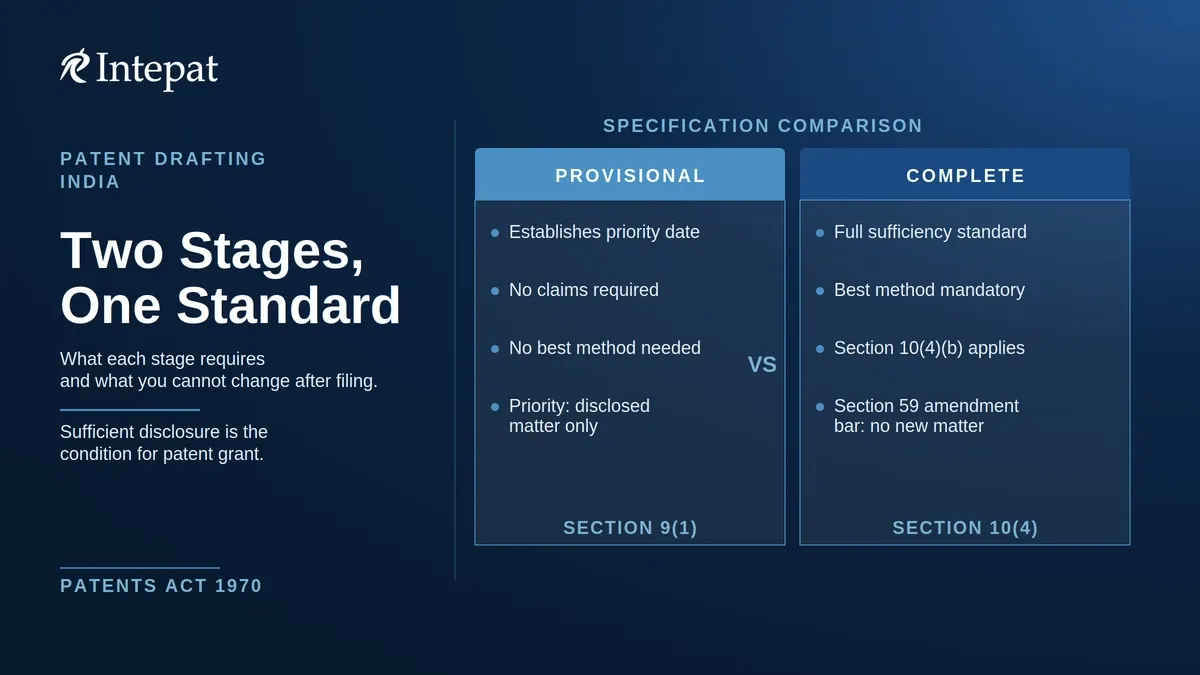
• A provisional specification protects your priority date but does not need to include the best method; a complete specification must.
• Once a complete specification is filed, new technical matter cannot be added. Gaps in the original disclosure cannot be cured by later amendment.
• The most common drafting failures are functional claims without structural support, missing worked examples, claims that reach beyond what the specification describes, and ambiguous language.
What Sufficient Disclosure Actually Means
The Patents Act does not use the phrase “sufficient disclosure” as a defined term. In practice it describes the standard that emerges from a combined reading of the Act and the Manual of Patent Office Practice and Procedure: the complete specification must describe the invention fully enough that a person of average skill and average knowledge in India can perform it based on what is written, without additional experimentation or inventive effort.
Three things follow from this standard that matter to a first-time filer.
First, the benchmark is not a layperson and not a world-leading expert. It is the person with average competence in the relevant field. A specification pitched at a general audience may say too little for a skilled reader to work the invention; one that assumes expert knowledge of unpublished techniques may say too little for anyone outside the inventor’s laboratory.
Second, “perform the invention” means reproducing what the claims cover, not merely understanding the concept. A claim that a coating improves heat resistance must be supported by a description that tells a skilled engineer what the coating is made of, how it is applied, under what conditions, and to what specification, so that engineer can reproduce the result independently. Describing the outcome without the means is not sufficient.
Third, the standard applies to what is written at the time of filing. Subsequent corrections can address typographical errors and minor amendments within the scope of what was originally disclosed, but they cannot introduce technical matter that was absent. What the law requires you to disclose is fixed at the filing date.
Provisional Specification: What You Can and Cannot Omit
A provisional specification is a short techno-legal document whose primary job is to establish a priority date. Under Section 9(1) of the Patents Act 1970, where an application is accompanied by a provisional specification, the applicant must file a complete specification within 12 months from the date of filing, failing which the application is treated as abandoned.
The Act does not impose a sufficiency standard on provisional specifications in the same terms as it does on complete specifications. A provisional specification is not examined for sufficient disclosure in the way a complete specification is, and it does not need to include claims or the best method. Its job is to describe the invention at the level of detail available at filing, enough to establish what was conceived and when.
What provisional disclosure does determine, however, is the scope of the priority claim. A claim in the complete specification is only entitled to the provisional application’s priority date if it is fairly based on the matter disclosed in the provisional specification. An aspect of the invention that was not described in the provisional, even if it was conceived at the time, cannot claim that earlier priority date. A competitor who files on the same aspect between the provisional and complete filing dates may therefore have the earlier claim to that aspect.
The practical message: file provisional specifications with as much technical detail as you have at the time. Omitting information to keep the provisional short does not simplify the process; it either narrows the scope of priority entitlement or forces you to support the complete specification with later-developed data, which carries its own risks.
The Transition to Complete Specification
The complete specification is where the sufficiency standard applies in full. Beyond the description of the invention and its method of performance, Section 10(4)(b) of the Patents Act separately requires the applicant to disclose the best method of performing the invention known to the applicant and for which the applicant is entitled to claim protection.
The best method obligation is based on what the applicant knew at the filing date of the complete specification. Per the Manual of Patent Office Practice and Procedure (Section 05.03.12), this includes any improvement to the method that the applicant may have acquired during the period of provisional protection before the complete specification is filed. An applicant who develops a significantly better manufacturing process between the provisional and complete filing dates must include that process in the complete specification. Describing only the earlier, inferior method while withholding the better one is a disclosure failure.
The other critical constraint at this stage is that Section 59 of the Act bars any post-filing amendment that would introduce matter not in substance disclosed in the specification before the amendment. This is not a technicality. It means that the complete specification must be self-sufficient at the moment of filing. There is no mechanism to add a new example, a new data set, a new embodiment, or a new method after filing and have it treated as if it had always been there. The specification you file is the specification your patent claims will be judged against, at examination, at opposition, and at revocation.
The implication for founders and inventors: treat the complete specification as a finished technical document before it is filed, not a draft to be refined after filing. A well-prepared invention disclosure given to a patent agent before drafting begins is the most effective way to ensure nothing is missed.
Four Drafting Failures That Trigger Objections
Disclosure failures typically fall into one of four patterns. All four are avoidable with adequate preparation. The table below maps each pattern to its source and the risk it creates at examination.
| Failure pattern | What goes wrong | Risk at examination |
| Functional claims without structural support | Claim defines what device does, not how; specification lacks mechanism description | Sufficiency objection; claim may be rejected or narrowed |
| Missing worked examples (chemical/pharma) | Therapeutic effect asserted without data, synthesis route, or experimental conditions | Sufficiency objection; assertion of effect is not evidence of workability |
| Claims broader than disclosed embodiments | Genus claimed; only one species disclosed; property not shown to extend across genus | Objection under Section 10(5): claim not fairly based on matter disclosed |
| Ambiguous or undefined language | Terms such as ‘approximately’ or ‘optimal conditions’ used without a defined range or criterion | Claim fails Section 10(5) clarity requirement; examiner cannot confirm scope |
Functional claims without structural support. A claim defines the invention. If the claim says “a device that reduces power consumption by 30 percent,” the specification must describe the structure or method that produces that reduction specifically enough for a skilled engineer to replicate it. Describing what the device does without describing how it does it leaves the claim without sufficient support. Where the function itself is the inventive step, a working structural or mechanistic description is not optional.
Missing worked examples in chemical and pharmaceutical inventions. The Manual of Patent Office Practice and Procedure specifically identifies examples as a required component of descriptions in chemical-related inventions. A specification for a new compound that asserts a therapeutic effect without data, experimental conditions, or a reproducible synthesis route will face a sufficiency objection at examination. Assertions of effect are not evidence of workability; worked examples are.
Claims broader than the disclosed embodiments. A specification may disclose one working compound in a chemical genus and then claim the entire genus. If the disclosure does not demonstrate, or at minimum make technically credible, that the claimed property extends across the genus, the claims reach beyond the specification’s support. Section 10(5) of the Act requires claims to be fairly based on the matter disclosed. A claim that covers embodiments the specification has not taught a skilled person to make or use is not fairly based.
Ambiguous or undefined language. Terms that a skilled reader cannot interpret without guessing make a specification both hard to work from and legally vulnerable. Phrases like “approximately,” “substantially,” or “optimal conditions” are not inherently problematic; they are problematic when the specification does not define what range or criterion they refer to. An examiner who cannot determine what the claim covers cannot confirm that it is clear and succinct as Section 10(5) requires.
What the Examiner Will Check
At examination, the Patent Office examiner will check the specification against the criteria in the Manual of Patent Office Practice and Procedure (Section 09.03.07). This covers whether the subject matter is fully and particularly described, whether the claims define the scope of the invention correctly, and whether the best method has been disclosed. For inventions involving biological material obtained from India, the examiner also checks that the source and geographical origin have been disclosed and that approval from the National Biodiversity Authority has been obtained where applicable.
Deficiencies in any of these areas result in an objection in the First Examination Report. The applicant has an opportunity to respond to objections, but a response to a sufficiency objection must work with what is already in the specification. It cannot introduce new technical content.
Frequently Asked Questions
FAQ schema note: 6 Q&A pairs, each answer 40–60 words, definitional format, schema-ready for FAQPage structured data.
| What does “sufficient disclosure” mean in an Indian patent specification? | Sufficient disclosure means the specification describes the invention fully enough for a person with average skill and average knowledge in the relevant field in India to perform it from the specification alone, without additional research or inventive effort. The standard applies at examination and in any revocation or opposition proceeding. |
| Does a provisional specification need to meet the sufficiency standard? | A provisional specification is not examined for sufficient disclosure in the way a complete specification is, and it does not need to include claims or the best method. Its function is to establish a priority date. However, only those aspects of the complete specification that are fairly based on the provisional disclosure are entitled to that earlier priority date. |
| Can I add new technical information to a complete specification after filing? | No. Section 59 of the Patents Act 1970 prohibits any amendment that would introduce matter not in substance disclosed in the specification before the amendment. A disclosure gap present at the filing date of the complete specification cannot be cured after filing. The specification must be complete and self-sufficient at the moment it is filed. |
| What is the best method obligation and when does it apply? | Section 10(4)(b) of the Patents Act requires the complete specification to disclose the best method of performing the invention known to the applicant at the time of filing. This includes any improvement acquired during the period of provisional protection. An applicant cannot satisfy this obligation by disclosing an inferior method while withholding a better one. |
| What happens if my claims are broader than what the specification describes? | Section 10(5) requires claims to be fairly based on the matter disclosed in the specification. A claim that covers embodiments the specification does not teach a skilled person to make or use fails this test. At examination the claim will draw an objection; after grant, it can be relied on as a ground of post-grant opposition or revocation. |
| How can I reduce the risk of a sufficiency objection? | Prepare a detailed invention disclosure before engaging a patent agent, covering the working mechanism, materials or steps, variants tested, results or data, and the best method you currently know. The more technical detail the agent has to work from, the less likely the drafted specification will leave gaps that an examiner or challenger can exploit. |
This article explains the law on sufficient disclosure in patent specifications in India as updated on June 2026 and is for general information only. It is not legal advice. Government fees, forms, and procedures change; confirm current requirements with the Indian Patent Office before you file. For advice on your specific invention, consult a registered patent agent.