




An abandoned patent application in India has no general statutory revival procedure comparable to restoring a lapsed granted patent. The position depends on the type and timing of the abandonment: a Section 9(1) default has no ordinary extension mechanism, while a Section 21(1) FER default carries real Controller extension and condonation power that can run well past six months.
This is the position under Indian patent law, which governs applications filed with the Indian Patent Office regardless of where the applicant is based. The rest of this article explains how an application becomes deemed abandoned, what administrative relief remains available before that becomes final, and how courts have approached applicants who ask them to intervene once it is.
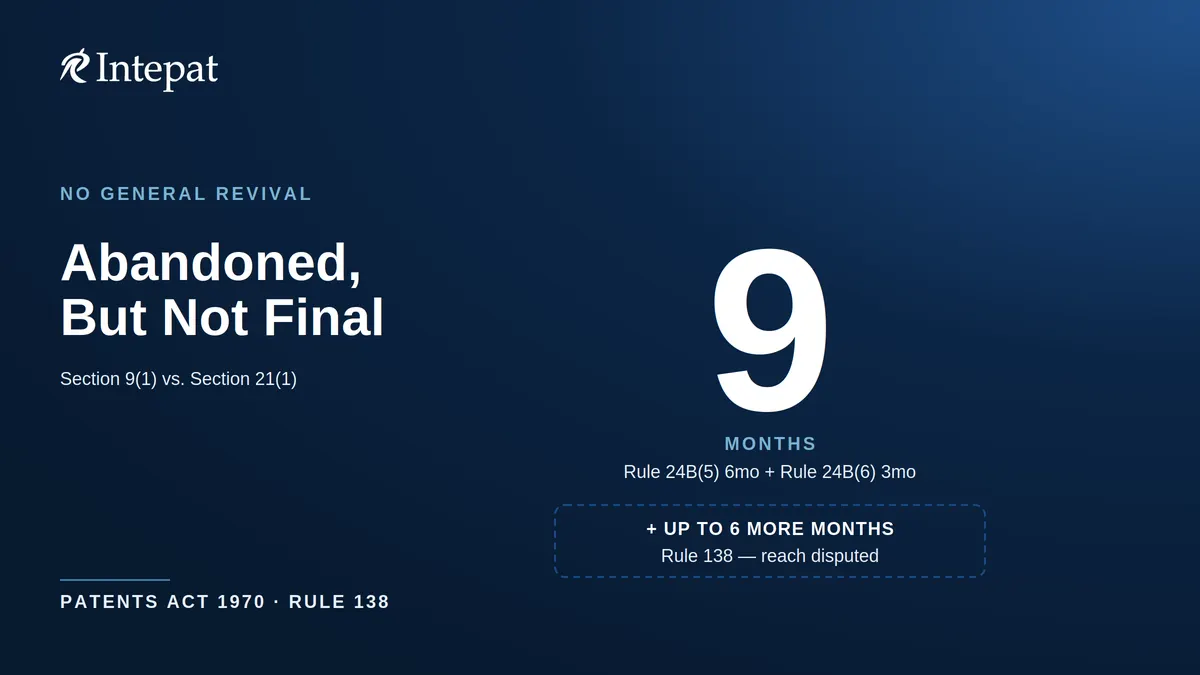
Quick answer: There is no general statutory procedure to revive a finally abandoned Indian patent application. For a Section 21(1) FER default, though, Controller relief runs further than the ordinary six month period: Rule 24B(5) and (6) give up to nine months, and Rule 138, substituted in 2024, separately lets the Controller extend time or condone an already occurred delay by up to six further months on Form 4. How far this combined relief runs, and whether it can reach an application after the nine months have technically lapsed, is not settled by any single authoritative source; this article explains the textual basis rather than asserting one figure. Once available relief is exhausted or missed, the Act leaves no administrative route back, though courts have set aside abandonment orders in appropriate cases.
When Does a Patent Application Become “Deemed Abandoned”?
This article covers two important prosecution stage grounds on which a patent application can be deemed abandoned: Section 9(1) and Section 21(1) of the Patents Act. A third ground exists under Section 40, for contravention of a secrecy direction under Section 35 or an unauthorised foreign filing under Section 39, but that is a narrower, separate scenario not covered here.
Section 9(1) governs the first of the two grounds this article covers. Where an application (other than a convention application or a PCT national phase application) is filed with a provisional specification, the applicant must file a complete specification within twelve months of the filing date; if no complete specification is filed in that window, “the application shall be deemed to be abandoned.” No hearing, notice, or separate order is needed for this to take effect, and the Act contains no ordinary extension mechanism for this period.
Section 21(1) governs the second, more commonly litigated ground. Once the Controller issues the First Examination Report (FER), the applicant must comply with every requirement it raises within the prescribed period; missing that period means the application “shall be deemed to have been abandoned.” That prescribed period starts at six months from the FER (Rule 24B(5)), extendable once by three months on a Form 4 request filed before the original period expires (Rule 24B(6)).
Reaching the end of that combined nine months does not end the Controller’s power to grant relief. Rule 137(2)(iv), inserted by the Patents (Amendment) Rules, 2024, removes Rule 24B(1), (5) and (6) from Rule 137(1)’s general irregularity correction power; it does not touch Rule 138, which is a separate, self-contained power. Rule 138, substituted by the same 2024 amendment, opens “notwithstanding anything contained in these rules” and lets the Controller extend time for an act not yet done, or condone a delay that has already happened, by up to six months, on a Form 4 request filed before the expiry of that six month window itself, and the same request may be made more than once within the six months (G.S.R. 211(E), cl. 14).
The amendment’s fee schedule treats a Rule 24B(6) extension and a Rule 138 extension as two separate Form 4 line items, the second priced far higher than the first (cl. 15, First Schedule entries 4(iii) and 4(v)), and the amended Form 4 description in the Second Schedule lists Rule 24B(6) and Rule 138 side by side as matters it covers (cl. 16). The Gazette text supports Rule 138 reaching a FER default that Rule 24B(6) alone would not save, but it states no single combined total, and how the Patent Office currently applies this to an application already treated as deemed abandoned under Section 21(1) is not addressed in any primary source this article has located; that gap is discussed further below.
Does the Patents Act Allow the Controller to Revive an Abandoned Patent Application?
Not once abandonment is final, no. But “no revival” is not the same statement at every stage, and treating it as one is the most common error in describing this area.
Rule 138 is framed as an extension and condonation mechanism, not as a revival procedure, and its own wording distinguishes the two: it lets the Controller extend time for something not yet done, or condone a delay, meaning a lapse that has already occurred. That second limb means Rule 138’s text is not confined to acting before the Section 21(1) period has fully run; on its face it can excuse a default after the nine month Rule 24B period has already lapsed, within the further six month window the rule itself sets. What this means in practice for an application already deemed abandoned under Section 21(1), whether Rule 138 can be used to cure that position administratively, or whether abandonment under Section 21(1) is final the moment the prescribed period lapses regardless of Rule 138, is not resolved by any reported Controller decision or judgment this article has located, and practitioner commentary is divided on it.
Once every available Rule 138 request has genuinely been exhausted or missed, neither the Act nor the Rules contain a standalone administrative restoration procedure equivalent to the Section 60 restoration available for a lapsed granted patent.
Two further, narrower extensions sit in the Act itself, and they turn on different conditions. Section 21(2) lets the Controller extend the Section 21(1) period until a date the High Court determines, but only where an appeal is pending on the application for the main invention (or, for a patent of addition, on either that application or the main application) and only on a request made before the Section 21(1) period expires. Section 21(3) is triggered differently: where the time within which that appeal may still be instituted has not yet expired, the Controller may extend the Section 21(1) period further, even after the period itself has already run out, so long as the appeal window remains open. Separately, Section 38 lets the Controller extend time for anything required under the Act once a Section 35 secrecy direction is revoked, whether or not the time had already expired, though that power is specific to the secrecy direction context.
The genuine gap with some other jurisdictions is narrower than a blanket comparison suggests. United States patent law lets an applicant petition to revive an application abandoned unintentionally under 37 CFR 1.137, decided administratively by the USPTO, without the layered extension structure the Indian Rules use instead. India has no general administrative revival provision equivalent to that once an application has become finally abandoned and the applicable Indian extension and condonation mechanisms, principally Rule 138, are no longer available.
Have Indian Courts Allowed Revival of a Deemed Abandoned Application?
Yes, in specific circumstances, through the High Courts’ writ jurisdiction, and whether a statutory appeal is also available is itself unsettled. The Delhi High Court has developed a line of authority holding that where an applicant shows no intent to abandon and has itself pursued the application diligently, even a lapse caused by the applicant’s patent agent, a deemed abandonment order can be set aside despite the Controller having no power to grant the underlying extension.
That jurisdictional question has not been resolved consistently. In Sonalkumar Sureshrao Salunkhe and Others v. The Assistant Controller of Patents (2024 SCC OnLine Bom 1260, Bombay High Court, order dated 6 May 2024), the Court held that Section 117A does not provide a statutory appeal against an order passed under Section 21(1) and dismissed the appeal before it as not maintainable on that ground. Shiv Nadar, discussed below, was nonetheless entertained by the Delhi High Court as a commercial appeal. An applicant should not assume a statutory appeal is available against a Section 21(1) order and should treat a writ petition as the more consistently available route, while raising an appeal in parallel where the facts and forum support it.
In European Union Represented by the European Commission v. Union of India and Others (2022 SCC OnLine Del 1793), decided 31 May 2022, the Delhi High Court, exercising writ jurisdiction, condoned delays of close to a year in filing FER replies in two applications, holding that the applicants had shown no intention to abandon, had continued to pursue the applications, and that the delay traced to miscommunication between the applicants’ outgoing and incoming patent agents rather than to the applicants’ own conduct; the applications were restored. In Ferid Allani v. Union of India and Others (2008 SCC OnLine Del 1756), the Court had earlier condoned a similar delay, observing that deemed abandonment deprives an applicant of the valuable rights a patentee acquires under Section 48 once a patent is granted. The European Union ruling drew on this reasoning and on the Delhi High Court’s own decision in Telefonaktiebolaget LM Ericsson (Publ) v. Union of India & Ors. (2010 SCC OnLine Del 1086) and the Madras High Court’s ruling in PNB Vesper Life Science Pvt. Ltd. v. Controller General of Patents, Designs & Trademarks (2022 SCC OnLine Mad 3190), all reaching the applicant on the same basis: no intent to abandon, and a statutory right too valuable to lose over a procedural lapse.
The most recent application of this line came in M/S Shiv Nadar (Institution of Eminence Deemed to be University) v. The Assistant Controller of Patents and Designs (C.A.(COMM.IPD-PAT) 33/2024, Delhi High Court, decided 23 April 2026). The Assistant Controller had deemed the University’s application abandoned after its FER reply arrived four days past an already extended deadline, a gap that fell across a weekend. The Court set the order aside and restored the application, holding that the University had pursued the application diligently since 2018, filed its request for examination on time, and applied for the extension before the original deadline expired, and that a four day delay spanning a weekend did not show negligence or an intent to abandon. The Court accepted that the Controller had no power to condone the delay, but held that this limit does not bind a court exercising its own jurisdiction on appeal.
That acceptance should be read against its own timeline: the missed deadline in Shiv Nadar arose in February 2023, before Rule 138 was substituted with its current six month power in March 2024. The order does not identify what extension mechanism, if any, applied to the Controller at the time, and it should not be read as defining the scope of the Controller’s present Rule 138 power for a FER default occurring after 15 March 2024.
What Does a Court Look at Before Restoring an Abandoned Application?
Courts examine the applicant’s factual conduct, not just the length of the delay, asking whether that conduct points toward genuine abandonment or toward an applicant who was actively, if imperfectly, pursuing the application.
The Shiv Nadar order summarised the factors this way: negligence of the patent agent, a lack of diligence on the applicant’s part, and a failure to follow up on the application are the circumstances that can point toward an actual intent to abandon. That is not the same as saying any error by a patent agent defeats relief: European Union turned on the opposite finding, condoning a near year delay because the lapse traced to a mismanaged handover between the applicant’s outgoing and incoming patent agents while the applicant itself had continued to follow up, the Court comparing the agent’s mistake to that of an advocate representing a litigant. Conversely, a request for examination filed on time, an extension request filed before the Rule 24B(6) deadline, and a short, explained gap between internal approval and the agent’s filing all support a finding that the applicant never intended to give up the application. The European Union ruling put a related point differently: prosecuting a patent application involves deadlines that patent agents are expected to know fall into extendable and non-extendable categories, and it placed the Section 21(1) deadline for putting an application in order for grant in the non-extendable category once the Rule 24B(6) window had run. That classification was made in 2022, before Rule 138 introduced its further extension route in 2024, and should be read as a description of the position at the time rather than of the Controller’s present powers.
No reported decision fixes a maximum number of days a court will excuse; the Delhi High Court has condoned gaps ranging from four days to close to a year on their individual facts, and each ruling stresses that the outcome turns on the applicant’s factual record, not a fixed grace period.
What Should an Applicant Do to Avoid Deemed Abandonment?
The safest course is to treat the Section 9(1) twelve month deadline as fixed, since the Act contains no ordinary extension for it, and to treat the Rule 24B(5) six month FER deadline as the point to act rather than the final deadline, since further relief may still be available on a timely request.
For a pending FER, an applicant should file any Rule 24B(6) extension request in Form 4 before the original six month period from the FER expires, since that extension is only available on a request made before that expiry. If more time is needed once the combined nine months under Rule 24B(5) to (6) runs out, Rule 138 separately allows the Controller to extend time or condone a delay of up to six months on another Form 4 request, filed within the six month window the rule itself sets; on the rule’s own wording that window is not limited to requests made before the Rule 24B(6) deadline expires, and a Rule 138 request also carries a substantially higher fee. Even so, whether the Patent Office currently treats a Rule 138 request as capable of curing a FER default already treated as deemed abandoned under Section 21(1) is not settled in any source this article has located, so an applicant should not treat Rule 138 as a guaranteed fallback and should confirm current practice with a registered patent agent well before relying on it. Once every available route has genuinely been exhausted or missed, no more administrative relief exists, and the position becomes the one described above: no statutory revival, though a court may still intervene on an appropriate factual record. Where a reply does slip past a deadline, keeping a clear, dated record of the request for examination, any extension requests, and the reasons for the final delay gives an applicant the same kind of factual record that supported relief in the Shiv Nadar and European Union rulings, if the matter has to go before a court on writ or, where available, appeal. Checking the application’s prosecution status periodically also helps an applicant catch a FER, or a Controller’s response to a filed reply, before a deadline is missed rather than after.
For a provisional application, the Section 9(1) twelve month deadline for filing the complete specification has no ordinary extension provision in the Act, so it should be diarised independently of the FER stage deadlines described above.
A deemed abandoned application is also distinct from a granted patent that later lapses for non-payment of a renewal fee, or from other ways a filing can become inactive: abandonment under Section 9(1) or Section 21(1) happens during prosecution, before grant, and the restoration route for a lapsed granted patent under Section 60 is a separate procedure with its own timeline.
Frequently Asked Questions
The Patents Act gives the Controller no power to revive an application deemed abandoned under Section 9(1) for not filing a complete specification within twelve months, and this deadline has no ordinary extension provision in the Act. An applicant in this position would need to consider filing a fresh application, subject to any loss of priority date and prior disclosure of the invention.
Rule 24B(5) gives an applicant six months from the date the FER is issued to comply with all requirements. Rule 24B(6) allows the Controller to extend that period once, by three months, on a Form 4 request filed before the original six months expire. Rule 138 can extend time or condone a delay further, on separate conditions covered in the next two questions.
At least nine months from the FER: six months under Rule 24B(5), plus three more under Rule 24B(6). Rule 138 separately lets the Controller extend time or condone an already-lapsed delay by up to six further months, but whether this reaches a FER default after nine months have passed is disputed, not settled at one figure.
Yes, in writ jurisdiction. The Delhi High Court restored applications in European Union v. Union of India (2022) after delays of close to a year, and in M/S Shiv Nadar v. Assistant Controller of Patents (2026) after a four-day delay, finding no intent to abandon in both. Whether a statutory appeal is separately available is unsettled: Sonalkumar (2024) held it is not.
Yes. Under 37 CFR 1.137, a US applicant may petition to revive an application abandoned unintentionally, decided administratively by the USPTO. India has no general administrative revival provision once an application is finally abandoned, though Rule 138 gives the Controller extension and condonation power that can reach beyond the ordinary nine-month Rule 24B period, a narrower but genuine difference from the US route’s single unified petition.
Yes. Rule 24B(6) allows one three-month extension on a request filed before the original FER deadline expires, and Rule 138 separately lets the Controller condone a delay that has already happened, or extend time not yet run out, by up to six months on Form 4. How far this reaches once the combined nine months under Rule 24B have lapsed is not settled by any single authoritative source.
This article explains the law on deemed abandonment and revival under the Patents Act, 1970 in India as at August 2026 and is for general information only. It is not legal advice. Government fees, forms, and procedures change; verify current requirements with the Indian Patent Office or a registered patent agent before acting.