




This article states the Trade Marks Rules 2017 as notified on 6 March 2017. It has not been updated for later amendments.
The Trade Marks Rules 2017 are the procedural rules for registering and maintaining trademarks in India, notified on 6 March 2017 to replace the Trade Marks Rules 2002. They prescribe eight forms in the Second Schedule, set a lower fee for individuals, startups and small enterprises, prescribe how sound and three-dimensional marks are filed, and allow service by email and hearings by video conference.
The Rules were made by the Central Government under section 157 of the Trade Marks Act 1999 and govern applications and proceedings before the Indian Trade Marks Registry. They change how a filing is made, served and paid for, not the tests in the Act that a mark has to pass.
Quick answer: As notified in March 2017, the Trade Marks Rules 2017 (G.S.R. 199(E), 6 March 2017) replaced the 2002 Rules. An application went on Form TM-A at Rs 5,000 per class for an individual, startup or small enterprise and Rs 10,000 for others, 10% less if filed online. The Rules also provided expedited processing, well-known determination by the Registrar, email service and video hearings.
What the Trade Marks Rules 2017 are
The Trade Marks Rules 2017 are new principal rules, not an amendment. The Department of Industrial Policy and Promotion notified them as G.S.R. 199(E) in the Gazette of India of 6 March 2017, and they came into force on that date, repealing the 2002 Rules without disturbing anything already done under them.
A step taken under the 2002 Rules before the new Rules took effect is not undone by the repeal (Rule 158). The 2017 Rules came into force on publication (Rule 1(2)), and steps taken from then on use the forms and fees they prescribe (Rules 10(1) and 11(1)).
Eight forms in the Second Schedule
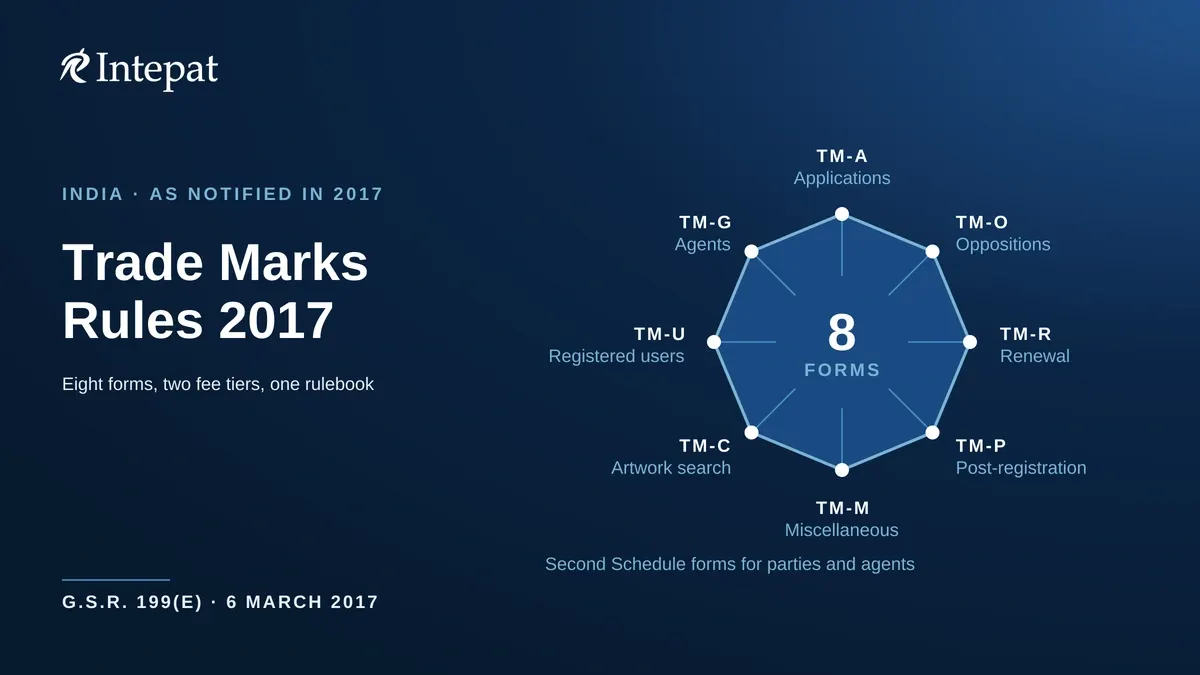
The Rules prescribe eight forms for an applicant or other party: TM-A for applications, TM-O for oppositions, rectifications and counter statements, TM-R for renewal and restoration, TM-P for post-registration changes, TM-U for registered users, TM-C for the trademark search and certificate that the proviso to section 45(1) of the Copyright Act 1957 requires when an artistic work used, or capable of being used, in relation to goods or services is submitted for copyright registration (Rule 22(1)), TM-G for trademark agents, and TM-M for miscellaneous requests such as amendment, review and expedited processing.
A single Form TM-A covers an ordinary trademark, a collective mark, a certification mark and a series of marks, and an application other than a series application covers one mark only, in as many classes as the applicant names (Rule 23(4)). A claim of use before the filing date needs an affidavit of use with supporting documents (Rule 25(2)), and Form TM-A warns that the statement as to use, once made, is final. The Registrar uses four forms of his own, RG-1 to RG-4, for notices and certificates.
Forms TM-M, TM-P and TM-U each carry the same warning: one form is meant for one request only, and where more than one request is claimed on a single form, the first is entertained and the rest are ignored. Two TM-M requests on the same application therefore need two filings and two fees.
Two fee tiers and an e-filing rate
The First Schedule sets two rates for a new application: Rs 5,000 per class for an individual, startup or small enterprise, and Rs 10,000 per class in all other cases, each per mark. Filing online cuts each figure by 10%, to Rs 4,500 and Rs 9,000. Expedited processing and the well-known request can only be made online.
| Request | Physical filing (Rs) | E-filing (Rs) | Unit |
| Application: individual, startup or small enterprise | 5,000 | 4,500 | Each class, each mark |
| Application: all other applicants | 10,000 | 9,000 | Each class, each mark |
| Opposition or counter statement | 3,000 | 2,700 | Each class |
| Renewal | 10,000 | 9,000 | Each class |
| Expedited processing: individual, startup or small enterprise | Not allowed | 20,000 | Each class, each mark |
| Expedited processing: all other applicants | Not allowed | 40,000 | Each class, each mark |
| Request to include a mark in the well-known list | Not allowed | 1,00,000 | One mark |
Figures are those notified in March 2017, taken from the First Schedule of the Gazette text. The lower tier applies to applications and expedited processing only. Opposition and renewal carry one rate for every applicant. Renewal on Form TM-R can be filed up to one year before expiry (Rule 57(1)). Within six months after expiry, renewal with a surcharge adds Rs 5,000 per class to the renewal fee, or Rs 4,500 online (proviso to section 25(3); proviso to Rule 59; First Schedule, entry 4). After six months and within one year after expiry, a mark removed for non-payment may be restored and renewed if the Registrar is satisfied that restoration is just (section 25(4) of the Act; Rule 60). That adds Rs 10,000 per class to the renewal fee, or Rs 9,000 online (First Schedule, entry 5). A three-class application by a company that is neither a startup nor a small enterprise costs Rs 27,000 online, against Rs 13,500 for an individual.
Paying too little has a procedural cost. A document on which a fee is payable, filed with no fee or an insufficient fee, is deemed not to have been filed for the purposes of any proceeding under the Rules (Rule 10(5)). A fee short of the applicable tier is an insufficient fee, so an applicant filing a trademark application in India had to confirm its category before paying.
Who qualifies as a startup or small enterprise
A startup is an entity in India recognised as such by the competent authority under the Startup India initiative, or a foreign entity that meets that initiative’s turnover and incorporation criteria and files a declaration. For the lower fee, Rule 2(1)(v) set an investment ceiling by reference to the medium-enterprise limits in section 7(1) of the MSMED Act 2006: investment in plant and machinery for an enterprise making goods, and investment in equipment for an enterprise providing services. The Rule’s Explanation defines “enterprise” by reference to industries listed in the First Schedule to the Industries (Development and Regulation) Act 1951. The ceiling figure sits in the MSMED Act, not in the Rules. A foreign enterprise qualifies on the same tests, and investment in plant and machinery is calculated at Reserve Bank of India reference rates.
Form TM-A asks the applicant to state its category and says that in the case of a startup or small enterprise the requisite certificate should be provided. The Rules name no particular certificate, so hold the document that proves the category (recognition as a startup, or the enterprise registration) before claiming the lower fee.
Filing sound marks, 3D marks and shapes
The Rules set out how unconventional marks, such as sounds, three-dimensional marks and shapes, are represented in an application. Whether such a mark can be registered is a question under the Act.
For registering a sound mark, the sound is submitted as an MP3 file of no more than thirty seconds, with a graphical representation of its notations (Rule 26(5)). Form TM-A adds that the musical notes go in the space for the mark itself.
A mark is treated as a three-dimensional trademark only if the application says so (Rule 23(2)(c)). The application then carries three different views; if those do not sufficiently show the mark, the Registrar may call on the applicant to furnish, within two months, up to five further views and a word description, and if those still fall short, a specimen (Rule 26(3)).
A mark consisting of the shape of goods or their packaging is treated differently: it needs at least five different views and a word description from the outset, and if those do not sufficiently show the shape, the Registrar may call for a specimen of the goods or packaging (Rule 26(4)).
Expedited processing through to disposal
Once the application number issues, an applicant may ask on Form TM-M for expedited processing. The application is then to be examined expeditiously and ordinarily within three months from the date of submission of the application, and the later stages, from the reply to the examination report to any opposition, are to be dealt with expeditiously until final disposal, subject to guidelines the Registrar publishes in the Journal.
The fee is Rs 20,000 per class for an individual, startup or small enterprise and Rs 40,000 per class for everyone else, payable online only. Form TM-M asks for a declaration of the reason for expedited examination. The Registrar may limit how many expedited requests are accepted by notice in the Trade Marks Journal (Rule 34(2)).
“Ordinarily” is the Rule’s own word, and it makes three months a working target rather than a guarantee. The request should bring the examination report forward, which also starts the one-month reply period sooner, so evidence of use and distinctiveness should be assembled before the request is made.
Well-known marks determined by the Registrar
Any person may ask the Registrar to determine a mark as well-known, on Form TM-M with a statement of case and supporting evidence, for a fee of Rs 1,00,000 per mark, online only. A mark so determined is published in the Journal and entered in a list maintained by the Registrar (Rule 124(5)).
Before deciding, the Registrar must take into account section 11(6) to (9) of the Act, the provisions on well-known trademark status, and may invite objections from the public, to be filed within thirty days. A mark found to have been included in error, or no longer justified on the list, can be removed after the concerned party has been given due opportunity of hearing (Rule 124(6)).
Email, electronic receipts and video hearings
Every applicant, opponent or other party must give an address for service in India that includes both a postal address and a valid email address, and a trademark agent must also give an Indian mobile number. Without an address for service in India the Registrar need not send any notice, and no later order can be challenged for want of notice (Rule 17(3)). The Registrar may serve documents by email.
A document emailed by the Registry is deemed served when the email is sent, not when it is opened (Rule 18(2)), and proof of service needs only show that it went to the email address the party gave. The Rule deems service, not receipt, so a period the Rules count from receipt, such as the one-month reply to an examination report, is safest diarised from the sending date as a precaution. Every application for registration is acknowledged with a system-generated electronic receipt, given to the applicant or sent to the email address provided (Rule 32).
Hearings may also be held by video conference or other audio-visual means, and a hearing held that way is deemed to have taken place at the appropriate office (Rule 115(1)).
Deadlines in examination and opposition
In an opposition, the notice on Form TM-O is due within four months of the Journal publication that advertised the application (Rule 42(1)), and the counter statement within two months of the applicant receiving the Registrar’s copy of the notice of opposition (Rule 44(1)). The opponent then has two months from service of the counter statement either to file affidavit evidence, deliver copies and exhibits to the applicant and tell the Registrar of the delivery, or to tell both that it relies on the notice of opposition (Rule 45(1)). The applicant has two months from receiving that evidence or intimation to do the same, relying on the counter statement or evidence already filed if it chooses (Rule 46(1)). Reply evidence is optional: the opponent may file it within one month of receiving the applicant’s affidavit copies (Rule 47).
Under the notified text, an opponent or applicant who takes no action required by Rule 45(1) or 46(1) within the period is deemed to have abandoned the opposition or the application respectively (Rules 45(2) and 46(2)).
The Rules give an applicant one month from receiving an examination report to respond, failing which the Registrar may treat the application as abandoned. In trademark opposition proceedings, no party gets more than two adjournments of a hearing, and none longer than thirty days.
An adjournment request goes on Form TM-M with the prescribed fee, with reasonable cause, at least three days before the hearing, and the Registrar may grant it if he thinks fit and on terms he directs (Rule 50(2)). Missing the adjourned hearing has a defined consequence: an absent applicant’s application may be treated as abandoned, and an absent opponent’s opposition may be dismissed for want of prosecution (Rule 50(3) and (4)).
Under the notified framework, parties needed to monitor both the email inbox and the postal address given for service, to count from the earliest deemed date of service, and to allow for the Registrar refusing an adjournment request, since he might refuse even the first and could not give more than two.
This article explains the law on the Trade Marks Rules 2017 in India as at March 2017 and is for general information only. It is not legal advice. Government fees, forms, and procedures change; confirm current figures with the Trade Marks Registry before you file. For advice on your specific mark, consult a trademark attorney.