




When you pick a brand name in India, the single biggest filing risk is choosing a name that simply describes your product. Indian trademark law will refuse to register it, and the courts back that refusal consistently. This guide explains why, what the line between descriptive and distinctive actually looks like, and how to choose a name that registers and holds.
This guide is written for Indian founders and small-business owners. It applies to applications filed with the Trade Marks Registry under the Trade Marks Act 1999. For the complete picture of what trademark registration costs, what rights it confers, and what it does not protect, see the complete guide to trademark registration in India. For the full list of absolute and relative grounds on which applications are refused, see Sections 9 and 11 of the Trade Marks Act: why trademark applications are refused.
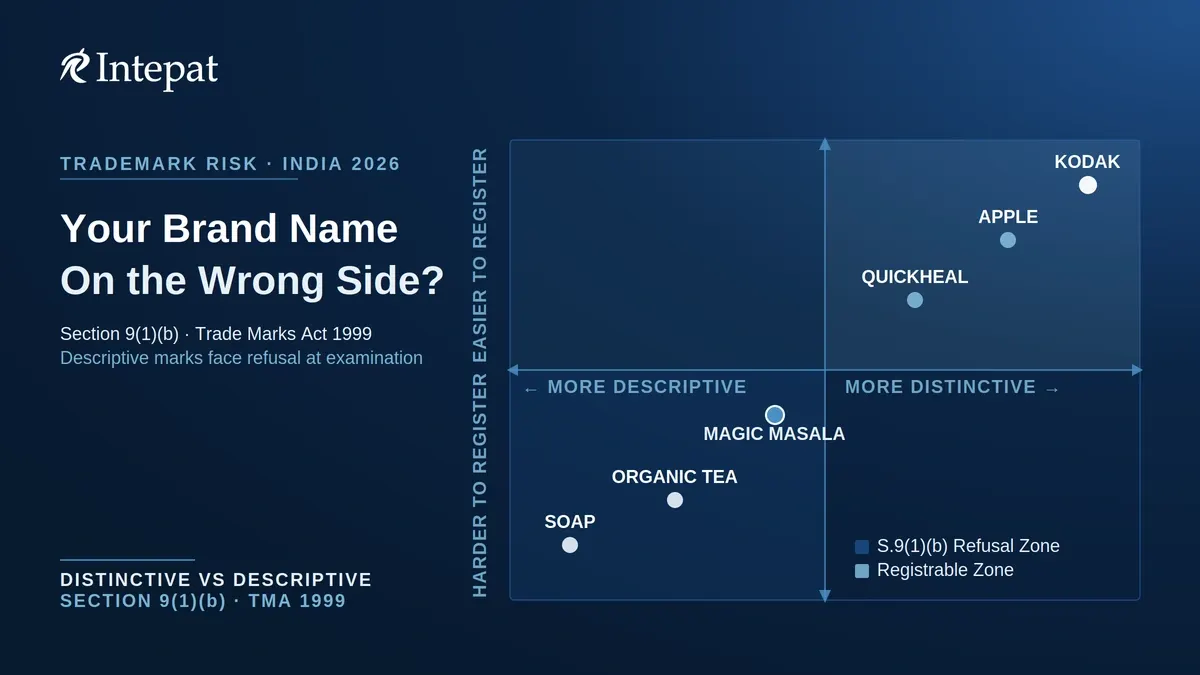
What Makes a Trademark Distinctive?
A trademark earns its protection by identifying where a product comes from. APPLE tells you the laptop came from one company. FRESH JUICES tells you nothing about the source; it just describes the product. Indian law only registers the first kind.
The Trade Marks Act 1999 puts it plainly. A mark must be “capable of distinguishing the goods or services of one person from those of another person.” Marks that fail this test fall into three groups:
- Completely generic: the common word for the product itself (SOAP for soap).
- Descriptive: they say something about the product’s kind, quality, purpose, ingredients, or geography (ORGANIC TEA for tea, SIMLA for tobacco from Simla).
- Completely customary in trade: competitors in the sector routinely use them to describe their own products (“express” or “fresh” in certain industries).
Two things a first-time filer often miss. First, the same name can be distinctive for one product and descriptive for another: AYUR might be fine for steel products, but it is too close to “ayurveda” to work easily for herbal cosmetics. Second, the test is applied from the buyer’s point of view, not the founder’s. A name can feel creative and original to its creator while being immediately understood as ordinary description by the customer.
Some marks are inherently distinctive from day one: invented words (KODAK, GOOGLE), or ordinary words used in completely unrelated contexts (APPLE for computers). These need no proof; they register because they are already source identifiers by nature.
The importance of this distinction becomes clear at two moments. The first is when you choose a name: picking a distinctive name from the start costs nothing extra but produces a much stronger asset. The second is when you try to enforce your rights. A business whose name is clearly distinctive can write a cease-and-desist letter and expect to be taken seriously. A business whose name is descriptive of the product category will face the immediate response that “everyone uses this kind of language,” and that response is often correct.
What Happens When Your Name Is Refused: Section 9(1)(b)
When your trademark application reaches the Registry, the examiner reviews it against Section 9 of the Trade Marks Act 1999. A refusal on the ground that your mark is descriptive will cite Section 9(1)(b), which covers names that “serve in trade to designate the kind, quality, quantity, intended purpose, values, geographical origin or the time of production” of the goods or services.
The key word in that clause is exclusively. If your name combines a descriptive word with a distinctive element, say, a made-up word alongside a category description, the Registry may still accept the whole mark, because the descriptive part does not dominate the whole. But this protection has a limit: registering a composite mark does not give you a monopoly over the descriptive part. If someone else uses the descriptive portion alone, you will have difficulty stopping them.
The Delhi High Court made this clear in the PhonePe case (2021). PhonePe was a registered trademark, but the Court held that this registration gave PhonePe no exclusive right over “Pe” as a suffix, because “Pe” is simply a creative spelling of “Pay”, which is descriptive of payment services. Registering the whole composite did not hand PhonePe a monopoly over its descriptive component.
What this means for you: If your plan is to lock down a descriptive word by combining it with your brand, expect that the descriptive word stays available to competitors. Your protection covers your specific combination only.
If you receive a Section 9(1)(b) objection after filing, you have a limited window to respond. The examiner has given you a specific reason for the refusal. Your reply needs to address that reason directly: either by arguing that the name is more distinctive than the examiner has found, or by filing evidence of use that shows consumers already associate the name specifically with your business. The guide to responding to a trademark examination report explains what a reply should cover and how to structure the evidence.
The Five Types of Brand Name, from Riskiest to Safest
Indian trademark practice sorts brand names into five types. Understanding where your name sits tells you how much registration risk you are carrying.
Generic names are the common word for the product. SOAP for soap, COMPUTER for computers. These are not registrable, full stop. Even years of use will almost never change that.
Descriptive names say something about what the product does, what it contains, where it is from, or who it is for. ORGANIC TEA, FAST DELIVERY, KIDS WEAR, PAIN RELIEF GEL. These face a Section 9(1)(b) objection on filing. They can be registered only if you prove that consumers have already come to associate the name specifically with your business. That is a high bar, discussed below.
Suggestive names hint at a benefit without spelling it out. The consumer has to take a mental step to make the connection. QUICKHEAL for antivirus software, NETFLIX for internet streaming. These are generally registrable without needing to prove extensive use.
Arbitrary names are real words, but ones with no connection to the product. APPLE for electronics, CAMEL for cigarettes. Because they give the buyer no information about what the product is, they are strong trademark candidates.
Invented names (also called fanciful marks) have no meaning in any language. KODAK, XEROX, GOOGLE. These are the strongest marks: they are distinctive by definition and very hard for competitors to attack.
The practical lesson: the further your name sits from the descriptive end of this list, the smoother your path to registration and the stronger your position when you need to enforce it.
| ✔ Quick check for your name. Read your proposed name and ask: “Does this tell me what the product is?” If yes, it is likely descriptive. Ask next: “Does it tell me who makes it?” If no, it is almost certainly descriptive. |
What Indian Courts Have Decided
Trademark disputes over descriptive names have reached Indian courts many times. Four cases produce the clearest practical lessons for founders.
| Mark | Product | What the court decided | What it means for you |
| SUPER CUP | Tea (Godfrey Philips v. Girnar, Supreme Court 2004) | “Super Cup” describes a good cup of tea. It is descriptive and laudatory. But a descriptive mark can be protected if it has acquired a secondary meaning: if buyers now associate it with one specific source. The court sent the case back for evidence on this point. | A descriptive name is not automatically a dead end, but you carry the full burden of proving that consumers already identify it with your business. |
| LOSORB / LOW ABSORB | Edible oil (Marico v. Agro Tech, Delhi HC 2010) | Seven years of sales, used alongside the Saffola and Sweekar brands, was not enough to prove acquired distinctiveness. The competitor was free to describe its own product as “low absorb technology.” | Sales volume alone does not prove distinctiveness. The use must be consistent, standalone, and source-identifying. Long use alongside a stronger main brand will not save a descriptive sub-name. |
| MAGIC MASALA | Instant noodles (ITC v. Nestle, Madras HC 2020) | “Magic” is a word of praise and “masala” is a common food term. Neither party could monopolise the combination. ITC had also never applied to register MAGIC MASALA as a standalone trademark. | Even large companies cannot monopolise descriptive and laudatory combinations. If you want to protect a name, register it specifically and early. |
| PHONEPE suffix “Pe” | Digital payments (PhonePe v. Ezy Services, Delhi HC 2021) | “Pe” is a phonetic spelling of “Pay”. Registering PHONEPE as a composite mark gave no monopoly over the suffix. Creative spelling of a descriptive word does not make it distinctive. | A registered composite mark does not protect its descriptive parts. Competitors can still use the descriptive element in their own mark. |
Three other cases confirm related points. The Delhi High Court held that AYUR (derived from “ayurveda”) can be exclusively owned for cosmetics after long-established goodwill. This shows that a word’s dictionary meaning is not the end of the analysis if consumer perception has moved on. The Calcutta High Court’s SIMLA case from 1968 remains the standard authority for geographical names: prominent place names face a very high evidence bar, and three years of substantial sales was not enough to cross it.
Three Things Founders Often Get Wrong
Treating registration as a formality. Many founders assume that if they have been using a name for a year or two and have not been challenged, it can be registered. The Registry does not work that way. The examiner assesses the name on its inherent qualities at the filing date. Prior unchallenged use does not make a descriptive name registrable; only proved acquired distinctiveness does, and the bar for that is higher than most founders expect.
Relying on a logo or stylised version to protect the words. Registering a logo that contains a descriptive name gives you a right in the logo as a whole. It does not give you a right in the descriptive words alone. A competitor who uses those words in plain text, without copying your logo, may be free to do so. If you want to protect the words, you need to file the word mark separately, and the word mark will face the same descriptiveness test.
Confusing “no objection from competitors” with “safe to register.” A descriptive name may have gone unchallenged for years simply because no one has bothered. The moment you file for registration, the Registry examines it actively. Competitors also monitor trademark applications and may oppose at the publication stage. A name that has felt safe in practical use can hit resistance the moment you try to formalise your rights in it.
Understanding these three patterns prevents the most common and expensive mistake founders make with brand names: spending years and marketing budget building equity in a name that turns out to be difficult or impossible to register cleanly.
There is also a fourth issue worth noting for founders who have received conflicting advice. It is common to hear that “generic” and “descriptive” are the same thing, or that any word in the dictionary is unregistrable. Neither is true. Genuinely generic names face a near-absolute bar. Descriptive names face a high bar but one that can be overcome with evidence. Suggestive names are generally registrable. Arbitrary and invented names are strong candidates from day one. Understanding exactly which category your name falls into is the starting point for any honest assessment of your registration risk. If you are unsure, a brief assessment from a trademark attorney before you commit to the name will cost far less than rebranding after two years of use.
Can Your Descriptive Name Still Be Registered?
Yes, but only if you can prove acquired distinctiveness. This is the idea that through long and consistent use, consumers in India have come to associate your specific name with your business alone, rather than understanding it as a description of the product category.
The law calls this the “saving clause” (the technical term is the proviso to Section 9(1) of the Trade Marks Act 1999). To use it, you need to show that the name had already built that level of recognition before you filed your application. Use that builds up after filing does not count.
What evidence does the Registry expect?
You will need to file a sworn statement (called an affidavit) accompanied by documents. The Registry looks at:
- How long you have been using the name, and where in India you have been using it
- Your sales figures for the goods or services sold under that specific name, broken down by year
- What you have spent on advertising and marketing that specifically promotes this name
- Media coverage, press mentions, awards, or industry recognition that links the name to your business
- Consumer surveys or statements from trade associations, if available
Why this is harder than it sounds. The question the Registry is asking is not “has this business done well?” but “do Indian consumers, when they see this name, think of this specific business?” Those are different questions. If your descriptive name has always appeared alongside a stronger main brand, the sales and advertising figures relate to the main brand, not to the descriptive name by itself. The Marico case is the clearest demonstration of this: Marico used “Low Absorb” alongside its established Saffola and Sweekar brands, so seven years of sales proved the strength of those brands, not the distinctiveness of “Low Absorb” as a standalone identifier.
If you have been using the name for only two or three years, or if competitors in your market also use similar descriptive language for their own products, the acquired-distinctiveness route is unlikely to succeed at this stage. In that situation, the practical alternatives are: redesigning the mark so that a distinctive element dominates, filing a stylised or logo version rather than the plain words, or simply replacing the descriptive name with something invented.
A Six-Point Check Before You File
Run your proposed name through these six questions before you file. Each maps to a real examination risk. None requires a lawyer; they are the same questions a trademark examiner will ask.
- The customer test. Show the name to someone who does not know your business. Ask them what kind of product it refers to. If they describe the product correctly and specifically, the name is likely descriptive. If they look blank or guess something unrelated, the name has a better chance.
- The dictionary test. Look up every word in a standard English or Hindi dictionary. If the definition tracks what your product is or does, expect a Section 9(1)(b) objection. SIMLA appeared in every dictionary as a famous Indian city; that alone put the tobacco brand SIMLA at risk under the geographical-name objection.
- The competitor test. Would other businesses in your sector naturally use this word or phrase to describe their own products or services? If yes, the Registry will resist giving you a monopoly over it. Everyday words like “organic”, “pure”, “fast”, “premium”, and “fresh” typically fail this test across most product categories.
- The imagination test. Does a customer need to take a mental step away from the literal meaning to understand what the name refers to? NETFLIX takes a small step (internet plus films). ORGANIC JUICE needs no step at all. A name that requires a genuine leap of imagination to connect with the product sits in a much safer zone.
- The use-as-a-brand test. Have you been displaying this name prominently on packaging, in advertising, and on your website as the brand identifier, separately from any other name? Or has it appeared only as a description alongside your main brand? Courts look at this closely. In the ITC v. Nestle case, one reason ITC’s claim failed was that MAGIC MASALA had never been applied for as a standalone trademark and had not been used consistently as a sub-brand in its own right.
- The evidence reality check. If the name is descriptive and you plan to rely on long use to register it, be completely honest: can you produce documents showing Indian consumers connect this specific name to your business alone? If the honest answer is “our sales are mainly under the main brand” or “we have only been using this for two years,” the evidence route is unlikely to work at this stage.
A structured pre-filing trademark search will surface conflicts with earlier similar marks. That is a separate risk from the descriptiveness question, but address both before you file. The Section 9 and Section 11 grounds for refusal guide explains the full set of reasons a mark can be refused, including objections that go beyond descriptiveness.
Choosing a Name That Works
Indian trademark law protects brand names, not product descriptions. The practical implication is straightforward: a name that tells a customer what the product is will face resistance. A name that tells a customer who made it will register and hold.
If you are at the naming stage, invest time in a distinctive name: something invented, arbitrary, or at minimum strongly suggestive. The registration cost is the same, the renewal cost is the same, but the protection is far stronger and the enforcement path far clearer.
A useful naming exercise is to generate three versions of your brand name: one descriptive (what the product does), one suggestive (a hint that requires a small mental step), and one invented (a word with no prior meaning). The descriptive version is usually the one you think of first, because it is the most obvious. The invented version feels unfamiliar, because you have not heard it before. But the invented version is the one that builds into a truly defensible asset, because no one else can claim to have a right to use it in the ordinary course of their trade.
If you have already received a Section 9 objection on a name you have been using for years, your options depend on the evidence you can assemble. Where the evidence of consumer recognition is genuinely strong, the acquired-distinctiveness route is open. Where it is not, a redesigned or stylised version of the mark is often the more practical path than a sworn statement the evidence will not support. The trademark registration process in India sets out the full examination and response lifecycle.
The line between distinctive and descriptive is not an arbitrary legal technicality. It reflects a real principle: names that inform the public about product categories belong to everyone in the trade. Names that identify a specific source belong to the business that built them. Choosing which side of that line to be on is one of the most consequential brand decisions a founder makes.
Frequently Asked Questions
A distinctive trademark identifies who made the product: APPLE for computers, AMUL for dairy. A descriptive trademark names a feature of the product: FRESH MILK for milk, FAST COURIER for delivery. Indian law registers the first kind and generally refuses the second, unless the business can prove long-established consumer recognition.
It means the examiner considers your mark descriptive: that it describes the kind, quality, purpose, or origin of the goods rather than identifying a specific source. The solution is either to argue that the name is more distinctive than the examiner believes, or to show evidence of long use that has built consumer recognition of the name as specifically yours.
Yes, if you can prove “acquired distinctiveness.” This means showing, with documented evidence, that consumers in India already associate your specific name with your business and not just with the product category. The evidence must predate your application. The bar is high: Indian courts have found that even seven years of substantial sales was insufficient where the use was not clearly source-identifying.
You will need a sworn statement accompanied by: sales figures by year and region; advertising and marketing spend on the name specifically; media coverage mentioning the name in connection with your business; and, ideally, consumer surveys or trade-association statements. Evidence that relates to a larger parent brand, with your descriptive name used as a secondary label, will generally not be enough.
No. If your mark combines a distinctive element with a descriptive one, for example, a brand name plus a category descriptor, the registration covers the combination. The descriptive component remains available for competitors to use in their own descriptions. The PhonePe case (2021) confirmed this clearly for the “Pe” suffix.
Disclaimer: This article is general information about Indian trademark law as at June 2026 and is not legal advice on any specific mark or application. Trademark decisions depend on the specific mark, the goods or services, the evidence of use, and competitive conditions in your market. Consult a registered trademark attorney before filing or responding to an objection. Statutory law and case law continue to develop; verify current positions against primary sources including the Trade Marks Act 1999 on India Code.